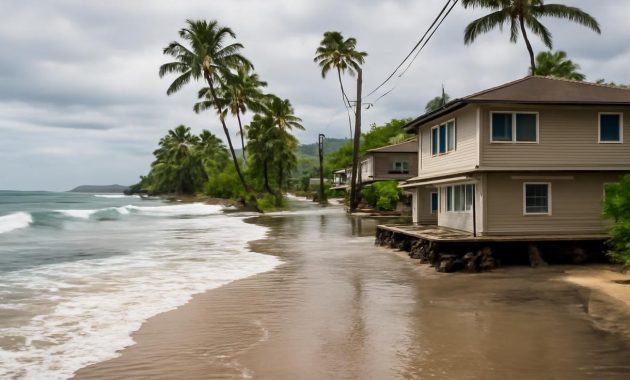
The water is inching higher, but it rarely announces itself with drama. It shows up quietly instead—in the rusted-out underside of a family car parked near the shore, in the salt that whitens the roots of a beloved mango tree, in the way a child’s favorite tidepool disappears under murky water a little more often each year. In Hawai‘i, sea level rise is not a distant, abstract future. It is a puddle that never quite dries, a shortcut road that now floods on sunny days, the slow unspooling of what people thought would always be there.
A House Where the Ocean Knocks First
On O‘ahu’s Windward side, there is an old plantation-style house that used to stand a comfortable distance from the water. The kind of place with jalousie windows and a lanai where generations have sat to watch the swell roll in, grayer on storm days, blue-green on calm ones. Thirty years ago, the family would say the ocean was “over there”—at least fifty steps past the ironwood trees, beyond the patch of naupaka and a line of bleached coral rubble.
Now, when the swell comes from the north and the tide peaks at just the right moment, the ocean doesn’t feel “over there” anymore. It feels right here—slapping the base of the seawall, surging through gaps, pooling on the lawn. The family jokes that they have “oceanfront flooring” when the garage floods, but their laughter is thin and brittle. The concrete pad is spiderwebbed with cracks from years of pounding waves. The ironwood trees have toppled one by one, their roots gnawed free by erosion.
They’re not alone. Across the islands, many residents can point to a line in the sand—literal or metaphorical—where the shoreline used to be. A place where they’d set up a beach umbrella, where the uncles would park trucks for a weekend barbecue, where kids learned to swim in water that reached only to their knees.
These memories carry measurements more precise than any tidal gauge. They are the human units of change, the way people talk about sea level rise when the science turns personal.
“It’s Not Just the Big Storms Anymore”
If you ask longtime residents when they first started to really feel sea level rise, they don’t usually talk about major hurricanes or epic winter swells. They talk about the strange new normal of “king tides”—those extra-high tides that now behave like tiny previews of tomorrow.
On a blazing afternoon in Waikīkī, a group of hotel workers huddle under a patch of shade on their break. They’ve seen it all: tourists taking selfies with palm trees at improbable angles, honeymoon couples surprised by sudden surge waves that soak their expensive outfits, and now, water that regularly laps where dry sand once stretched.
“Used to be, you only worried if one big storm was coming,” one of the workers says, eyes on the shimmering edge of the Pacific. “Now, floods just show up. You check the tide charts like you check the weather. It’s not just the big storms anymore.”
The changes creep inland, following old stream beds, squeezing through storm drains, bubbling up from beneath. In low-lying neighborhoods near Honolulu’s airport, for example, residents have grown used to what scientists call “nuisance flooding” and what locals simply call “the water problem.” Saltwater pushes up through the drainage system on extra-high tides, filling streets and turning lawns to sponges. Cars idle through brackish pools that glint oddly rainbow from oil residue.
Nothing about these scenes screams catastrophe. There are no breaking waves toppling houses in real time, no dramatic rescues. But there is a gnawing, chronic disruption—the kind that wears people down slowly, like an old net fraying strand by strand.
When Everyday Life Gets Rearranged
Most people in Hawai‘i don’t talk about sea level rise in degrees Celsius or centimeters per decade. They talk about what they can no longer count on. A dad who has to leave for work twenty minutes earlier on certain days because the coastal road might be flooded. A kupuna who no longer feels safe walking to the bus stop when the tide is high and the sidewalk disappears under a slick of water. A small shop owner whose floorboards have warped from repeated soakings.
Step by step, sea level rise is rewriting the daily script of island life—sometimes so subtly that it’s easiest to pretend nothing has changed. But Hawai‘i’s residents are noticing, not only with their eyes, but with their routines.
| Everyday Change | What Residents Notice | Connection to Sea Level Rise |
|---|---|---|
| More frequent “sunny day” flooding | Water on roads and in yards even when it hasn’t rained | Higher ocean levels pushing into storm drains and groundwater |
| Shrinking beaches | Less sand for sitting, playing, and setting up canopies | Erosion from waves reaching higher on shore more often |
| Salty soils in yards | Plants yellowing or dying, especially near the coast | Rising groundwater becoming saltier as it mixes with seawater |
| Infrastructure wear and tear | Parking lots, seawalls, and roads cracking or sinking faster | Constant exposure to higher water levels and wave energy |
Each item in this quiet ledger of inconvenience adds up to something larger—a collective sense that the islands are shifting underfoot.
Disappearing Beaches, Disappearing Stories
Beaches in Hawai‘i are not just scenery; they are living rooms, playgrounds, chapels, and classrooms. They are where aunties tell stories as they untangle fishing lines, where teenagers gather at dusk to share secrets and songs, where families scatter ashes into the moving, gleaming sea.
As sea level rises, many of these beaches are thinning, squeezed between hard infrastructure and a relentless ocean. This “coastal squeeze” is a bit like pinching a ribbon between your fingers and watching it disappear: the sand simply runs out of room.
On Maui, an elder stands at the edge of a shoreline road that now teeters unnervingly close to the waves. He remembers when his grandfather’s house sat comfortably behind a wide stretch of sand, shaded by kiawe trees. The house is long gone, and even the spot where it once stood is now ocean. The stories remain, but their physical touchpoints are fading.
“We used to come here for everything,” he says. “Baby lu‘au, graduations, just to hang out. You could leave coolers and chairs on the sand all day. Now, if you turn your back too long, the ocean might take it.”
For Native Hawaiian communities, the loss is layered. Places that served as traditional fishing grounds or cultural sites are slipping underwater or becoming harder to access as the shoreline reshapes itself. Heiau (temples), fishponds, and burial areas close to the coast are increasingly vulnerable, not only to storms, but to the persistent, climbing baseline of the sea itself.
The grief is not only about land. It’s about continuity—the fear that when a place disappears, something essential about the stories and practices tied to that place may fray as well.
The New Meaning of “High Tide Line”
There is an old rhythm to the tides that fishers, surfers, and sailors have always known: the way certain rocks only show at low tide, the timing of currents that favor one side of a bay or another. Sea level rise doesn’t erase this rhythm, but it shifts the entire song higher up the staff. High tide is higher than it used to be. Low tide is often not as low.
Walk along some of Hawai‘i’s more crowded beaches on a king tide day, and you can see the new “line” carved in real time. Waves run right up to the backs of hotel properties or private homes, pushing past staircases that once led neatly down to sand but now descend into tumbling water. The smell is a mix of sunscreen and saltier-than-ever air, tinged with something metallic from submerged infrastructure.
For many residents, that smell is not just sensory—it’s a warning.
Underground, the Ocean Is Rising Too
One of the strangest parts of Hawai‘i’s sea level story is that the water isn’t only coming from the side; it’s coming from below. Under the islands lies a lens of freshwater floating atop denser seawater. As the level of the surrounding ocean climbs, so does the level of groundwater, like a hidden tide lifting everything from beneath.
In practical terms, that means that even places that don’t seem right next to the shoreline can experience the symptoms of sea level rise. Basements and utility corridors in low-lying urban areas may flood more often. Septic systems and older cesspools can fail as groundwater reaches them, leaking pollution into environments that used to be buffered by dry soil. Tree roots drown in soil that never quite dries out.
People may not see this subterranean rise, but they feel the consequences: fouler-smelling streams, more frequent backups in drainage systems, and stubborn patches of yard that transform into mini-wetlands with every king tide.
When Salt Creeps into the Garden
In coastal communities on Hawai‘i Island, some families have noticed that the same plants their grandparents grew now struggle or fail. Taro patches that once flourished closer to the shore need to be moved mauka—toward the mountains. Fruit trees drop leaves at odd times of year, their roots stressed by increasing salinity.
In one Hilo neighborhood, a woman who has lived most of her life within earshot of the surf picks up a handful of soil from beside her sagging fence and sifts it between her fingers. “Used to be, this was rich, dark, and stayed damp but not soggy,” she says. “Now it gets crusty with salt after the really high tides. Even when there’s no wave over-topping, you can tell something’s changed.”
For island residents who measure seasons in the bloom of plumeria and the ripening of breadfruit, these subtle shifts in what the land will grow are another way of feeling sea level rise—through taste, color, and the health of backyard ecosystems.
Who Feels It First, and Hardest
Not all communities in Hawai‘i experience sea level rise equally. The island image that often circulates on postcards—luxury condos and beachfront resorts framed by swaying palms—obscures a more complicated reality.
In some areas, wealthy property owners can afford to install or reinforce seawalls, elevate structures, even lobby for protective measures that help their specific stretch of shoreline for a while. Meanwhile, working-class families renting in the same flood-prone areas find themselves dealing with mold, repeated damage to cars and furniture, and the creeping anxiety of rising insurance costs or evacuation orders.
In Native Hawaiian and other local communities with deep generational roots, the land is more than an asset; it is identity, lineage, and responsibility. When erosion slices away at a family’s ancestral parcel, the loss cannot be tallied strictly in dollar terms.
When “Home” Becomes a Question Mark
Imagine your mortgage payment or rent hasn’t changed, but the value and safety of what you’re paying for is eroding, inch by inch. Some families in Hawai‘i are already facing difficult decisions: Do we raise the house on stilts? Do we relocate, even if it means leaving a place where our great-grandparents are buried? Do we sell, knowing that whoever buys will inherit a ticking clock?
There is a new kind of math playing out across kitchen tables: balancing love for a place with the practicalities of staying safe in it. Sea level rise turns “home” into a shifting calculation.
For renters, the choices can be even more stark. If their low-lying apartments or houses flood too often, they may be forced out with few alternatives nearby that they can afford. People end up moving farther inland or to higher elevations, sometimes away from jobs, schools, and the coastlines they rely on for subsistence fishing and cultural practices.
Adapting in Real Time
Yet even as the water creeps in, people are not simply standing still, staring at the tide. Across Hawai‘i, adaptation is becoming a verb, not a buzzword. Communities are mapping flood-prone roads, rethinking where to build new homes and infrastructure, and debating how—and where—to pull back from the most vulnerable shorelines.
Along some eroding beaches, old seawalls are being questioned or removed, allowing sand to move more naturally, even if it means surrendering hard edges and human-made boundaries. Wetland restoration projects aim to give water a place to go during high tides and storms, rather than funneling it toward homes and businesses.
Students in island schools are learning not only the science of climate change, but also the mo‘olelo—stories—that frame caring for the land and ocean as a long-term relationship, not a temporary convenience. They talk about “ahupua‘a thinking”: understanding that everything from the mountain to the reef is connected, and that what happens at one end of that system ripples, literally and figuratively, to the other.
Some of the most powerful work is rooted in old knowledge applied to new realities—rebuilding fishpond walls to better handle higher water levels, planning housing that clusters on safer ground while leaving room for natural buffers at the coast, collecting oral histories that record what shorelines once looked like so future generations can understand the scale of change.
Still, there is no single, comforting fix. Adaptation here does not mean “winning” against the sea. It means learning how to live honestly with a shoreline that will keep redrawing itself.
Holding on, Letting Go
On a late afternoon on Kaua‘i, the sky turns the soft color of guava flesh as the sun slides down. At a small beach park, families pack up coolers, and surfers ride the last waves before the light fades. High tide is creeping in, as it always has, but each year, the water’s reach extends a little farther up the shore.
A young boy stands at the new edge of wet sand, toes sunk in, looking at where the waves erase his footprints almost as soon as he makes them. His grandmother, sitting in a folding chair, watches him quietly. She has lived long enough to remember when the grassy area behind her was twice as wide, when ironwood needles carpeted what is now open water.
“Everything changes,” she says softly. “But we still have to take care. Even if we know this place will look different for him, and different again for his kids, we take care now.”
Most Hawai‘i residents already feel the effects of sea level rise—not as one sudden event, but as a pattern of small, persistent trespasses. A road closed more often. A beach narrowed. A garden that won’t grow what it used to. A beloved house where the ocean now knocks first.
The question moving forward is not whether the islands will change—they always have, and always will. The question is how people will shape their lives, laws, and loyalties in response, and whether they can do so in a way that honors both the science and the soul of these islands.
In the hush between waves, in the shimmer of flooded streets on bright blue days, Hawai‘i is already answering. Not with certainty, but with a complicated, deeply human mixture of grief, creativity, and stubborn care for home.
Frequently Asked Questions
Are Hawai‘i residents already experiencing sea level rise today?
Yes. Many residents are seeing more frequent “sunny day” flooding, shrinking beaches, salt-damaged yards, and infrastructure that wears out faster along the coast. These changes align closely with measured sea level rise around the islands.
How much has sea level risen around Hawai‘i so far?
Measurements vary by island and location, but tide gauges show that sea level around Hawai‘i has risen by several inches over the last century, with the pace increasing in recent decades. Even a few inches can significantly increase coastal flooding and erosion when combined with tides and storms.
Why do some places flood even when it’s not raining?
Higher ocean levels push seawater into storm drains and up through the ground in low-lying areas. During especially high “king tides,” this can cause streets and yards to flood even under clear, sunny skies.
Which communities are most affected?
Low-lying coastal communities—especially those near aging infrastructure, older drainage systems, and eroding shorelines—feel the effects first and most intensely. Working-class and Native Hawaiian communities can be particularly vulnerable because they may have fewer resources to move or adapt, and deeper cultural ties to specific coastal places.
Can Hawai‘i adapt to sea level rise?
Adaptation is already happening, but it requires hard choices. Strategies include redesigning coastal roads, restoring wetlands, rethinking where new buildings are allowed, and in some cases, relocating structures away from the most at-risk shores. Long-term success depends on planning ahead, investing in resilient infrastructure, and listening to both science and local knowledge.
What can individual residents do?
Residents can stay informed about local flood and sea level projections, support community and government efforts to protect and restore natural buffers, document changes they see in their neighborhoods, and participate in planning meetings. On a household level, people can prepare for more frequent flooding, consider future risks when buying or renovating property, and reduce their own climate footprint where possible.
Will the islands themselves disappear?
Hawai‘i as a whole will not vanish overnight, but specific low-lying coastal areas and some beaches are already shrinking and will continue to change. The coastline of the future will look very different from today’s map. The challenge is to manage that change in a way that protects people, culture, and the most vulnerable parts of the islands.