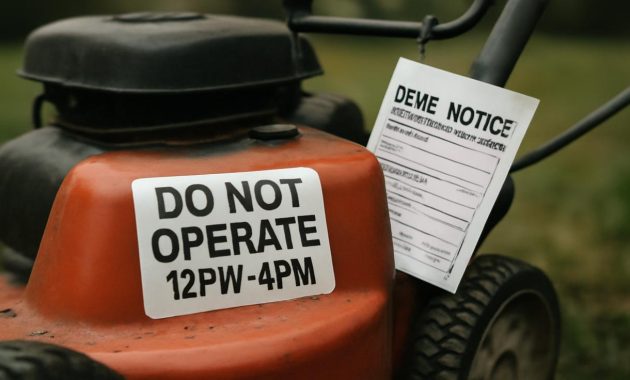
The first thing you’ll notice, that first warm day in late winter, isn’t the birds. It’s the silence of the machines that usually drown them out.
On February 15, the soundtrack of American suburbia—those buzzing, roaring, coughing lawn mowers—goes partially quiet. Not gone, exactly, but pushed back into the morning and pulled forward into the evening. Between noon and 4 p.m., by new local and regional rules that are beginning to spread like a creeping vine across ordinances, the grass stays uncut. The engines stay still. And if they don’t, there’s a fine waiting like a ticket tucked under a windshield wiper.
It sounds small, almost laughably small, the sort of rule your neighbor might grumble about over the fence while you both pretend not to care that much. But walk outside at 1:15 p.m. on a bright Saturday this spring, and feel what has changed: the air, the heat, the soundscape, the insects doing their quiet, crucial work in the shade of your lawn. The new mowing curfew is more than a bureaucratic tweak. It’s a small, radical pause in the weekly ritual of taming our little green carpets—and it arrives with a message, and a warning, for homeowners.
When the Law Comes for Your Saturday Chores
The notice didn’t come wrapped in drama. Maybe it arrived as a line on your town’s email newsletter, buried between recycling reminders and library events. Maybe it was a sign at the hardware store, or a mention at a city council meeting streamed to a half-interested audience. But the rule is blunt enough:
No lawn mowing between 12:00 p.m. and 4:00 p.m., effective February 15. Violations subject to fines.
That’s it. Four hours carved out of the day, bracketed neatly around what many of us think of as “prime time” for catching up on weekend chores. For shift workers, for parents ferrying kids from practice to birthday parties, for people who work long weekdays and cling to afternoon sunlight, this hits a familiar nerve: yet another slice of control gone from the calendar of our own homes.
You can almost hear the complaints:
“What if I only have Saturday afternoons?”
“I paid for this property. Now I can’t mow when I want?”
“This is just overreach.”
But behind the rule there is a story—a sweaty, buzzy, sun-bleached story—about heat, water, air, and the invisible things that make our lawns possible in the first place.
The Hot, Noisy Heart of the Day
If you’ve ever pushed a gas mower across a yard in July at 1 p.m., you already know the body version of the science: your shirt sticks to your back; your head throbs under the sun; the air feels like someone holding a hair dryer to your face. Your lawn, meanwhile, is going through its own struggle.
Midday is when the sun leans hardest on the ground. Soil dries out faster. Plants lose water quickly through their leaves. Grass that’s already a little thirsty can tip into stress, its blades going dull, its roots pulling back. Mow at that moment—slice off the cooler top growth, expose the crown of the plant, send a sharp, hot blast of engine exhaust into the air hovering over the yard—and you’ve just turned a manageable heat problem into a harsher one.
In recent summers, cities and counties have quietly started to notice how small behaviors stack into big consequences. Heat waves now last longer and hit harder. Urban and suburban areas, with their asphalt, shingles, and trimmed lawns, trap heat like a low-slung greenhouse. Hospitals see more heat-related illnesses. Power grids strain under air-conditioning demand. Every degree matters, and every bit of evaporative cooling from shaded soil and deeper grass blades makes a difference.
The new midday mowing bans ride on that insight. Let the lawns stand a little taller in the hottest hours. Let the soil keep its thin veil of shade. Let the roar and fumes of hundreds or thousands of mowers be shifted into cooler windows of the day.
And then there is the sound itself. Noise ordinances used to focus on late nights and early mornings. But in some neighborhoods, the noon to 4 p.m. stretch has become an unbroken chorus of landscaping equipment as crews roll from house to house. For people who work nights, for infants napping, for older residents whose health is aggravated by constant mechanical noise, those hours can be brutal. The new rule creates a four-hour refuge—an artificial siesta for humans and for everything that lives out in the grass.
Bad News, or a Different Kind of Good?
At first glance, this is undeniably bad news for homeowners whose weekends are already a jigsaw puzzle. Maybe you picture it now: you get home from the kids’ game at 11:45 a.m., wheel the mower out of the garage, glance at the clock, and realize you have precisely fifteen minutes before the forbidden window slams shut. The grass is already long. The forecast says rain tomorrow. You can feel the frustration rising like heat from concrete.
There are fines attached, and they’re designed to sting—not ruin your life, but make you think twice. Towns know that “strongly encouraged” suggestions tend to wilt faster than dandelions under herbicide.
Here’s a simple way of imagining how this might look where you live:
| Aspect | Before Feb 15 | After Feb 15 |
|---|---|---|
| Allowed mowing hours (typical) | 7 a.m. – 8 p.m. | 7 a.m. – 12 p.m., 4 p.m. – 8 p.m. |
| Midday mowing | Common, often continuous | Prohibited, subject to fines |
| Noise during 12–4 p.m. | High (mowers, blowers, trimmers) | Reduced (hand tools, quiet work) |
| Heat & air quality impact | Higher emissions and heat stress on lawns | Lower midday emissions, cooler soils |
| Risk of fines | Limited to noise/other violations | Added penalties for mowing in restricted hours |
It’s tempting to see only the inconvenience and the threat of a ticket. But step away from the calendar for a moment, and look more closely at your own lawn. That bright green rectangle is not just a chore; it’s a tiny, artificial ecosystem that you’ve been disciplining into submission for years.
Those clippings you bag and drag to the curb? Food, if left mulched, for the soil microbes that keep your grass rooted and resilient. The bees that zigzag through clover and dandelions and tiny lawn flowers? Pollinators that help your neighborhood trees, gardens, and wild patches bear fruit and seed. The birds you barely notice, hopping through the thatch to snap up beetles and larvae? Free pest control.
Midday is when much of this work happens: insects moving more slowly in the heat to conserve energy, birds working the shade under bushes and along fence lines, microbes bubbling away under the soil surface as long as it stays just cool and moist enough. Cutting, compacting, roaring through that world when the sun is harshest delivers an outsized punch to a system already under pressure from droughts, fertilizers, and disease.
The Invisible Ecology Beneath Your Feet
Picture your lawn at 2:30 p.m. in July under the new rule. The mower is quiet. The hose is coiled. You’re inside, maybe, or gone, or stretched in the shade with a book. Out there, things are happening you rarely see.
The grass blades tilt slightly, tracking the light. Where they arch over the soil, they cast a filmy shadow that keeps the ground a few degrees cooler than the air above. That difference, small as it seems, can mean slower evaporation—an extra hour or two of moisture before the topsoil dries and cracks. In a summer of water restrictions, that extra hour matters.
Down at the crown of each plant, the part you rarely see unless you kneel and part the blades with your fingers, the grass is repairing the tiny tears and ragged edges from the last mowing. When cuts happen under lower heat, in morning or evening, the plant seals and heals faster. When they happen under the violent glare of midday, the tissue can scorch before it has a chance to recover.
Underneath, a maze of roots, fungi, and microorganisms is trading nutrients in a network of microscopic commerce. Bacteria transform bits of clippings and organic matter into forms plants can use. Fungi extend the effective reach of each root hair, pulling moisture from soil pockets the plant could never touch alone. Disturb that system at its most fragile point in the day—when moisture is minimal and temperatures push toward the upper limits of what these organisms can manage—and it doesn’t rebound instantly. It sags. Over weeks and months, that sag shows up as a lawn that browns faster, needs more water, gets patchier, invites more weeds.
Then there are the creatures big enough to notice if you pause for a moment. The bees and hoverflies nosing around low blossoms; the beetles shuffling under leaves; the grasshoppers that launch themselves like miniature rockets an inch ahead of your shoes. Many of them retreat deeper into the cover of the lawn during the hottest part of the day. A mower blade at that time is not just a haircut—it’s a scythe sweeping through the last, best shade in the yard.
The new rule doesn’t say “Save the bugs.” It says, in the blunt language of governance, “Don’t mow from noon to four.” But between its lines, that’s part of what it’s doing: carving out a daily ceasefire in the small war we’ve been waging against the wildness of our own properties.
From Control to Coexistence
The culture of the American lawn has always been about control. We like it even, obedient, edged. We use words like “tidy,” “well-kept,” “manicured,” as if we’re talking about a beard or a suit rather than a living mat of plants over shifting soil. The mower is the central tool in that story—a weekly declaration that we, not the grass, determine how high and how fast things will grow.
A four-hour ban doesn’t overturn that narrative, but it interrupts it. You can still mow. You can still stripe and edge and bag to your personal standard. You just can’t do it in the blazing middle of the day.
In that forced gap, something subtle happens. Your relationship with the lawn shifts, if only slightly, from endless enforcement to something closer to partnership. To mow early, you may have to listen to the weather—waiting for dew to lift so you don’t tear wet blades and invite disease. To mow later, you might start paying attention to when the sun drops behind the neighbor’s maple, taking the edge off the heat. You begin to notice patterns of light and shade, of soil that dries out faster here, that stays moist longer there. You begin, perhaps for the first time, to garden your lawn instead of just managing it.
And yes, this comes with friction. Landscapers have to reschedule their routes, maybe adding early morning or early evening shifts. Homeowners have to coordinate shared equipment and narrow windows. People who ignore the rule face fines that may start small but can escalate with repeated violations. There will be arguments at council meetings, testy letters to the editor, grumbles in line at the coffee shop.
But nature is quietly on the side of the rule. Grass cut at cooler hours uses less water to recover. Lawns mowed a bit less often, and a bit higher, grow deeper roots and resist drought. Neighborhoods that swap some clipped turf for native shrubs and shade trees run a few degrees cooler. And in those quiet midday hours, a thousand small lives—pollinators, soil organisms, birds—get a daily reprieve.
Rethinking What a “Good” Yard Looks Like
The new ban arrives in the middle of a larger conversation about what our yards should be. For decades, the default has been uniform grass, chemical fertilizers, weed control, and a regular mowing cadence that leaves everything looking like a golf course fairway.
But as droughts deepen and summers stretch hotter, that standard starts to look strange—like insisting on a wool suit in August. Across the country, you can see the slow drift toward alternatives: native plant gardens buzzing with bees, “no-mow May” signs staked in front of shaggy lawns, strips of clover seeded into grass to feed pollinators and fix nitrogen naturally. Some cities offer rebates for replacing turf with drought-tolerant plants or permeable landscaping. Others are targeting noisy gas-powered equipment, phasing it out in favor of electric tools.
The noon-to-four mowing prohibition fits neatly into this larger shift. It doesn’t force you to abandon your lawn, but it nudges you to see it as something that exists in a larger system of air, water, climate, and habitat. It asks you to imagine that a “good” yard is not just one that looks sharp from the curb, but one that plays a role—a positive one—in the health of the block, the watershed, the creatures that rely on it.
That might mean you let the grass grow half an inch taller than you’re used to. It might mean you mow a day later instead of gambling on a narrow midday window. It might mean that, on a bright Saturday, you look at a shaggy patch of lawn at 1 p.m., feel the tug to “fix it,” and instead decide to read, nap, or walk until the sun starts to tilt and the hours open again.
Learning to Live with the Quiet
So what does this rule really change, beyond the threat of a ticket? In a way, it forces us to do what the heat and the ecosystems have been quietly asking us to do for years: pay attention.
It invites a different kind of Saturday rhythm. Early mornings become the time for machines: the whir of an electric mower, the soft clatter of a reel mower, the hum of a trimmer. Late afternoons, too, when the angle of the sun softens and the shadows grow longer. In between, there is a gap—a slice of enforced quiet you might fill with something you didn’t know you missed: listening to the layered calls of birds, noticing how the scent of cut grass lifts differently in the cool of evening, watching a dragonfly patrol the yard’s invisible airways.
The fines are there as a stick, but the rule also offers a carrot you can’t quite write into legislation: the discovery that your yard is more interesting, more alive, and frankly more beautiful when you’re not constantly chasing it into submission at the hottest, harshest part of the day.
It is bad news for the old habits, for the reflex that says, “If I can see it, I should be cutting it.” It’s an inconvenience to the personal schedules we’ve built around the assumption that the environment will always bend to us. But it may be good news—quiet, green, buzzing, shaded good news—for the strip of earth we call ours, and for everything that shares it, usually without our notice.
When February 15 arrives and the first clear, warm noon settles over your neighborhood, step outside. Listen for what’s missing. The roar may be gone, but something else is waiting in the silence: the chance to rewrite, just a little, the story of how you live with your patch of the world.
Frequently Asked Questions
Does the noon–4 p.m. mowing ban apply every day or just weekends?
In most places adopting this rule, the restriction applies every day of the week, not just weekends. Check your local ordinance, as some communities might tailor it to certain days or seasons.
What kind of equipment is covered by the ban?
Typically, any powered lawn-mowing equipment—gas or electric—is covered. Some areas also include string trimmers and leaf blowers, while allowing quiet hand tools. Your local guidelines will define exactly what’s restricted.
Are there exceptions for professional landscapers?
Usually, the rule applies to both homeowners and commercial crews, though some jurisdictions may allow limited exceptions with special permits. Landscapers will generally need to adjust schedules to comply.
How much are the fines for mowing during restricted hours?
Fines vary, but many communities start with a modest penalty for the first offense and increase the amount for repeat violations. Think of it as a deterrent rather than a revenue source.
Can I still water and do other yard work in the middle of the day?
Yes—unless your area has separate watering restrictions. The rule specifically targets mowing and, in some places, noisy power equipment. Quiet activities like hand weeding, pruning, or gardening are generally allowed.
Is this really about the environment, or just about noise?
It’s about both. The ban helps lower midday noise, reduce heat stress on lawns, cut emissions from engines at the hottest time of day, and protect pollinators and soil life when they’re most vulnerable.
How can I adapt my routine to comply without falling behind on yard work?
Plan mowing for early morning after the dew dries, or early evening as the temperature drops. Consider mowing slightly less often, raising your blade height, and exploring more resilient landscaping that needs less frequent cutting.