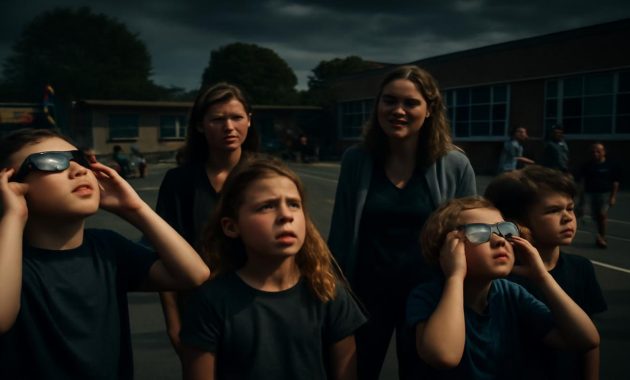
The letter from the school arrived on a Tuesday afternoon, printed on thin blue paper that smelled faintly of toner and anxiety. “Due to the upcoming solar eclipse,” it began, “the district is reviewing whether to modify or cancel the school day on April 8.” By dinner, the message had already detonated across group chats and social feeds. Screens lit up with anxious questions and blurry screenshots: Is it safe for kids to be outside? Are they overreacting? Are they doing enough? Somewhere behind all the noise, the Earth kept turning, quietly lining itself up with the Moon and the Sun for the longest solar eclipse of the century—an event older than any institution now arguing over it.
The sky that stops a school day
Long before the first lawsuit threat or parent email, this story belonged to the sky. The eclipse itself will be a slow, eerie unfolding: a bright late-morning or early-afternoon sun thinning into a crescent, the daylight dimming in a way that feels wrong to the body, then a sudden drop into an almost-night that lasts minutes but stretches, in memory, into something much larger.
In the path of totality, day won’t simply “get darker.” It will change character. Colors flatten. Shadows sharpen into razor-thin doubles. Birds go quiet, then confused. Streetlights flicker on against a not-quite-night. The temperature slips down just enough that you feel it on the hairs of your arms. Somewhere a dog starts barking at nothing it understands.
Yet on the ground, in parking lots and cafeterias and cramped administrative offices, the question isn’t awe. It’s liability. Should millions of children be in classrooms when the sky goes dark in the middle of the day? Or at home, where the school has no control at all over whether they stare, unprotected, into the Sun?
It’s an oddly modern problem: a cosmic event older than language colliding with the nervous systems of institutions that live in a world of risk assessments, insurance policies, and instant outrage. The Moon will slide across the Sun exactly the same way it did a thousand years ago. We, however, are very different.
The longest shadow of the century
On paper, this eclipse is a marvel of numbers. Astronomers describe it in crisp, unemotional terms: the longest total solar eclipse of the century visible from this particular region, a ribbon of shadow sweeping a cross-continental path. For a few precious minutes, some towns will see the Sun vanish entirely behind the Moon, its corona spilling out like white fire. Even far from the center line, the partial eclipse will bite a deep, unnatural chunk from the Sun’s familiar disk.
Inside that thin path, time will feel stretched. Traffic may freeze on highways as drivers pull over, phones pointed skyward behind flimsy cardboard glasses. City centers will hum with pop-up watch parties. Rural fields could host caravans of eclipse chasers, their tripods and telescopes pointing at the same exact patch of sky as a second-grader in a schoolyard a thousand miles away.
But that same second-grader—call her Maya—has become the heart of a battle between caution and curiosity. Her mother scrolls articles about eye damage late into the night, words like “permanent” and “retinal burns” glowing blue in the dark. Her father remembers watching a partial eclipse through homemade pinhole viewers as a kid and wonders when fear became the loudest voice in the room.
Somewhere in a district office, a superintendent reviews a spreadsheet of recommendations from legal counsel. “If we keep schools open,” one memo notes, “we assume responsibility for student safety during the eclipse period.” Another points out parental choice: “Closing school shifts all liability to families, but may be perceived as fear-mongering.” Numbers and words stack against each other. The shadow is still days away, but its presence is already felt.
Safety versus wonder: what are we really protecting?
The risks are real. Staring directly at the Sun during an eclipse, even for a few unprotected seconds, can damage the retina. Children, with their thinner lenses and endless curiosity, are particularly vulnerable. Eye specialists warn about solar retinopathy—painless, often permanent injuries that might not show up immediately, like ghostly blind spots waiting to be discovered days later.
Parents know this. They’ve read the headlines, the horror stories, the worst-case scenarios framed in bold. So when a school announces that students will be outside to view the eclipse, even with proper glasses, some hear: We’re betting your child’s vision on every eight-year-old following instructions perfectly.
Yet there’s another risk, quieter but just as real: the loss of something rare and unrepeatable. For many children, this will be the only major eclipse they remember in their lifetime. Not just remember from the news—but remember with their whole body. The strangeness of dark noon. The chorus of crickets rising, confused. The circle of adults around them, united for once in pointing, gasping, trying to find words for what is happening above their heads.
Teachers of science and nature feel this tug sharply. They’ve spent years urging students off screens and into the living world—counting dragonflies by a pond, measuring the angle of the Sun with cardboard protractors, tracking the phases of the Moon in smudged pencil on homework sheets. Now the sky is offering a masterclass, for free, and the response from some corners is: pull the blinds; stay inside; pretend it’s any other Monday.
The conflict runs deeper than a single event. It’s about how we teach children to live in a world full of awe and hazard, beauty and risk. Do we respond by sealing every door we can, or by learning, together, how to step carefully into the experience?
Inside the school board meeting when the sky is on the agenda
By early spring, “the eclipse issue” has become a fixed item on school board agendas. Folding chairs fill with parents and teachers. A projector hums at the front of the room, its light pooling weakly on a screen that will eventually show the planned timing of totality down to the minute.
A parent in a denim jacket takes the microphone first. Her voice is tight; she’s holding printed photos of damaged retinas she found online.
“You are asking us to trust that hundreds of children will all follow directions perfectly in an event they will want to look at,” she says. “If even one child goes home with permanent damage, who is responsible? Are we turning our kids into a liability experiment?”
Murmurs ripple through the room. A few heads nod. Others stiffen. In the third row, a science teacher shifts her weight forward, waiting.
When her turn comes, she pulls a well-worn astronomy textbook from her bag and places it on the podium like an offering.
“I’ve spent fifteen years trying to make the solar system feel real to my students,” she begins, her voice steady but urgent. “We show them diagrams, animations, little foam balls on sticks. Once in a century, the universe volunteers to do the demonstration for us. To say we should hide them from it—for fear, not facts—feels like telling them the world is too dangerous to look at.”
She’s not reckless. She outlines a plan: certified eclipse glasses for every student, checked beforehand; rehearsed instructions; indoor options for any child whose parents opt them out; supervision ratios; rehearsed “eyes down” cues. She shows research that supervised school-based viewing, with proper equipment, can actually reduce the risk compared to children left to improvise at home with no guidance.
On the far side of the room, a district lawyer adjusts his glasses. “We have to consider the perception of risk as well,” he says. “If something goes wrong, the narrative will not be, ‘This was a carefully supervised educational experience.’ It will be, ‘The school forced my child to go outside during a dangerous event.’”
The debate see-saws. One board member suggests an early-release day, so families can decide what to do on their own. Another worries that sending students home in the peak hours of the eclipse just means unsupervised kids roaming the streets, tempted by the darkened sky.
Some districts announce full closures, treating the eclipse almost like a blizzard moving through the calendar. Others double down on staying open but indoors, planning to keep students away from windows during the crucial minutes, as if warding off a ghost.
In hallway conversations, the arguments feel more human, less scripted. “I’m not scared of the eclipse,” one father says quietly. “I’m scared of being the only parent who lets my kid watch it, if something happens.”
Where science, fear, and memory collide
The science behind the safety guidelines is fairly straightforward: it is never safe to look directly at the Sun without proper protection, eclipse or not. The eclipse doesn’t make the Sun more dangerous; it makes the temptation to stare at it more powerful.
But our reactions are shaped less by science than by stories. Some parents remember tales from their own childhood—warnings that eclipses could “burn your eyes out,” cursed myths whispered on playgrounds, or vague threats about going blind that merged space with superstition.
Others remember the 2017 eclipse, when social media filled with people improvising viewers from cereal boxes and welding glass. Many watched safely. A few, inevitably, posted panicked updates about spots in their vision afterward, stories that now circulate in parent groups like warnings carved into digital stone.
Meanwhile, older adults recall something else: the wonder. A grandfather in his seventies describes skipping a college lecture in the 1970s to watch an eclipse from a football field. “We didn’t have the glasses,” he laughs. “We made pinhole projectors with cardboard. The campus gave us instructions, but no one was talking about lawsuits. Just excitement.”
Today, schools walk a narrower path. Insurance companies ask detailed questions. State education departments send dense guidance documents outlining best practices and worst fears. Social media amplifies each decision into a potential scandal before the ink is dry.
Yet under all the institutional noise, a simpler, quieter current runs: the longing to give children a moment they’ll talk about decades from now. To put them under a changing sky and say, “This is your planet, in motion. This is you, in the middle of something vast.”
Parents, schools, and the thin line of trust
The eclipse debate has exposed a fragile seam that was already fraying: trust between families and schools. The pandemic years strained it; culture wars stretched it thinner. Now, something as ancient and apolitical as the alignment of the Sun and Moon arrives, and still the questions echo with deeper anxieties.
“If they can’t keep my child safe from the Sun,” one parent writes in a local forum, “how can I trust them with anything else?” The comment isn’t really about ultraviolet light. It’s about accumulated fears—about security, about bullying, about health, about the right books on classroom shelves.
On the other side, teachers feel caught between professional judgment and public suspicion. “We’re trained educators,” a fifth-grade teacher says. “We teach lab safety, we manage field trips, we guide kids through all sorts of controlled risks. But talk about the sky and suddenly we’re treated like we’re dragging kids into traffic.”
Many districts land on compromises that read like small negotiated treaties:
| Decision | What It Looks Like | Why They Choose It |
|---|---|---|
| Full school closure | No classes; day treated like a weather emergency | Minimizes institutional liability; shifts responsibility to families |
| Half day / early release | Students sent home before eclipse peak | Balances instruction time with parental control over viewing |
| Indoor shelter-in-place | Blinds closed; no outdoor activities during eclipse | Avoids direct exposure but sacrifices live experience |
| Supervised outdoor viewing | Glasses provided; structured lessons and staff supervision | Embraces educational value while applying safety protocols |
Alongside these decisions come permission slips, opt-out forms, emergency contact updates. Parents are asked: Do you want your child outside? Inside? At home? Each checkbox is a tiny referendum on how they weigh risk and wonder.
For some families, the solution is simple: they’ll keep their kids home, pull lawn chairs into the yard, and make their own eclipse memory. For others, work schedules and childcare realities mean school is the only option, and they’re begging districts to provide a safe, structured way for their children not to miss this cosmic chapter.
The child at the center of the shadow
In all the noise, it’s easy to forget the person whose experience will matter most: the child looking up, or not looking up, on that day.
Imagine again that second-grader, Maya. In one version of events, she stands in a field behind her school, the grass cool under her sneakers. She’s wearing cardboard eclipse glasses that smell faintly of ink and plastic. Her teacher’s voice floats over the crowd: “Eyes down for a moment… now look!”
The world shrinks to the disk of the Sun—a perfect black hole ringed with pale fire. Maya doesn’t know the words “corona” or “totality” yet, but she knows this doesn’t feel like any sky she’s ever seen. Around her, a hush falls, softer than in any assembly. Even the loud kids are quiet.
Later, years later, when school and board meetings and emails have all blurred, she will remember this: the feeling that the universe is bigger and stranger than she thought—and that the adults in her life trusted her enough to share it with her, safely.
In another version, she sits at home with the blinds half-drawn. Her mother, terrified by what she’s read, has forbidden her to step outside until the eclipse is over. The house feels oddly dim. Shadows on the floor look wrong. She tries to read, but her eyes keep drifting to the slits of light at the window.
She grows up with a different story: that the sky can turn dangerous without warning, that the safest response to mystery is to close the curtains and wait it out.
Most families, of course, will find a middle path. A careful viewing through approved glasses. A quick trip outside, then back in to watch a livestream. A phone photo that turns out grainy but means the world anyway.
What remains, long after the day returns to its usual blue, is the story we tell children about their place under the sky. Are they spectators, shielded from risk by layers of adult fear? Or participants in a universe that asks them to be both cautious and brave?
When the shadow finally comes
On the day itself, the debates will go quiet, replaced by something more immediate. Clouds will either cooperate or not, indifferent to petitions and press releases. The Moon will keep its schedule, sliding slowly across the Sun in a movement we cannot speed up or slow down.
In some schools, hallways will dim as blinds are pulled tight, teachers continuing lessons under artificial light while the outside world slips, briefly, into a twilight dream. Students will catch snatches of it anyway—the change in the color of the light, the unease in the air during lunch.
Elsewhere, playgrounds and parking lots will transform into open-air observatories. Teachers will become amateur astronomers, counting heads, adjusting glasses, telling students when to look away. For a few minutes, the usual rules of schoolyard life will suspend. The kid who always fidgets will stand still. The one who never talks will whisper, “Wow.”
Parents who chose to keep their kids home will gather on balconies and driveways, ovens temporarily ignored, email inboxes closed. The adult world will, just for a breath, make space for looking up.
And in that pause, something rare might happen: people, scattered across cities and towns and school districts, all noticing the same thing at the same time. All aware, if only faintly, of the same giant mechanism grinding away above their heads, indifferent to their arguments and fears.
Day will turn to night and then back to day. The birds will re-adjust. Traffic will resume. The next morning, the news cycle will move on.
But inside the lives of the children who saw it—or who were told they couldn’t—something more lasting will settle. A sense of whether the world is mostly a place to be protected from, or a place to be present in, carefully, eyes shielded when necessary, curiosity intact.
Long after the lawyers have filed their memos and the administrators have archived their emails, the Moon’s shadow will keep sliding across the Earth, once every so often, whether or not we are ready. The question that remains for us is simple and hard: when the sky changes, do we hide our children from it, or do we stand beside them and show them how to look safely at a dangerous, beautiful world?
Frequently Asked Questions
Is it actually dangerous for children to be outside during a solar eclipse?
Simply being outside during a solar eclipse is not harmful. The danger comes from looking directly at the Sun without proper eye protection. With certified eclipse glasses, pinhole projectors, or indirect viewing methods, it can be a safe and powerful learning experience.
Can a child go blind from looking at an eclipse?
Staring at the Sun during an eclipse without proper protection can cause solar retinopathy, which may lead to permanent blind spots or vision damage. Total blindness is rare, but the risk of serious harm to vision is real enough that precautions are essential.
Are schools overreacting by closing for the eclipse?
Schools are balancing educational opportunity with legal and safety concerns. Some communities feel closure is the safest option; others believe supervised viewing at school is safer than leaving children unsupervised at home. Whether it’s an overreaction depends on local context, preparedness, and community expectations.
What is the safest way for children to watch the eclipse?
The safest methods include using certified eclipse glasses that meet international safety standards, or indirect methods like pinhole projectors or watching crescent-shaped shadows under trees. Young children should be closely supervised, with clear instructions on when and how to look.
Why do some parents want schools to stay open for the eclipse?
Many parents see the eclipse as a once-in-a-lifetime educational moment. They trust schools to provide structured, supervised activities, proper protective equipment, and scientific context that they may not be able to offer at home.
Why do other parents feel schools are putting children at risk?
Some parents worry that in a large group, not every child will follow directions perfectly, and that even a few seconds of unprotected viewing could cause lasting damage. Others are concerned about liability and prefer to make their own choices about how and whether their child experiences the event.
Will children remember this eclipse later in life?
Many likely will, especially if they experience it directly and with some sense of ceremony or explanation. Eclipses often become vivid, lifelong memories—moments when people remember where they were, who they were with, and how the world briefly felt different.