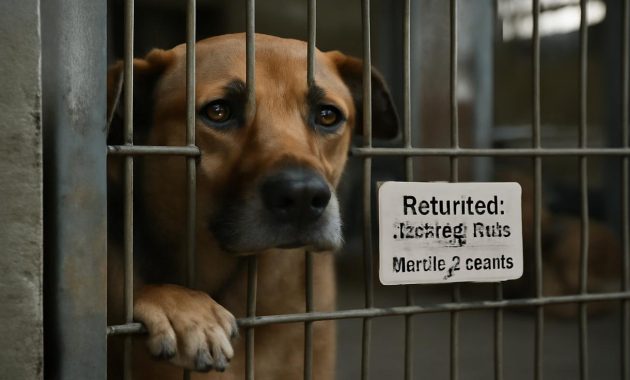
The first time I see her, she’s pressed so close to the kennel door that her nose leaves a little foggy circle on the glass. One paw hovers mid-air, frozen in an unfinished step, as if she’s torn between coming closer and backing away. Her eyes—soft, amber, question-filled—lock onto mine with the kind of hope that feels a lot like a weight. Somewhere behind me, a volunteer laughs, a door slams, a stainless-steel bowl clatters on concrete. But in that thin corridor that smells of lemon cleaner and dog biscuits, there is only her, the shelter dog who has already had a home once and lost it.
Returned: The Story No One Sees on the Adoption Photo
They called her Maple when she first came in—because of her warm brown coat, someone said, or because she arrived in October when the trees outside the shelter burned gold and red. The name stuck. So did she.
Maple’s intake notes are short and practical, a few lines typed into a box on a screen: “Female, approx. 3 yrs. Spayed. Returned due to housing issues.” It isn’t dramatic. No neglect, no cruelty case, no emergency rescue from a roadside ditch. Just two words: housing issues. But if you stand in front of her kennel long enough, you start to feel the weight pressed between the spaces of those words. The boxes left unchecked. The things nobody quite knows how to write down.
Someone once bought her a collar. Someone once picked out her first toy—maybe a squeaky duck, maybe a rope with knots at each end. Someone watched her spin in uncertain circles in a new living room, then slowly learn the shape of the space, the corners where the shadows fell in the afternoon. She had a bed, or at least a blanket that smelled like people, like furniture polish and laundry detergent and dinners cooking in the next room.
Then came the notice. A rent increase. A lease change. A building sold. A new landlord with new rules that didn’t include forty pounds of wagging dog. The intake staff has heard it all: “We have to move, and the new place doesn’t allow dogs.” “Our landlord changed the pet policy.” “We can’t find anything we can afford that will take her.” Maple’s people cried when they handed over the leash, the staff remembers that. They brought her food and her collar, but left the bed because they said she liked the couch more anyway. The small details cling in the memory of the volunteers, like dog hair on a black sweater.
The Sound of Waiting
Shelters are full of sound. The echo of barking ricochets down the cinderblock hallways, big dogs setting off small dogs in a wave that rises and falls all day. There’s the hiss of hoses rinsing down runs, the clink of metal tags on collars, radios murmuring from the front desk. But for Maple, the soundtrack of her days has become quieter, less urgent. Her bark is not a frantic, high-pitched plea; it’s a single, low “woof” when someone passes, a soft, questioning sound that trails off into silence when they keep walking.
At first, in those early weeks back at the shelter, she was frantic with disbelief. When someone walked away from her kennel, she would spin in circles, paws slipping on the concrete, nails clicking as she dashed from one end of the small space to the other. She pawed at the gate when volunteers left, whining a thin, heart-tugging note. On her bed—thin fleece laid on plastic—she sat rigid and listening, eyes fixed on the door, ready to move the instant shoes appeared in her line of sight.
But time, in a shelter, behaves strangely. It expands and thins, stretching from morning feeding to the evening rounds, marked by the rattle of kibble in stainless steel bowls. Maple learned the rhythm of it. Breakfast. Barking. Walks. Naps. Cleaning. Dinner. Lights dimmed. Doors clicked shut. The bright, crackling disbelief that this was temporary faded into something heavier: a waiting that settled into her muscles like rain soaking into dirt.
She still comes forward when somebody stops, still sits when a volunteer asks, tail sweeping hopeful arcs across the floor. Every time, she seems to ask the same question with her eyes: This time? Is it you?
The Dog Behind the Kennel Door
On paper, Maple is an “easy” dog. She’s house-trained, medium-sized, no known bite history, does well with older kids, walks politely on a leash once she burns off that initial fizz of excitement. She knows “sit” and “down” and “stay” (for at least three wobbly seconds). She likes people, adores treats, and worries a bit about loud noises. She’s the kind of dog you can picture dozing by your feet while you answer late-night emails or watching squirrels with fierce concentration from the apartment window.
But shelter life blurs the edges of even the best-behaved dogs. The fluorescent lights hum at all hours, and there is always another bark, another clang, another unfamiliar hand reaching in. Maple startles easily here. When the door at the end of the hall bangs shut, she flinches, then pretends she didn’t. She paces for a few minutes after a loud cleaning shift, her nails tracing the same faint arcs on the floor day after day. The staff writes “sensitive to noise” on her profile, because how do you explain that a dog is just tired of living in a place that never really sleeps?
On her walks, though, Maple loosens. The shelter sits on the edge of a small town, and there’s a thin strip of woods behind the parking lot where volunteers take the dogs. Out there, the sounds soften—birds instead of barking, wind instead of the whirr of washing machines. Maple’s whole body seems to lengthen as her paws hit grass, as if she’s been crammed into a too-small box and can finally unfold.
She sniffs everything. She plunges her nose into piles of fallen leaves, sending them whispering apart. She buries her face in the tall grass, inhaling sun-warmed earth and the invisible stories left behind by rabbits and raccoons and last night’s stray cat. Her tail lifts a little higher. Her step turns springy. For twenty minutes at a time, Maple is not a dog “returned over housing issues”; she is simply a creature stitched from muscle and joy and scent, moving through the world exactly as she was built to do.
How Long Is “Too Long” in a Shelter?
Ask anyone who’s worked in a shelter long enough, and they’ll tell you: there is a season for every dog. The wiggly puppies vanish almost as soon as their adoption photos go up—tiny paws, floppy ears, captions that read “Meet Peanut!” and “Lulu’s ready for you!” Older dogs, big dogs, black dogs, and those labeled with the vague, heavy word “issues” often wait longer. Maple sits somewhere in between. Not a senior, not a puppy. Not a breed that makes people stop and say, “Wow, look at her.” Just Maple—brown, medium, quiet, overlooked.
Weeks became two months, then four. Her original intake date faded from the whiteboard in the office, replaced by new names and new stories. But for the staff and volunteers, Maple became part of the shelter’s daily language. “Has Maple had her walk?” “Did Maple get her meds?” “Can someone bring Maple into the play yard?” Her presence became a kind of certainty, as reliable as the stack of towels in the laundry room.
And yet, every time a potential adopter walked past her kennel and glanced at her profile, hope prickled again. Maybe this one. Maybe them. Maybe today.
Some visitors paused and smiled, but moved on. Some didn’t notice her at all because she wasn’t jumping or barking loud enough to grab their attention. When they stopped, she sat, like she’s been taught, assuming that being very, very good is the key to finally unlocking the door for good. Imagine the confusion of doing everything right and still being left behind.
When “Housing Issues” Means a Broken Heart
“Returned over housing issues” is a phrase that shows up a lot in shelter notes. It’s quick, neutral, sanitised. On a printed kennel card, it takes up little room. It doesn’t describe the late-night arguments about finances, the fruitless online searches for pet-friendly rentals, the sick feeling of reading “no pets allowed” over and over again. It doesn’t capture someone sitting in a half-packed living room, a dog’s head in their lap, whispering, “I’m so sorry, I’m so sorry,” into soft fur.
It doesn’t show Maple’s confusion on the car ride back to the shelter. The way she probably perked up when they turned into the familiar parking lot, maybe thinking she was just there for a check-up, a quick hello. The way her people’s hands shook when they signed the surrender forms, while Maple leaned into their legs, pressing her whole weight against them because that’s where home was.
Housing policy doesn’t know about loyalty or routine. It doesn’t care who slept at the foot of which bed, or how many nights that dog watched over a child scared of storms. It doesn’t see the soft, breathing shape on the couch during lonely evenings, the reason someone got out to walk every morning when depression made the rest of life feel impossible. All it sees is a checkbox: pets allowed or pets prohibited. The rest—Maple’s whole heart, her entire short history of belonging—that gets repackaged into two clinical words: housing issues.
And so here she is again. Back on the adoption floor. Back under fluorescent lights. Back waiting.
A Day in Maple’s Shelter Life
If you shrank yourself small enough to become Maple’s shadow, this is what a day might look like:
- 6:30 a.m. The overhead lights flicker on. Maple lifts her head from her blanket. Someone is rolling a cart down the aisle. Breakfast is coming. She stands, stretches—front legs long, hips arched, tail giving a half-asleep wag.
- 7:00 a.m. Food bowls clatter. The smell of kibble thickens the air. Maple eats, not hurried now; she’s learned there will always be another meal here, even if the rest of life feels uncertain.
- 8:30 a.m. Volunteers arrive, cheerful voices bouncing down the hall. Doors open, leashes jingle. When it’s her turn, Maple does a little dance, paws light, body wiggling. Outside, the air is cool, carrying hints of car exhaust and dew on cut grass. Her nose twitches at every breeze.
- 10:00 a.m. Back in her kennel, she watches people pass. Some stop; some don’t. Her ears swivel toward every laugh, every new voice. She naps in patches of light. She chews her toys. She waits.
- Afternoon. Another walk. Maybe some time in the play yard with a tennis ball, though she’s more interested in sniffing fence posts than fetching. A staff member kneels to scratch the spot behind her ears that makes her eyes half-close. For a second, Maple forgets this is temporary.
- Evening. Dinner. The day’s noise softens. Most visitors have gone home to their own pets, their own couches. Maple circles her blanket three times and settles in, nose tucked under her tail, the faint sounds of the night staff moving in the background.
In the quiet moments, when her eyes slip shut and her breathing steadies, maybe she dreams of that other home—the sound of keys in a particular front door, the shape of a hand always reaching down to her. Or maybe, mercifully, she’s just dreaming of open fields and endless, unbroken walks.
Looking for Forever, Again
Maple isn’t alone in this story. Shelters everywhere have dogs like her: once-chosen, once-claimed, once-photographed under soft household lamps and shared with captions like, “Welcome to the family!” Then, through no fault of their own, they’re back behind glass, waiting to be chosen again in a world that treats pets as both family and, too often, as conditional luxuries.
The staff here knows Maple well by now. They’ve learned the tilt of her head that means she’s unsure, the way her paws dance when she’s really excited, which treats she’ll work hardest for. They’ve seen her wag shyly at timid visitors, then step back to give them time. They’ve watched her curl up like a child, chin on her paws, when another dog down the row leaves for good with a new family.
They talk about her with the protective fondness of people who have loved a dog longer than they expected to. “She’d be perfect for someone who likes quiet evenings.” “She just needs a soft place and some patience.” “She’s so easy to love—someone just has to see her.”
Somewhere out there is the person or family who will walk past the kennels, glance at Maple, and feel something catch in their chest. Not because she’s the flashiest dog, but because, in that quick, wordless exchange of looks, they recognize a familiar kind of waiting in her. Maybe they, too, know what it is to be between homes, between certainties, between one chapter and the next.
If Maple Could Ask
If Maple could speak, she might not talk about the complicated web of housing policy and income and impossible choices that landed her back here. Dogs don’t understand escalating rent or limited listings or the strange, human rules that decide which bodies get to live inside four walls.
She might ask simpler questions:
- Will you come back when you say you will?
- Will my bed always be there at the end of the day?
- Will I still be here, years from now, when my muzzle goes gray and my steps get slower?
And maybe:
- Can I unpack my heart this time? All the way?
Because that’s what “forever home” really means, under all the slogans and adoption drives and heartwarming social media posts: a place where a dog can finally stop half-waiting to be moved again. A life where the future is not a question mark hanging over every lease renewal.
A Small Table of Maple’s Big Truths
On paper, Maple can be summed up in a few lines. But each small fact holds an entire world:
| Detail | What It Really Means |
|---|---|
| Returned for housing issues | She was loved, but the system failed both her and her people. |
| Approx. 3 years old | Old enough to be past the chaos of puppyhood, young enough for new adventures. |
| Medium, mixed-breed | She fits into most lives: apartments, houses, long walks, or lazy Sundays. |
| Sensitive to noise | She dreams of a quieter corner of the world, where doors don’t slam all day. |
| Loves people, seeks connection | Despite everything, her trust isn’t broken. She’s still willing to try again. |
What It Means to Open Your Door
To adopt a dog like Maple is to step into the middle of her story, not the beginning. It’s recognizing that “returned” is not another way to say “reject” or “problem,” but often just the scar left by circumstances bigger than she is. It’s understanding that a dog can be both confused by change and astonishingly resilient, that she can learn new routines and form new attachments, even after losing what she thought was permanent.
It also means making a quiet promise: to choose a home with her in mind; to think about renewal notices and emergency plans the way you might for any other family member. It’s not about being perfect, but about being committed—about saying, “We’re in this together, as far as we can possibly go.”
When Maple finally leaves the shelter—for good, this time—it won’t be with fanfare. There will be paperwork and a quick photo in front of a faded banner that says something like “Today is my adoption day!” She’ll probably pull on the leash in her eagerness, toenails skittering on tile as she heads toward the door that leads out, out, out.
At the threshold, she might pause, just for a second, and look back. Not in doubt, but in the way we sometimes take one last glance at a place that held us during a hard chapter. Then the door will open, and Maple will step into the bright, ordinary miracle of a new life. A backseat car ride that doesn’t end at a shelter. A front door that opens again and again to the same people. The slow, patient work of unpacking her worry and planting trust in its place.
In the end, Maple’s story isn’t just about a dog returned for “housing issues.” It’s about what happens when we decide that the phrase “forever home” is not a marketing slogan, but a commitment worth bending our lives around. It’s about all the animals, in shelters everywhere, who are waiting right now with paws on the edge of hope, listening for the sound of someone finally coming for them and never turning back.
Frequently Asked Questions
Why are so many dogs returned to shelters over housing issues?
Dogs are often returned when their families face sudden rent increases, evictions, building sales, or new pet restrictions. In many areas, pet-friendly housing is scarce or very expensive, and people are forced to choose between having a roof over their heads or keeping their animals, even when they deeply love them.
Does being “returned” mean a dog is badly behaved?
Not usually. “Returned” simply means the previous home couldn’t keep the dog. The reasons are often unrelated to behavior: housing rules, financial hardship, health problems, or major life changes. Many returned dogs, like Maple, are well-mannered, loving companions.
Are returned dogs harder to adopt?
They can be, mostly because some adopters worry that “returned” signals a problem. But returned dogs often come with valuable information from their previous homes—what they’re like with kids, if they’re house-trained, what they enjoy—which can actually make for easier matches.
How long do dogs typically stay in shelters?
It varies widely. Some dogs are adopted within days, especially puppies and small breeds. Others—often medium to large mixed-breed adults like Maple—can wait months or longer, depending on the shelter’s location, capacity, and how many people are looking to adopt.
What should I consider before adopting a dog like Maple?
Think about your housing stability, finances, schedule, and lifestyle. Ask yourself if you can commit to caring for a dog for 10–15 years, including through moves or job changes. Talk honestly with shelter staff about your situation; they can help you find a dog whose needs and energy level match your life, giving both of you the best chance at a true forever home.