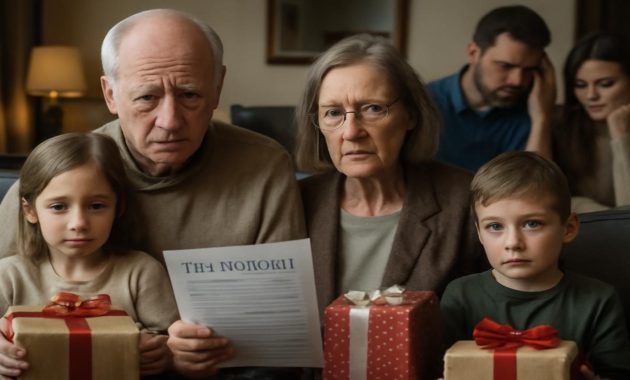
The envelope is thin, soft at the corners, the way old paper feels after years of being moved from drawer to drawer. On the front, the handwriting loops gently: “To Mia, on your 10th birthday. Love, Grandma.” Mia’s mother watches as her daughter carefully slides a finger under the flap. Inside is a card smelling faintly of lavender and a crisp banknote that a pension has made possible only with a bit of quiet sacrifice. For a brief moment, the three of them—child, mother, and grandmother—are connected not just by blood, but by this simple gesture of care passing from one generation to the next.
Now imagine that somewhere in the background, invisible but present, is the tax authority. Watching. Counting. Calculating. That birthday note, the Christmas envelope, the quiet transfer that helps pay for driving lessons or university fees—suddenly no longer just an expression of love, but a potential entry in a taxable ledger.
A kitchen table, a policy proposal, and a knot in the stomach
The story often starts at a kitchen table. A chipped mug, a half‑finished crossword, the news murmuring in the background. A headline drifts across the screen or the radio: “Authorities propose new tax on gifts from grandparents to grandchildren.” At first, it sounds like a mistake. A tax on what? On a birthday note? On that occasional envelope to help cover rent? Surely they mean massive inheritances, the kind that pass down mansions and investment portfolios, not the forty or fifty here and there that keeps the car insured or the heating on in winter.
But as details slowly emerge, the knot in the stomach tightens. The policy, we’re told, is part of a broader reform to “close loopholes” and “ensure fairness in intergenerational transfers of wealth.” The language is abstract; the reality is anything but. For millions of families already walking a financial tightrope, grandparents have become an unofficial, unpaid social safety net. The proposal, in its clean bureaucratic wording, cuts straight through the heart of that quiet support.
This is not a story about vast sums hidden in offshore accounts. It’s about the twenty euros slipped into a lunchbox “just in case.” The phone call that ends with, “Don’t worry, darling, I’ll help you this month.” The way an old savings book, once meant to fund retirement dreams of travel, slowly empties to keep the younger generation from sinking.
Why authorities say they’re doing this
To understand why anyone would even consider taxing gifts between grandparents and grandchildren, you have to zoom out from the kitchen table to the wider landscape. Public finances are under pressure. Populations are aging. The cost of education, housing, and healthcare is climbing at a pace that strips families of breath. At the same time, wealth—especially property and financial assets—is increasingly concentrated among older age groups.
From a strictly fiscal perspective, large, untaxed transfers of wealth flowing down generations look like a missed opportunity. Economists argue that when significant assets are handed over tax‑free, it amplifies inequality. The child of wealthy grandparents might receive help with a house deposit, a private education, or seed money for a business, while another grandchild in a different postal code, whose grandparents have little or nothing to spare, starts adult life from far behind on the track.
Authorities frame the proposed tax as a measure of justice: an attempt to put a modest brake on the quiet river of money that quietly reinforces privilege. “It’s not about punishing generosity,” policy documents insist, “but about ensuring that large wealth transfers contribute a fair share to the social system that benefits everyone.”
On paper, it sounds almost rational. In reality, the difference between a “large wealth transfer” and a lifeline can be hard to see from the vantage point of a government report.
The emotional economy of small gifts
If you’ve ever watched a grandparent hand a folded note to a grandchild, you’ll know it isn’t just currency changing hands. It’s a distilled form of love, pride, and sometimes, regret. “I couldn’t do this for your mother when she was your age,” a grandfather may think, “but maybe now I can help you.” These gifts often arrive wrapped in layers of memory—of growing up poor, of nights counting coins, of promises whispered secretly: If I ever have enough, I’ll make sure my grandchildren don’t go through this.
For struggling families, those envelopes are not extras. They are fuel. They keep the fridge stocked, the school trips possible, the textbooks bought, the rent just barely paid. Grandparents become shock absorbers in an economy full of potholes. When the washing machine breaks or the car fails its inspection, it’s often not a bank that saves the day. It’s a grandmother, opening an envelope of her own—one that once held her pension statement—and deciding she can stretch just a little more.
To tax these gestures feels, to many, like more than just a financial hit. It feels like a moral misreading of what’s really going on between generations. It’s as if the state is stepping between outstretched hands and saying, “You can still help, but only if we take a cut first.” The idea lands not as fiscal fine‑tuning, but as an affront—to solidarity, to family loyalty, to the deeply human impulse to care for those who come after us.
Where does “fairness” end and intrusion begin?
Supporters of a gift tax often start from a reasonable premise: without some checks and balances, those with more will always find ways to move money around to avoid contributing to the collective pot. They point to the way wealthy families already structure inheritances to bypass taxes—using trusts, strategic gifts, and other tools that most of us will never need, let alone fully understand. From this vantage point, taxing gifts from grandparents to grandchildren is simply closing one more door to avoidance.
But the proposal bumps into a stubborn question: at what point does a fair system become an intrusive one? To enforce such a tax, authorities would need rules, thresholds, documentation. How much can a grandparent give per year before the tax applies? Must every bank transfer be declared? What about cash drawn from an ATM and handed over at the back of a café, or slipped into a birthday card?
The more tightly the state tries to regulate, the more it trespasses into the private corners of family life. This isn’t just about paperwork; it’s about the feeling of being watched when you help your grandchild, the uneasy sense that an act of care has been reclassified as a taxable event. Even families who would never meet the taxable threshold might change their behavior, out of confusion or fear of doing something “wrong.”
Numbers on a page, lives in the margins
Behind the policy debate, there’s a quieter story about who actually gives and who receives. It’s tempting to picture wealthy grandparents passing on large transfers, but the everyday reality often looks starkly different. Many older people on modest pensions are sharing from what little they have. They are renting, not owning. They are skipping new clothes, postponing dental appointments, turning down the heating and putting on an extra sweater so they can say “yes” when a grandchild whispers that things are tight this month.
The figures, across many countries, tell a consistent story: younger generations are earning less, relative to costs, than their parents did, while the price of housing and education has outpaced wages. Grandparental help is not simply a “nice to have”—it has become a structural component of how some families survive. For every story of a luxury flat purchased outright by grandparents, there are countless unseen stories of overdrafts quietly paid off, debt avoided, and mental breakdowns averted by a transfer made at just the right moment.
To simplify the landscape, imagine three very different family situations:
| Scenario | Grandparents’ Means | Type of Gift | Impact of Tax |
|---|---|---|---|
| A | Low income, small pension | Occasional small cash to cover basics | Adds anxiety; may reduce vital support |
| B | Comfortable, own a modest home | Help with university fees or rent | Could trigger tax if thresholds low |
| C | Very wealthy, significant assets | Large regular transfers, early inheritance | Intended main target of reform |
The trouble with broad measures is that they do not walk into living rooms and look around. They can’t distinguish between a precarious grandmother in Scenario A and a well‑advised family in Scenario C who may, even then, find ways around the new rules. Without careful design, a tax that claims to chase big fish risks tangling the smallest boats in its net.
Trust between generations—and between citizens and the state
Intergenerational solidarity is not just about money; it is a deep, often wordless agreement: we will look out for each other, each in our season of strength. Parents care for children; later, children care for aging parents. Grandparents stand like old trees, offering shade and fruit to those who gather beneath their branches. These are moral obligations long before they ever become legal ones.
When the state inserts itself into this subtle ecosystem, it intervenes not only in wallets but in trust. Many older people already feel that they have “paid their share” through decades of work and taxation. Younger adults, facing insecure work and rising costs, often oscillate between resentment of a system that seems rigged against them and gratitude for grandparents who help them survive it. If the state begins to tax the very help that holds this fragile peace together, there’s a risk of souring attitudes on both sides.
Grandparents may feel punished for doing what any loving person would do. Grandchildren may sense that their relationship with older relatives is being bureaucratized, translated into account balances and declarations. And hovering above it all, mistrust in government deepens—another layer of “they don’t understand how we live” settling over already weary citizens.
Is there a middle path between outrage and necessity?
Some policy makers argue that the tax on gifts is a “harsh but necessary” step. They point to gaps in education funding, social care, climate adaptation—costs that must be covered somehow. They remind us that when large fortunes flow down untaxed, governments have to look elsewhere: towards consumption taxes that hit the poor hardest, or cuts to services that the vulnerable rely on most. In this light, taxing certain transfers from grandparents to grandchildren is framed as a reluctant but responsible way to keep the social contract from fraying further.
But “harsh” and “necessary” are not fixed points; they depend on how we draw the lines. A more nuanced approach might accept the core goal—reducing the role of private wealth in entrenching inequality—while fiercely defending small‑scale, survival‑level generosity. That could mean:
- Setting relatively high annual exemptions, so that typical birthday gifts, help with groceries, and emergency rent support never come close to being taxed.
- Focusing on large, planned transfers—like early inheritances of property or sizeable investment sums—where professional advice and documentation already exist.
- Designing simple, clear rules that do not demand that every family turn into amateur accountants tracking every ten‑euro note.
Such measures would not erase all controversy. Even carefully tailored reforms can be felt as violations when they touch something as intimate as family care. Yet they might at least align the law more closely with its stated target: structural inequality, not survival solidarity.
On the other side, opponents of any such tax often speak in the language of outrage. To them, this isn’t just a flawed policy—it is a symbol of a state that has lost its moral compass, that no longer respects the invisible labor of grandparents who quietly patch the holes in the social fabric. But outrage, like austerity, is a blunt tool. It risks shutting down the conversation at the very moment when subtlety is most needed.
What kind of future are we really funding?
Beneath all the debate, a larger question hums: what kind of future are we trying to build, and who is responsible for maintaining it? If we decide that families alone must bear the burden—parents and grandparents endlessly compensating for low wages, high rents, and thin public services—then we are quietly accepting a world where luck of birth increasingly determines who thrives. In that world, untaxed private transfers are lifelines for some, but they are lifelines only for those who have someone able to throw them.
If, instead, we want a society where the basics—education, healthcare, housing stability—are guaranteed at a level that does not demand constant rescue missions from grandparents, then the money has to come from somewhere. That “somewhere” is always contested terrain. Wealth taxes, inheritance levies, corporate profits, consumption, income—all become battlegrounds. A proposal to tax gifts from grandparents to grandchildren is one skirmish in a much larger war over who pays for tomorrow.
Perhaps the hardest truth is this: intergenerational solidarity cannot be left solely to families, nor can it be entirely outsourced to the state. It is a shared project. The question, then, is not simply whether the new tax is “harsh” or “outrageous,” but whether it nudges us toward a fairer balance or pushes us further into mutual suspicion and quiet desperation.
Listening at the threshold
If you pause on the landing of an apartment building on a weekday evening, you can sometimes hear the muffled sounds of these debates without a single word about tax policy being spoken. Behind one door, a grandmother on speakerphone saying, “I’ll transfer something tomorrow, but you must promise to keep some for yourself.” Behind another, a young couple wondering if they dare ask their parents for help again. Behind yet another, a retired couple tallying their expenses and deciding they can’t give as much as they did last year.
This is where any reform will land—with the soft thud of an envelope on a kitchen table, with the silent calculations of a pensioner staring at an online banking screen. Policy may speak the language of fairness, efficiency, and sustainability. Families speak the language of worry, fatigue, love, and obligation.
Whether the proposed tax on gifts from grandparents to grandchildren becomes law or dies in committee, the questions it raises will not vanish. How do we ensure that help from older generations doesn’t become the only thing standing between the young and collapse? How do we tax wealth without taxing care? How do we acknowledge the quiet heroism of grandparents without turning every act of generosity into an indexable, trackable event?
Somewhere, a child is still opening an envelope that smells faintly of lavender. Somewhere, a grandparent is still choosing to go without to give just a little more. Between them stretches a fragile bridge of trust and tenderness, built over years of stories, shared meals, and worn‑out bank cards. Any government that dares to step onto that bridge should tread gently. Numbers may be necessary; but if they drown out the human voices beneath, the damage will be counted in more than just revenue lost or gained.
Frequently Asked Questions
Will small gifts like birthday money really be taxed?
Most proposals suggest exemptions or thresholds so that typical small gifts would not be taxed. However, details matter: if thresholds are low or rules unclear, families may still feel anxious or change their behavior even when their gifts are technically exempt.
Why do authorities want to tax gifts between grandparents and grandchildren?
Supporters argue that untaxed intergenerational transfers can reinforce inequality, especially when wealthy families move large sums without contributing to public finances. They see such a tax as part of a broader effort to make the system fairer and to fund public services.
Would this mainly affect wealthy families?
That is the stated intention, but broad measures can easily touch families of modest means if thresholds are not high enough or if rules are complex. The main concern is that struggling families and generous but low‑income grandparents might feel the pressure most keenly.
Could this tax damage relationships between generations?
It could, especially if grandparents feel they are being punished for helping, or if grandchildren feel awkward about receiving money that must be reported. Even the perception of intrusion can erode trust, regardless of the actual amounts involved.
Is there an alternative to taxing small family gifts?
Yes. Policymakers could focus on large, structured transfers of wealth, maintain generous annual exemptions for smaller gifts, and strengthen taxes on major assets and inheritances. The challenge is designing rules that address inequality without undermining the everyday solidarity that keeps many families afloat.