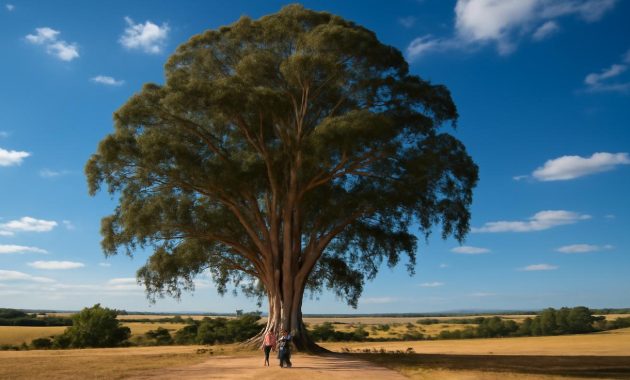
The first hint that you’re nearing it is not the sight of the tree itself, but the way the light changes. Somewhere in the low, rolling countryside of rural Seville, a stretch of dusty farm track slips into shadow, and the air cools as if you’ve stepped into a stone church. You look up, expecting a hillside, a building, something huge to be blocking the Andalusian sun. Instead, you see it: a column of pale, flaking bark rising out of the ochre soil, soaring so high you almost have to lean backwards to take in the crown. This is one of Spain’s tallest trees—a colossal eucalyptus that reaches roughly 60 metres into the sky—and standing at its base feels a little like standing at the foot of a lighthouse, except the sea here is made of wheat, wildflowers, and distant olive groves.
A Giant Hiding in Plain Sight
Rural Seville is not the place most people imagine when they picture forest giants. They think of mist‑shrouded beech woods in the north, or ancient pines in the mountains of Navarra. But here, in a landscape usually painted in sun‑baked gold and soft browns, this eucalyptus rises like a vertical river of silver and grey, an almost improbable presence in a land of low horizons.
The tree stands in a patchwork of fields and scrubland, where abandoned farmhouses crumble slowly into the soil and small streams carve temporary veins across the countryside after winter rains. The first time you see it from afar, it doesn’t look real. The canopy seems to float, detached from any visible trunk, a hazy green cloud hung above the land. Only as you draw closer does the body reveal itself: a vast, tapering shaft of bark, streaked cream, ash, and cinnamon, shedding in curling ribbons that collect at its feet like forgotten parchment.
There’s a quiet drama in the way the tree occupies its space. It throws a shadow long enough to swallow a tractor. The fields around it look miniaturised, as if part of a carefully built model. A nearby stand of young poplars, tall by ordinary standards, suddenly appear stunted, like teenagers forced to stand next to a professional basketball player for a family photo. Everything about the area seems calibrated to normal human scale—except for this one living anomaly that points very calmly, very steadily, straight into the sky.
The Sound of a Tree That Has Seen a Century
On still days, the eucalyptus hums quietly with insect life—bees visiting the creamy, fringed blossoms in spring, beetles exploring the flaky puzzle of the bark. But when the wind turns up from the south, the entire crown begins to speak. The leaves, long and slender like green feathers, twist and flutter, turning the slightest breeze into a chorus of soft, papery rustling. Higher up, where the branches thin and the leaves catch more air, the sound deepens, shaken loose into something almost oceanic.
At ground level, that music filters down in layers. Stand with your back pressed against the trunk and you hear the bass notes of the wind rattling the upper branches, a long, low “whoomph” with each passing gust. Take a few steps away, and the sound lightens into a shiver, a fine sifting of whispers over your head. The tree seems to translate the sky, rendering invisible currents into something tactile and audible, a living barometer in leaf and wood.
The bark, too, tells its story. Touch it and you find smoothness lined with scars, like ceramic worn by decades of handling. Where the outer layers have peeled, delicate new surfaces gleam almost pearly in the slanting light. Moss claims the shaded creases, and near the base there are the tell‑tale tunnels of old insects, dark hieroglyphs etched along the trunk. Each mark is a reminder that, for all its fresh strips of bark and evergreen leaves, this tree has already lived through many human lifetimes in the surrounding farms—seen land sold, abandoned, ploughed again, and seen the seasons shift in ways the locals quietly debate over late‑night beers.
How a Southern Landscape Came to Host a Giant
Eucalyptus trees are not native to Spain. Their ancestral roots lie half a world away, in the landscapes of Australia and Tasmania, where some species rise even higher than this Sevillian giant. Their journey to the Iberian Peninsula began in the nineteenth century, when botanists and foresters became fascinated by their rapid growth and hardy nature. In an era hungry for timber, paper pulp, and fast solutions to erosion and marshland, eucalyptus seemed like a miracle tree: quick to establish, generously tall, and tolerant of poor, tired soils.
In Andalusia, they were planted along railways and roads, around farms for shelter, and in larger stands where landowners experimented with new forestry. Many of those plantations have come and gone, but some individuals—like the 60‑metre colossus in rural Seville—were left to grow beyond their original purpose. Over the decades, as tractors replaced horses and new crops took over old pastures, the eucalyptus simply kept climbing, adding ring after ring, turning each year of sun and rain into additional height and thickness.
It’s not just its raw measurements that make this tree such a curiosity; it’s the context. Andalusia is a region defined by heat and water scarcity. Summer here is not a gentle season—it is an elemental presence. The thermometer regularly climbs past 40°C, and the ground hardens to something closer to fired clay than soil. To survive, anything rooted in this land must be tenacious. The eucalyptus has reached for a different strategy: sink deep taproots down to hidden moisture, grow fast enough that the challenges of youth—grazing animals, accidental damage, human felling—become less threatening each year. Where an olive tree measures longevity in centuries of slow, patient thickening, this outsider chose a different path: outrun danger by racing skyward.
A Tree That Rearranges the Scale of Things
Standing beneath a tree of this stature distorts your sense of proportion. Cars passing on the nearby lane look like toys. The scattered farm buildings, with their tiled roofs and low walls, begin to resemble the ceramic villages that decoratively crowd Spanish hearths at Christmas. It is as if the tree quietly insists on a different measuring stick, one that begins at metres and ends somewhere close to your own neck craning point.
The numbers are straightforward enough: around 60 metres in height; a trunk circumference that would take several adults, hand in hand, to encircle; branches that begin far above the ground, forcing your gaze upward just to see where the first great arms emerge. But these figures do little justice to the lived experience of being near it. When you walk slowly around the base, the trunk appears to lean slightly no matter where you stand, a parallax trick created by its sheer bulk against the rolling backdrop. Look up too long and the world tilts, the sky beginning to spin as if the entire landscape were balanced on this single axis of wood.
Even the smell carries its own scale. Crush a fallen eucalyptus leaf between your fingers and a sharp, almost medicinal fragrance bursts out—cool, bright, with hints of menthol and citrus. Multiply that by hundreds of thousands of leaves, all warming in the Andalusian sun, and the air beneath the canopy becomes faintly scented, a high, clean note mingling with the dust and dry grass of the surrounding fields.
The Tree and Its Neighbours
In a part of Spain where most trees are deliberate, strategic plantings—rows of olives, bands of citrus, carefully spaced almond orchards—this eucalyptus has become something else: a landmark, a point of orientation, an unspoken reference in local conversation. Ask for directions and you might be told to drive “towards the big eucalipto and then take the track that follows its shadow.” In a landscape without many vertical cues, anything that draws the eye upward automatically becomes a compass.
The tree’s neighbours are mostly quiet, working things: wheat fields, patches of sunflowers, cracked concrete irrigation channels. A small irrigation pond nearby mirrors the tree’s reflection on still evenings, turning its skyward thrust into a line that seems to pierce the earth as well. Birds, ever pragmatic, have fully adopted the giant. Kestrels patrol from the mid‑level branches, using the height advantage to scan for field mice. Hoopoes glide in low, their soft crests folding and opening as they search the leaf‑litter. On warm nights, bats trace invisible loops around the outer branches, scooping up insects drawn to the faint moisture held in the dense crown.
Not everyone, however, greets the eucalyptus with uncomplicated affection. Farmers mutter about the thirsty habits of these Australian imports, how they draw water from the soil with greedy efficiency. Conservationists worry about what happens when such non‑native giants seed themselves into already stressed ecosystems, competing with local species that evolved for Mediterranean rhythms of drought and flood. Yet even the critics, standing under the long shadow of this particular tree, often fall quiet. It is difficult to argue purely in numbers and water tables when confronted with a living, breathing monument that has slipped quietly into the category of “old neighbour.”
Measuring a Colossus
For tree enthusiasts and dendrologists, Spain’s tallest and widest trees are objects of serious, almost scientific admiration. They are measured, catalogued, compared, and debated. Getting the height of a 60‑metre eucalyptus is neither simple guesswork nor a matter of leaning a tape measure against the trunk. It involves lasers, geometry, and patient observation—modern echoes of the techniques once used by foresters armed only with a compass and a length of string.
Field researchers typically combine laser rangefinders with inclinometers, taking multiple readings from different distances to triangulate a height that accounts for leaning trunks and uneven ground. The trunk’s diameter at breast height (known as DBH) is carefully recorded. Photos are taken from every angle. Sometimes drones are sent up to capture the crown from above, revealing the full architecture of branches that is impossible to see from the earth. Every few years, if funding and enthusiasm align, the giant might be re‑measured, its growth noted—millimetres, perhaps a few centimetres more toward the sky.
That growing list of measurements becomes part of a broader quiet competition: which tree is truly the tallest in Spain? A eucalyptus in Galicia, a monumental fir in Catalonia, a venerable pine in the interior mountains—each has its supporters. Yet the Seville eucalyptus holds its own among these giants, a southern outlier that refuses to conform to expectations about where big trees “should” live.
| Tree | Approx. Height | Region | Notable Feature |
|---|---|---|---|
| Eucalyptus in rural Seville | ~60 m | Andalusia (South Spain) | One of Spain’s tallest individual trees |
| Tall eucalyptus in Galicia | 60–65 m (varies by source) | Northwest Spain | Grows in a wetter Atlantic climate |
| Mountain conifers | 40–50 m | Northern & central ranges | Slower‑growing, native species |
Climate Change in the Shadow of a Giant
Few places in Europe feel the changing climate as immediately as southern Spain. Heatwaves arrive heavier, sometimes earlier. Rainfall patterns stagger drunkenly from drought to downpour. The Seville eucalyptus, rooted where it is, becomes an accidental witness, a vertical timeline written in rings of wood and in the stress carved into its leaves.
In wetter years, the tree responds with a flush of new growth. Branch tips gleam with fresh, tender leaves, almost bluish in their youth. Following winters of scant rain, the foliage tightens, the overall silhouette of the crown thinning slightly, like a person unconsciously drawing in their shoulders. Storms have grown more violent, too. Locals remember a particular night when a fierce wind ripped great limbs from lesser trees in the area, leaving the roads littered with broken branches. The eucalyptus survived, but not untouched: a massive limb several storeys up tore free and crashed down, carving a crater in the soil and sending splinters of wood flying dozens of metres away.
Events like that leave behind more than just physical scars. They become part of the community’s story about the tree. Children are told how it “fought the storm,” how “even the big eucalipto felt that wind.” In this way, the giant is slowly being woven into the region’s emotional climate history. It anchors memory in a landscape too often described in abstract numbers—millimetres of rainfall, degrees above average. Beneath its branches, the conversation becomes more tangible: people point, recall, compare, and quietly imagine what further extremes might come within its remaining lifetime.
Visiting Without Leaving a Mark
If you’re lucky enough to find yourself beneath this towering eucalyptus—or one of its equally impressive cousins elsewhere in Spain—there is a quiet responsibility that comes with the awe. Giant trees are resilient, but they’re not invincible. Soil compaction from too many feet, carved initials, broken branches collected as trophies: these small human gestures add up over time, particularly in a landscape already under stress.
The art of visiting such a place lies in learning to be present without insisting on proof of your presence. You can stand beneath the canopy, listen to the wind in the leaves, breathe in that cool, camphor‑tinged air, and leave with nothing more tangible than the memory of your neck craning, of your perspective shifting. Photographs are part of this exchange, of course—a way to capture scale and share wonder. Yet the tree asks almost nothing in return, except a little space around its roots and the courtesy of treating it as more than a backdrop.
In a world trained to celebrate peaks—tallest, oldest, biggest—there’s something quietly radical about appreciating a single giant simply for existing, without needing to climb it, brand it, or turn it into an attraction. This eucalyptus, after all, has grown so vast largely because it was left alone: an early planting that slipped through the net of practical use and became, over decades, a testament to what happens when time and conditions align generously for a living thing.
Why This One Tree Matters
At first glance, it might seem curious to single out one eucalyptus in rural Seville for so much attention. Spain is full of remarkable trees: twisted, thousand‑year‑old olives that remember Moorish Andalusia; cork oaks that have given their bark again and again to stoppered bottles around the world; junipers gnarled by high‑altitude winds into impossible shapes. Yet this 60‑metre colossus matters for more than its height alone.
It is a reminder that landscapes are not as fixed as they appear. Here is an Australian native, planted by human hands—with economic intentions, perhaps—and yet, with time, it has become something else entirely. It is a landmark, a micro‑habitat, a participant in local memory. It is both an example of our long habit of moving species across continents and a living question mark about how those experiments play out over a century or more.
It also offers something quieter: perspective. In the rush of modern life, where so much of our world is flat screens and short attention spans, standing under a tree that big demands you look up and stay looking up for more than a few seconds. Your body registers the distance from your feet to the furthest leaf tip. Your eyes trace patterns in bark and branch that have taken decades to form. For a brief time, you are fully present in three dimensions, aware of height in a way that city streets and office ceilings rarely require.
As the sun drops behind the low hills, the eucalyptus shifts from shimmering guardian to dark silhouette. Bats emerge. The fields quiet. The giant stands, as it always has, without comment, catching the last light on the uppermost leaves long after the ground below has slipped into dusk. Perhaps that is its greatest gift: not simply its improbable size, but its unwavering, vertical reminder that there are lives unfolding on timescales and at scales far beyond our own. And in rural Seville, on a patch of unassuming land, one of those lives happens to be a towering eucalyptus pointing, day after day, patiently toward the sky.
FAQ
Why are there eucalyptus trees in Spain?
Eucalyptus trees were introduced to Spain in the nineteenth century, mainly for timber, paper pulp, and erosion control. Their fast growth and adaptability made them attractive to foresters, and they were planted widely in some regions, especially along the Atlantic coast and in parts of the south.
How tall can eucalyptus trees grow in Spain?
Some eucalyptus specimens in Spain reach around 60 metres or slightly more, placing them among the tallest trees in the country. Growth depends on local climate, soil, and water availability, so not all plantings reach such impressive heights.
Is the 60‑metre eucalyptus in Seville a protected tree?
Protection status can vary by municipality and region. Many exceptionally large or old trees in Spain are catalogued and given some form of protection, but not all are formally listed. Local regulations and conservation groups often play a key role in recognising and safeguarding such specimens.
Are eucalyptus trees bad for the local environment?
Eucalyptus trees are non‑native in Spain and can pose ecological challenges. They grow quickly, consume a lot of water, and can outcompete native species, especially in sensitive or over‑planted areas. However, individual trees that have become integrated into the landscape, like the Sevillian giant, also offer habitat and shade, so their impact is complex and context‑dependent.
Can visitors see this particular eucalyptus in rural Seville?
Access depends on its exact location and land ownership. Some notable trees stand on private land or near working farms, where respectful distance is important. When visiting any large tree in rural Spain, it is best to stay on public paths, respect property boundaries, and avoid damaging roots or bark.