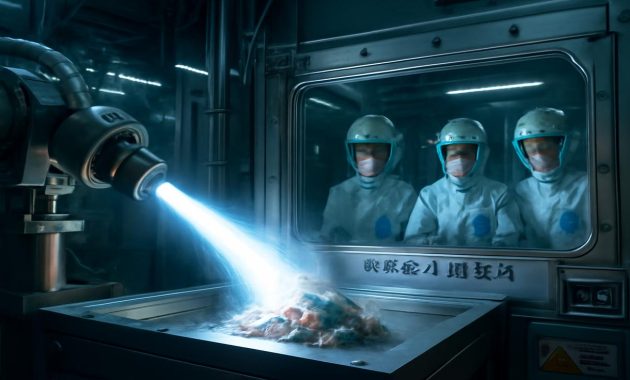
The plastic begins to melt long before you see it. You feel it first—a subtle shift in the air, that strange mix of heat and ozone that prickles your skin. Behind a thick pane of reinforced glass in a lab outside Daejeon, South Korea, a brilliant, blinding column of light roars down into a steel chamber. It looks less like a recycling machine and more like a fragment of a star, trapped and weaponised. Around it, engineers in pale blue lab coats watch their screens. On one of them, a line dips, then steadies. Power input stable. Temperatures over 5,000 degrees Celsius. Inside the chamber, broken, dirty plastic—labels, food residue, impossible-to-recycle scraps—ceases to be itself.
A Torch That Eats the Undesirable
The problem with plastic has never just been that there’s too much of it. It’s that so much of it is the wrong kind. Take-out containers smeared with sauce, flexible films, multi-layer snack packets made from different materials pressed together. These are the misfits of the recycling world—the ones that don’t fit the neat categories of PET bottles or clean HDPE containers. They’re burned, buried, or exported. Or worse, they escape entirely, drifting down rivers and across oceans, grinding over decades into microplastics we can’t see but can’t avoid.
In most countries, recycling plants function like elaborate sorting systems. Conveyor belts, scanners, spinning discs, streams of air. They’re good at separating what we already know how to handle. They’re terrible at transforming the rest. Until now, “mixed plastic waste” has been shorthand for “problem we’ll quietly shove out of sight.”
Inside that South Korean lab, the team behind a new plasma torch hopes to change that shorthand. They call it a world first: a plasma-based system specifically designed to break down stubborn, contaminated, mixed plastic into simple building blocks that industry can reuse. Not just as lower-grade plastic, but as high-value feedstocks for fuels and chemicals.
The Day They Turned Garbage into Gas
Imagine a random bag of trash from a city street: a coffee cup lid, some cling wrap, a candy wrapper, a cracked toy. Traditional recyclers might salvage the PET bottle in the corner, maybe some rigid containers if they’re spotless. The rest? Incinerator or landfill. But in a pilot test of the new plasma torch, South Korean researchers did something different. They shredded that problematic mix, fed it into their chamber, and flipped on the power.
What happened next evokes more science fiction than sanitation. The plasma—an electrically charged gas hotter than a volcano—didn’t just melt the plastic. It ripped it apart at the molecular level. Polymers, those long intertwined chains of carbon and hydrogen, snapped like over-tightened strings. In milliseconds, they devolved into syngas: a simple blend of carbon monoxide and hydrogen.
Syngas isn’t garbage. It’s raw potential. Refined in the right way, it becomes hydrogen fuel, synthetic natural gas, ammonia, methanol, or new plastics entirely. That battered snack wrapper and grimy cling film, in other words, can be reborn as something much cleaner, more tightly controlled, and with real economic value.
From Fire to Lightning
Unlike the controlled flames of an incinerator, plasma is more like lightning stretched into a continuous column. In this torch, electricity arcs through a gas to create a searing, luminous jet. At temperatures exceeding 5,000 degrees Celsius—far hotter than traditional combustion—plastic doesn’t so much burn as disintegrate.
There are no half-burned residues hiding toxins. At those temperatures, most complex molecules cannot survive. They’re stripped to simpler gases that can be captured, cleaned, and transformed. Any remaining solid is a vitrified slag—an inert, glassy material usable for construction purposes. Landfill is no longer the default destiny.
Why This Feels Different from Old Promises
If this all sounds too convenient, you’re not alone in your skepticism. The history of “miracle” recycling technologies is long and bumpy. Pyrolysis plants—using heat and low-oxygen environments to turn plastic into oil—have come and gone, many struggling with economics, maintenance, or unresolved emissions. Gasification facilities have shut down after costly miscalculations. The dream of turning trash into treasure is littered with the ruins of failed startups and over-hyped concepts.
So what makes a South Korean plasma torch feel different?
First, it’s designed with a narrower focus: not to replace all recycling, but to tackle the worst of what we can’t handle. PET bottles should still be collected, washed, and re-shaped into more PET bottles. High-quality, single-stream plastics have their own circular loops. The plasma torch is for the ugly stuff—the leftovers that no one wants. Mixed, dirty, complex plastics that clog machinery and contaminate batches. These are the plastics that currently drive incineration and landfill flows.
Second, the system’s energy balance is more nuanced than it first appears. Yes, this torch is power-hungry. Anything that holds plasma steady at star-like temperatures has a significant appetite. But the syngas it produces is energy-rich. When burned cleanly or processed into fuel or hydrogen, it can offset fossil energy that would otherwise be extracted. The researchers’ modeling suggests that, under the right conditions, overall greenhouse gas emissions could be significantly lower than landfilling or incineration, especially if the torch is powered by renewable electricity.
Third, South Korea isn’t treating this as a silver bullet. It’s being framed as one piece of a mosaic: paired with aggressive collection systems, strict product design rules, and expanding reuse models. The plasma torch doesn’t get anyone off the hook for making smarter packaging. It simply claims a new role: last resort, but not last in value.
How the Plasma Torch Process Works
The steps are surprisingly simple on paper, even if the details are full of engineering complexity:
- Collection and Sorting: Mixed plastic waste—often including heavily contaminated or multi-layer products—is gathered from municipal streams or industrial facilities.
- Pre-processing: The waste is shredded, sometimes dried, and screened for large metal or non-plastic contaminants.
- Plasma Treatment: The shredded feedstock is fed into the plasma reactor. Inside, the plasma torch subject it to extreme heat in a controlled environment with limited oxygen.
- Syngas Capture: As the plastic decomposes, gases are collected, cooled, and cleaned of particulates and residual contaminants.
- Product Conversion: The resulting syngas is fed to downstream systems to produce fuels, hydrogen, or chemical feedstocks.
From the outside, the facility might look like a slightly more futuristic version of an industrial plant: pipes, tanks, vents, control rooms. Inside, the main difference is invisible—the physics happening at the heart of the torch, where plastic ceases to be “waste” and becomes a set of reconfigurable atoms.
Numbers Behind the Bright Light
In early tests, the South Korean team has reported conversion efficiencies that make industrial partners lean forward in their chairs. A large fraction of the plastic’s carbon and hydrogen content can be captured as usable syngas, with far lower dioxin and particulate emissions than conventional incinerators. The system is designed to meet strict air-quality standards, using advanced scrubbing and filtration.
To understand the potential impact, it helps to put some key dimensions side by side. Consider the three major pathways for dealing with mixed plastic waste today:
| Aspect | Landfilling | Incineration | Plasma Torch Recycling |
|---|---|---|---|
| Primary Outcome | Long-term burial, slow degradation | Heat and electricity, ash and emissions | Syngas for fuels, hydrogen, chemicals |
| Value Recovery | Almost none | Moderate, via energy generation | High, via chemical feedstocks |
| Climate Impact | Long-term methane, ongoing leaks | CO₂ and pollutant emissions | Depends on power source; potential net reductions vs. fossil fuels |
| Waste Volume After Treatment | Near 100% remains stored | Ash and slag remain | Small amount of inert, vitrified slag |
| Compatibility with Mixed, Dirty Plastics | Accepts all, but locks problems in place | Accepts all, but with higher pollution risk | Designed specifically for difficult mixed and contaminated plastics |
These comparisons are imperfect—systems differ in scale, regulation, and local context. But they hint at why governments and corporations are paying attention. If a technology can squeeze high-value outputs from the dirtiest inputs, it opens a door that’s been stuck for decades.
On a Small Peninsula, Thinking on a Planetary Scale
South Korea is not a large country, but it is densely populated, highly industrial, and acutely aware of land constraints. There is only so much room for landfills. There is only so much tolerance for incinerators in communities already breathing the exhaust of cars and factories. The country has been experimenting with strict waste sorting rules and pay-as-you-throw systems for years. Residents know the feel of different-colored bags and the sound of bottles clinking in designated bins.
The plasma torch project slots into that culture of restless innovation. It’s being developed not in isolation but in concert with academic labs, state agencies, and corporate partners. The goal is clear: a scalable, exportable technology that could be dropped into waste systems far from Seoul.
If it works on the scale its creators imagine, coastal nations battling plastic-choked shorelines could reimagine ports as hubs of reclamation, not just offloading. Industrial zones ringed by factories might pipe plasma-produced syngas directly into chemical plants. Instead of shipping bales of mixed waste halfway across the world, countries could transform it at home into clean inputs.
The Smell of Burning Doubt
Still, inside that glass-walled control room, the work is thick with caution. Every new test run brings data that could confirm or challenge their optimism. Will maintenance costs climb faster than expected? Will electrode wear or unexpected byproducts appear at scale? Will communities embrace a technology whose main visible feature is an almost frightening artificial lightning bolt?
Public perception may be one of the hardest parts. For many people, high-heat treatment of waste, no matter how controlled, feels like incineration in new clothes. Engineers talk in charts and emissions curves; neighbors talk about smoke stacks and trust. To earn that trust, the plasma torch will have to prove its difference not just in theory, but in air quality around real plants, under real weather, over real years.
Another doubt smolders quietly: what if a powerful “end-of-pipe” solution undermines upstream change? If industries know that a torch can disassemble almost anything, will they abandon efforts to design simpler, more recyclable packaging? Will convenience once again outrun caution?
The South Korean teams are aware of this risk. So are environmental groups watching from the sidelines. The emerging consensus is that any deployment of plasma recycling must be tightly integrated with plastic reduction goals. Caps on production, bans on certain polymers, and incentives for reuse need to grow in parallel. The torch can help clean the mess we already have; it must not become an excuse to keep making more.
Standing Outside the Lab, Thinking of Rivers
Step out of the facility after a long day of tests and the scene flips. The roar of the torch fades, replaced by the ordinary noise of a city breathing: buses sighing at stops, delivery scooters whining past, people carrying take-out in plastic bags. Somewhere a river is moving quietly around a bend, bearing with it bits of those same bags, straws, wrappings—pieces of a global habit that has outlived its innocence.
It’s easy to picture this new torch as a clean line between “before” and “after,” a brilliant divide where we pass from wastefulness to wisdom. But technology rarely works that way. Instead, it offers us choices, sharper and more uncomfortable than we’d like.
A plasma torch that can crack dirty plastic into syngas doesn’t automatically mean less trash in oceans. It means we have one more tool, and now we must decide how seriously we want to use it. Will we demand that it runs on renewable energy? Will we pair it with strict targets to cut unnecessary plastic at its source? Will we share it with countries who currently receive the world’s exported waste, or keep it as a competitive advantage?
Somewhere in South Korea, a team of engineers shuts down the torch for the evening. The blazing column gutters and disappears, leaving only the dim hum of cooling equipment. On their screens, data scrolls and settles into curves and columns that will, over the coming months, turn into scientific papers, policy pitches, and investment decks.
Out in the world, the plastic tide continues. But now, in one lab at least, there is proof that even our dirtiest, most unloved plastic can be unmade and reimagined. Not as smoke, nor as buried regret, but as something simpler, cleaner, and ready to be used again.
It is not the end of the plastic story. But it could be the moment we stop pretending the last chapters are already written.
Frequently Asked Questions
What exactly is a plasma torch?
A plasma torch is a device that uses electrical energy to turn gas into plasma—a superheated, electrically charged state of matter. In waste treatment, this plasma reaches temperatures far higher than normal flames, allowing it to break down complex materials like plastic into simpler gases.
How is this different from burning plastic?
Incineration burns plastic in the presence of oxygen, creating combustion byproducts such as CO₂, dioxins, and particulates. A plasma torch operates in a controlled environment with limited oxygen, using extreme heat to decompose plastics into syngas, which can then be cleaned and reused as fuel or chemical feedstock.
Can plasma torch technology recycle all kinds of plastic?
It is particularly effective for mixed, dirty, and hard-to-recycle plastics that conventional systems cannot handle, including multi-layer films and contaminated packaging. However, it is meant to complement, not replace, traditional mechanical recycling for clean, single-stream plastics like PET bottles.
Is plasma recycling environmentally friendly?
Its environmental footprint depends on how it is implemented. When powered by low-carbon electricity and equipped with strong emission controls, it can significantly reduce greenhouse gas emissions and pollution compared with landfilling or incineration. It also recovers more value from waste by producing reusable syngas.
Will this technology reduce plastic pollution in oceans and landfills?
It has the potential to reduce the amount of plastic that ends up in landfills or is exported for disposal, which can indirectly reduce leakage into the environment. However, it must be part of a broader strategy that includes reducing plastic production, improving collection systems, and encouraging reuse and redesign.
When will we see plasma torch facilities in regular use?
Pilot and demonstration plants are the first step. If these prove successful technically and economically, larger commercial facilities could follow within a few years. Adoption speed will vary by country, depending on regulations, energy costs, and waste management priorities.
Does this mean we no longer need to worry about reducing plastic use?
No. Even the most advanced recycling technologies cannot keep up with unlimited plastic production and consumption. Reducing unnecessary plastic, reusing products, and redesigning packaging remain essential. Plasma torch recycling is best understood as a powerful backstop for the plastics we cannot avoid or mechanically recycle.