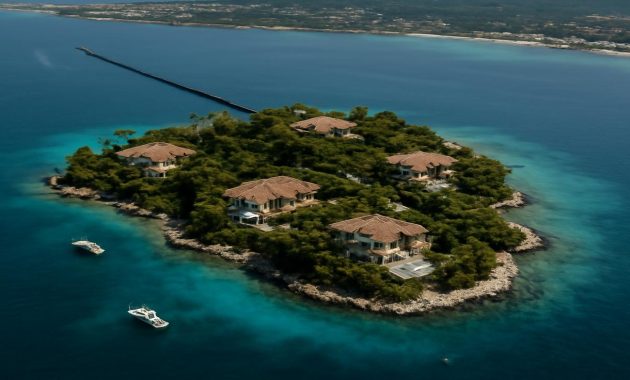
The water is so clear it looks fake—like someone turned the saturation up too high. From the drone shots in the real-estate listings, the island is a perfect emerald set in a ring of glassy turquoise, with docks tracing the shoreline like delicate silver stitches. The brochures call it “pristine,” “remote,” “exclusive.” They do not mention the pipes.
The Island of Endless Money—and Limited Plumbing
Imagine, for a moment, that you’re standing on the rocky shoreline of an island that belongs, effectively, to billionaires. The houses are not houses but glass-and-steel miracles, hovering above the waterline like ships run aground on purpose. Helipads gleam in the sun. Infinity pools cling to the cliff edge. A private security boat idles, engine low, circling like a patient shark.
Now try to imagine where the toilet flush goes.
This is the unglamorous seam where fantasy splits: every paradise has a pipe. For most of us, this is dealt with by a maze of public infrastructure—septic tanks, treatment plants, inspections, maintenance, fees. For the ultra-rich on certain islands, that infrastructure is either absent, inconvenient, or—most offensive of all—expensive.
So the story goes like this: Jeff Bezos and other billionaires move to an island community, dazzled by nature and privacy. Their estates, perched above fragile coastlines, skip the cumbersome business of responsible waste management. No septic tanks for these fortresses of glass. Instead, they look to an old temptation: send their waste away, make it someone else’s problem, avoid the bill.
In a way, there’s nothing new about rich people finding ways to export the mess. What is new is the scale: the engineering, the legal maneuvering, the quiet pressure to reshape laws and pipes and coastlines so their lives remain frictionless. The island’s rocky spine and shallow coves are just the backdrop. The real story flows under the surface, in the invisible direction of waste and responsibility.
The Smell of an Unasked Question
On certain mornings, the island smells wrong.
Not everywhere. Not all at once. The wind has to be just so––coming in low and slow from the billionaire side of the island toward the fishing side, where the houses are small and the docks are homemade, patched together with salvaged beams. But when conditions line up, a sour, synthetic tang creeps in with the tide.
Locals talk about it the way people talk about a shared secret they don’t want to own. “Only bad after rain,” someone says. “Just a low tide thing,” another insists. But in the pauses, the eyes drift toward the big houses. Toward the bare rock ledges where, if you looked closely, you might see plastic-capped pipes jutting from beneath meticulously terraced landscaping.
Officially, of course, nothing is wrong. Officially, there are permits and plans and “environmental impact assessments” that lean on terms like “within allowable discharge limits.” Officially, everybody is following the rules—or at least the version of the rules that have been nudged, over time, by consultants and lawyers and “stakeholder conversations” in conference rooms far from the smell of low tide.
But unofficially, people can read a shoreline. Fishers notice the way seaweed changes color in certain coves. Kayakers notice the scum that gathers in a film where the waves fold back on themselves. Parents notice the rashes on their kids’ legs after they swim near certain docks.
Underneath the estate gardens, beyond the last manicured lawn, the same quiet question hangs in the air: where does it all go?
The Magic Trick of Invisible Pipes
Waste is the one thing money never stops producing. Toilets, showers, dishwashers, laundry rooms, commercial-sized kitchens feeding staff and guests. For a billionaire compound, daily water use can resemble that of a small hotel. On an island with thin soil and old infrastructure, this isn’t a small technical detail; it’s the central plot.
If it were any of us building a cottage on an island, the list of options would be short and blunt: install a septic tank that meets code, or don’t get a permit to build. Septic tanks are like gravity: unglamorous, unavoidable, and non-negotiable. You pay for the tank, you pay for pumping, you live with the knowledge that what you flush is your problem, literally buried in your own backyard.
But for the ultra-rich, the toolkit is different. They can hire consultants to explain how local regulations were written long before estates of this scale were imagined. They can propose “innovative solutions,” which often boil down to this: we’ll hook into your system instead.
Not pay to upgrade it. Not pay their proportional share. Just hook in, extend, connect—like a vine wrapping around a sturdier tree. The neighbor in this case isn’t another mansion. It’s the town, the village, the working harbor on the other side of the island whose wastewater system was designed for modest homes and seasonal tourists, not for palaces with 15 bathrooms and year-round heated pools.
The proposal is clear in its subtext: we’ll send our waste to you. You manage it. You absorb the overflow, the cost, the risk. We keep the view—clean and unbroken by the sight of tanks, trucks, or treatment equipment.
The Quiet Numbers Behind the Flush
When people argue about things like this during town meetings, the discussion often sounds dry—gallons per day, treatment capacity, line pressure, runoff, nutrient loads. But under that dry language is a very physical reality. Wastewater isn’t an idea; it’s a volume, a weight, a chemical stew.
Imagine a small coastal treatment plant built decades ago to serve, say, 800 residents. Add to that system a few multi-wing estates each using as much water as 20 or 30 homes. Then add staff housing, guest suites, spa facilities, private gyms. The plant doesn’t see “wealth.” It only sees flow.
Every flush is a decision about who pays and who absorbs the risk.
Consider a simplified snapshot of what this imbalance looks like when it’s boiled down to raw, unromantic numbers:
| User Type | Typical Daily Water Use (per property) | Share of Total Wastewater on Island | Share of Treatment Costs Paid |
|---|---|---|---|
| Local family home | 300–400 gallons | ~35% | ~60% |
| Seasonal cottage | 150–250 gallons (in season) | ~15% | ~25% |
| Billionaire estate | 5,000–10,000+ gallons | ~50% | ~15% |
The specifics vary from place to place, but the pattern is recognizable: those generating the most strain on fragile infrastructure often pay the least relative to their impact. And when they push to avoid on-site septic systems altogether—preferring instead to “tie in” to existing public or communal systems—they’re not avoiding costs. They’re relocating them.
Living Downstream from Power
On an island, “downstream” is a slippery word; water curls, doubles back, swirls in eddies. But socially, it’s clear enough who lives downstream from whom.
On the high side of the island, privacy hedges sway above tall security fences. On the low side, crab traps lean against weathered sheds. Children learn to swim in the same coves where their grandparents launched dories. The ferry lands here, not there. The grocery store, the post office, the single gas pump—they’re all on the working shore.
When billionaires choose not to build their own septic systems, the downstream isn’t just metaphorical. The island’s currents, the shape of its coves, the direction of its prevailing winds all conspire to carry what leaves one shore toward another.
It’s easy to frame this as a simple story of villains and victims—selfish mansions versus humble fishing shacks—but the reality is trickier. The jobs created by these estates are real. So are the property taxes, the construction contracts, the service work. Some locals defend the billionaires fiercely: “They put food on our tables.” Others, more quietly, ask why putting food on the table seems to require swallowing what comes down the pipe.
Power on a small island doesn’t always show up as obvious coercion. Sometimes it’s just an unspoken assumption: that the landscape, the regulations, even the notion of “reasonable” are infinitely flexible in the direction of wealth. As if rocks can be reshaped, as if water will always find a way to carry someone else’s burden out of sight.
The Language of Avoidance
Documents never say, “We want to send our waste to our neighbors without paying.” They are much more careful than that. They talk about “regional solutions” and “shared infrastructure.” They suggest that individual septic systems are “fragmented” and that centralized treatment is “more efficient.”
Sometimes that’s true. Centralized systems can be better—when everyone pays fairly, when the system is designed for the flow it will receive, when upgrades are funded by those who require them. But on an island where the largest water users contribute the least per gallon, “shared infrastructure” is too often code for “some of us share the view, others share the bill.”
Environmental consultants produce binders full of charts and models. They show how effluent will be diluted, how discharge points will be carefully located. They reference compliance with distant standards. But rarely do those models account for the lived experience of a child with a rash, a fisher who notices changes in eelgrass, or a community that watches its taxes climb to service debts incurred to handle someone else’s excess.
In this way, the story of pipes and septic tanks on this one island becomes a mirror of a much larger pattern. Carbon emissions, plastic waste, industrial toxins—the richest, most powerful actors on the planet have long searched for ways to enjoy the benefits while externalizing the costs. The medium changes—air, water, soil—but the logic remains stubbornly the same: send the waste away and call it progress.
What Happens When the Tank is Metaphorical
Part of why this particular story feels so raw is that septic tanks, for all their prosaic ugliness, are radical in one quiet way: they make you own your own mess. The tank is right there under your property, its very existence a reminder that every comfort has a consequence.
To decline that responsibility when you have the money to handle it is more than a simple cost-saving measure. It’s a declaration about the kind of relationship you believe you have with the place you inhabit. It says: my presence here is an exception, an upgrade, something that must be accommodated by others. The island should rearrange itself to fit me, not the other way around.
This is the opposite of how islanders, historically, have survived. On small pieces of land ringed by temperamental water, humility isn’t morality—it’s pragmatism. You don’t cut more forest than the soil can hold. You don’t fish more than the spawning can replace. And you don’t overload the thin, living skin of earth and sea with more waste than it can absorb.
The idea that someone might come here and build palaces without tanks and then pipe their invisible overflow into the commons strikes at an almost cellular level of island culture. It’s not just an environmental concern. It’s an insult to the unwritten rule: if you live here, you live with your own consequences.
Rethinking What “Luxury” Means
There is a version of this story that ends differently. In that version, obscene wealth is matched by equally extravagant responsibility. The mansions still rise, but beneath them lie advanced treatment systems that outperform anything the town can afford—small, quiet plants that clean water to near-drinkable standards before releasing it back into the ground. Monitoring is transparent. Data is public. The engineering becomes part of the bragging rights: look how lightly we stand here.
Luxury, in that alternative future, isn’t about how far you can send your waste. It’s about how completely you can contain it. The badge of status is no longer the infinity pool but the zero-discharge estate—the house that, by design, does not expect its neighbors to bear any fraction of its burden.
This isn’t fantasy. The technology exists. What’s missing is the will—and the expectation that you cannot call something “world-class” if it treats the surrounding world as a dumping ground.
Listening to the Island
For now, though, we are left with the smell on certain mornings. With the quiet confusion of tourists who came for pure water and post-card coves and find signs warning them off particular beaches after a heavy storm. With the fine print of town budgets strained by upgrades to treatment plants decades earlier than expected.
We are left, too, with a question that lingers long after the latest helicopter has lifted from its pad and vanished toward the mainland: what does it mean to belong to a place?
Belonging, in the oldest sense, has nothing to do with owning land. If anything, it’s the reverse: the land owns you. It sets your limits, your seasons, your possible futures. It tells you, with rain and tide and sickness and health, what it will and will not tolerate.
When billionaires arrive with more money than the local tax base and more leverage than any one island can match, they often carry a different definition: belonging as entitlement. I am here because I paid. Therefore, what I build is justified, and what I require must be accommodated.
But the island doesn’t read contracts. It reads load. Nutrients. Bacteria. Temperature. It reads the subtle shifts in eelgrass beds and shellfish beds and the timing of plankton blooms. It registers extra gallons in its hidden aquifers and fragile coves the way a body registers a low-grade fever—quietly, persistently, until one day the symptoms can no longer be brushed off as “just a bad smell after rain.”
If there’s any hope of rewriting this story, it starts with listening to that non-human feedback—and with rejecting the tidy illusion that some people, by virtue of net worth, are allowed to live as though their waste disappears into thin air.
FAQ
Do billionaires on islands really avoid installing septic tanks?
In many high-end coastal developments, large estates seek alternatives to conventional on-site septic systems. They may try to connect to existing municipal or communal wastewater systems instead of building and maintaining their own full treatment, especially when those systems were never designed for such large users. The issue is less about outright illegality and more about leverage, loopholes, and who ends up paying for the extra strain.
Is sending wastewater to a shared treatment plant always a bad thing?
Not necessarily. Centralized wastewater treatment can be efficient and environmentally sound when the system is designed for it and costs are shared fairly. Problems arise when major new users—like huge estates—connect to undersized systems, push them beyond capacity, or contribute far less than their proportional impact on infrastructure and the environment.
What kind of environmental harm can this cause to an island?
Overloaded or poorly managed wastewater systems can lead to nutrient pollution, algal blooms, declining fish and shellfish populations, contamination of swimming areas, and long-term damage to coastal ecosystems like eelgrass beds and coral or rocky reefs. On small islands with thin soils and limited freshwater, the impacts can be especially severe and hard to reverse.
Can modern technology solve this problem on private estates?
Yes, to a large extent. Advanced on-site treatment systems, clustered “mini-plants,” composting solutions, and water recycling can greatly reduce or nearly eliminate harmful discharges. The technology is available; the main barriers are cost, regulation, and willingness. For billionaires, cost is rarely the real obstacle—it’s priorities and expectations.
What can local communities do when facing this kind of pressure?
Communities can tighten regulations, demand transparent environmental assessments, require that large developments build and maintain their own high-standard treatment systems, and link building permits to clear capacity limits. Public participation in hearings, independent scientific review, and insistence on fair cost-sharing are critical. At the heart of it, residents can refuse to accept the idea that their health, taxes, and waters must absorb the hidden price of someone else’s luxury.