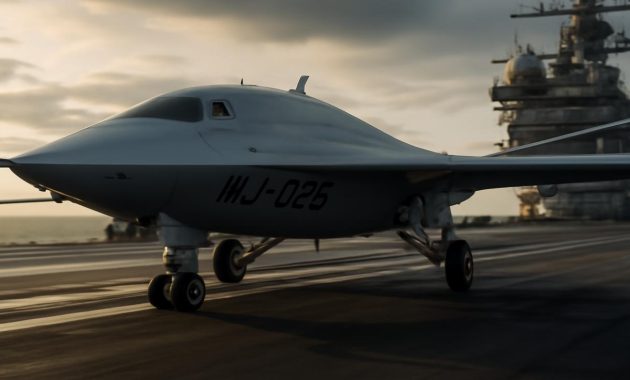
The first time the X-47B rolled across the deck of an aircraft carrier, the ocean was calm but the air above it was anything but. Steam hissed from the catapult. Jet blast shimmered in the heat. Sailors in color-coded jerseys moved in orchestrated chaos, their hand signals slicing through the roar. And right there, surrounded by a ballet of humans and machines, a strange, tailless aircraft did something utterly unremarkable—yet quietly revolutionary. It taxied.
The Quiet Revolution Hidden in Plain Sight
Taxiing is the part no one talks about in airshows or recruitment videos. It isn’t dramatic like a catapult launch or cinematic like a carrier landing in heavy seas. But walk the deck of a U.S. carrier and you realize: the ship is really a floating choreography of wheels, wings, and very small margins for error. If something goes wrong when an aircraft is simply moving from point A to point B on deck, the consequences can be immediate and catastrophic.
That’s why the United States betting on an unmanned tanker is bigger than any one test flight. This new drone—known as the MQ-25 Stingray—is not just learning how to fly from carriers. It’s mastering the most underrated, least glamorous, and most unforgiving step of all: how to behave like a good citizen in one of the most congested, dangerous workplaces on Earth.
When people hear “carrier drone,” they imagine sleek silhouettes dropping from the sky or laser-precise strikes at long range. The MQ-25 is something different. It’s a workhorse with wings. Its mission is not to bomb or spy, but to refuel other aircraft in midair—quietly extending the reach of the entire air wing. And the path to that future starts with something as humble as taxiing in tight spaces on a pitching deck without anyone on board.
The Day the Deck Got a New Kind of Aircraft
Picture this: It’s early morning aboard a Nimitz-class carrier. The sea is a restless blue-gray, flecked with white. The deck is slick with condensation. Long shadows stretch past parked fighters and folded wings. Among them, slightly alien in its profile, sits the MQ-25. No canopy. No cockpit. Just a sleek, slightly bulbous forward fuselage and a single engine tucked in a raised spine, like a shark’s dorsal fin.
In the past, the center of attention on deck has always been human pilots and their jets—the F/A-18s and F-35s straining at the catapult. But today, sailors’ eyes follow this unmanned aircraft as it begins to move under its own power. A deck controller, standing several yards away, is holding a device that looks like a ruggedized game controller—a handheld unit that connects the human brain to this pilotless machine.
With a tilt of the controller, the drone inches forward. The nosewheel tracks the worn yellow lines painted on the deck. Crew members stand clear, watching. It turns, stops precisely on command, then pivots into position as if it has been doing this for years. That motion—smooth, obedient, deeply unflashy—is the real milestone. Because every safe foot it travels proves something the Navy has never truly had before: an unmanned aircraft that can live comfortably in the extremely human, extremely dangerous environment of a carrier deck.
Taxiing on land is one thing: wide concrete, controllable conditions, ample margin for error. Taxiing on a crowded carrier deck, while the ship moves, the wind shifts, engines scream, and a dozen different people juggle dozens of different tasks—this is quite another. To fit in here, a drone can’t just be smart; it has to be trustworthy.
The Underrated Art of Taxiing
Talk to anyone who has spent time on a carrier and you’ll hear the same phrase: “This place has no room for mistakes.” The deck is about 4.5 acres—roughly the size of a small supermarket’s parking lot—trying to function as a fully operational airport. Jets are landing, launching, refueling, rearming, folding their wings, being shuffled from bow to stern and back again.
In that chaos, taxiing is not a trivial step. It’s the invisible hinge between everything else that matters. No aircraft can launch until it’s in the right place. None can land unless the deck is cleared. Every movement is a potential collision if someone misjudges a turn by a few feet or a few inches. For a human pilot, the rules and rhythms of this world are drilled into muscle memory. For an unmanned tanker like the MQ-25, they have to be translated into code, sensors, and carefully choreographed human oversight.
And that’s what makes the Stingray’s taxi tests so important. The drone isn’t just responding to simple commands like “go forward” or “turn left.” It’s navigating a living environment: avoiding people, stopping on a dime, following ground crews’ instructions, reacting to unexpected hold orders. It must start, stop, and turn with repeatable precision—while engines roar, wind gusts hit its broad wings, and the deck itself can rise or fall several feet in a single swell.
This is where the line between “unmanned” and “autonomous” gets blurry—and where the Navy is taking a notably cautious path. The MQ-25 is still under human supervision, but it’s learning to make the fine-grained, second-by-second adjustments a pilot would normally handle instinctively. Each taxi test builds confidence, not only in the drone’s hardware and software, but in the crews who must trust it to move safely among them.
Why a Tanker Could Change Everything
If the MQ-25 were just another experiment in flashy autonomous tech, its story might end at the prototype stage. But the Navy is serious about this one because it solves a very specific, very old problem: range.
Carrier-based fighters like the F/A-18 and F-35 are powerful but finite creatures. They can only carry so much fuel. Every mile they fly from the carrier to a mission area—and back—eats into the time they can spend on station. The solution, for decades, has been midair refueling. But here’s the catch: the tankers doing the refueling have often been the fighters themselves, carrying buddy refueling pods and burning precious flight hours just to gas up other jets.
The MQ-25 flips that equation. Instead of tying up front-line fighters as makeshift tankers, the Navy gets a dedicated refueling aircraft that doesn’t need a pilot and can be designed purely around fuel capacity, endurance, and efficiency. It’s not glamorous, but it’s a force multiplier. Every drop of fuel transferred in midair becomes extra minutes on station for a fighter, extra range toward a distant target, extra flexibility for a carrier’s commander.
Imagine a carrier operating farther from shore, outside the range of most coastal missile batteries. The fighters it launches are still able to strike deep inland or patrol distant skies because, somewhere along the way, an invisible gas station meets them at altitude—unmanned, persistent, and tireless. That invisible gas station is what the MQ-25 is trying to become.
| Feature | Traditional Carrier Fighter | MQ-25 Unmanned Tanker |
|---|---|---|
| Primary Role | Strike, air defense, limited refueling | Aerial refueling (tanker) |
| Crew | 1 pilot (plus support crew) | Unmanned, remotely directed |
| Deck Footprint | High (weapons, support gear) | Optimized for fuel and endurance |
| Operational Range Impact | Limited by own fuel and combat load | Extends range of entire air wing |
| Risk to Human Life | High in combat and complex operations | No onboard crew at risk |
From Taxi Tests to the Open Sky
The MQ-25 has already proven it can do more than just roll around the deck. It has taken off from shore bases, connected with manned aircraft in midair, and successfully transferred fuel. It has shown that it can find and plug into the refueling basket trailing from another aircraft—a delicate maneuver that even experienced pilots describe as a mix of art and nerves.
But carrier aviation has its own gravity. What works in the quiet predictability of a land base has to be revalidated on a floating airfield that never stays still. That’s why the Navy’s approach has been incremental, almost painstaking: first taxiing. Then taxiing more. Then integrating into deck operations with other aircraft. Then catapult launches, arrested recoveries, nighttime work, rougher seas, busier cycles.
Hidden within each of those steps is a series of questions that go beyond hardware. How do you schedule an unmanned tanker into a launch sequence traditionally built around human pilots? Who “owns” the MQ-25 during a hectic flight deck evolution—the air wing commander, the ship’s captain, the drone operators in the control center? If a last-minute weather shift forces a reshuffle of the deck, how quickly and safely can the drone reposition?
These questions are being answered not in glossy concept art or speculative reports, but in the smell of jet fuel, the shriek of tie-down chains, and the taut awareness of sailors who know that any new system has to earn its way into their trust. The Stingray is not just proving its technology; it’s carving a place for itself in the culture of carrier aviation.
Human Hands, Autonomous Wings
For all the talk of autonomy, nothing about the MQ-25’s journey is fully hands-off. Stand on the island—the carrier’s superstructure—and you’ll see the same teams you always have: air bosses, flight deck directors, communications specialists, maintenance crews. What’s changing is the relationship between their decisions and the aircraft that carry them out.
The handheld controller used to taxi the MQ-25 is a symbol of that shift. It’s tactile, immediate, and deeply human. A sailor uses it to guide the aircraft into place the way you might steer a remote-controlled car, but the stakes are vastly higher. Around them, other teams are watching the drone’s telemetry, monitoring its engine performance, making sure its sensors see what they should see.
Over time, as confidence builds, more of those fine motions can be delegated to the aircraft itself. Maybe the drone learns to follow a pre-planned path across the deck, slowing for known choke points and reacting to unexpected obstacles with built-in rules. Maybe deck crews begin to treat it with the same intuitive understanding they reserve for manned jets, timing its movements almost without thinking.
Yet human judgment will remain at the core. If a storm front rolls in faster than expected or a minor incident clogs the deck, someone will still weigh the risks and make the call: launch now, delay, divert, move the drone out of the cycle. Technology can extend perception and sharpen reactions, but the sea still has a way of humbling anything that forgets it’s ultimately a guest on the water.
The New Geometry of Range
Step back from the deck for a moment and imagine the broader geometry of a carrier’s reach. Until now, planners have drawn their mental circles—how far strike aircraft can go, how long they can loiter, how much payload they can carry—around the fixed limit of their internal fuel and a handful of tankers. The MQ-25 stretches those circles, subtly but significantly.
More tanking capacity means fighter squadrons can reconfigure their loadouts, shedding some fuel tanks in favor of more weapons or sensors. It means carriers can operate just a bit farther from crowded shorelines and still maintain a credible air presence. It means surveillance aircraft can stay aloft longer, scanning wider corridors of ocean or land. It doesn’t break the laws of physics; it simply bends the operational math in the Navy’s favor.
That new math becomes particularly important in a world where adversaries are building longer-range missiles, more capable sensors, and increasingly sophisticated defenses. A carrier no longer has to creep dangerously close to a hostile coastline just to get its jets within striking distance. The MQ-25, if it performs as hoped, gives commanders options—space, time, and flexibility.
And it all loops back to that deceptively humble scene: a pilotless aircraft rolling down a yellow line on a moving deck, stopping exactly where it should, turning without drama, joining the dance instead of disrupting it. Logistics is destiny in military operations. The ability to move fuel at the right time, to the right place, without risking a pilot, is not a side story. It’s the story.
From Prototype to Everyday Presence
There is a moment in any new technology’s life when it stops being a prototype and starts becoming furniture—part of the landscape, no longer surprising. Someday, the MQ-25 could reach that point. Sailors fresh from training might step onto their first carrier and simply accept that some of the aircraft they work around don’t have cockpits. Deck crews might juggle manned and unmanned jets with equal familiarity. Pilots might take for granted that somewhere out there, at a pre-briefed waypoint, an unmanned tanker is circling, ready to top them up.
To get there, the drone has to do many things right: fly safely, refuel reliably, integrate with ship systems, justify the space it takes up aboard. It has to survive the environmental brutality of life at sea—salt air, searing sun, sudden storms. It has to pass the quiet test that no computer can fully model: Do the people entrusted with this mission feel that this machine is a help, not a hazard?
Each successful taxi test nudges that perception forward. Each smooth launch and recovery weaves the MQ-25 more tightly into the fabric of carrier life. The true measure of its success may be how unremarkable it eventually becomes—how much it fades into the background hum of operations, even as it silently adds miles to every mission’s range.
The United States is betting on that future. Not on a sci-fi swarm or an all-seeing autonomous fleet, but on a single, specialized drone that does one thing very well: carry fuel to where it’s needed most. A drone that has already passed its most underrated test—belonging on the deck—and is now edging steadily toward the open sky, where its real work begins.
FAQ
What is the MQ-25 Stingray?
The MQ-25 Stingray is an unmanned aerial refueling aircraft being developed for the U.S. Navy. Its primary mission is to refuel carrier-based aircraft in flight, extending their range and time on station.
Why is taxiing such a big deal for an unmanned tanker?
Taxiing on an aircraft carrier involves moving safely through a very crowded, constantly changing environment. For an unmanned aircraft to operate there, it must be able to maneuver precisely without endangering people or other jets. Proving that capability is a critical step toward full integration into carrier operations.
How will the MQ-25 change carrier air wing operations?
By taking over the refueling role, the MQ-25 frees up manned fighters from tanker duty, allowing them to focus on combat and patrol missions. It also extends the effective range and endurance of the entire air wing, giving carrier commanders more flexibility in where and how they operate.
Is the MQ-25 fully autonomous?
The MQ-25 is designed to be unmanned, but not completely independent. It operates under human supervision, follows programmed procedures, and responds to commands, while also using onboard systems to handle routine tasks and fine control in real time.
When will the MQ-25 be fully operational?
The MQ-25 is progressing through testing stages, including taxi trials, flight tests, and carrier integration. Full operational deployment will depend on the success of these tests and the Navy’s certification process, with the goal of making it a regular part of carrier air wings in the coming years.