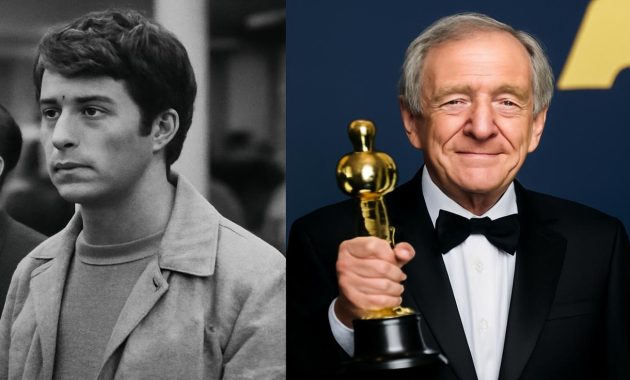
The first time he saw himself on screen, he almost missed it. A blur of a boy in a brown coat, half-hidden behind a crowd of adults and cigarette smoke, frozen for less than three seconds in a film that would go on to be nominated for an Oscar. He was nobody. Not even a name in the credits—“uncredited extra,” if history were being generous. Yet somewhere in that darkened cinema, 54 years before anyone would call him the world’s best actor, he felt something shift. Not a thunderbolt. Not a holy calling. Just a quiet, disorienting sense that his life had been nudged a few degrees off its expected course.
A Boy in the Back of the Frame
He remembers the smell more than the lines. The film set in 1972 was a storm of sensations: tangy reel-to-reel chemicals from the camera, coffee gone cold in paper cups, wool coats damp from morning rain, the lingering sweetness of someone’s cheap cologne. He was 17, hired for a day to fill up the background, to make a fictional street feel like it belonged to an actual city.
They sat him on a stoop, pressed a newspaper into his hands, told him not to stare at the camera. So he stared at the shoelaces of the lead actor instead, noticing the frayed ends, the way they slapped the pavement as the man walked past with practiced anguish. He watched the director lift a hand, the energy of fifty people hanging on that soft, almost lazy gesture. Action. Cut. Action again.
For everyone else, it was a workday. For him, it was an earthquake. Not the kind that topples buildings, but the kind that cracks a hairline fracture through the bedrock—silent, invisible, decisive. He’d grown up thinking of work as something solid and straightforward: fixing cars, stacking boxes, clocking out at 5:00 p.m. And here was this strange universe where people rearranged entire streets to tell a story and then went home like it was just another Tuesday.
Months later, when he bought a ticket to see the finished movie, he sat in the dark with his jacket zipped to his chin and waited. The film unspooled like a dream: snow, arguments, close-ups of trembling hands. Then, suddenly, there he was—back left of the frame, hair falling into his eyes, pretending to read. Three seconds. That was it. The moment passed and the story moved on without him.
But he could not move on without it.
The Decades Everyone Forgot
Stories about “overnight success” like to skip the lonely years, but his life was mostly lonely years. The film gathered awards and column inches, the lead actors became legends, and the boy on the stoop graduated high school, then quietly failed out of community college. His parents didn’t talk much about dreams. They talked about rent, about groceries, about oil changes and dental bills. Acting was a hobby for people who already owned houses.
So he did what people do: he worked. He spent five years in a warehouse where his breath puffed white in the winter and sweat soaked through his shirts in the summer. He learned how to navigate a forklift and how to roll his eyes just enough to survive a supervisor’s bad mood. Sometimes, heading home in the flicker of streetlights, he would pass a movie theater and feel the phantom fullness of that 1972 set press around him again—the cables, the laughter, the way time seemed to stretch between “action” and “cut.”
He tried, a few times, to get back to it. An acting class above a laundromat where the radiator clanked through every monologue. An audition for a commercial where he forgot his lines and wound up apologizing so many times he made the casting assistant visibly uncomfortable. A community theater group that let him play “Man at Bar” and “Townsperson #3,” as long as he was willing to help strike the set afterward.
He wasn’t bad. He just wasn’t undeniable. And in an industry built on scarcity, “not bad” is another way of saying “we’ll be in touch” when they won’t.
Years stacked on years. He learned to measure time not by birthdays but by jobs: the season he worked nights at a bakery, the era of the call center with its headphones and scripts, the short, bruising stint in door-to-door sales. His hair went from shaggy to practical to thinning. Friends from high school got married, had children, moved to suburbs where cul-de-sacs curled like question marks.
He collected small roles the way others collected parking tickets: a line in a student film here, a silent walk-on in a short there, each one familiar and thrilling and then gone. If you’d watched them all in order, you might have noticed something curious: he was getting better. Subtly, stubbornly, almost in spite of himself.
Learning to Listen to Silence
He couldn’t afford proper training at first, so he built his own classroom out of borrowed DVDs and dog-eared books. Late at night, the blue light of the television would spill across his living room as he watched the same scenes on loop, not for the plot but for the muscle beneath it.
Why did one line land and another evaporate? How could an actor say almost nothing and still carry the whole scene on the shift of a jaw, the pause before an answer? He studied faces the way some people study birds, alert to small, ephemeral movements: the cautious lift of an eyebrow, the quick sweep of the eyes when someone lies, the way a mouth can smile without joy.
On the bus, he watched people instead of scrolling the newspaper. A man tracing circles on his knee while pretending to nap. A teenager chewing their thumbnail until it bled. A woman pinching the bridge of her nose before answering a call she didn’t want to take. Everyone, he thought, was always acting a little—performing versions of themselves for bosses, partners, strangers.
He took notes. Not on paper—he couldn’t risk looking like a creep—but in his mind, filing away gestures and rhythms. When he finally returned to acting classes, this time in a drafty black-box theater downtown, he walked in with years of quiet observation stitched into his bones.
He was older than everyone else in the room by then. The other students were lit by the cold fire of their twenties, sharp and bright and convinced that the window of opportunity would slam shut any second. He recognized that fear. He’d lived in it for decades. But something about getting older had loosened its grip.
“You don’t seem nervous,” one of them said, watching him before a scene.
“I’ve already lost more than this part,” he replied, not unkindly.
Age, it turned out, was a strange kind of blessing. He no longer needed to be dazzling. He only needed to be true. When he forgot to impress, he started to express. His scenes grew quieter, more specific. He stopped reaching for big emotions and started allowing small, accurate ones. On stage, in that dim, drafty room, he practiced being honest in front of strangers.
The Role Nobody Was Supposed to Notice
The turning point came disguised as another forgettable job. A friend from the black-box classes recommended him to a young director shooting a low-budget film on the edge of town. They needed a man to play a father; older, worn down, authentic. Two days of work, maybe three. No guarantees.
By then, he’d learned not to weigh an opportunity by its glamour. Scripts that glittered often turned out hollow; scripts that looked small on paper could sometimes crack the air open. This one was simple: a family splintering under the weight of unspoken grief. His character had only a handful of lines. Most of what he did would happen in the negative space around them.
The set felt familiar and new at once. The cameras were sleeker, the crew younger, the coffee better. But the core was the same: a group of people bending light and sound into story. On his first day, standing under the hum of LED panels, he felt that old 17-year-old tremor flicker through him.
“Just be there,” the director said. “You don’t have to do much. Let the kids bounce off you.”
So he didn’t “do” much. He listened. To the actress playing his daughter, words snagging in her throat. To the silence between takes when everyone pretended they weren’t thinking about their own families. To the way the air seemed to thicken before difficult scenes, like the room itself was holding its breath.
In one key moment—a dinner table confrontation—the script gave him a single line. One short sentence, nothing special on the page. But something in the build-up, the weeks of living inside this quiet, guilt-stricken man, cracked him open. When the camera rolled, he didn’t plan. He let the line arrive the way truth sometimes does in real life: late, reluctant, edged with regret.
The room changed. No one moved for a beat after “cut” was called. The young camera operator blinked like he’d just woken up. The boom operator rubbed his forearms as if shaking off a chill.
“Do you want another take?” the director asked.
“You tell me,” he replied.
They did it twice more. It was never quite the same.
When the World Finally Looks Up
He forgot about the film almost as soon as it wrapped. Independent projects had a way of vanishing into laptops, unfinished edits, empty bank accounts. He went back to his other jobs, to watching people on buses, to standing in line at the grocery store and wondering, privately, if his life had already crested without him noticing.
Then, nearly a year later, his phone buzzed during his lunch break. The director was on the other end, words tripping over each other.
“We got in,” she said. “To the festival. The big one.”
He laughed, assuming a regional event, something they could drive to in a borrowed car. When she named it, he nearly dropped his sandwich. This wasn’t the kind of festival where people like him expected to appear on screen; it was the kind where critics flew in from other continents, where red carpets reflected flashbulbs like constellations.
At the premiere, he wore a suit that wasn’t quite tailored and shoes that pinched his toes. He felt like an imposter in the lobby full of sculpted hair and lacquered confidence. But when the lights dimmed and the projector whirred to life, a different certainty settled over him. The film belonged to the audience now, and so did his work inside it.
They watched in silence. Somewhere near the middle, his scene arrived—the dinner table, the hard question, the line that had torn its way out of him. The theater stayed very still. He could hear someone breathing unevenly three rows behind him.
Afterward, the applause felt like weather: sudden, enveloping, a little unreal. People came up to the director first, as they should, but then they started drifting toward him, too. Not with the fevered excitement of fans, but with something he understood more deeply: recognition. The kind that says, I have lived something like that, and you showed it to me.
Within weeks, a scene from the film began circulating online—not through marketing budgets or billboards, but through the quiet algorithm of human emotion. People shared it with captions like “This is my father” or “I didn’t know how to say this until now.” His name traveled with it, a small, steady current.
Critics noticed. Then casting directors. Then, astonishingly, awards committees. The word “supporting” appeared next to his name in early predictions, then “front-runner,” then phrases he’d never allowed himself to imagine: “career-defining,” “masterclass in restraint,” “the kind of performance that redefines what screen acting can be.”
When his name was finally read on that biggest stage—the one the 1972 film had once reached without him—he felt something like vertigo. Not because of the golden statue now sweating in his palm or the velvet-heavy curtains behind him, but because he could see both versions of himself at once: the boy in the back of the frame and the man at the center of it.
The Long Road in Numbers and Moments
Years later, an interviewer asked him to sum up his “overnight rise.” He laughed, softly. Then, on a napkin, he scribbled what he remembered—not the glamor, but the spans of ordinary time that had carried him here.
| Stage | Approx. Years | What He Was Really Learning |
|---|---|---|
| Uncredited Extra | 1 | How a set breathes; the power of standing still in a moving frame |
| Odd Jobs & Occasional Classes | 20+ | Patience, humility, listening closely to ordinary people |
| Community Theater & Shorts | 15 | Repetition, failure, the courage to keep showing up |
| Black-Box Classes | 5 | Honesty over flash; trusting small, precise choices |
| Breakthrough Film | 1–2 | Letting a lifetime of observing pour into a single moment |
“It looks linear when you put it like that,” he said, folding the napkin. “But living it felt like standing in fog. You only ever see a few steps ahead.”
What It Means to Be the “Best”
The label “world’s best actor” clung to him like a coat a size too large. Journalists used it. Festival juries echoed it. Young performers approached him at events, their faces bright and nervous, asking how it felt.
He always gave the same answer: “I don’t believe in ‘best.’ I believe in ‘ready.’”
Ready, to him, meant something unfashionable and unsung: decades of paying attention when nobody was watching back. It meant absorbing disappointment without letting it calcify into bitterness. It meant giving his full, unguarded effort to roles that would be seen by maybe a dozen people, or none at all.
“People think the most important work happens when the camera is on,” he once told a classroom of students. “But for me, it was all the years before that. All the times life said, ‘No, not yet,’ and I had to decide whether to close or stay open.”
He never spoke badly of the 54 years it took for the industry to notice him. Those years taught him how to make friends with uncertainty, how to live a life that wasn’t always framed or lit or approved. They gave him stories under his skin—a patchwork of griefs and small joys—that he could draw on when the moment finally required it.
When asked why audiences responded so strongly to his late-blooming performance, one critic wrote, “You feel that this man has actually lived. That he has walked through decades of mornings and evenings, of ordinary losses and private, unrecorded victories. The camera doesn’t have to work hard to find something interesting in him; he brings a whole world in his gaze.”
Perhaps that, more than awards or lists or glowing profiles, was what made him great: not that he had mastered the art of pretending, but that he had spent a lifetime paying such close attention to reality that he could honor it, gently and truthfully, on screen.
The Echo of the First Frame
Sometimes, in interviews, people would bring up the old film—the Oscar-nominated one where he’d been an extra in the background. They’d splice together images: the boy on the stoop in grainy 1970s light and the man accepting an award in crisp high definition. Look how far he’d come, they said. Look at the distance between those two frames.
He didn’t see distance. He saw a thread.
In that first film, he had been asked to sit down, hold a newspaper, and occupy the edges of someone else’s story. He’d done it with the earnestness of a teenager who sensed, even if he couldn’t articulate it, that there was something sacred about being part of any story at all.
In his breakthrough role, decades later, he was again asked to sit at a table and occupy a space that, on paper, seemed secondary. A father at the edge of his children’s arc. A background presence behind their louder pain. But this time, he brought fifty-odd years of living to the chair.
“I’ve been in the background my whole life,” he once said with a wry half-smile. “I just got very, very good at it. And then one day, someone pointed a camera a little closer.”
The magic was not that he transformed overnight from nobody to legend. It was that he had been quietly becoming, all along, in the margins that no one else thought to watch. The world finally turned its head, and there he was—fully formed, not in spite of the long delay but because of it.
So when people call him the world’s best actor, he nods politely, knowing how flimsy and temporary such titles can be. Inside, he holds a different story: a boy on a stoop, a man at a table, and a life spent learning to turn ordinary days into the kind of truth that, once seen, cannot easily be forgotten.
Frequently Asked Questions
Was he really an uncredited extra in an Oscar-nominated film?
Yes. Early in his life, he appeared briefly as an extra in a film that went on to receive an Oscar nomination. His role was so small that his name never appeared in the credits, but that experience deeply shaped his sense of what storytelling could be.
How long did it actually take for him to be recognized as a great actor?
It took roughly 54 years from his first appearance as an extra to his widely celebrated breakthrough performance. In between, he worked a variety of non-acting jobs, did community theater, short films, and continuous training.
Did he go to a formal drama school?
He never attended a major conservatory or elite drama school. Instead, he pieced together his education through small acting classes, community theaters, and a great deal of self-study—watching films, reading plays, and observing people in everyday life.
What made his breakthrough performance so special?
Viewers and critics responded to the depth and authenticity of his work. His performance was quiet but emotionally precise, suggesting a whole lifetime of experience beneath every small gesture. Many felt they were watching a person, not an actor performing.
What can aspiring actors learn from his story?
His journey highlights the value of patience, resilience, and constant observation. It suggests that the years when no one is watching are not wasted; they are often where craft, humility, and emotional truth are forged. He shows that it is never too late to do your best work—and that being “ready” matters more than being “early.”