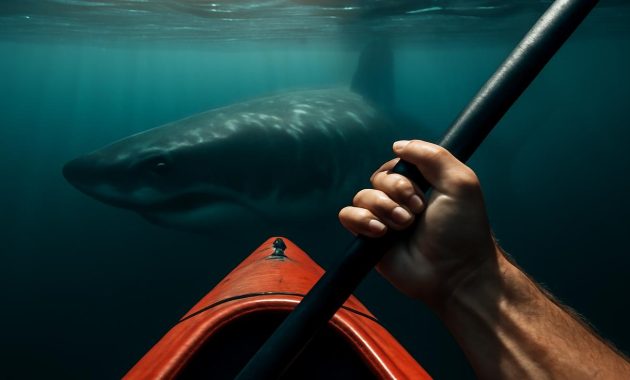
The ocean was calm that morning, the kind of stillness that tricks you into thinking the world is at peace. Sunlight spilled over a glassy Pacific, gulls traced lazy circles above, and a single red kayak rocked gently in the swell just off the California coast. Out there, somewhere between the soft hiss of shore break and the blue, unknowable drop-off, a man lifted his phone, hit record, and pointed the camera at what he first thought was a shadow. What he captured instead was a stalker—a great white shark, massive and unhurried, pacing him beneath the hull.
The First Flicker of Something Wrong
At first, it was just a feeling.
He’d launched before sunrise, sliding the kayak over damp sand, the plastic scraping softly as the tide pulled back like a sigh. The morning smelled like kelp and cold salt and something metallic from the fishing pier. Out beyond the breakers, the world narrowed to the whisper of his paddle slicing water and the steady inhale-exhale of his own breathing under a faded life vest.
He was alone but not lonely. This was his sanctuary: the murky green below, the pastel sky above, a slow, meditative rhythm as he scanned for birds, bait balls, maybe a dolphin fin if he was lucky. A GoPro bobbed lazily on his chest mount, the way it did on every trip, mostly capturing uneventful footage of rolling swells and distant boats.
But then the water changed.
Not in a dramatic, movie-style way—no sudden churn, no explosive breach. Just a subtle tightening. The surface dimmed a shade, like a cloud had passed over the sun, though the sky stayed clear. Off his right side, maybe twenty yards away, he noticed a dark patch that didn’t match the surrounding water. It moved against the swell instead of with it.
The part of his brain trained by years on this coastline clocked it instantly, even as another part scrambled to pretend it was nothing: floating kelp, a log, some harmless shadow. His hand went to the paddle, then to the phone sealed in a waterproof sleeve. Habit, more than anything. He lifted the phone, lens pointed toward that shifting dark shape.
The camera’s tiny eye focused. The shadow resolved. A dorsal fin knifed the surface—tall, triangular, impossibly sure of itself.
His heart stopped, then slammed back to life.
The Moment the Ocean Turned Predator
The fin didn’t belong to a dolphin; he knew that instantly. It was too rigid, too sharp, slicing straight lines instead of playful arcs. The body beneath it was thick, gray, and long—so long that the tail fin didn’t appear until after a heartbeat’s lag. He watched the length of it glide past like the silhouette of a submerged car.
The great white shark was easily as long as his kayak, maybe longer. Out here, scale distorts, but fear never does. Every nerve in his body fired. The air tasted like pennies. Each tiny sound grew loud: the drip of seawater off his paddle blade, the creak of plastic under his knees, the faint hiss of his breath in the windless morning.
He should have paddled. Every survival instinct screamed for motion, for flight. But movement also draws attention. So he did what, days later, people online would argue about in the comments: he stayed still, and he kept filming.
There’s a strange split that happens in moments like that. Half of you is pure animal panic, pupils blown wide, stomach gone weightless. The other half steps outside your body, calmly cataloging details. That detached narrator part of him noticed the shark’s route: wide, circling, never fully breaking the surface except for that iconic dorsal fin and, occasionally, the ghostly suggestion of its snout.
The water around his kayak thickened with meaning. The same swell he’d been riding a minute ago now felt like a moving floor in a predator’s arena. Underneath him, just a few inches of plastic, a grid of bungee cords, a couple of dry bags. No engine. No metal hull. No escape hatch.
“Okay, okay, okay…” he whispered. The camera recorded it all: his uneven breathing, the nervous laugh that slipped out like it belonged to someone else, the whispered commentary half meant for future viewers, half for whatever calm remained inside him.
The Stalker in the Deep
It’s one thing to see a shark from a safe distance—a quick flash of a fin near a boat, a distant shape that disappears as quickly as it appears. It’s another thing entirely to realize one is tracking you. Not charging. Not fleeing. Just…following.
The shark sank out of sight, its shadow dissolving into the green-brown murk. For a moment, he lost it completely. That was worse than seeing it. Visibility near the California coast can be tricky—layers of sediment and plankton turning the water into smoked glass. You can sense presence without form. Beneath him, the ocean might have been empty. It might have held a bus-sized predator inches from his dangling fingertips.
He angled the kayak slightly shoreward with the smallest strokes he could manage, every muscle fighting the urge to dig in and sprint. His paddle blade barely broke the surface, like he was trying not to wake something.
Then, from the opposite side, the shark appeared again.
It glided by slower this time, parallel to the kayak, maybe ten feet away. The pale underside flashed as it rolled slightly, a single, unblinking black eye angling up. In his video, the frame shudders as his hands shake, but that eye is visible—a dark coin, expressionless, taking him in.
It was inspecting him. That’s what the marine biologists would later probably say. Investigating, evaluating. Not hunting. Not yet. The shark’s path drew a loose, patient circle. Every time he turned the kayak toward land, the shadow drifted into view again, as if pacing his progress, like some silent, prehistoric escort.
He realized, with a sick lurch, that he’d drifted farther out than he thought. The shore looked smaller now, details blurred. The pier was a suggestion. People on the beach, if there were any, were just anonymous dots.
He whispered into the phone, “It’s still here. It’s following me.” The words sounded unreal even as he said them, like dialogue from a documentary he’d once watched from the safety of a couch.
Filming Fear: Why He Kept the Camera Rolling
Later, when the video made the rounds online, strangers would ask the same thing over and over: Why didn’t you just paddle? Why keep filming? Why point a camera at something that could end you in one wrong move?
But in that moment, the act of filming became a lifeline.
Holding the phone gave his hands a job other than shaking. Narrating gave shape to the chaos in his head. The lens turned terror into something he could frame, process, document. If something happened—if the shark breached, if the kayak flipped, if he disappeared under churning foam—at least there would be proof. At least his last minutes wouldn’t vanish into rumor and guesswork.
There was another reason, smaller but real: he’d seen too many stories that sounded like exaggerations, tales of “the biggest shark ever” with nothing but words behind them. Here, the evidence was right in front of him, circling, slicing through the water with horrifying grace. If he survived, this would be footage that said, No, this really happened. I wasn’t being dramatic. I was being followed.
He zoomed in as much as he dared, trying not to overbalance the narrow craft. The dorsal fin cut back into frame. Behind it, the shark’s back glistened like wet stone. Sunlight dappled its sides in fragmented patterns that almost looked beautiful, if not for the context. Occasionally, the tail flicked slowly, the sheer power in that casual movement sending shivers through the water and, by extension, through him.
He muttered to the shark, the way you talk to a dog you’re not sure will bite. “You’re good, buddy. Just passing through. I’m just plastic and bad-tasting human. Nothing interesting here.”
It was absurd. But talking felt better than screaming.
Minutes That Stretch Like Hours
Out there, time rearranges itself. What the camera would later show as a six- or seven-minute encounter felt to him like an afternoon. Every second swelled. The shark vanished, then reappeared. Each new sighting felt like a coin toss in which the stakes were your legs, your ribs, your heartbeat.
He began counting under his breath. Ten slow strokes of the paddle, then a pause to scan. The shark would fall back, sink a little deeper, then drift close again. Once, it surfaced so near that he could see faint scars along its flank, pale against the slate-gray skin—evidence of an older life, collisions with other giants, scraps for survival that made his current predicament feel small and suddenly, weirdly, shared.
The ocean smelled different now—stronger, like iodine and cold iron. A small breeze kicked up, stippling the surface with little ripples that made spotting the shark harder. Each chop of water became a potential fin. His world shrunk to a paranoid loop: scan, spot, whisper, stroke, repeat.
Far off, he heard the low thrum of a boat engine. It sounded impossibly distant, like a song from another planet.
Great Whites and the California Coast: The Reality Behind the Terror
From the shoreline, the Pacific often looks tame: surfers bobbing beyond the break, paddleboarders standing tall, tourists splashing in the shallows. But along much of California’s coast, especially near upwelling zones and seal rookeries, great white sharks are not visitors—they’re residents.
Biologists have documented a growing number of juveniles and subadults frequenting nearshore waters, drawn by rich feeding grounds and warming ocean temperatures. While attacks on humans remain rare, encounters are becoming more visible, thanks to drones, GoPros, and phones exactly like the one he was now clutching between white-knuckled fingers.
In many ways, he’d entered their living room.
He knew some of this, in the abstract. He’d read about shark nurseries, watched grainy research videos of tagged whites cruising along the same shoreline where families build sandcastles. Knowing it, though, and feeling the bulk of a living, breathing predator tracking your movements beneath a fifteen-foot kayak are two very different educations.
What he was experiencing was textbook exploratory behavior. No lunging, no sudden vertical charge—the hallmarks of an all-out attack weren’t there. Instead, the shark moved with deliberate curiosity. It circled, came close, fell back, then circled again. Maybe it was attracted to the silhouette of the kayak, the faint splashes of the paddle, or the subtle vibrations of a nervous heart beating too fast.
The statistics offer comfort in retrospect:
| Detail | Context |
|---|---|
| Confirmed shark species | Great white shark (Carcharodon carcharias) |
| Typical California sightings | Regular nearshore, especially near seals and cooler currents |
| Risk to kayakers | Very low overall, but encounters and bluff charges do occur |
| Shark behavior in this case | Investigative circling, no impact or breach observed |
| Outcome | Kayaker reached shore safely; encounter captured on video |
But inside that moving circle of muscle and teeth, statistics felt distant and unhelpful. All that mattered was his fragile boat, the dark water, and the fact that he was outmatched in every imaginable way.
Closing the Distance to Shore
The coastline finally began to grow larger instead of smaller. That was the first real mercy. The pier posts took shape. The cliffs resolved into patterns: scrub, sandstone, the faint zigzag of a trail he’d hiked a dozen times. His arms burned, but adrenaline had blunted the pain.
The shark stayed with him longer than he could later explain. Maybe the kayak’s silhouette remained interesting. Maybe the shark was simply traveling on a path that coincidentally paralleled his own. Either way, it shadowed him until the water shifted color from deep green to a lighter, more familiar sandy hue. The depth below him shallowed; the shark’s outline grew harder to distinguish against the churn of waves pushing toward the beach.
At some invisible line, the shark peeled away. One second, its shadow flanked him. The next, it slipped down and out, as if a plug had been pulled from the moment itself. No dramatic turn, no splash. Just gone. The predator returned to its obscured world with all the ceremony of a passing cloud drifting off the sun.
He kept filming for another full minute, scanning, hardly trusting the absence he saw. Only when his kayak rose on the back of a breaking wave and he felt the sucking pull of shoreward surf did he finally lower the phone, hands shaking so hard he nearly dropped it.
The First Time He Watched Himself Be Afraid
On the beach, his legs couldn’t decide whether to hold him up. The sand felt too solid, too bright, like the earth had cruelly forgotten what he’d just come from. People walked dogs along the tideline. A jogger checked a smartwatch. Somewhere, a child laughed as a wave chased tiny feet back from the water.
He dragged the kayak above the wrack line, collapsed beside it, and only then dared to replay the footage.
There is something uniquely surreal about watching your own terror in third person. The video didn’t capture the metallic taste in his mouth, the constriction in his chest, the static of panic in his ears. But it did capture the quiver in his voice, the way the frame jumped when the shark came particularly close. It recorded the low, involuntary exhale he’d made the last time the dorsal fin slid by.
On the small screen, the shark looked both closer and farther than it had in real life. Perspective flattened distance. Its fin cut through the water with mechanical precision, but that unblinking eye, glimpsed as it rolled, anchored the encounter in something undeniably alive.
He watched the video once, then again, heart pounding even from the safety of dry land. People would later call him brave for staying calm, for not flailing or bolting. Watching himself, he didn’t see bravery. He saw a man doing the only thing he could keep doing—filming—when every other choice felt like a bad one.
The Internet Finds the Shark
When he finally shared the video online, it rippled outward in the way raw, unfiltered encounters with the wild often do. The footage struck a chord—not because it was the most dramatic shark video ever filmed, but because of its intimacy. No swelling music, no slow-motion edits. Just a wobbly horizon, ragged breathing, and that unmistakable fin.
Comment sections filled with armchair analysts and veteran watermen. Some praised his composure; others said he should never have been out there alone. A few insisted that great whites were misunderstood, that he’d been statistically safer there than in his car on the drive home. Others shared their own near-miss stories: seals rocketing past kayaks, mysterious bumps from below, sudden eruptions of baitfish driven to the surface by something big and unseen.
Marine enthusiasts chimed in to estimate the shark’s size, age, and behavior. One pointed out the slow, measured tail beats—signs of cruising, not chasing. Another highlighted the distance between dorsal and tail as an indicator of length. Together, they reconstructed a narrative that, in the moment, had been nothing but raw instinct and fear.
He read the comments with a strange mix of relief and unease. On one hand, the encounter now belonged to a wider community. He wasn’t alone in trying to make sense of it. On the other, his most vulnerable few minutes—his whispered bargaining with a creature that never heard him—now lived on endless screens, replayed on loop by strangers killing time on lunch breaks and late nights.
What Encounters Like This Really Mean
It would be easy to frame the story as a brush with death and leave it there: kayaker almost eaten, shark as monster, ocean as villain. But the truth, as usual, is more layered.
The great white shark that paced his kayak is part of an ecosystem older than human memory. Long before plastic hulls and smartphone cameras, these predators moved through the same waters, tracking seals and fish along invisible highways of current and temperature. Their presence along the California coast is both a sign of a thriving apex predator and a reminder that our favorite playgrounds double as their hunting grounds.
Encounters like his are rising, not necessarily because sharks are becoming more aggressive, but because we’re stepping more boldly into their realm, armed with better tools to record and share what happens there. Drones zoom over lineups where surfers wait, capturing pale shadows gliding just beyond their dangling legs. Kayakers and paddleboarders extend their range, trusting GPS more than gut. And always, the cameras roll.
His video doesn’t show a shark attacking. It shows a shark looking. Measuring. Existing.
Still, the fear he felt is not misplaced. Great whites are capable of staggering violence. A single exploratory bite from an animal that size can be catastrophic for a human. Respecting that power is part of earning the right to be out there at all.
He still goes back on the water now, though it took time. The first few trips after the encounter were jittery: every floating clump of kelp a phantom fin, every dark patch a suspected shadow of something larger. But as the months passed, the ocean reclaimed its softer edges. Dawn once again became a time of quiet reflection, paddles dipping, birds calling.
He’s different, though. More alert. More humbled. And always, always aware now that somewhere under the hull, in that layered, unknowable blue, something might be watching back.
FAQ
Was the shark actually trying to attack the kayaker?
From the behavior seen in the video and described by the kayaker, the shark appeared to be exhibiting investigative or curious behavior rather than an outright attack. It circled and paced the kayak without breaching or striking, which is consistent with exploratory movements often seen in great whites.
How big was the great white shark?
Estimates based on fin size and body length relative to the kayak suggest the shark was roughly in the range of the kayak’s length or slightly longer, likely between 10 and 14 feet. Exact size is difficult to determine from video alone, but it was clearly a substantial animal.
What should kayakers do if they encounter a great white shark?
Experts generally advise staying as calm as possible, avoiding sudden splashing, keeping limbs inside the vessel, and slowly but steadily paddling toward shore or a nearby boat. It’s important not to attempt to touch or provoke the shark, and to keep visual contact when possible.
Are shark encounters off California common?
Shark encounters are becoming more frequently documented thanks to cameras and drones, especially along areas with active marine life. However, actual attacks on humans remain rare relative to the number of people who enter the water each year.
Is it safe to kayak alone in areas known for great white sharks?
Many people do kayak alone in these areas without incident, but it does increase risk. Safety recommendations include going with partners, staying aware of local wildlife reports, avoiding areas with active feeding like dense seal colonies, and carrying communication devices along with flotation and safety gear.