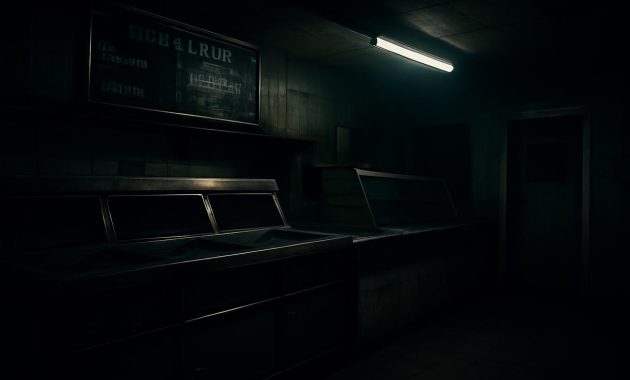
You know how certain smells stay with you forever? For some people, it’s cut grass in summer or their grandmother’s perfume. For me, it’s hot chip-fat oil at 11:37 p.m., when the extractor fan is wheezing like it’s dying and the last drunk customer is swaying in the doorway. That smell—salt, vinegar, burnt crumbs, cheap disinfectant—soaked so deep into my life that I did the only thing that made sense.
I turned it into a horror game.
People think I’m joking when I say that. A chippy? A fish-and-chip shop as nightmare fuel? But I swear to you, the place where I used to work was already halfway to a haunted house. I just stripped away the fluorescent cheerfulness and the laminated menu and showed what was always there, lurking behind the fryers.
This is the part where I’m supposed to say I exaggerated everything for the game. I didn’t. If anything, I toned it down.
The Night Shift That Never Ends
The chippy sat on the corner of a narrow street, wedged between a shuttered betting shop and an off-license that never seemed to close. The sign outside promised “FRESH FISH DAILY!” but the sea was a 50-minute drive away and none of us had seen a real boat in years. Inside, it was all chrome, cracked tiles, and that steady, oily heat radiating from the fryers like a fever.
My shift started at four in the afternoon, which meant by six I’d already stopped noticing the sting of the oil in my nostrils. By nine, my clothes carried a permanent shimmer of grease. By eleven, my mind did this strange thing where sound and time got fuzzy. There was always the hiss of the baskets dropping, the bubbling of oil, the beep of the timer that everyone ignored, the hum of the drinks fridge, the buzz from the faulty light in the corner. Layer that on top of the murmuring queue, the doors banging, and the constant slop of scooped chips, and your brain just… frays.
That fraying is where my game started.
There’s this moment on a long shift when reality goes thin around the edges. You stare at the same tiled wall and swear the grout lines are breathing. Steam ghosts up the window and your reflection looks a split-second out of sync with you. You’re tired, your feet hurt, and you swear you can hear someone whispering your name between the beeps and the fryer’s rumble.
Tell a horror fan that, and they’ll ask: was the place haunted? I don’t know. But it felt like it wanted to be.
Grease, Ghosts, and the Birth of a Game
The horror game idea didn’t arrive as a flash of genius. It seeped in, the way the oil seeped into my hair, my shoes, my life. I was mopping the floor one night, watching the dirty water drag long gray streaks across the tiles, and I imagined a player standing exactly where I was, alone in the shop, long after closing.
The lights hum. The fan rattles. Outside, the street is empty. Or it should be.
I pictured those tiny noises, those mechanical sighs and coughs, growing into something else: footsteps where there should be none, a breath too close to your ear, the creak of the back door that you know—know—you locked. The more I thought about it, the more the chippy stopped being a workplace and became a level design.
When customers weren’t in, I’d mentally map out routes. The narrow corridor to the storeroom: perfect for a claustrophobic chase. The back fridge, where the light flickered and the motor made that low, grinding noise: an obvious spot for a jump scare. The serving counter, shining and reflective: distorted reflections, moving a second slower than you do.
I started jotting down ideas on the back of delivery slips. “Timer beep becomes heartbeat.” “Oil bubbling sound reversed = whispering?” “Watchers behind glass of hot cabinet.” It felt like some kind of confession, to take everything that depressed me about the place and twist it into something purposeful. If I couldn’t escape the chippy, maybe I could trap other people in it—safely, through a screen.
The Customers Who Follow You Home
Every regular knows that certain late-night customers are their own kind of horror. The ones who lean too far over the counter. The ones who’re too quiet. The ones who say your name too easily, like they’ve been practicing it. In the game, I didn’t turn them into monsters; I made them almost normal.
That’s worse, isn’t it? Almost normal.
One of my regulars had this habit of ordering the same thing every Friday—large chips, extra salt, no vinegar, two battered sausages—and staring at me, not in a creepy way, exactly, just… relentlessly. One Friday, he held out the money, then pulled it back and said, “You must dream about this place.”
I laughed it off, but he wasn’t joking. “Places like this get into your head,” he added. “All the lights. All the faces.”
That line went straight into the game script. I didn’t even have to change it.
In the game, customers appear out of nowhere, already at the counter when you turn around. Their orders are off by a word, a detail. “Cod and ships.” “Small flicks, please.” You squint at them and their faces are… blurred, like your eyes are struggling to focus. They look like everyone and no one: faces your brain half-recognizes from real life but can’t place. It’s the feeling you get when a stranger knows your name.
The Chippy as a Maze You Don’t Remember Building
The real shop was tiny. You could see from the front door to the back wall in one glance. But in my game, the chippy is a maze that shifts in small, unreasonable ways. At first, the layout is exactly like the real place: counter at the front, fryers behind, corridor leading past the staff toilet to the dry store, and a heavy, fire-door to the alley. But each “night” the player works, something is slightly off.
The toilet door is on the other side of the corridor. The light switch is farther away. The freezer room has two doors now instead of one. The mind notices before the character does: wasn’t that shelf lower? Didn’t the calendar on the wall have a different date yesterday?
I built the level design out of a specific feeling I’d get on certain nights near closing time, when I was running on fumes. I’d go into the back for more potato cakes and for one dazed heartbeat, I wouldn’t know where anything was. My body knew—muscle memory turned me toward the right shelf—but my eyes refused to match what I saw with what I remembered. It was like walking into a recreation of the shop, not the real thing.
In the game, that becomes a slow-burn terror: your workplace quietly refusing to stay put.
From Real-Life Rot to Game Mechanics
People joke that working with food will put you off eating it. What they don’t tell you is that it also turns you into a kind of unwilling archivist of decay. You start clocking how quickly batter goes soggy, how long fish lasts before its smell sharpens from ocean to something sour and metallic, how old oil clings to everything and never, ever really leaves.
I turned that into a central mechanic: rot as a timer.
In the game, every item in the shop has a hidden freshness value that ticks down. Fish, chips, oil, even the cleaning rags. If you don’t keep up with the work—emptying, scrubbing, replacing—things in the shop begin to… change. The oil darkens further than it should, turning almost black, and when you look into its surface, you don’t see your reflection. You see the shop behind you, empty, lights off—except you can hear the fryers still running.
Leave the fish too long, and it starts to twitch. Not dramatically—just a subtle, sickening little shudder when you’re not looking straight at it. Let the rag pile sit unwashed, and it begins spreading damp patches along the tiles, footprints that lead somewhere the layout says there is no door.
Underneath it all, I coded one simple rule: neglect equals manifestation. The mess you ignore becomes the thing that stalks you. That came straight from real life too. Because when you’re understaffed and underpaid, you skip corners. You don’t deep-clean the way you should, and the shop remembers. It grows sticky in hidden places.
The Story I Was Afraid to Admit Was Mine
If anyone asks, I tell them the game’s plot is about a generic overworked employee trapped in an endless shift. That is true, but it’s also a dodge. The real confession is this: the character is me, if I’d stayed.
In the game, you sign on for one week of night shifts. “Just cover, until the new staff arrive.” That’s what my boss said when our last night worker left. In the game, the new staff never show up. In reality, I did. I kept showing up, long after I’d sworn I’d leave. One more payslip. One more week. One more rota reshuffle where my requests vanished like they’d never been written.
I built those small betrayals into the emails and texts the player receives on the in-game phone. The manager who always says “You’re a lifesaver” but never changes the schedule. The coworkers seen only in old photos: arms slung around each other, uniforms a slightly different style, faces scribbled out. The more you work, the more you find evidence of others who worked there too long. Notes tucked inside the till drawer: “DON’T STAY PAST MIDNIGHT.” “THE CLOCK IS LYING.” “CHECK THE OIL AFTER CLOSE.”
That last note came from real life. One night, as we were cleaning down, my coworker Sam nodded at the fryers and said, “We should drain and filter that, but don’t bother tonight. Nobody looks in the oil after midnight.”
“Why not?” I asked.
He shrugged. “Bad luck.”
That stuck with me. Not a ghost story, not exactly—just an offhand superstition. Perfect horror game material. In my version, if the player defies the note and stares into the drained oil after midnight, they see shapes that are almost faces: the last reflections of people who never clocked out.
The Secret Language of Closing Time
Closing a chippy is its own ritual. The order you do things in matters, not for any mystical reason, but for survival. If you forget to switch off the lights in the right sequence, you end up walking back through the dark, bumping into counters. If you mop too early, you’ll slide on your own work. The last twenty minutes before you lock the door is a dance of habit and exhaustion.
In the game, I amplified that into a kind of spellcasting. Each night, the closing routine appears on the wall as a checklist. Wipe counters. Drain fryers. Lock back door. Switch sign to “CLOSED.” Simple. Familiar. But the order is crucial. Get it wrong, and the shop… notices.
Miss a step, and you hear a knock from the locked freezer room. Skip wiping the counter, and greasy handprints appear on the glass, fingers too long, pressing inward. Forget to lock the back door, and the wind you feel on your neck is somehow too warm.
It’s not the big scares that land hardest; it’s the tiny disapprovals from the building itself. Like the place has grown tired of being mistreated and is finally looking back at you.
Twisted Inspiration: Turning Boredom into Nightmare Fuel
When people finally play the game, they always ask the same question: “How did you come up with this?” And I never know whether to answer honestly: I didn’t come up with it. I just stopped looking away.
The twisted inspiration wasn’t some demonic visitation or cursed fryer. It was boredom. Crushing, repetitive, bone-deep boredom that slowly hollowed out my sense of what was normal. The mind hates emptiness; it fills in the gaps.
On a dead Tuesday night, with only the low hum of the fridge for company, my brain would entertain itself by imagining the customer door jingling open with no one there. I’d stare at the CCTV monitor, watching the grainy black-and-white alley, and picture something just out of frame, almost visible. I’d line up polystyrene trays and imagine them shifting positions when I turned away.
That’s all horror is, in the end: paying too much attention to the things everyone else edits out. The flicker of a fluorescent tube. The shape of a stain. The echo of your own footsteps.
To capture that in the game, I obsessed over small details:
| Real Chippy Detail | Horror Game Twist |
|---|---|
| Timer beeping when food is ready | Beep shifts off-beat, becomes a second heart in the room |
| Condensation on front window at night | Shapes appear in the fog that don’t match anyone inside |
| Grease stains on floor and walls | Stains stretch into handprints, footprints, then writing |
| Back alley with overflowing bins | Bin bags twitch as if something inside is breathing |
| Staff noticeboard with old rotas | Names on past schedules don’t match any living staff |
Every element had to feel like it could be real at first glance. Only then, only slowly, did it slide into the uncanny.
The Part That Still Bothers Me
People have fun with the game. They stream it, scream at the right bits, laugh nervously at the quiet ones, and then move on with their lives. I watch those clips sometimes with this strange double-vision: half of me proud, half of me unsettled.
Because here’s the thing: after all the late-night coding, the sound design tweaks, the playtests, and the patch notes, I still dream about the real chippy more than I dream about the game version.
Only now, the two are starting to bleed together.
In my dreams, I’m back behind the counter. I can feel the familiar ache in my lower back, the thin film of sweat on my neck. I know exactly where the salt is, how sticky the handle of the fridge feels, how the floor slopes ever so slightly toward the back door. Except the calendar on the wall is from the game. The handwritten notes are from the game. The CCTV monitor is showing the game’s corridor layout, not the real one.
And every time, just before I wake up, I look into the fryer and see my reflection. Only it’s not wearing my old uniform.
It’s facing away from me.
FAQ
Is your horror game based on a real fish-and-chip shop?
It’s inspired by a very real chippy where I worked for several years, but the game’s shop is a distorted composite. I merged real layouts, memories, and sensations, then pushed them into the uncanny.
Did anything genuinely supernatural happen while you worked there?
Nothing I’d swear to under oath. What did happen were a lot of late nights, frayed nerves, strange coincidences, and small superstitions—exactly the kind of material that horror thrives on.
Why choose a chippy as the setting for a horror game?
Because it’s familiar, bright, and ordinary. Horror hits harder when it invades everyday spaces. A chippy has constant noise, harsh lighting, and repetitive routines—perfect ingredients for psychological horror.
How much of the main character is actually you?
Their exhaustion, financial anxiety, and weird attachment to a place they hate are all mine. The more supernatural things—well, I like to think I got out before it ever came to that.
What advice would you give someone who wants to turn their job into a horror game?
Pay attention to the small stuff. The sounds you stop hearing, the smells you stop noticing, the rituals you perform automatically. That’s where the real unease lives. Don’t start with monsters; start with what already feels wrong when you’re alone there at night.