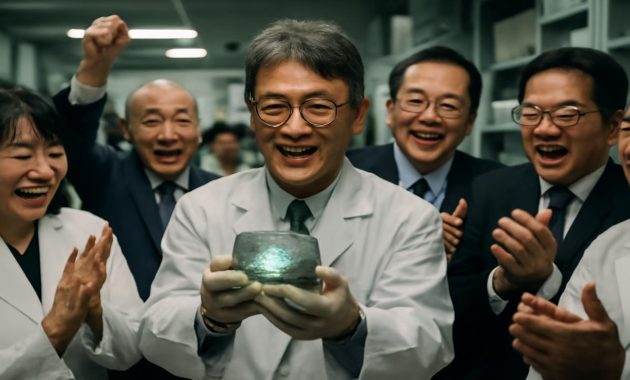
The ocean is quiet here, 6,000 meters below the Pacific surface. No light, no color, only a slow drift of mineral-rich mud that has been falling, grain by grain, for millions of years. Somewhere in this midnight plain lies a secret that could power the world’s electric dreams for almost a thousand years: a staggering cache of rare-earth elements hidden in Japan’s deep-sea territory. In an age of climate anxiety, supply-chain wars, and frantic technological leaps, the story of how Japan found this underwater treasure feels less like a news item and more like a turning point in our relationship with the planet itself.
An Ocean Floor Discovery That Rewrites the Future
The story begins in 2011, with a research vessel rocking gently on the surface of the Pacific, hundreds of kilometers off Japan’s coast. The crew isn’t searching for fish or oil. They are hunting for something invisible to the naked eye—atoms of metals so obscure that most people couldn’t name three of them, yet so essential that every smartphone, wind turbine, and electric car quietly depends on them.
As a sediment core is hoisted aboard, dripping and unremarkable, no one can see what it really represents. It looks like any other slice of seafloor mud: brown, dense, cold to the touch. But in labs, under fluorescent lights, those dull sediments reveal an astonishing truth. They are packed with rare-earth elements—yttrium, europium, terbium, dysprosium—the metals that make screens glow, motors spin, and magnets cling with superhuman strength.
Years later, a more detailed survey around Japan’s remote Minamitorishima Island—little more than a speck of land guarding a vast swath of Japanese waters—finally puts a number to the find. Enough rare-earth elements, scientists estimate, to meet global demand for hundreds of years. Some studies even dare to suggest a figure: deposits equivalent to more than 700 years of global consumption for certain critical elements.
Nothing has changed on the surface of the sea. The waves still roll. The sky still empties its light onto a seemingly endless blue. Yet, in that moment, the world’s rare-earth map is quietly redrawn.
The Strange Metals at the Heart of Modern Life
Rare-earth elements sound exotic, but if you’re reading this on a phone, tablet, or laptop, they are already sitting in your hand. The name is slightly misleading: they are not truly “rare” in the sense of being absent, but rare in the sense that they are scattered, thinly spread, and difficult to extract in concentrated, usable form.
They are the quiet specialists of the periodic table. Neodymium and dysprosium help build ultra-strong magnets for electric vehicle motors and wind turbines. Europium and terbium bring vivid reds and greens to digital screens. Lanthanum refines oil. Yttrium toughens ceramics and lasers. And that’s just the beginning.
For the last few decades, one country has dominated the mining and refining of these obscure metals: China. At times, over 80–90% of the world’s rare-earth production came from Chinese mines and processing facilities. This concentration turned rare earths from niche scientific curiosities into geopolitical pressure points. When trade tensions rose or export quotas tightened, the anxiety in tech and manufacturing capitals was almost palpable.
Japan knew that feeling intimately. In 2010, after a maritime dispute, China briefly restricted rare-earth exports to Japan. Electronics makers and automakers felt the tremor instantly, like an earthquake rippling through their supply chains. That moment left a mark. It also planted a seed: what if Japan could find its own source—massive, secure, and long-lasting?
From Scarcity to Seafloor Abundance
In a twist almost too poetic to script, the answer lay not in deserts or mountains, but in the soft, silent plains of the deep Pacific. Around Minamitorishima and other seamounts and plateaus, layers of sediment had been quietly accumulating for millions of years, rich in minerals carried by ocean currents and volcanic dust.
Analyses stunned researchers. Some cores held concentrations of rare-earth elements tens or hundreds of times higher than typical seabed mud. Even more shocking, when scaled across the region, the numbers ballooned into what many described as a “semi-infinite” resource—effectively, a supply that could support humanity’s needs for countless generations if used carefully.
To put this into perspective, consider the rough contrast between traditional land-based reserves and Japan’s deep-sea trove:
| Aspect | Typical Land-Based Rare-Earth Mines | Japan’s Deep-Sea Deposit (Minamitorishima Area) |
|---|---|---|
| Location | China, Australia, USA, Myanmar, others | Exclusive Economic Zone around Minamitorishima Island |
| Estimated Scale | Decades of supply for key elements | Hundreds of years for certain elements (700+ years of global demand in some estimates) |
| Depth | Surface to a few hundred meters underground | ~5,000–6,000 meters below sea surface |
| Extraction Challenges | Land disruption, waste, chemical processing | Extreme pressure, cold, technological innovation required, environmental unknowns |
| Geopolitical Control | Highly concentrated in a few producer nations | Firmly under Japan’s jurisdiction (EEZ) |
Suddenly, a country with few domestic fossil fuels but world-class engineering and manufacturing had stumbled on a mineral endowment that could shape the clean-energy era. Yet the discovery came bundled with a thorny question: at what cost do you touch the deep sea?
Mining at the Edge of the World
The deep ocean might be Earth’s last true wilderness. Sunlight never reaches it. Temperatures hover just above freezing. The pressure is so intense that a human body would be crushed into silence in an instant. But despite the harsh conditions, life thrives in strange, delicate forms—sea cucumbers and brittle stars tracing pale patterns in the mud, microbial communities slowly feeding on chemical whispers drifting down from above.
To mine here is to intervene in a world we barely understand. Japanese engineers imagine remote-operated vehicles crawling across the seafloor, vacuuming sediment rich in rare earths, and pumping it up through long pipes to ships above. It sounds tidy in diagrams, but there’s a visceral unease when you picture the fine plume of sediment billowing out behind those machines, spreading like underwater dust storms across habitats that have evolved for eons in stillness.
Japan, acutely aware of its image as a steward of marine resources—and of the global scrutiny now aimed at deep-sea mining—is cautious. Pilot projects and small-scale tests explore how to collect seabed mud efficiently, how to separate rare earths with less chemical waste, how to track and contain plumes. Laws and international regulations lag behind the speed of technology. Conservationists warn that we are on the brink of industrializing the last frontier without a full map of the consequences.
Here lies the irony: the same rare-earth elements that promise to cut emissions, build clean transport, and stabilize renewable energy grids might be extracted in ways that alter deep-sea ecosystems forever. The story is not just about a jackpot of minerals; it is about our struggle to transition away from one kind of planetary strain without creating another.
Japan’s Delicate Balancing Act
In Tokyo’s ministries and boardrooms, the Minamitorishima deposit is both a strategic asset and an ethical puzzle. On one hand, it offers what Japan has long coveted: resource security, reduced dependence on foreign suppliers, and a stronger hand in negotiating the green transition. On the other hand, Japan is a signatory to international environmental agreements and home to a public increasingly sensitive to ecological damage.
Researchers frame their mission with almost meditative care: Can we touch the seabed lightly? That phrase has become an unofficial mantra in the broader conversation about deep-sea mining. It inspires innovation in narrower, more precise collection tools, better mapping of sensitive habitats, gentler pumping systems, and improved mineral processing to minimize toxic waste.
Yet honesty demands this acknowledgment: there is no such thing as consequence-free extraction. The question is no longer whether we leave a mark, but whether we can learn to weigh those marks—on the deep sea, on coastal communities near refineries, on the atmosphere, on human workers—and choose the lesser harm.
A 700-Year Promise in a 70-Year Crisis
The number “700 years” clings to the imagination. It sounds like a fantasy from a different age, when people believed in inexhaustible forests and endless fish. Measured against the urgency of the climate crisis—which scientists tell us must be confronted in mere decades—it feels almost absurd. Why think in centuries when we are failing at the scale of election cycles?
Yet that is exactly why this discovery is so unsettling and so important. It forces us to peer over the edge of our short-term panic and consider a longer horizon. The world is scrambling to replace fossil fuels with electric vehicles, batteries, and renewables. That transition, turbocharged by policy and market pressure, could devour metals at a staggering rate. Batteries thirst for lithium, nickel, and cobalt. Turbines and motors need rare earths. Without careful design and recycling, the clean-energy revolution risks becoming an era of mining fever.
Japan’s deep-sea deposit whispers a different possibility: a slower, more stable supply of key materials that might reduce the frantic scramble and the geopolitical knife fight over rare-earth access. If managed well, it could create breathing room—time to improve recycling technologies, redesign products to use fewer critical elements, and find alternative materials.
But resources that stretch for centuries can also lull societies into complacency. Oil felt endless once. So did old-growth forests and whales and wild rivers. The 700-year figure is a promise and a warning all at once. Having so much of something does not guarantee we will use it wisely. It only raises the stakes of our decisions.
Beyond Extraction: A New Contract with Matter
What if the true significance of this discovery isn’t the metals themselves, but the chance to rewrite our relationship with the materials that shape our lives? In a world where most of us never see a mine, a refinery, or the grimy back end of the devices we cradle, rare earths remain abstract. We “upgrade” a phone; we don’t feel the drag of a mountain leveled or a river poisoned.
Japan’s undersea treasure is, paradoxically, an invitation to look closer. To trace the path from the deep muddy seafloor to the humming motor of an electric car. To recognize that our sleek, polished visions of a clean future still sit on foundations of rock and mud and salt and sweat. If the narrative ends with “700 years of supply secured,” we’ve missed the point. If it leads us to smarter design, stricter environmental standards, and products built to last and be reborn, then the deep-sea mud becomes more than a mineral bank; it becomes a catalyst.
Imagine a world where rare-earth magnets circulate through several generations of machines, pulled from old motors and reborn in new ones. Where Japanese engineers perfect low-impact extraction that the world demands be the standard, not the exception. Where the deep sea is studied in as much detail as a national park before a single industrial machine touches it. The Minamitorishima mud, in that vision, is not just a deposit—it’s a test.
The Sea, the Future, and Us
On another research voyage, a camera-equipped robot descends through the twilight zone of the ocean, past shimmering fish and drifting jellyfish, into the midnight depth where the Minamitorishima sediments lie. Its lights sweep across a barren-looking plain pocked with small burrows and scattered creature tracks—proof that life is here, slow and nearly invisible but persistent.
One of the scientists on board watches the feed in a dim control room, headphones on, hands wrapped around a mug that’s long gone cold. The screen shows only mud, meters and meters of it. Yet she knows the numbers hiding behind those gray pixels. Enough dysprosium for generations of wind turbines. Enough yttrium for countless displays. Enough cerium and lanthanum for a reimagined energy system.
Outside, the waves are restless but oblivious. Inside, the conversation is intense, almost philosophical. Should we cut into this seabed? How quickly? With what safeguards? Who benefits? Who bears the unseen costs?
Japan’s mega rare-earth deposit is not a miracle solution to our problems. It doesn’t solve climate change or erase political tensions or magically clean up the messy reality of extractive industries. But it alters the terrain on which those battles are fought. It offers a vast, tangible resource that might, if we are wise, buy us time and options in an increasingly constrained world.
Seven hundred years is longer than any modern nation has existed in its current form. Longer than the age of fossil fuels so far. When we talk about consuming that much future, we are talking about touching the lives of people not yet imagined, living with technologies not yet invented, under climates we are only beginning to influence.
The deep sea holds its silence. Japan has found a key to an enormous vault. Now the world must decide how, and whether, to turn it.
FAQ
What exactly did Japan discover in its deep-sea territory?
Japan discovered vast deposits of rare-earth-rich mud on the seafloor near Minamitorishima Island within its Exclusive Economic Zone. These sediments contain high concentrations of rare-earth elements used in electronics, renewable energy technologies, and advanced manufacturing.
Why are rare-earth elements so important?
Rare-earth elements are crucial for making powerful permanent magnets in electric vehicle motors and wind turbines, as well as for producing screens, lasers, medical devices, catalysts, and many other high-tech components. Modern digital life and much of the clean-energy transition depend on them.
What does “700+ years of global consumption” mean?
Some scientific estimates suggest that, for specific rare-earth elements, the total amount contained in Japan’s deep-sea deposits could meet current global demand for hundreds of years—potentially more than 700 years for certain metals, if consumption patterns stay similar.
Can Japan start mining these deep-sea deposits right away?
No. While the resources are there, large-scale deep-sea mining is not yet commercially or environmentally ready. Japan is still testing technologies, studying environmental impacts, and working within national and international regulations before considering full-scale extraction.
What are the environmental concerns about deep-sea mining?
The deep sea hosts unique, little-understood ecosystems. Mining could disturb habitats, create sediment plumes that smother organisms, and introduce noise and light into dark, quiet environments. Because recovery in the deep sea can be extremely slow, damage might last for centuries.
How might this discovery affect global geopolitics?
By giving Japan a potentially massive domestic supply of rare earths, the discovery could reduce global dependence on a few producers, especially China. This may shift negotiating power, diversify supply chains, and influence trade and security strategies around technology and energy.
Does this deposit mean we no longer need recycling or efficiency improvements?
No. Even with huge deposits, mining and processing still have environmental and social costs. Recycling, better product design, reduced material use, and alternative technologies remain essential to minimize overall impact and ensure long-term sustainability.