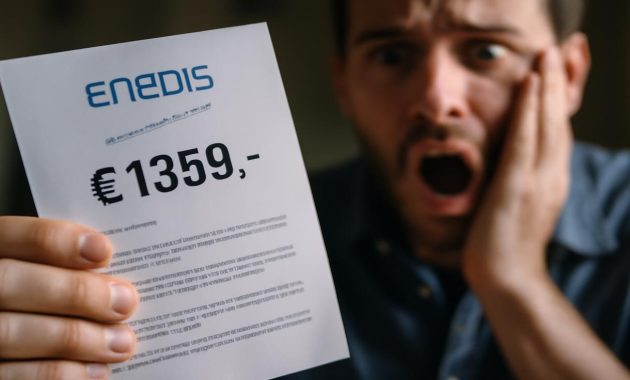
The envelope looks plain enough when it slips through the letterbox. No bold colors, no threatening stamps. Just the quiet, familiar weight of an official letter. You turn it over in your hands, feeling that faint roughness of recycled paper, seeing your name framed in the little plastic window. And then you spot it: “Enedis” and a reference to your electricity meter—your Linky meter. Maybe you’ve heard the debates on the radio, maybe you’ve seen neighbors talking about it in the stairwell. But this time it’s not just talk. This time, the letter is for you. Inside, a figure is waiting: 1 359. Not a random number, but an amount, a demand, a bill you didn’t expect.
When a Routine Letter Starts to Feel Like a Summons
You sit at the kitchen table, the usual hum of the fridge suddenly louder than before, like it’s leaned in to listen. Outside, the light is dim, that odd in-between color of a late afternoon that hasn’t yet decided to become evening. You unfold the pages. The words feel dense, crowded around numbers and references. You read: “Linky meter,” “regularisation,” “consumption adjustment,” and then you see it again—1 359.
It’s not just the money. It’s the surprise, the way it cuts across your quiet domestic landscape. A bill for something you thought was already being handled, month after month. Kilowatt-hours, estimates, remote readings: these things are supposed to happen somewhere in the background, in a realm of cables and databases and technicians you never see. Yet here it is, the invisible system materialized into a concrete amount due, like a ghost finally stepping into the room.
For many households, these new letters about the Linky meter come with a strange cocktail of feelings: confusion, suspicion, resignation, even anger. It feels like being called to account for years of electricity use you barely remember—dark winter mornings, ovens preheating for family dinners, electric heaters ticking on in cold bedrooms. Every moment powered by that unseen current now seems to be lined up and tallied, all leading to this quietly shocking figure: 1 359.
The Green Box That Changed the Conversation
The Linky meter itself doesn’t look like a villain. If you’ve ever seen one in the hallway of your building, or tucked away in a cupboard near the front door, it’s almost cheery: a nugget of bright green plastic, a small digital screen, a little button you may have pressed once or twice. It hums silently, counting, measuring, translating your life into numbers.
When Enedis began rolling out Linky meters across France, the pitch was simple and modern: no more estimated bills, more precise tracking of consumption, remote readings without the need for someone to come and check the dials. Smart energy for a smart age. The idea was to pull electricity out of the shadows of guesswork and put it into the clear light of real-time data.
But data has a way of becoming personal when it arrives in an envelope. Before Linky, many households lived in a gentle rhythm of estimates and corrections. A meter reader would come every so often, you’d receive a bill based on a mix of real readings and approximations, and usually the corrections were small enough to disappear into the ebb and flow of the month. You didn’t think about it much.
Now, with Linky, the logic has flipped. The meter knows precisely what you use, almost hour by hour. For some, that’s a promise of fairness: no more paying too much, no more rounded-up estimates. For others, it has become a spotlight shining into the past, revealing years of underestimations that suddenly stack up into a single, hefty “regularisation” bill. That’s how a number like 1 359 is born—out of the gap between what was assumed and what actually happened.
The Moment the Number Lands: Breaking Down the 1 359
Let’s imagine the scene more closely. The letter lies open on the table. The key paragraph explains that Enedis, thanks to the Linky meter’s precise data, has recalculated your historical consumption. Maybe for months or even years, your bills were based on low estimates. Maybe no one read your meter regularly. Maybe your lifestyle changed—a new baby in the house, more electric heating, working from home—but the estimated invoices didn’t keep up.
Now, the system has caught up all at once. What looked like small differences here and there have merged into one large correction. The result is a regularisation: 1 359 euros to pay. “Due by…” a date that suddenly feels dangerously close.
It sounds simple on paper, but in daily life it’s brutal. Electricity isn’t a luxury for most people; it’s the fabric of everyday survival. You cook with it, you store food with it, you light your children’s homework with it, you heat your shower. You didn’t choose to consume “too much” energy in some frivolous way. You were just living, day after day, trusting that the bills you received were a fair reflection of what you used.
In that moment, 1 359 stops being an abstract sum and becomes something else entirely: the cost of unexpected sacrifice. What will you have to cut to pay that? A holiday that was already modest? Weekend outings? A child’s activity? Or maybe the question is more urgent: will this mean dipping into savings, taking on debt, or choosing which bill can be delayed?
| Situation | What It Can Mean in Practice |
|---|---|
| Years of estimated bills below actual use | A sudden “catch-up” invoice that may reach 1 359 € or more |
| Change in habits (telework, new appliances) | Real consumption rises but estimates lag behind, inflating the later adjustment |
| Irregular meter readings in the past | Long period with no correction, then one big regularisation based on Linky data |
| Tariff misunderstanding or contract poorly adapted | You pay more than expected when your profile is finally aligned with your real use |
From behind a desk in an office, this might look like simple accounting: aligning columns, balancing differences, sending out letters. Inside a home, it feels more like a sudden wave breaking over a family’s careful budget.
Letters, Labels and the Quiet Pressure of Official Language
The letter doesn’t shout. It doesn’t threaten in bold red capital letters. Its power lies in something softer: the authority of its language, the way it folds technical terms around a very simple message—“you owe this.”
Reading it, you might feel a dull sense of being out of your depth. The vocabulary feels precise but distant: “index de consommation,” “télérelève,” “régularisation,” “période de référence.” It’s like stepping into a room where everyone is speaking a language you recognize, but only halfway. You understand enough to be worried, not enough to feel in control.
What you don’t see—what the letter never describes—is the invisible path your data has taken. Each day, the Linky meter quietly notes how many kilowatt-hours slip through your circuits. It sends that information off, not in the noisy crackle of overhead lines but in the silent pulses of the power grid itself. Somewhere, far from your kitchen table, servers collect and store it, algorithms organize it, systems calculate it. Eventually, a figure is spat out, polished, wrapped in administrative phrasing, and mailed back to you.
There is a strange intimacy to this. The meter knows things that even you don’t: how much energy you burn at 3 a.m., whether your evenings are bright and late or quiet and dim. And yet, the only time this knowledge appears in your life is when a bill arrives or when a letter like this demands a sum like 1 359. Between you and that deep reservoir of data, there is only a thin veil of official prose.
When the System Speaks, Who Gets to Answer?
The asymmetry is obvious. The system can speak to you—through letters, invoices, notices—but answering back can feel like shouting into a void. Many people, on opening this kind of letter, immediately wonder: “Can I contest this? Do I have any recourse? Or is this just the way it is?”
There are phone numbers to call, of course, sometimes an email address, perhaps a mention of a mediator or ombudsman if you disagree with the amount. But the energy to fight a bill often competes with the energy it takes simply to get through the week. After a full day of work, children, chores, you may not feel ready to take on a maze of call centers and documentation, to dig out old bills, to decipher consumption histories.
So the letter weighs more than its few grams of paper would suggest. It carries the weight of unequal knowledge, of an infrastructure you rely on but don’t fully understand. And that imbalance seeps quietly into the atmosphere of the home, like a draft you can never quite seal.
Under the Neon Glow: Life Adjusts Around the Meter
In the days that follow, the presence of the meter becomes more tangible. That little green box you barely noticed before now feels like a silent witness. You pass it on your way out the door, glance at its screen, maybe press the button to scroll through the numbers. They blink back at you: today’s index, yesterday’s, some cryptic codes.
Suddenly, every everyday act takes on a new edge of awareness. You hesitate before switching on the electric heater. You notice how many lights are on in the living room. You time the dishwasher to run at night if your tariff is lower then. The hum of your home’s appliances forms a kind of background music you can’t quite ignore anymore.
Conversations around the dinner table shift as well. You talk about the bill, about what 1 359 means for the next few months. Maybe you tell the story to friends or neighbors. You discover you’re not alone: others have received similar letters, similar figures. Someone down the hallway has a number even higher. Another claims they were able to negotiate a payment plan. A third didn’t open the letter for days, paralyzed by the fear of what it might say.
The Linky meter, once a mere piece of hardware installed with a brief visit from a technician, has become a character in the neighborhood story—a green eye watching from cupboards and stairwells, quietly counting what everyone would prefer to forget until the bill arrives.
Between Control and Care
There is, undeniably, a promise within this system. With precise data, households could, in theory, take more control. Know exactly how much that extra heater costs. See, day by day, what difference it makes to unplug devices or switch to LED bulbs. Use detailed consumption curves to adapt, optimize, even reduce their footprint. The potential is there: knowledge becomes power, in the literal and figurative sense.
Yet for that promise to feel real, it needs to be accompanied by care. By clear explanations, by support for those facing sudden, heavy regularisations, by options that respect the reality of people’s lives. Without this, the precision of the data ends up feeling less like empowerment and more like surveillance paired with punishment.
When Enedis sends out letters demanding sums like 1 359, they are not just balancing accounts. They are, whether they intend it or not, entering the private, fragile space of household budgets, of late-night worries, of kitchen-table negotiations. That space needs gentleness as much as it needs numbers.
Finding Your Own Voice in the Middle of the Noise
So what happens next, after the letter, after the initial shock? In some homes, it becomes the start of a long administrative journey—phone calls, meter checks, maybe even disputes. In others, it prompts a quiet reckoning with energy use: a fresh look at old habits, a renegotiation of which comfort is non-negotiable and which can be adapted.
Some people choose to dive into their consumption data, to understand the patterns hidden inside the Linky readings. They learn the vocabulary, decode the charts, turn the meter from an opaque judge into a tool. Others simply endure, fitting one more unexpected expense into a budget that was already pulled tight at the seams, and hoping that next year will be kinder.
Between these stories lies a question that hums softly beneath the everyday: how do we, as individuals, stay human in systems that see us primarily in numbers—kilowatt-hours, tariffs, consumption bands, euros due? A smart meter like Linky is a marvel of engineering, a necessary step in modernizing the grid, preparing for renewable energy, smoothing out peaks of demand. But at the endpoint of every cable, there is not a statistic, but a person stirring a pot on an electric stove, a child doing homework under a lamp, an elderly neighbor warming her hands by a radiator.
If there is a path forward, it may begin with recognizing that dual reality. Yes, we need accurate data, fair billing, a system that works. But we also need letters that don’t just deliver numbers, but offer understanding. We need conversations where households are not treated as passive recipients of decisions made far away, but as partners in the quiet, shared project of powering our lives without breaking them.
And perhaps, the next time a plain white envelope from Enedis slides silently through the letterbox, the number inside will still matter—but it won’t arrive alone. It will be accompanied by clarity, by options, by a sense that behind the digits, someone has remembered that on the other side of this letter, there is a kitchen table, a pile of everyday worries, and a person taking a deep breath before they unfold the page.
FAQ: Linky Meters, Letters and the 1 359 Question
Why am I suddenly receiving a large regularisation bill linked to my Linky meter?
Large bills often appear when past consumption was underestimated for a long period. Once the Linky meter starts providing precise data, Enedis or your supplier may recalculate your actual use, leading to a one-time “catch-up” amount.
Is the Linky meter itself increasing my electricity consumption?
No. The Linky meter measures, but does not consume significant energy. What changes is the accuracy of the measurement: it reveals your real consumption, which may be higher than the previous estimates.
Can I contest the amount if I think the 1 359 bill is wrong?
Yes. You can contact your electricity supplier first to request explanations and a detailed breakdown. If disagreement remains, you can escalate to customer service, then to a mediator or relevant consumer protection bodies.
Can I ask to pay such a large bill in installments?
In many cases, yes. Suppliers often allow payment plans for unusually high regularisations, especially if the amount is linked to past estimation errors. It’s important to request this as early as possible.
How can I better understand and track my consumption with a Linky meter?
You can regularly check the meter’s screen to read your index or use the online tools provided by your supplier, which often show daily or hourly graphs. Observing these patterns helps you see how habits and appliances affect your bill.
What should I do if I’m in financial difficulty because of this bill?
Contact your supplier quickly to explain your situation and ask for a payment plan. You can also seek advice from local social services or consumer associations, which may help you negotiate or access specific support schemes.
Does the Linky meter change my tariff automatically?
The meter itself does not change your contract. However, precise data may lead your supplier to suggest a different tariff option more suited to your profile. Any change must be clearly explained and agreed to by you.