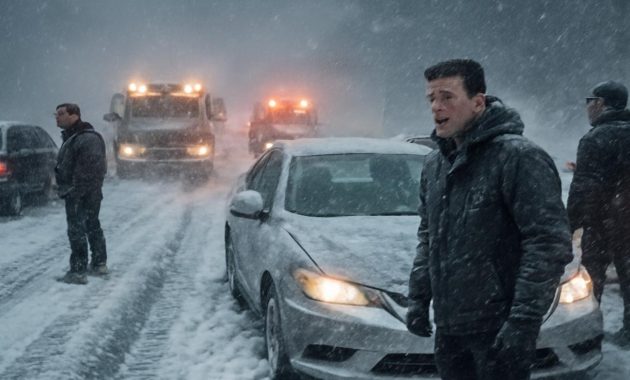
The first thing people noticed wasn’t the snow itself. It was the silence—the soft, padded quiet that settled over the town just after dusk, as though someone had slipped a thick wool blanket over every sound. Streetlights glowed in hazy halos, catching a steady curtain of flakes drifting down at an angle, almost lazy. But the radar screens in the highway operations center told a different story. On those glowing monitors, an angry bloom of color erupted over the region like a bruise, expanding and deepening by the minute. Somewhere between the gentle hush outside and the shrill beeping inside, a snowplow operator reached for his radio and said, “We’re going to lose the roads.”
The Forecast That Changed Everything
All day, the weather had been flirting with the idea of trouble—whispers of “significant snowfall,” hints of “rapid accumulation,” the usual winter drama that most drivers meet with a shrug and a fresh cup of coffee. But as the evening commute crept closer, the language from forecasters sharpened. “Heavy snow bands.” “Whiteout conditions likely.” “Travel may become impossible within minutes.”
By the time commuters started packing up their laptops and tugging on winter boots, the official update landed: a flash snow event, intensifying faster than models expected. The phrase that stuck out—cold, clinical, and terrifying—was this: roads may become impassable in under 15 minutes once heavy bands arrive.
Fifteen minutes. That’s barely a podcast intro. It’s less time than it takes to crawl through one city intersection at rush hour. Suddenly, every choice that seemed simple a few hours before turned into a small, personal crisis. Do you race home and risk getting trapped on a highway that might vanish under a white blur? Or do you abandon your car where it sits—parking garage, curbside, office lot—and wait the storm out, surrendering to the snow’s timetable instead of your own?
In offices, on factory floors, in grocery store break rooms, people stared at their phones, re-reading the alert. The words didn’t quite feel real, like a movie script accidentally delivered by push notification. Outside, the snow still looked almost delicate. Inside, adrenaline began to simmer.
When the Storm Outruns the Plows
On a normal snowy day, the relationship between storm and snowplow is a kind of dance—predictable, practiced, if occasionally grumpy. Snow falls, plows roll. They push it aside, throw down salt or brine, and the road reappears in lines of black asphalt cutting through white. But this time, the storm came with a different choreography.
In the operations center, regional maps glowed with colored highways. Each color represented a status: clear, partially covered, fully snow-covered, or “travel not advised.” By early evening, a new patchwork started to form—a mosaic of red and purple lines marching steadily outward from the storm’s heart.
Plow drivers listened to the updated forecast in their cabs, heaters buzzing, wipers squeaking against already crusting glass. They were used to hard nights, to the loneliness of long miles and the hypnotic swirl of snowflakes in their headlights. But snowfall totals weren’t the real headline this time. It was the rate.
Two, three, even four inches an hour in the heaviest bands—thick enough that plowed roads could vanish again before the plow even looped back. Add fierce winds sculpting drifts across lanes like sudden walls, and the calculus turned brutal.
One driver, Liam, nudged his truck into fourth gear, the big diesel growling up a gentle grade. Ahead, a line of red taillights burrowed through the storm like a caravan of desperate beetles. “I’m trying to keep one lane open,” he told the dispatcher, eyes narrowed to slits against the constant flicker of white. “But it’s like pushing water back into the ocean.”
The storm wasn’t just falling; it was racing—and, mile by mile, it was winning.
The Moment the Roads Start to Vanish
From the driver’s seat of a commuter sedan, the transformation happens in stages so subtle you don’t realize where you crossed the line. First, your tires stop making that familiar hiss of rubber on wet pavement and move into a soft, muffled crunch. Street paint—the yellow and white lines that organize your sense of space—begins to blur, then dissolve completely. You’re steering not by markers, but by memory.
Wind pushes curtains of snow sideways, as if someone’s shaking a white rug above the road. The guardrail on your right becomes a ghost, a shadow, then disappears entirely. You lean forward instinctively, as if closer will somehow mean clearer.
Then the real shift comes: your speedometer says 30, but your body says 60. The world beyond your windshield shrinks to a shallow dome of vision—maybe two, three car lengths—and beyond that, nothing. The highway becomes a rumor. The lane you’re sure you’re in might actually be the shoulder. Or the grassy median. Or the oncoming lane. You don’t know. You just hope.
This is where plows are supposed to be your lifeline, carving a playable path through chaos. But during this kind of storm, even their bright amber strobes can disappear in the churn. Drivers following closely behind a plow for safety suddenly lose it in the whiteout, as if it had been swallowed whole.
On the scanner, chatter rises: stalled vehicles, jackknifed trucks, someone spun out and facing the wrong way on the interstate. The language shifts from “slow travel” to “do not travel.” Yet thousands of cars are already out, threading their way through a game whose rules keep changing every mile.
Snowplow Showdown: Machines vs. Momentum
There’s a quiet, gritty heroism to snowplow work that rarely makes the news—unless something goes terribly wrong. Behind every cleared lane is a person who’s been awake since before dawn or who hasn’t seen their own driveway in daylight for days. On a night like this, their task becomes almost mythic: hold the roads long enough for people to get home, or to shelters, or just to some kind of safety before the storm slams the door completely.
But even heroism has limits. With snowfall piling up faster than it can be moved, every decision starts to feel like triage. Highways over side streets. Major arteries over sleepy cul-de-sacs. Hospital routes over mall parking lots. In the control room, pins on the map mark trouble spots: steep grades where trucks are already losing traction, intersections notorious for fender-benders in the best conditions, bridges that freeze over as soon as the temperature blinks.
Radio calls turn clipped and urgent:
“Unit 12, we’ve got three stuck on the hill, blocking both lanes.”
“Do I try to get in there, or stay on Route 6?”
“…Stay with 6. We’re losing it.”
Old-timers, the drivers who can read snow the way sailors read waves, talk about storms like this in almost physical terms. The snow has a “heft,” a “texture,” a “temper.” This one is dense, wind-packed, fighting back against the blade in heavy curls. By the time a plow completes a six-mile loop, its own tracks have nearly vanished. It’s like sweeping the floor in a house that’s still under construction, sawdust spinning down the air faster than the broom can move.
Everywhere, momentum grows—snow’s, wind’s, panic’s. The showdown isn’t just between storm and steel; it’s between the slow, methodical progress of public safety and the restless impatience of human schedules, appointments, school pickups, evening shifts that can’t be skipped. The snow doesn’t care why you’re on the road. It only cares that you’re there.
Risk the Drive or Surrender the Car?
This is where individual lives compress into one fraught question: Do I try to make it, or do I stop now? It’s rarely a clean choice. There’s a sick child at home waiting for medicine. There’s a dog in a crate that hasn’t been let out since noon. There’s a boss who “really needs you” for the closing shift. There’s rent you can’t afford to lose. Weather alerts don’t know about any of that.
You pull your car out of the lot anyway, reasoning that the route is familiar, the drive short. You’ll just go slow. Everyone says that—I’ll just go slow—like it’s a spell against physics.
Ten minutes later, the storm’s heaviest band hits. Snow cascades down in thick ropes, the air filling with spinning crystals that your headlights turn into pure glare. Your anti-lock brakes stutter at the first real stop sign. A downhill slope appears where you don’t remember one being. Your tires float for a heartbeat on slush, and the steering wheel goes light in your hands.
Somewhere ahead, taillights flash erratically—someone has stopped, or slid, or both. The road narrows to a single uncertain path marked by rutted tracks already filling in. Your heart does that tight clench when you realize: you’re committed now. Turning back might be just as dangerous as pushing forward.
This is the emotional center of the snowplow showdown—not the big machines grinding across interstates, but the quiet, desperate calculus inside each sealed-up car. Staying put feels wrong, like surrender. Moving on feels reckless, like tempting fate.
Some drivers pull into plowed gas stations and idle in long, steaming lines, the smell of exhaust mixing with frozen air. Others angle their cars into the edge of a parking lot, snow already building up to the wheel wells, and call friends or family with shaky voices. A few, stubborn or brave or just exhausted, push on until they can’t anymore—until the car finally fishtails into a drift, or a hill turns into a slick white slide that gravity wins.
How Fast “Buried in Minutes” Really Happens
“Buried in minutes” sounds like hyperbole until you stand on the shoulder of a road during a peak band of lake-effect or nor’easter snow. The flakes thicken from lace to felt, from airy to wet and heavy. In the time it takes to lace up your boots, a thin dusting becomes a visible layer. In the time it takes to argue with yourself about whether to leave now or wait, your car’s windshield grows an opaque frost mask.
Let’s say a typical sedan sits with about eight inches of clearance. At a snowfall rate of three inches per hour—with drifts much higher in wind—your vehicle’s undercarriage starts to plow its own reluctant furrow in less than half an hour. If you stall out or slide off into a shallow ditch, what looks “not that bad” at 6:10 p.m. can be half a door deep by 6:40.
Here’s a simple way to picture it:
| Time Stationary in Heavy Snow | Snowfall Rate | Likely Effect on a Parked or Stuck Car |
|---|---|---|
| 15 minutes | 2–3 in/hour | Tires partially covered; traction already reduced, visibility much worse |
| 30 minutes | 2–3 in/hour + wind | Drifts forming around wheels; risk of getting stuck leaving a spot or shoulder |
| 60 minutes | 3–4 in/hour + wind | Car can be drifted in above the rocker panels; doors harder to open, exhaust pipe at risk of blockage |
| 2+ hours | 3–4 in/hour + gusts | Vehicle potentially “invisible” from a distance; plows may bury it further while clearing lanes |
Meanwhile, plows are trying to keep at least one navigable path open on main routes. But to do that, they often have to push snow outward—toward medians, curbs, and, inevitably, around stranded vehicles. A car abandoned at a bad angle can turn from an inconvenience into an anchor around which drifts form like miniature snow dunes. Which means, paradoxically, that leaving your car in the wrong place can make it harder for rescue or emergency crews to reach you or anyone else.
It’s a bitter kind of math. In the very storms that make people want to stay with their cars, their cars can become the least safe place to be—especially if the engine keeps running, snow piles up over the tailpipe, and invisible exhaust fumes start seeping silently into the cabin.
The Human Soundtrack of a Whiteout
Listen closely in a storm like this, and the landscape has its own shifting soundtrack. The deep, throaty scrape of plow blades on pavement. The hollow whump as they throw arcs of wet snow against embankments. The irregular spin and whine of stuck tires digging themselves deeper. A horn, held down a second too long, edged more with fear than frustration.
In neighborhoods, the world contracts to the distance of a front porch light. People crack their doors, half expecting to see their street completely transformed—and it is. Cars that were clean and defined an hour earlier soften into rounded shapes, outlines blurred under thick white coats. Footprints disappear. Fence posts become stubby white columns. The sky and the ground merge into one continuous, unbroken gray.
From living rooms, blue weather maps glow on screens, arrows and warnings flashing. Some families text loved ones still on the road: “Where are you now?” “Can you pull off somewhere?” “Please just stay put.” Others are the ones answering those texts from the front seats of slowing cars, watching snowflakes slam against their windshields like they’re driving into static.
In those moments, the snowplow showdown stops being abstract infrastructure drama and becomes deeply personal. It’s about who will get home and when, and whether the thin orange lights of a plow will appear ahead like a kind of moving refuge, or never appear at all.
Learning to Read the Storm’s Terms
Every big winter storm writes its own folklore, a series of stories that locals tell for years afterward: the night the interstate turned into a parking lot, the time neighbors skied down the main street, the morning someone opened their door to a wall of snow. Embedded in those stories is a quieter lesson: storms like this don’t negotiate. They announce their terms, and our best chance lies in reading those terms early and clearly.
For drivers, that means understanding that “heavy snow” isn’t just about how pretty it looks under streetlights. It’s about visibility dropping to near zero without warning. It’s about plows physically unable to keep up, no matter how many are deployed. It’s about your margin for error shrinking from yards to inches.
The more we listen to the language of these forecasts—words like “rapid deterioration,” “whiteout,” “flash freeze”—the more they start to feel less like noisy background and more like the opening chapter of a story we get to help shape. The decision to leave work an hour early, to cancel that drive, to check on a neighbor before the roads disappear—that’s not surrender. It’s partnership with the place you live in, and with the people tasked with keeping its arteries open through the longest nights.
Out on the highway, Liam finishes another slow pass, blade down, pushing a wave of snow taller than a toddler off to the side. Behind him, for a few fleeting minutes, black asphalt appears again, streaked and wet, like a river of dark steel cutting through a white canyon. He knows it won’t last. The storm is still winning. But for now, somewhere behind his truck, a few dozen drivers get to follow in his wake, hazard lights blinking, making their way through the storm’s terms as safely as they can.
Up ahead, the snow thickens once more, swallowing his own taillights into the glow. He lowers his head, tightens his grip on the wheel, and pushes on.
FAQ
What does it mean when snowfall is forecast to “bury roads in minutes”?
It usually means snowfall rates of 2–4 inches per hour or more, often combined with strong winds. In those conditions, roads can go from wet to completely covered and nearly impassable between typical traffic light cycles or within a single short commute.
Why can’t snowplows keep up during these intense storms?
Plows work in loops, and when snow is falling faster than they can complete a pass, the cleared lanes fill back in before they return. High winds also blow snow back over freshly plowed stretches, and stuck or crashed vehicles can block access to critical areas.
Is it safer to keep driving slowly or to stop and wait it out?
If visibility drops to near zero or you’re losing traction, it’s often safer to exit the road as soon as you can find a safe, well-lit place—such as a plowed lot—rather than stopping on the shoulder. Stopping in live lanes or on blind curves is extremely dangerous in low-visibility conditions.
What should I do if I get stuck or stranded in my car?
Stay with your vehicle unless you can clearly see safe shelter nearby. Run the engine intermittently for heat, ensuring the exhaust pipe stays clear of snow. Turn on hazard lights, conserve phone battery, and call for help with your precise location if possible.
How can I prepare before a storm like this hits?
Keep your gas tank at least half full, carry a winter kit (blanket, shovel, food, water, flashlight), and closely monitor updated forecasts. If officials strongly discourage travel, adjust plans early—leaving before the worst bands arrive is far safer than trying to outrun them once they’re overhead.