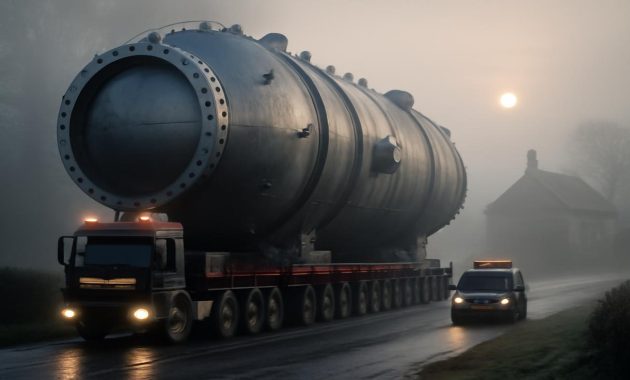
The ship slid upriver in the dark, a hulking shadow against the grey Bristol Channel sky. No banners, no brass band, no minister in a high‑visibility vest waving for the cameras. Just diesel engines, security cordons, and—bolted to the vessel’s spine—a 500‑tonne steel cylinder: a nuclear “heart” forged in France, destined for the concrete belly of Hinkley Point C. On the cliffs above, dog walkers hunched into the wind, barely glancing at the quiet arrival of one of the most controversial machines in Britain’s recent history. Below them, an industrial ritual of our age was unfolding: one country’s engineering pride, another’s energy gamble, and taxpayers in both asking, often aloud, why they are paying so much for power they might never fully control.
When a Colossus Crosses the Sea
The 500‑tonne reactor pressure vessel—an immense steel casing that will one day cradle superheated water and fuel rods—is not really designed to be seen. Its future life is hidden, deep within layers of reinforced concrete, sealed away from everything it is meant to serve. Yet seeing it in transit, riding a barge like a beached whale in chains, forces the question: what exactly have we signed up for?
On paper, the journey is simple enough. From the foundries and assembly halls of Framatome in France, the vessel is transported to a port, craned onto a heavy‑lift ship, carried round coastlines and estuaries, then eased onto a custom‑built trailer, each wheel the height of a child. It creeps along cordoned‑off roads at walking pace, escorted by police cars and engineers with radios, until finally it disappears behind the fences of Hinkley Point C in Somerset.
In that movement—from French steelworks to English clay—we can trace a story of globalised energy, of political promises, and of an uneasy partnership between foreign state‑backed giants and the people expected to foot the bill. This is not just an engineering project. It is a social contract written in atoms, subsidies, and decades‑long guarantees.
The Quiet Price of “Cheap” Electricity
Successive UK governments have sold Hinkley Point C as part of a grand solution: low‑carbon, “reliable baseload” electricity for around six million homes, for sixty years or more. They point to the climate crisis, to aging fossil fuel plants, to the need to keep the lights on when the wind doesn’t blow and the sun doesn’t shine. Set against that looming challenge, a few ships landing scratch‑built nuclear colossi can seem almost heroic.
But beneath the rhetoric lies an awkward detail: in order to get those foreign firms—mainly the French state‑backed EDF and its Chinese partner, CGN—to build Hinkley at all, Britain promised them something extraordinary. A guaranteed price for the electricity, locked in for 35 years, and index‑linked to inflation. While wholesale energy prices rise and fall like tides, Hinkley’s future output has been promised a smooth, golden river of income.
Taxpayers and bill‑payers are not funding Hinkley through a single up‑front cheque so much as through a long, slow drip. Every electricity bill, for decades, will carry a whisper of that bargain. When you boil a kettle in 2040, a slice of its cost will be heading—via EDF’s accounts—back across the Channel, paying for that night an invisible ship nosed into a Somerset port with a 500‑tonne talisman of the nuclear age.
The Numbers Behind the Glow
It is hard to keep track of a project that stretches over multiple governments and generations. To bring the scale into focus, it helps to lay the bones of the deal on the table.
| Key Aspect | Details |
|---|---|
| Main Developer | EDF (majority owned by the French state), with Chinese partner CGN |
| Project Type | Two EPR nuclear reactors at Hinkley Point C, Somerset |
| Reactor Vessel | Approx. 500 tonnes each, manufactured in France and shipped to the UK |
| Contract Length | 35 years “strike price” guarantee for electricity generated |
| Who Ultimately Pays? | UK consumers through energy bills, and potentially taxpayers via wider support |
This is the part that sticks in the throat of many: the quiet certainty that profits—should they come—will mostly accrue abroad, while the risk of high bills and any political backlash will be borne at home.
Steel, Steam, and Sovereignty
When that French‑forged vessel is finally lowered into its concrete cradle, it will be slotted into a web of pipes, pumps, turbines, and cables made by yet more foreign and domestic specialists. It will not “know” that it is in Britain. At full power, it will not care whether its neutrons are heating showers in Bristol or buzzing factories in Birmingham. Yet wrapped around that vessel is a deep set of questions about sovereignty.
Energy is one of the quiet foundations of national independence. It is hard to speak of taking control of borders or budgets when your winter warmth and industrial heartbeat depend on international corporations and state‑backed enterprises whose priorities you do not set. When France loads a 500‑tonne reactor component onto a ship and sends it to a British coast, it isn’t conquering territory, but it is shaping the future physics of Britain’s power grid.
For some, this is simply the reality of a connected world. No country makes everything; supply chains stretch over oceans; the days of purely national megaprojects are gone. For others, it feels like a quiet surrender. Britain, once a pioneer of nuclear power, now relies on foreign designs, foreign capital, foreign engineering capacity—even as it underwrites the long‑term costs through its own citizens’ bills.
Watch the vessel inch along the specially reinforced roads near Hinkley and the abstract debate turns curiously tangible. The steel was poured elsewhere, the profits will flow elsewhere, but the security fences, the spent fuel, and the protests will live on British soil.
Why Taxpayers Feel the Heat
Ask around in the nearby towns and villages—Bridgwater, Burnham‑on‑Sea, the cluster of hamlets along the Quantock Hills—and you will hear mixed feelings. Some have found work on the project; hotels and rental homes are full of contractors; cafés serve hi‑viz breakfasts at dawn. Others see only congestion, rising rents, and a sense that the real winnings are happening far away.
The questions come thick and fast:
- Why are household bills underwriting guaranteed returns for a foreign‑owned company?
- Why was such a generous price agreed, when renewables like wind and solar now undercut it per unit of electricity?
- Why, if this is “British” energy security, does so much of the core technology arrive shrink‑wrapped from overseas?
Politicians answer with familiar lines: energy security, jobs, climate responsibility. They point to the complexity of building the first new nuclear plant in a generation, to the skills being developed, to the supply chain anchored in British firms. And there is some truth there. Massive projects are rarely simple villain‑hero stories.
Yet the structure of the deal means that ordinary people absorb much of the uncertainty. If costs spiral, schedules slip, or technical issues emerge—as they have on similar EPR reactors in France and Finland—the companies will push to protect their returns. Governments, terrified of blackouts and political fallout, will be tempted to sweeten terms. The invisible colossus may be French steel, but the safety net underneath it is woven from British wallets.
The Landscape Remembers
Stand on the shingle beach just down the coast and you can hear the sea muttering against the shore, the same restless rhythm that crashed here long before the first Hinkley station was built in the 1960s. Back then, nuclear energy arrived with a kind of futuristic optimism: clean, modern, a promise of power “too cheap to meter,” as its early evangelists liked to say.
The reality turned out messier: accidents abroad, cost overruns at home, a mounting stockpile of radioactive waste with no permanent solution. Yet the dream never fully died. Faced with the climate crisis, nuclear has regained a certain grim allure—an option that, while flawed, can churn out vast amounts of low‑carbon electricity from a small patch of land.
What makes the modern version different is the way it sits inside a globalised economic system. The old nuclear plants felt, if not exactly home‑grown, at least rooted in national projects. Today, the Hinkley colossus feels more like a node in a sprawling network of state interests, financial engineering, and transnational risk.
The landscape will remember all of it: the slow caravans of oversize loads inching through country lanes; the sudden appearance of tower cranes on the horizon; the years of construction dust and floodlights; the quiet hum—one day—when the station finally comes online and the current begins to flow.
Could We Have Chosen Another Path?
It is tempting to imagine alternative futures. A Britain that doubled down on offshore wind and tidal power, threading turbines along its storm‑rich coasts and harnessing the Severn’s famous tides. Streets thick with insulation crews; roofs glittering with solar panels; communities part‑owning their own small‑scale generation; a grid smarter and more flexible, sharing power instead of just shipping it from monolithic plants.
Some of that is happening. Wind power has surged; solar has grown quietly on warehouses and homes; battery storage is spreading. Costs have plunged. In competitive auctions, renewables often bid far below Hinkley’s locked‑in power price. Yet the government still chose to anchor its future plan with this enormous, foreign‑built nuclear cornerstone.
To its advocates, that is simply prudence. Sun and wind fluctuate; demand spikes on cold, still evenings; decarbonisation demands a reliable backbone. To its critics, it is a failure of imagination and industrial strategy, propping up an old model of centralised, capital‑heavy generation that locks in high costs and foreign dependence.
Both views contain pieces of the truth. But the ship hauling that 500‑tonne vessel across the Channel doesn’t care about policy nuance. It is just one more movement in a commitment that has already been made, one more steel‑clad confirmation that, for better or worse, Britain has chosen this path.
A Colossus in the National Imagination
Years from now, most people will never think about the origin of the metal at the heart of their electricity supply. They will flick a switch, plug in a car, stream a film, and complain about the bill. The French vessel, now invisible behind layers of shielding, will toil away in near‑silence, heating water to unimaginable temperatures and pressures, spinning turbines, feeding the grid with its atomic heartbeat.
But perhaps we should remember how it arrived—how a foreign state‑backed company became the custodian of such a critical piece of our infrastructure, how the costs and risks were socialised while the control remained elsewhere. Not out of resentment, but out of clarity. Energy is not just a commodity; it is a story we tell about who we are, what we value, and how much trust we place in distant powers.
The dog walkers on the cliff will change. The ministers and executives who signed the contracts will retire or move on. Children not yet born will inherit the long tail of this decision: the bills, the waste, the carbon avoided, the jobs created, the politics of dependence. Somewhere deep within Hinkley’s maze of steel and concrete, the French‑forged colossus will keep working, indifferent to borders, quietly reshaping the balance between nations every second it runs.
On that first night, though, as the ship edged toward the jetty under sodium lights, it was still just a shape in the dark. The sea hissed against the hull; winches squealed; gulls circled, calling at the disturbance. Above, in warm living rooms dotted across Somerset and beyond, people boiled kettles, charged phones, and put children to bed, unaware that a new chapter of their energy future had just slipped almost unnoticed into port.
Frequently Asked Questions
Why is a French company supplying key components for Hinkley Point C?
EDF, which is majority owned by the French state, is the main developer of Hinkley Point C. It uses its own EPR reactor design and supply chain, including large components manufactured in France. The UK government invited EDF to build the plant because Britain no longer had a domestic company capable of delivering a project of this nuclear scale alone.
How are UK taxpayers and bill‑payers involved financially?
Instead of paying directly from general taxation, the main support comes via a guaranteed electricity price for Hinkley’s output over 35 years. If the market price of electricity is lower than this fixed “strike price,” consumers effectively make up the difference through their bills. Taxpayers may also be indirectly exposed through wider government guarantees and support mechanisms.
Is nuclear power from Hinkley Point C really low‑carbon?
Yes, in operation nuclear plants emit very low levels of greenhouse gases compared with fossil fuel stations. There are emissions associated with construction, mining, fuel processing, and decommissioning, but over its lifetime nuclear is generally considered a low‑carbon source of electricity, comparable to some renewables.
Why didn’t the UK just build more wind and solar instead?
The UK has significantly expanded wind and solar, and their costs have fallen sharply. However, they are variable sources, depending on weather and daylight. Supporters of Hinkley argue that nuclear provides steady, predictable “baseload” power. Critics say that modern grids can balance renewables with storage, demand management, and flexible generation without needing such an expensive nuclear project.
What happens to the nuclear waste from Hinkley Point C?
High‑level waste, mainly spent fuel, will be stored securely on site for decades, in specially engineered facilities. The UK plans to develop a deep geological disposal facility for long‑term storage, but this has not yet been completed. Ultimately, the management and disposal of nuclear waste remains a long‑term responsibility borne by the host country.
Will the power from Hinkley Point C make my bills cheaper?
Hinkley is unlikely to reduce bills in the short term. Its guaranteed price is higher than recent bids from new wind and solar projects. However, proponents argue that over its long life it will provide price stability and insulation from volatile fossil fuel markets, which could prevent even higher costs in some future scenarios.
Is it normal for foreign state‑backed firms to own key energy assets?
In today’s globalised energy market, it is not unusual. Many countries host foreign‑owned utilities, pipelines, and power stations. What makes Hinkley particularly contentious is its scale, long‑term contracts, and the strategic nature of nuclear power, which sharpen concerns about sovereignty, national security, and who ultimately benefits from the investment.