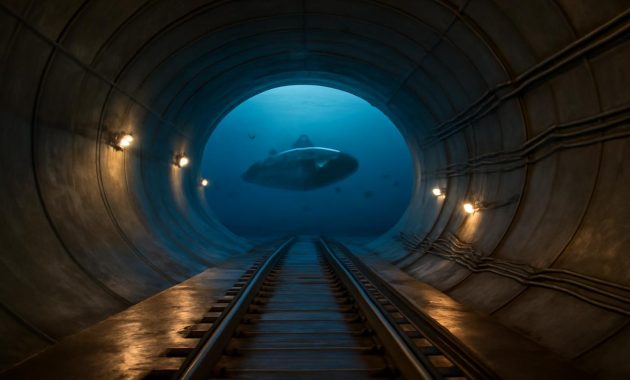
The first rumor arrives as casually as a weather update. An engineer friend sends a late-night message: “They’ve started. The machines are actually in the water.” No fanfare, no breaking news alert, just a line of text that feels almost too calm for what it means. After more than a century of sketches, proposals, and dismissed fantasies, construction has begun on a rail line that will run beneath the oceans—a continuous, pressurized, steel-and-carbon-fiber thread, stitching entire continents together through the darkness of the deep sea.
The Day the Impossible Became an Engineering Project
In the control room, the lights are low to keep the screens easy on the eyes. A ring of monitors curves around a group of people in polo shirts and fleece jackets, their faces reflected in satellite maps and live feeds from the seafloor. Outside, waves slap against the hull of the support vessel. Inside, coffee cools untouched.
On one of the center screens, a robotic submersible crawls across the sediment like a bright mechanical crab. Its cameras peer into the gloom, illuminating a ribbon of freshly laid tunnel shell—segment zero of a project that could make you board a train in one hemisphere, plug in your laptop, fall asleep to the muted hum of the rails, and wake up breaching daylight on another continent.
“We’ve talked about this for thirty years,” says Elena Park, one of the senior engineers supervising the operation. Her voice is steady, but she taps her pen against the console, an old habit from nervous grad-school presentations. “Now we’re not simulating anymore. We’re actually here.”
The here she means is both literal and abstract. Literally: a ship anchored above a mid-ocean ridge, with weather shifting by the hour and waves that can turn from gentle to hostile in a day. Abstractly: standing at the front edge of a human endeavor that sounds like folklore until you see the blueprints, the budget, the legal agreements, the kilometers of prefabricated tunnel sections stacked like enormous silver vertebrae in coastal yards around the world.
Descending into the World Beneath the Waves
No one will ever lean out a train window and see this tunnel from the outside. That is the strange, almost melancholy beauty of it. The structure has been designed not to be seen, only to be trusted.
Picture a long, hollow needle, not resting on the seabed, but floating, tensioned, and anchored, like a cello string pulled taut between continents. In the shallows and along continental shelves, it will burrow beneath the seafloor, shielded by rock and sediment. In the abyssal plains and deep ocean trenches, it will be housed in a pressurized shell, suspended from gigantic mooring systems drilled into the crust. It will flex, ever so slightly, with tides, earthquakes, and the restlessness of a living planet.
Construction had to start almost invisibly. First came years of surveys: sonar mapping the dramatic folds of underwater mountains, autonomous drones reading the subtle chemistry of seawater, and satellites tracking the shifting tectonic plates. Biologists identified migration corridors for whales, dolphins, and deep-diving turtles, ensuring the structure’s anchors and maintenance portals would avoid these living highways.
Only when the maps were layered and the models agreed did they begin to send down the first components—segment by segment, lowered through water a few meters at a time. On screen, the process looks almost delicate: a bright rectangle descending into blue-black nothingness, guided by thrusters and laser measurements, until it lines up with the previous piece and seals with a practiced, hydraulic embrace.
The Tunnel That Moves with the Earth
“You can’t fight the ocean,” says Akash Menon, a structural engineer who has spent his career studying how bridges and tunnels flex. “You listen to it. You move with it, or it tears you apart.”
To cross ocean basins that plunge 4,000 meters or more, the designers borrowed lessons from suspension bridges, oil platforms, submarines, and space stations. The tunnel walls will be made from layered composite materials—steel, high-strength carbon fiber, nano-engineered ceramics—that can withstand staggering pressure while remaining elastic enough to ride out seismic jolts.
Sections of the line will be built as “floating tunnels,” submerged 50 to 200 meters below the surface, tethered to the seabed with cables thick as ancient tree trunks. Deeper portions will be routed through undersea canyons where the geography offers shelter. Every few hundred kilometers, there will be reinforced maintenance and evacuation nodes—silent chambers in the dark, each outfitted with emergency submersibles and pressurized docking bays.
The teams talk about these structures with the calm, detailed focus of people discussing kitchen renovations. Load-bearing tolerances, corrosion rates, microcracks from temperature cycling. But the scale plays tricks on your sense of proportion. One “short” segment under review—just a small part of the first phase—will span a distance longer than many countries.
| Feature | Approximate Value |
|---|---|
| Initial tunnel phase length | 3,500 – 4,000 km |
| Maximum operating depth | Up to 4,000 m below sea level |
| Planned cruising speed of trains | 500 – 700 km/h (pressurized environment) |
| Projected travel time: Continent to Continent | Under 8 hours (depending on route) |
| Estimated CO₂ reduction vs. air travel | Up to 80% per passenger-km |
Between Continents, A New Kind of Journey
The future passenger experience is being prototyped in a warehouse thousands of kilometers from the sea. Step into the mock-up and you’re greeted by quiet. No engine roar, no buffeting wind. The car is a long, softly lit capsule: wide windows that will show an artificial horizon and shifting ambient light to keep your body clock in tune; reclining seats that rotate so families and friends can face each other; soundscapes that can mimic forest rain, city streets, or nothing at all.
Trains in this tunnel won’t go quite as fast as their vacuum-tube hyperloop cousins once promised, but they’ll move faster than conventional high-speed rail, riding in a controlled, pressurized tube where weather doesn’t exist and friction is partly tamed. You’ll board in one climate and disembark in another, having watched no landscape out the window, yet having passed beneath entire weather systems, above submarine ridges, and under migratory arcs of birds and whales.
“We had to rethink what ‘view’ means,” says designer Louise Tremblay, rubbing a thumb across a swatch of seat fabric the color of sea glass. “Out there, it’s dark. It’s beautiful in its own way, but it’s not the kind of thing you stream for entertainment. So the view becomes about connection in other ways—live data from the ocean, simulated journeys, shared spaces on board.”
In one concept, parts of the ceiling become a live canvas of the sea above: currents rendered as color, schools of fish as glimmering arcs, whale songs translated into shifting geometries. It will still be a tunnel, yes. But it could also be a quiet, moving observatory for a world humans rarely see.
Engineering with the Ocean, Not Against It
For all its alchemy of steel and software, this project is being watched most closely by people who care about the very thing it might disturb: the ocean itself. The memory of earlier, clumsier feats of infrastructure runs deep—pipelines scarring seafloors, shipping routes colliding with whale habitats, noise that travels farther underwater than most of us ever imagined.
“You can’t just lay a metal line across a living system and expect nothing to happen,” says marine ecologist Dr. Samira Ortega, scrolling through years of acoustic data on her laptop. “The ocean is full of voices: shrimps, fish, whales. Noise is one of the great invisible pollutants.”
From the beginning, the rail consortium had to open its planning rooms to biologists, oceanographers, and Indigenous communities whose knowledge of coastal waters stretches far beyond satellite imagery. Construction windows were timed around breeding seasons for key species. Underwater machinery was retrofitted with noise-dampening housings, and anchor points were relocated when surveys found fragile coral gardens or deep-sea sponge fields.
The idea is that, once built, the tunnel’s day-to-day impact should be quieter than a cargo ship, with the added benefit of potentially reducing long-haul air and sea traffic. Trains will run in a sealed tube; their vibrations and sound mostly trapped and managed. Even so, monitoring arrays—tiny listening stations on the seafloor—will keep an ear on things: whale calls, snapping shrimp, the low thunder of distant storms. If certain frequencies spike, if the ocean’s voices shift in unforeseen ways, there are plans to adapt operating speeds, maintenance schedules, and perhaps, one day, technology we haven’t yet invented.
The Long Shadow of Climate and Time
It’s easy to talk about grand projects as if they exist outside history, but this tunnel is being born into a world already unsteady with change. Glacier melt is altering sea levels. Currents are wobbling. Weather systems are weaving new and uneasy patterns. The engineers are not blind to this. They design not for a static ocean, but for a restless one.
Every anchor, every mooring cable, every composite shell is modeled against scenarios that stretch far beyond the end of most political terms: higher seas, more violent storms, temperature shifts that warp the chemistry of the water itself. The structure, in theory, could last a century or more. It must learn to live in oceans that will not be the same oceans we know today.
“We joke that the tunnel will experience more climate futures than any single person,” says Park, half-smiling, half-worried. “So we design like we’re building a ship for a voyage our grandchildren will be on, long after we’re gone.”
In this way, the rail line becomes not just an answer to logistical questions about speed and connectivity, but a reflection of how seriously we take our own long-term presence on this planet. It is infrastructure as a statement about whether we plan to be here, still moving, still connecting, still trying to do better.
A New Geography of the Imagination
For centuries, maps have drawn oceans as blank blue spaces, wide bands of nothing between the intricate shapes of continents. The first globes were built in a time when crossing the seas meant weeks of creaking wood and sailcloth. Then came steamships and transoceanic flight, shrinking those distances into something almost casual. Yet psychologically, the oceans have stayed vast and separate, a kind of frontier between worlds.
This tunnel threatens to redraw that emotional geography. If you can board a train on one side of the planet and arrive on another without ever seeing sky or water, what happens to your sense of distance? What happens to the idea of “overseas” when the sea is no longer something you cross, but something that hums quietly above your head while you read a book or video call a friend?
Some critics worry about what might be lost in the speed. That vastness, that sense of crossing a threshold, has shaped art, migration, even the rhythm of letters and stories. To erase it with a sealed steel corridor feels, to some, like flattening the globe into a logistics problem.
Others argue that the psychological gap is already gone. Our messages cross oceans in milliseconds. Our economies are entangled from port to port. The tunnel doesn’t make the world small; it just makes our physical bodies as quick as the rest of our lives.
Voices from the Edge of the Future
In a small coastal town that might one day be a major terminal, reactions are mixed in a deeply human way. On the pier, an old fisherman squints at the cranes on the horizon and shrugs. “We’ve been watching ships come and go all my life,” he says. “If they want to put their train under the water now, fine. Just don’t scare the fish.”
A few blocks inland, a café has started naming drinks after the project: Abyss Espresso, Continental Drift Latte. Two students at the counter argue about whether they’ll trust the idea of traveling under four kilometers of water. “I already don’t think about how high up I am in a plane,” one says. “This is just the same, but sideways.”
On a video call from the engineering vessel, Park listens to these reactions with the tired amusement of someone who knows that public opinion will swing a hundred times before the project is done. “It’s like every big leap,” she says. “Some people see hope. Some see risk. Most people see inconvenience and construction noise. But in a few decades, if we’ve done it right, their kids won’t remember a world where this seemed impossible.”
In the background of her feed, a technician calls out a series of coordinates. Another tunnel segment is being lowered. Another small piece of impossible is becoming ordinary.
Between Fear and Wonder, A Metal Line in the Dark
It’s tempting to dress this story up as pure triumph: human minds outwitting depth and darkness, building a sleek future beneath the waves. But the truth is more complicated, more interesting. The tunnel is a negotiation—between ambition and restraint, convenience and respect, speed and silence.
Stand on the deck of the support vessel at night and the scale hits differently. The sea is a black plain, the stars cold and scattered. Below you, machines hum and lights glow in colors fish have never seen. Beyond the circle of illumination, the water is full of lives that do not know what a continent is, let alone a rail line.
Somewhere in that layered darkness, a new path is taking shape—a careful, heavily calculated intrusion, yes, but also a bridge that might, if we are lucky and wise, help us burn less fuel, fly less, and feel the distances between us soften in ways that matter.
When the first passengers board—years from now—they may think mostly about departure times, luggage limits, and socket adapters. They will step into a train, settle into their seats, and watch a door close. They may not think, in that moment, about the whales sweeping through the water above them, or the cables holding the tunnel in place, or the decades of argument and experimentation that made their journey possible.
But someone will. And perhaps that’s the quiet promise of this underwater rail line: not only to shrink the world, but to deepen our awareness of the layers we pass through, the worlds we usually ignore. A reminder, carried at 600 kilometers an hour beneath an endless weight of water, that even the most advanced infrastructure is still, always, built inside a living Earth.
Frequently Asked Questions
Is the underwater rail line actually under construction now?
Yes. According to the engineering teams and partner agencies involved, preliminary construction and installation of initial tunnel segments and anchor systems are already underway at selected deep-sea locations, following years of mapping, design, and environmental review.
How safe will traveling through a deep-sea tunnel be?
Safety is being treated as the central design requirement. The tunnel will use multiple layers of pressure-resistant materials, redundant sealing systems, and frequent emergency nodes equipped with life-support systems and evacuation submersibles. It is being designed to meet or exceed the safety standards of both modern aviation and high-speed rail.
What about earthquakes and undersea volcanic activity?
The route has been planned to avoid the most active seismic zones where possible. Where crossing tectonically busy regions is unavoidable, the tunnel will use flexible joints, shock-absorbing mounts, and real-time monitoring to allow for controlled movement. Structural systems are being modeled against worst-case earthquake and seafloor shift scenarios.
How will this project impact marine life?
Environmental impact has been a major point of scrutiny. Construction is being timed and located to avoid critical breeding and migration areas, and machinery is fitted with noise-dampening technology. Once operational, the sealed tunnel should create less ongoing disturbance than surface shipping routes. Long-term acoustic and ecological monitoring will track and help mitigate any unforeseen effects.
When will passengers realistically be able to use the tunnel?
Timelines vary by section, but the most optimistic projections suggest that the first operational route between two continents could open within a few decades. Initial phases will focus on shorter intercontinental links and cargo transport, with full passenger services following once systems are tested and certified over time.