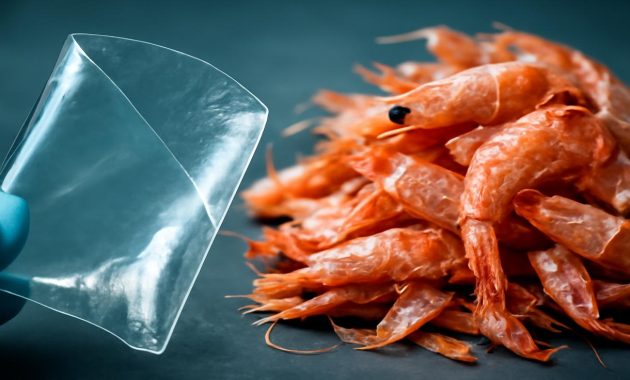
The smell hits you first: salt and metal and the faint sweetness of crustacean shells, stacked in bright orange drifts behind a seaside factory on Spain’s north coast. It’s early morning, gulls wheel and scream above, and forklifts move lazily between vats of prawn heads and carapaces, the discarded leftovers of last night’s feast. For most people, this is waste—slippery, smelly, destined for incineration or, at best, low-value animal feed. But to a small group of Spanish scientists walking carefully between the puddles and crates, this is something much more precious. This is the raw material of a quiet revolution.
The Day Plastic Met Its Match
Inside a nearby lab, the air changes from briny to sterile—the crisp tang of ethanol, the low hum of refrigerators, the faint hiss of gas burners. On a white bench lies a thin, translucent film, almost like the skin of an onion but smoother, more uniform. When you pick it up, it rustles faintly, catching the light like plastic. But this is no ordinary plastic. It began its life in the sea, wrapped around the bodies of prawns, and now, after years of work, it may end up wrapped around the food on your kitchen shelf.
Spanish researchers have just reached a colossal milestone: they’ve created a functional, scalable plastic alternative from prawn shells. Not a vague laboratory idea, not a fragile prototype that disintegrates when you breathe on it—but a real contender. A material that behaves like conventional plastic in many of the ways that matter… yet can break down naturally, spare landfills, and even help put seafood waste to genuine use.
For decades, we’ve been piling plastic into landfills and oceans, a material so ubiquitous it might practically define the Anthropocene. It wraps our food, lines our cars, forms our clothes. It’s in the soil, drifting in the water column, settling in the deep sea. The problem is as familiar as it is overwhelming: plastic is cheap, useful, durable—and almost impossibly stubborn when it comes time to say goodbye.
This new prawn-shell plastic, as odd as it first sounds, slips into that story like an unexpected plot twist. It offers something we rarely get in environmental narratives: a way to keep the convenience and performance we’ve grown used to, without insisting that ecosystems pay the bill for centuries to come.
The Secret Hidden in a Shell
To understand why this breakthrough matters, it helps to know what’s hiding inside those heaps of prawn shells. Beneath the mottled orange and pink, along with proteins and minerals, lies a biopolymer called chitin. It’s one of the most abundant natural materials on Earth, forming the exoskeleton of crustaceans, the wings of insects, and even the cell walls of fungi. As natural armor, it’s tough yet lightweight—exactly the kind of structure that makes engineers and chemists lean in closer.
The Spanish team’s work centers on extracting and transforming this chitin into chitosan, a closely related compound that can be processed into films, fibers, and coatings. This isn’t entirely new science; chitosan has been studied for decades. What’s new is how effectively these scientists have turned it into a genuinely plastic-like material—thin, flexible, clear, and robust enough to stand up to the harsh realities of packaging and handling.
On a chemical level, chitosan is a polysaccharide, a long chain of sugar molecules that can form strong, coherent networks. With the right partners and conditions—plasticizers for flexibility, natural additives for strength or barrier properties—it can be persuaded to behave like the plastic films that currently guard our snacks and produce. The trick lies in balancing performance with biodegradability; push the durability too far, and you lose the very thing that makes bioplastics worthy alternatives.
The Spanish researchers have walked that tightrope carefully. Their prawn-shell plastic resists moisture enough to protect food yet remains attractive to the microbial communities that will eventually break it down. It can sit on your counter without crumbling, but it doesn’t plan to haunt a landfill for hundreds of years.
From Fish Market to Future Material
Picture the journey. The story of this plastic begins not in an oil field, but at a fish market in Galicia or a seafood processing plant in Valencia. After prawns are peeled and packaged, their shells—normally an awkward byproduct—are collected instead of discarded. They’re washed, dried, and sent to processing facilities where the extraction begins.
The shells are treated to remove minerals and proteins, leaving behind a more purified chitin structure. This is then chemically modified—usually through a process called deacetylation—turning it into chitosan. At that stage, you have a versatile, powdery material that can be dissolved in slightly acidic water to form a smooth, viscous solution. Spread that solution thinly, let the water evaporate, and you’re left with a film—a ghostly, almost invisible sheet that feels at once familiar and astonishing.
Engineers tweak the recipe: a little glycerol here for flexibility, maybe a plant-derived oil for better water resistance, a natural antimicrobial compound for food preservation. Each batch is a small experiment in how to coax the best performance out of a material that originated in a tide-swept world of sand and salt.
There’s something almost poetic in this loop. Ocean creatures grow their armor from dissolved minerals and organic fragments. We harvest them, eat the meat, and then turn the discarded armor into a new kind of shield—one that might, in turn, help protect the same oceans from plastic pollution.
Why This Milestone Matters
It’s tempting to see prawn-shell plastic as just another clever trick in an endless parade of eco-innovations, but the implications run deeper. This is not a boutique solution aimed at niche luxury products. Spain’s seafood industry generates thousands of tons of shell waste every year, and globally, the number climbs into the millions. That is a continuous river of raw material, currently underused or tossed away.
By turning that waste into a valuable resource, Spanish researchers are punching holes in two problems at once: plastic pollution and organic waste management. It’s the sort of circular thinking that sustainability advocates dream about—turning yesterday’s discards into tomorrow’s infrastructure.
To appreciate just how different this material is from conventional plastic, it helps to set them side by side. The table below shows a simplified comparison of some key aspects:
| Feature | Conventional Plastic (e.g., PE) | Prawn-Shell Plastic (Chitosan-Based) |
|---|---|---|
| Origin | Fossil fuels (petroleum, natural gas) | Seafood industry waste (prawn shells) |
| Biodegradability | Extremely slow (decades to centuries) | Biodegrades under suitable conditions in months |
| Compostability | Generally not compostable | Potentially compostable in industrial or controlled systems |
| Barrier Properties | Good for moisture and gases (varies by type) | Strong oxygen barrier, moisture resistance tunable |
| Toxicity | May contain additives of concern, microplastic impacts | Derived from food-grade sources; breaks down to natural compounds |
| End-of-Life Issues | Landfill accumulation, marine pollution | Designed to return to biological cycles |
In a world where packaging is often used for hours but persists for centuries, the idea of a material that re-enters nature’s cycles at human timescales feels almost radical. The Spanish breakthrough plants a flag on the border of what’s possible. It tells manufacturers and policymakers, “Look, this can be done. The chemistry and engineering exist. What are we waiting for?”
Not Just Green—Surprisingly Smart
There’s another twist to the story: prawn-shell plastics aren’t only “less bad” than their petroleum cousins; they can, in some ways, be smarter. Chitosan has inherent antimicrobial properties, which means films made from it can help slow the growth of bacteria and fungi. Imagine a food wrapper that doesn’t just protect mechanically, but actively helps keep what’s inside fresher for longer—without resorting to complex chemical preservatives.
Researchers in Spain have been experimenting with loading these films with natural extracts—rosemary, thyme, citrus compounds—to amplify or tune their protective powers. In lab tests, such films can delay spoilage in certain foods, reduce surface contamination, and extend shelf life. That has implications not only for reducing plastic, but for reducing food waste, another silent giant of our environmental footprint.
Think about a supermarket filled with produce: apples glistening under spray mists, crates of berries, plastic-wrapped cucumbers, wedges of cheese sealed tight in transparent film. Every item is engaged in a quiet race against decay. If a prawn-shell film can give even a few more days of life to a shipment of strawberries or a batch of sliced cheese, the downstream savings—in wasted energy, water, and land—multiply quickly.
Then there’s the feel of the material itself. Early adopters describe it as surprisingly familiar: smooth, faintly crisp, easy to cut and seal with standard machinery after modest adjustments. The goal is not to reinvent the entire packaging line, but to slip into the places petro-plastics currently occupy, with as little friction as possible.
The Hurdles Between Lab and Shelf
Of course, this is not a fairy tale where the hero material rides straight from the lab into every kitchen on Earth. Between proof-of-concept and everyday ubiquity lies a long path lined with economic and logistical questions.
Scaling up production means securing reliable streams of shell waste, building or upgrading processing facilities, and optimizing recipes so they work on industrial equipment. It also means ensuring consistent quality—no easy feat when you’re dealing with biological raw materials that can vary in composition depending on season, species, and processing method.
Then there’s cost. Conventional plastic enjoys economies of scale that have been decades in the making. The oil and gas infrastructures that feed plastic manufacturing are extraordinarily well-established and heavily subsidized, both directly and indirectly. Any alternative has to find its footing in an economic landscape shaped to favor the incumbents.
Spanish teams are tackling these problems with a mix of engineering, policy conversations, and strategic partnerships. Pilot plants are testing how to handle tons of shells per day, not just kilograms. Startups are negotiating with seafood processors and supermarkets. Governments are watching closely, aware that the European Union’s mounting pressure on single-use plastics could create both demand and support for these homegrown solutions.
There’s also the question of perception. How will consumers feel about buying products wrapped in “prawn-shell plastic”? Will the knowledge that a film contains crustacean-derived material sit comfortably with everyone, particularly vegetarians, vegans, or people with shellfish allergies? The science so far suggests that allergens and proteins are largely removed during processing, but regulation and labeling will have to navigate these sensitivities carefully.
Reimagining Waste in a Coastal Nation
Walk along almost any Spanish harbor at dusk and you feel the country’s deep relationship with the sea. Nets drying on the quay, voices rising and falling in the markets, restaurants chalking up their daily specials—bream, mussels, prawns, squid. For centuries, the rhythm of coastal life here has followed the tides and the migrations of fish.
That maritime culture is part of what makes this research so resonant. Spain is not just solving a plastic problem; it’s reimagining its own waste streams as a source of value. What used to be a disposal headache can become a cornerstone of a new bio-based economy. Fishermen, processors, and coastal communities become not just suppliers of food, but of the raw ingredients for sustainable materials.
There’s a particular kind of hope in that. It suggests that solutions to global crises don’t always have to arrive from distant tech hubs or abstract policy documents. Sometimes, they can grow out of the very landscapes and livelihoods that have always been there—if we look at them with fresh eyes.
Imagine, for a moment, the same factory yard where our story began. Those heaps of shells no longer smell like a problem to be managed as cheaply as possible. Instead, they smell like money. Like innovation. Like the foundation of something that could ripple outward from Spanish ports to factories and markets a world away.
What This Means for the Rest of Us
So where does that leave you, standing in your kitchen or walking down a supermarket aisle thousands of kilometers away from that Spanish dock? For now, you might not see “prawn-shell plastic” listed on the label of your cereal bag or your pack of cherry tomatoes. This is early days for a technology that needs time, investment, and political will to mature.
But milestones matter. Every time a team of scientists proves that a biological material can stand toe-to-toe with petro-plastic in a real-world application, the field shifts. Sectors that once dismissed bioplastics as too weak, too unstable, or too expensive are forced to reconsider. Companies that publicly commit to reducing plastic footprints suddenly have one fewer excuse.
It’s also a reminder that the narrative around plastic alternatives isn’t a single-threaded story. Alongside prawn shells, there are films made from algae, coatings derived from plant starches, foams made from agricultural residues. Not all of these will succeed; some will quietly vanish, filed away as good ideas that weren’t quite good enough. But taken together, they mark a growing refusal to accept petroleum-based plastic as the unquestioned default.
The Spanish breakthrough slots into that movement not just as another data point, but as a vivid example, rich with sensory detail—a story of seafood markets and lab benches, of orange shells and translucent films. It makes the abstract idea of “bio-based circular economy” feel tangible, almost touchable.
And maybe that’s what we need most in this era of planetary overwhelm: stories that let us imagine a different material world. A world where the path from ocean to table doesn’t end in a landfill, but loops back toward the sea in gentler, more respectful ways.
FAQs
Is prawn-shell plastic completely biodegradable?
Yes, prawn-shell plastic made from chitosan is designed to biodegrade under suitable conditions. Microorganisms can break it down into natural compounds, typically within months rather than decades. The exact rate depends on temperature, moisture, and the presence of active microbial communities.
Can people with shellfish allergies safely use products made from prawn-shell plastic?
Most processing methods remove the proteins responsible for shellfish allergies, leaving mainly the chitin-based structure. However, because regulations and safety testing are still evolving, labeling and standards will be crucial. People with severe allergies should follow guidance from manufacturers and health authorities as these products enter the market.
Will prawn-shell plastic replace all conventional plastics?
No single material is likely to replace all plastics. Prawn-shell plastics are especially promising for specific uses, such as food packaging films and coatings. Other applications—like heavy-duty construction materials or long-lived components—may still require different solutions. The future will likely involve a mix of smarter plastics, both bio-based and recycled.
Is this material compostable at home?
Early versions of prawn-shell plastics may require industrial or controlled composting conditions to reliably break down, especially if they are engineered to resist moisture and handling. Some thinner films might degrade in well-managed home compost, but standardized certifications will be needed to clarify what consumers can expect.
Does using prawn shells for plastic harm marine ecosystems?
The shells used in these materials come from prawns already harvested for food. They are a waste stream, not an additional catch. As long as fisheries are managed sustainably, using the shells more completely can actually improve resource efficiency by extracting more value from each animal rather than increasing pressure on wild populations.
When will I start seeing prawn-shell plastic in stores?
Timelines vary, but the technology is moving from lab to pilot scale now. Some niche products and regional trials may appear within a few years, especially in countries with strong seafood industries and aggressive plastic-reduction policies. Widespread adoption will depend on scaling, cost, and regulatory frameworks.
How does this innovation help reduce overall plastic pollution?
By replacing certain single-use plastic items with materials that return to natural cycles, prawn-shell plastics can cut the volume of persistent waste entering landfills and oceans. When combined with reduction, reuse, and improved recycling, they form part of a broader shift away from the “take–make–throw away” model that created the plastic crisis in the first place.