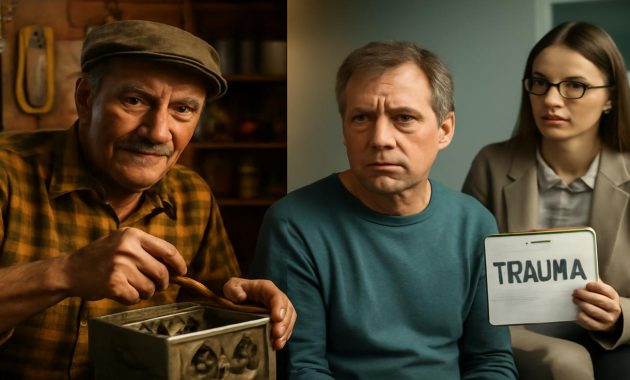
On a Tuesday afternoon in late autumn, a woman in her mid‑50s sits in her car outside the grocery store, hands still on the steering wheel long after the engine has gone quiet. Inside on the passenger seat is a list written in small, efficient handwriting; in her head runs another list, the old one—the one she never writes down. Don’t complain. Don’t waste. Don’t ask for help unless it’s an emergency. Don’t talk about feelings when there’s work to do. She doesn’t consciously recite these rules; they hum in the background, the way power lines buzz on summer nights.
She’s just come from a therapy session. Her therapist used a word she can’t stop rolling around in her mind like a pebble in her mouth: trauma. Childhood trauma. Intergenerational trauma. Even, possibly, “high‑functioning signs of trauma.” The woman was praised her whole life for being capable, independent, uncomplaining. Now she’s wondering if the qualities that got her here—through single parenthood, layoffs, aging parents, 3 a.m. emergencies with her kids—are not simply strengths, but symptoms.
If you were born in the 1960s or 1970s, you might recognize this feeling: the disorienting moment when the world starts calling your hard‑earned resilience by another name. Trauma. Dysregulation. Survival mode. It can land like an accusation, or like a key finally turning in a rusty lock. Usually, it feels like both.
The “Suck It Up” Childhood Era
For many in this generation, childhood came with a soundtrack of phrases that would now set social media ablaze. “Stop crying or I’ll give you something to cry about.” “Children should be seen and not heard.” “You’ve got food, a roof, and clothes. What more do you want?” That wasn’t abuse, people say now, it was just parenting then. And for a vast swath of families, it was. Ordinary, unremarkable, ubiquitous—and often emotionally barren.
You went outside after breakfast and came home when the streetlights flickered on. Seatbelts were a suggestion, bike helmets rare. If you fell, you got up. If you were scared, you were brave. If something awful happened, you didn’t tell, or if you did, you were told, “That’s life.” The adults you loved were carrying their own unspoken weights—war memories, addictions, religious strictness, grinding poverty, or just the expectation that emotions were private and softness was suspect.
If there was yelling—or silence so thick it felt like a weather system all its own—you adjusted. If your parents divorced in the 70s or early 80s, you navigated two households while your teachers made vague comments about “broken homes.” If money was tight during recessions and layoffs, you learned to turn lights off, reuse tinfoil, finish everything on your plate. Stoicism was virtue. Sensitivity was weakness. Help was charity, not a right.
The strange thing is: out of all that, something did grow. Competence. Ingenuity. Grit. A glint in the eye that says, “I’ll figure it out.” People born in the 60s and 70s became the bridge generation—the ones who can change a tire, read a paper map, and also troubleshoot a Wi‑Fi router. The ones who grew up analog and built early digital. Who went from rotary phones to smartphones, carbon copies to cloud drives. Survival, for many, became not just a mode but an art form.
So when the culture suddenly develops a new vocabulary for pain, and younger generations talk openly about mental health, a question rises from the deep: Were we actually hurting all along, and just didn’t have the words? And if so, what does that make our strength? Noble? Or merely evidence of how early we learned to carry more than children should?
The Therapy Boom and the Language of Wounds
Walk into any bookstore today and you’ll find shelves filled with words that didn’t exist in everyday conversation when Gen X and late Boomers were kids: complex PTSD, attachment style, hypervigilance, emotional neglect, neurodivergence. Podcasts dissect family systems. Social media carousels map out “toxic traits” and “red flags.” Long‑buried experiences are suddenly being named with clinical precision and, sometimes, dramatic flair.
The rise in mental health awareness is, on the whole, a blessing. Many people who grew up being told they were “too sensitive” are finally learning they were simply experiencing real hurt without validation. Others are discovering that what their families called discipline or tradition fits far more neatly under words like control, shame, or fear. For survivors of clear abuse, this new language can feel like a lifeline, proof that what they endured was not normal, not OK.
But for people whose childhoods were a subtler patchwork—part warmth, part distance; part safety, part walking on eggshells—the new language creates ambivalence. When a therapist gently points out that the way you never ask for help, never say no, always stay calm, always volunteer, always anticipate crisis could be a legacy of nervous systems shaped in households where needs were ignored or punished… it can feel like being told your proudest muscles are actually scar tissue.
This is the uneasy frontier where strength and trauma meet. Not all endurance is trauma, of course. Life demands effort; character is forged in real responsibility. But some of what we call “just who I am” might actually be “who I became to survive what I couldn’t name.” Untangling those threads is tricky, especially when you’ve built a whole life on them.
When Resilience Feels Like an Accusation
There is a particular sting for the 60s and 70s generation when resilience is reinterpreted as a trauma symptom. Many of them were the first in their families to go to college, to avoid addiction, to leave small hometowns, to build a different kind of household. They were the kids who “broke the cycle” by sheer force of will—keeping the lights on, packing the lunches, showing up for school plays even when their own parents never did.
Now, in therapy rooms and online spaces, the story they tell about themselves is being revised in real time. That hyper‑responsibility they wore like a medal? Could be parentification. The ability to work through illness, heartbreak, exhaustion? Possibly a numbed‑out nervous system that doesn’t register its own limits. The habit of scanning rooms for tension, anticipating problems before they arise? Classic hypervigilance. Their spotless houses and never‑late bills? Perhaps perfectionism born of fear.
Imagine spending decades being praised for these things—by bosses, partners, even society—only to be told with kind eyes and a clinical voice, “These might not be strengths. They might be coping strategies.” It can trigger a defensive flare: Are you calling my life a symptom? Are you saying all I’ve worked for is just a reaction?
On the other side of that defensiveness, though, something softer often appears. A quieter realization: No one ever told me I could do this differently. No one said, “You’re allowed to be tired.” “You’re allowed to want more.” “You don’t have to be the strong one all the time.” Being told your strength might be rooted in trauma isn’t necessarily an insult—it can be an invitation. To keep the strength, but loosen its grip. To ask whether all that responsibility is still needed, or if it’s just familiar.
Strengths, Symptoms, or Both?
Part of the confusion comes from the fact that a single behavior can be both admirable and adaptive. Consider this generation’s hallmark traits: independence, self‑reliance, loyalty, work ethic. None of these are inherently pathological. In many lives, they’re the reason there is food on the table, tuition paid, holidays salvaged.
The trouble comes when those same traits become rigid—when “I can handle it” turns into “I must handle it alone, always.” When being dependable morphs into being unable to rest. When caring for others is easier than acknowledging your own needs. In these cases, resilience and trauma aren’t opposites; they’re roommates, sharing the same space inside a person, shaped by the same early conditions.
For someone born in 1968, for example, who learned at 10 to cook dinner because their mother was working nights and their father was gone, competence in the kitchen is a strength. The belief that you are only valuable if you’re cooking for others, serving, anticipating—never asking to be served—that belief might be trauma. Separating the skill from the story is where healing lives.
Caught Between “Stop Whining” and “Honor Your Feelings”
People born in the 60s and 70s stand in a cultural doorway. Behind them: parents and grandparents who often treated emotional life like a leaky faucet—something to be tightened until it stopped making noise. Ahead of them: children and younger colleagues steeped in language about boundaries, burnout, and self‑care, who will cheerfully cancel plans because they’re “tapped out” and call it mental health.
The result is a generational whiplash that shows up at holiday tables and in office meetings. Someone in their 50s watches their 20‑something coworker decline overtime for “work‑life balance” and feels, deep down, an irrational flicker of resentment: Must be nice. At the same time, that same 50‑something, exhausted by decades of being the reliable one, secretly envies the younger person’s willingness to guard their time.
Meanwhile, older relatives may scoff at this new language of wounds. “We had it harder,” they insist. “No one cared about our feelings.” They’re not entirely wrong; many endured wars, economic hardship, and explicit discrimination. To them, the mid‑life exploration of “how my childhood shaped me” can sound like self‑involved indulgence. To the 60s/70s generation, squeezed in the middle, it can feel like being tugged by both sleeves: toughen up on one side, soften up on the other.
Social media amplifies the tension. One day your feed tells you, “You’re not lazy, you’re exhausted from capitalism and generational trauma.” The next, a viral post insists, “No one is coming to save you. Get up and do the work.” If you’re the right age, both messages hit home; you’ve spent your life getting up and doing the work, but also wondering why you’re so tired, so often, in ways that sleep doesn’t solve.
A Generation Learning a New Language Late
What complicates things further is that many born in the 60s and 70s are only now stepping into spaces where inner life is examined. Maybe their own children’s struggles pushed them into therapy. Maybe menopause, divorce, or the death of a parent shook loose old memories. Maybe they finally had enough stability to look inward without fearing everything would crumble.
Learning the language of trauma in mid‑life is like discovering late that you’ve been living by a set of unspoken rules and that some of them, while once lifesaving, are now quietly hurting you. It’s disorienting but also oddly hopeful. It means the story isn’t over yet. You can keep what works and gently return what doesn’t. You can parent differently, partner differently, work differently. You can stop repeating certain scenes and write new ones.
And crucially, you can redefine resilience. Not as white‑knuckling your way through, but as the capacity to adapt, to soften, to receive. As the courage to say, “I’m strong and I’ve been hurt. I’m capable and I’m tired. I’m proud of what I survived, and I wish I hadn’t had to survive so much.”
Choosing What to Keep and What to Lay Down
Mid‑life has a texture all its own. Bodies change; careers plateau or pivot; children grow up or never came; parents age or are gone. In this landscape, the question of whether your strengths are actually trauma isn’t an academic one. It shows up in your back pain, your insomnia, your inability to relax on vacation, your quiet resentment when no one else seems to notice the invisible labor you provide.
This is often when people begin to sort, consciously, through the traits they’ve carried for decades. Some decide: I like that I can handle a crisis; that’s staying. I like that I show up when others can’t. I’m keeping my loyalty, my work ethic, my problem‑solving. But the part where I never ask for help? Where I overfunction until I collapse? Where I can’t say “I’m not okay” without shame? Maybe that can evolve.
The process can be quiet and private, or shared with friends, therapists, partners. It may start with something as simple as saying no to a request you would once have accepted automatically, and watching the world not end. Or allowing yourself to feel hurt by something that, years ago, you would have shrugged off and swallowed. Or rewriting the internal script that says weakness and vulnerability are the same thing.
It helps to remember that resilience is not erased by naming trauma. If anything, acknowledging the wound often highlights the extent of your strength. Surviving with no language for your pain, no models for softness, no roadmap but “keep going” is its own kind of heroism. The invitation now is not to disown that hero, but to let them finally rest, sometimes, without calling it failure.
A Small Map for Self‑Reflection
If you’re wondering where your strengths end and your survival strategies begin, some gentle questions can help. Not to diagnose, but to notice:
| Area | What You’re Proud Of | What Might Be Costing You |
|---|---|---|
| Work | “People can always count on me; I get things done.” | Do you feel guilty resting? Do you struggle to say no? |
| Relationships | “I’m the rock; I hold everyone together.” | Do you hide your own needs? Resent others for leaning on you? |
| Emotions | “I don’t overreact; I stay calm.” | Do you numb out? Struggle to feel joy, not just relief? |
| Self‑Image | “I’m low‑maintenance; I don’t need much.” | Did you learn early that needs are a burden? Is it safe to want? |
Where you notice tension—where pride and pain sit side by side—that’s often the place where resilience and trauma are braided together.
What This Says About a Generation
The story of people born in the 1960s and 1970s is not a tidy one. It’s the story of latchkey kids and early coders, mixtapes and mortgages, Cold War duck‑and‑cover drills and Y2K anxieties, landlines and late‑night scrolling. It’s a generation that learned to swallow feelings and then, much later, to name them. To tape up their own wounds and now, at last, to let someone look at the scar tissue and say, “That must have hurt.”
Being told your hard‑earned strengths might be trauma is, at its core, a mirror held up not just to individuals but to a cultural shift. It reflects a world finally taking emotional life more seriously, sometimes clumsily, sometimes excessively, always imperfectly. It reveals how quickly language can change, and how slowly bodies and habits follow.
It also exposes a deeper tension running through our time: the pull between resilience and victimhood, between honoring our pain and building our capacity. Some people weaponize the language of trauma to avoid responsibility; others weaponize the language of toughness to avoid tenderness. Somewhere in the middle stands this in‑between generation, aware of both dangers, wary of both extremes.
Perhaps their task—and their gift—is to model a third way. To say: Yes, what happened to me matters. Yes, it left marks. No, I will not let those marks be the only story. Yes, I will keep working, loving, building, even as I unlearn the parts of myself that were built only for survival. Yes, I will allow myself both pride and grief about the ways I’ve been strong.
On that autumn afternoon, the woman in the car eventually unclips her seatbelt, takes a breath that feels unfamiliar in its depth, and walks into the grocery store. She will buy the same things she always buys. She will move with the same efficiency, the same quiet competence that has carried her for decades. But something small has shifted inside. She is no longer simply “the strong one.” She is a person who was strong for a reason. And now, finally, she is allowed to be more than that.
FAQs
Is every strength a sign of trauma?
No. Many strengths come from healthy challenges, supportive families, and personal values. A strength may be linked to trauma if it feels compulsive, rigid, or exhausting—if you can’t set it down without guilt or fear.
How do I know if my childhood was traumatic if “nothing that bad” happened?
Trauma isn’t only about obvious events like violence or disasters. Chronic emotional neglect, constant criticism, or growing up in an unpredictable home can shape your nervous system too. If your feelings were often dismissed, or you still feel driven to earn love or safety, it may be worth exploring with a professional.
Does calling something “trauma” encourage victimhood?
Naming trauma doesn’t have to mean staying stuck in it. The goal is not to blame forever, but to understand how the past shaped you so you can make different choices now. Accountability and compassion can coexist.
What if I’m proud of how tough I am and don’t want to change?
You don’t have to give up your toughness. The question is whether it’s costing you joy, health, or closeness. You can keep your resilience while also learning flexibility—choosing when to be strong and when to be soft.
Where can I start if this all feels overwhelming?
Start small: notice when you say “I’m fine” but you’re not. Practice asking for minor help. Reflect on what you’re proud of and what secretly hurts. A trusted friend, support group, or therapist can help you explore these questions at a pace that feels manageable.