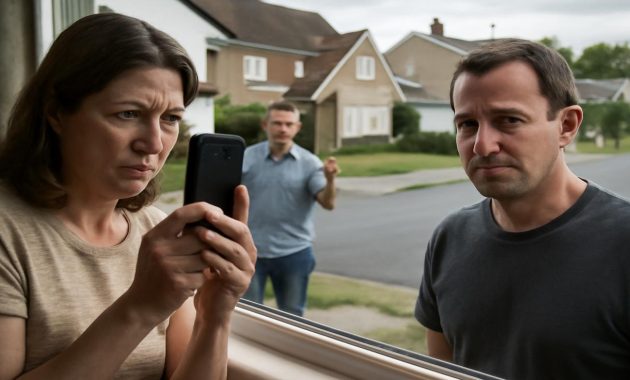
The woman with the phone doesn’t look like a villain. She’s standing at her second-floor window in a faded blue sweater, gently pushing aside a lace curtain with one hand, her other hand wrapped around a smartphone, its little camera eye staring down at the street. Children race their scooters along the sidewalk, a dog sniffs a lamppost, a delivery driver shoulders a stack of boxes—and somewhere behind that glass, a red recording light flicks on. She says she’s “protecting the neighborhood.” The people below say something different: they feel watched, judged, and quietly hunted by a lens they never agreed to face.
The Window Watcher on Maple Street
Her name (we’ll call her Linda) isn’t important. She could be almost anyone—a retiree with time on her hands, a stay-at-home parent between laundry loads, a remote worker taking a break from spreadsheets. What matters is the ritual.
Every day, sometime after lunch, Linda steps to her front window. From here, she has a near-perfect view of the street: the bus stop, the corner store, the narrow alley that locals use as a shortcut. In the glow of the afternoon light, she becomes the neighborhood’s unofficial security camera, except she’s a camera with opinions, fears, and a social media account.
Later, when the sky turns copper and the day’s recordings are neatly tucked into her phone’s memory, she uploads them—sometimes to a neighborhood Facebook group, sometimes to a private shared album, sometimes to a broader platform under an anonymous username. A teenager sitting on a low wall, head bent over his phone, becomes “Suspicious boy casing houses.” A woman trying to corral her excited dog into a car morphs into “Unknown vehicle in front of 2434 for 7 minutes.” A delivery driver pausing to check directions is framed as “Truck driving slowly past our homes. Anyone recognize this?”
She rarely adds outright accusations. Instead, it’s the questions, the raised eyebrows, the ominous captions that do the work. “Strange guy walking back and forth—anyone know him?” “This car didn’t look familiar.” “He was here yesterday too.” In the comments, other neighbors fill in the blanks with fear, speculation, and sometimes, outright hostility.
The Thin Line Between Watchdog and Voyeur
At first glance, Linda sounds like the kind of person many neighborhoods quietly rely on. The one who notices when the porch light across the street is left on too long, who knows the schedule of the garbage trucks and the faces of the mail carriers, who spots when a package has been sitting unattended on a step for too many hours.
Communities have always had watchers. For much of human history, the village window was as much a part of community safety as any locked gate. Someone was always paying attention—peeking through shutters, looking out from porches, trading notes over backyard fences. In many places, that quiet vigilance has stopped petty crime, prevented kids from getting hurt, and even saved lives.
What’s different now isn’t the watching. It’s the recording—and the sharing.
Once, a suspicious moment might have sparked a phone call to a neighbor or, at most, a cautious call to local authorities. Now, a flutter of digital taps can spread that moment—in all its ambiguity—to hundreds or thousands of people, many of them strangers, who will never meet the person caught in the frame, never hear their version of the story, never know if there was really anything to fear.
The smartphone turns the living room window into a one-person surveillance hub. With cloud storage, cheap data, and social feeds hungry for content, your sidewalk stroll can be captured, replayed, commented on, and archived indefinitely. You become a character in a story you didn’t consent to enter.
When Concern Starts to Look Like Obsession
For the people walking beneath Linda’s window, there’s no way to tell whether the eyes behind the curtain are merely curious or quietly cataloging them. Over time, this uncertainty shifts the atmosphere of an entire block. The street no longer feels like a shared space; it feels like a stage with a hidden audience.
One neighbor might learn that she’s been filmed because a friend sends her a screenshot: “Isn’t this you?” There she is, caught mid-gesture, bending to re-tie a child’s shoe, frozen as “Unknown woman loitering near driveway.” Another neighbor might discover their daily running route is being speculated about in a private chat: “He passes at 6:12 every morning. Weird, right?”
Linda, and people like her, often see these details as evidence—patterns that could help solve a crime one day. But for the people on the other side of the glass, it can feel like someone is keeping a dossier on their lives. When does attentive become intrusive? When does “We’re just keeping each other safe” turn into a polite mask for paranoia, bias, or control?
The Feel of Being Watched—Even When You Can’t Prove It
There’s a strange, bodily awareness that comes with the suspicion of being watched. Your shoulders tense slightly as you walk past certain houses. You find yourself performing normal tasks with extra stiffness—locking your bike, checking your phone, waiting for a rideshare—as if you’re trying to prove, to some invisible jury, that you have nothing to hide.
You may never see the camera. You just begin to sense where it probably is: that upstairs bay window with the perfect vantage point; the living room where the curtains are always drawn just enough to see out, but never fully open. You avoid stretching in the sun on the curb, or sitting too long on the low brick wall that lines the sidewalk. When your friend pulls over to drop you off and spends a few extra seconds saying goodbye, you catch yourself glancing up, wondering if you’ve just been promoted to “suspicious car lingering outside.”
For some people—especially those who already live under a heavier cloud of public scrutiny, whether because of their race, age, clothes, or simple bad luck—that weight can be suffocating. It’s not just the fear of being misjudged; it’s the knowledge that a single shaky, context-free video can ignite a digital mob.
Maybe you’re the teenager in a hoodie cutting through an alley you’ve walked since childhood. Maybe you’re the gig worker waiting for a ride request to come in, sitting in a parked car with the radio low. Maybe you’re the unhoused man who curls up beneath the same tree every night. When people like Linda point their lenses at you, they’re not just collecting images—they’re shaping stories. And stories have consequences.
What the Law Says—and Doesn’t Say
Legally, in much of the world, filming people in public spaces isn’t clearly forbidden. Sidewalks, streets, and parks are generally considered “public,” meaning fewer expectations of privacy. Laws vary by region, but in most places, you can be recorded without explicit consent as long as you’re in public view and the recording isn’t breaking other specific rules.
That’s the part people like Linda lean on: “If they’re in public, I have the right to film.” And in many cases, strictly speaking, they’re not wrong. But legality and ethics aren’t the same thing. There’s an entire frontier of digital life where the law lags behind the lived reality of being constantly observable.
The real trouble begins when those recordings are shared—especially when they’re labeled, captioned, or framed in ways that suggest wrongdoing or danger without proof. That can edge into defamation: accusing someone of criminal or suspicious behavior publicly, with no evidence. It can also become a form of harassment, especially when footage is repeated, targeted, or used to mobilize hostility toward a particular person or group.
And then there’s the problem that laws aren’t evenly experienced. Someone with social capital—who fits the unspoken profile of “neighbor” rather than “threat”—may be recorded and praised (“He’s always out walking, love seeing him around”). Someone else, with a different face, accent, clothing, or car, might find themselves labeled “sketchy” for doing exactly the same thing.
Fear, Bias, and the Stories We Tell Ourselves
Ask Linda why she does it, and she’ll tell you stories. The break-in on the next block three years ago. The time a stranger knocked on her door and asked a few too many questions about who lived there. The news reports about catalytic converter thefts, porch pirates, car break-ins. The local message board post about a missing child, a stolen bike, a hit-and-run.
She will talk about being afraid. Afraid of being targeted, of losing what she’s worked for, of bad things happening on a quiet street that’s supposed to feel safe. She’ll say, “If you’ve got nothing to hide, you shouldn’t mind being filmed.” She’ll insist that she’s not doing anything wrong—she’s just paying attention, just sharing what she sees.
But woven through her stories, if you listen carefully, is something else: a pattern in who she chooses to film. More often than not, it’s people who don’t look like her. People who move through the neighborhood but don’t obviously “belong” to it. Workers in uniforms. Teenagers. People with worn-out backpacks. People whose cars are old or loud or out of place among the sedans lining the driveways.
Many of us carry quiet, unexamined biases—assumptions about who’s safe and who’s suspect, who’s “one of us” and who might be trouble. The smartphone camera, in the hands of an anxious mind, gives those biases power. When they’re blasted into community groups, shared chats, or public feeds, those biases multiply, reinforced by likes, comments, and algorithmic boosts.
The Cost to Community Trust
On the surface, the rise of window watchers and neighborhood videographers looks like a form of community care. After all, people are investing time and energy into paying attention. But under that surface, something fragile can begin to fray.
Trust doesn’t only break when there’s a crime. It also breaks when people feel that normal, everyday living—walking, waiting, wandering—is being treated as suspicious. When anyone passing through might become a viral “what is this person doing?” post, people stop seeing their neighbors as neighbors. They become potential suspects, content, blurry figures to be zoomed in on and debated.
This erosion of trust can spiral. The more people record and share “suspicious” clips, the more others come to believe the neighborhood is under threat, even if actual crime rates stay flat. The street feels dangerous, not because of what’s happened, but because of what’s constantly implied.
Ironically, this kind of dread doesn’t always make neighborhoods safer. People become warier of each other, less likely to ask questions face to face. A teenager who’s been publicly labeled suspicious is less likely to see the neighborhood as a place that cares about them. The unhoused man on the corner, relentlessly filmed and shamed, drifts further from any hope of connection or support.
Is There a Better Way to Watch Out for Each Other?
It’s easy to dismiss someone like Linda as just another stalker with a smartphone, hiding her fascination behind the word “safety.” But treating her as a cartoon villain misses something important: there is a real desire, underneath all that filming, to protect what feels fragile in a changing world.
The question isn’t whether we should care about what happens in front of our homes. We should. The question is how we do it without turning our neighborhoods into low-budget surveillance states, where every misstep, misreading, or awkward pause is captured and posted for judgment.
| Approach | What It Looks Like | Impact on Community |
|---|---|---|
| Quiet Observation | Noticing patterns, writing down details if something seems truly off. | Can help with real incidents without shaming innocent people. |
| Direct Communication | Politely approaching someone or checking in with a neighbor before posting. | Builds trust and clears up misunderstandings quickly. |
| Responsible Filming | Recording only when there’s a clear, immediate concern; sharing only with relevant authorities. | Respects privacy while preserving evidence if needed. |
| Public Posting & Speculation | Uploading ambiguous clips with vague warnings or accusations. | Fuels fear, stigma, and misinformation; damages reputations. |
There are small, practical questions each of us can ask before we hit “record” or “post”:
- Is there an immediate safety concern—or just a feeling I can’t quite name?
- Could I simply watch and wait a little longer before assuming the worst?
- If I recorded this, do I really need to share it publicly, or only if asked by authorities?
- How would I feel if this exact clip, with this caption, were posted of me or someone I love?
- Is there a way to check in with a neighbor directly instead of broadcasting this to a crowd?
True public watchdogs—journalists, community advocates, even some citizen observers—operate with a sense of responsibility. They understand that a camera is not just a tool; it’s power. It can expose wrongdoing, but it can also distort, humiliate, and harm. The difference lies not only in what you film, but in what you do next.
Choosing Relationship Over Surveillance
Imagine a different scene. Instead of silently filming from behind curtains, Linda steps out onto her porch one afternoon when she notices a young man lingering near her neighbor’s car. Her pulse quickens; her hand reaches for her phone—but this time, she dials a different instinct.
“Hey there,” she calls, not unkindly. “You doing okay?”
The young man startles, then laughs awkwardly. “Yeah, sorry—I’m waiting for my rideshare. The app says he’s two minutes away. I think he’s lost.” He holds up his phone, screen glowing with the familiar map. She looks, sees the little blue car circling the block.
In a different version of this moment, his face and license plate might have ended up in a neighborhood thread, his image living on as “suspicious guy” long after the ride came and went. Instead, a small, human conversation resets the scene. There’s still room for caution—she can stay on her porch, keep a bit of distance—but she chooses to ask first, film later, if at all.
Not every situation will be this clear. Not every stranger will be benign. Sometimes, recording is the right call, especially when something obviously dangerous or unlawful is unfolding. But sliding the dial slightly, from default suspicion to cautious curiosity, changes the shape of a neighborhood in ways no camera ever can.
So, Protector—or Stalker?
Where does that leave Linda, the homemaker in the blue sweater at the window? Is she a public watchdog or just another stalker with a smartphone?
The uncomfortable answer is that she might be either, or both, depending not only on her intentions, but on her habits—the patterns of who she films, when, and why; what she does with the footage; how willing she is to examine her own fears and biases.
A watchdog pays attention, but also takes responsibility. They know that watching is only one part of care; listening, asking, and showing up matter just as much. A stalker, by contrast, claims concern as a cover for control. Their gaze reduces people to objects, curiosities, potential threats to be documented and discussed rather than spoken to.
The rest of us, walking beneath those upstairs windows, have choices too. We can push back in our own communities—questioning the constant flow of “suspicious person” posts, urging neighbors to blur faces, share privately, or simply close the camera app. We can build the kinds of relationships that mean we recognize one another, not as strangers passing through a lens, but as fellow residents of a shared place.
In the end, the story of a neighborhood is written less by its cameras than by its conversations. The question is not only who is watching—but whether we’re brave enough to look up from our windows and our screens, step outside, and actually talk to the people we’re so afraid of.
FAQ
Is it legal for someone to film me from their window while I’m on the street?
In many regions, yes—if you are in a public space like a sidewalk or road, the law often allows recording without your consent. However, local rules can vary, and there may be restrictions if the footage is used to harass, defame, or invade a reasonable expectation of privacy, such as filming inside your home through your windows.
What can I do if I find a video of myself posted in a neighborhood group?
You can start by politely asking the person who posted it to remove or blur you, especially if the caption implies wrongdoing. If they refuse and the post is harmful or defamatory, you may report it to the platform and, in serious cases, seek legal advice based on local laws.
How do I know if community filming has crossed the line into stalking?
Filming may become stalking when it is persistent, targeted at a specific person, and intended to intimidate, control, or cause distress. A pattern of repeated recording, posting, and commentary about your movements or routines may be grounds for concern and possible legal action.
Is there a responsible way to record suspicious activity?
Yes. Focus on genuine, immediate safety concerns, avoid sharing footage publicly unless absolutely necessary, and consider providing it directly to authorities if a real incident occurs. Whenever possible, avoid captions or commentary that assume guilt, and be mindful of how bias might shape your perception.
How can neighborhoods stay safe without turning into surveillance zones?
Building relationships is key: learn your neighbors’ names, establish communication channels like phone trees or moderated groups, and prioritize direct, respectful conversations over anonymous posting. Combine reasonable caution with empathy, and treat cameras as last-resort tools rather than first responses.