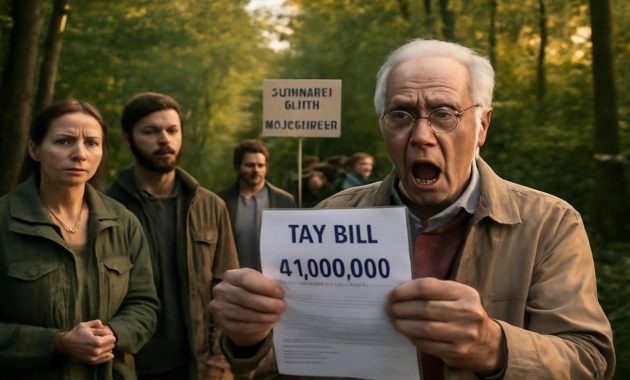
The first frost came early the year they marked the trees with red plastic ribbons. In the weak Irish sun, they glowed like wounds on the trunks—bright, jarring slashes against the mossy bark. A lone man in a wool cap stood at the edge of the track, hands buried deep in his coat pockets, watching the forest he’d spent thirty years planting become a legal battlefield. His name is Thomas Byrne, a retired schoolteacher who once believed that giving his forest to a wildlife charity would be the most beautiful thing he’d ever do. Now, that gift has tangled him in a million–euro tax nightmare and pulled an entire country into a raw argument about who should shoulder the cost of saving nature.
A promise planted in young trees
Thomas didn’t always own a forest. In the early 1990s, when he was still teaching history to fidgeting teenagers and cycling home in the rain, he bought 40 poorly drained hectares of rough land in the west of Ireland. People laughed. It was bog and scrub, they said. A place for rushes and sheep, not dreams.
But Thomas had grown up under the dappled light of hedgerow ash trees and in the quiet company of birdsong. He took government grants that encouraged citizens to plant trees and spent his evenings learning about native species. With a battered thermos in one hand and spades and stakes in the other, he planted alder and birch, oak and rowan. For years, his weekends were a steady rhythm of digging, staking, weeding, and worrying.
His colleagues at school joked that he was raising a “green pension.” He thought of it differently: a living classroom, a carbon sponge, a patch of Ireland that might still hum with wildness when the children in his class had children of their own.
By the time he retired, the forest was a proper, breathing thing—tall trunks, damp humus underfoot, robins dropping in behind him as he walked, hoping for disturbed insects. Deer left tracks in soft mud. Foxes drew faint lines through long grass. The wind spoke in a hundred leaf-languages. That was when the idea of giving it away began to root itself in his mind.
The gift that was supposed to be simple
One winter evening, at a community hall talk about rewilding, Thomas heard a speaker from a national wildlife charity describe how fragmented habitats were killing off everything from butterflies to barn owls. The charity dreamed of a patchwork of wild sanctuaries, spaces where nature could recover from decades of drainage and development.
After the talk, Thomas approached the speaker with his usual quiet bluntness. “I have a forest,” he said. “I’d like to give it to you. All of it.”
The charity representative thought he was joking. People donated a few acres sometimes, perhaps a modest bequest mentioned in a will. But forty hectares of established woodland? That was rare, precious—and complicated.
Meetings were arranged. Lawyers and land surveyors were brought in. There were cups of tea with board members who used words like “legacy,” “biodiversity value,” and “flagship project.” They walked among Thomas’s trees, admiring bracket fungi and listening for birds. Someone pointed out that, in a warming world, such a forest would be an important carbon sink. Someone else noted the potential for educational trails.
Thomas felt shy and proud, like a farmer showing off the best of his lambs at market. In his mind, the gift was as clean as rain: he would donate the forest; the charity would safeguard it forever. Nature, for once, would be on the winning side.
When he signed the papers, the moment felt quietly monumental. “For the birds,” he wrote in an old notebook that night, “and for the children who’ll never sit in my classroom.” He did not know, then, that those neat signatures were the prelude to a storm.
The tax bill that landed like a felled tree
Months later, an official-looking envelope arrived at Thomas’s small terraced house. It bore the neat, impersonal weight of the state. He made a sandwich, boiled the kettle, and opened it at the kitchen table, crumbs already on the plate.
Inside was a figure that made his breath catch: nearly one million euros in tax liabilities, interest, and penalties. In the eyes of the tax authorities, his donation was not simply an act of generosity; it was a transfer of a high-value asset subject to complex rules. The land and standing timber, appreciated in value over decades, were being treated as a taxable event.
The forest that had been his life’s quiet work had suddenly become a financial weapon pointed directly at his modest retirement.
He read and reread the letter. “Not possible,” he muttered, tracing the dense bureaucratic paragraphs with a shaking finger. A retired teacher’s pension, a small inheritance from his parents, a battered second-hand car—none of it came close to the amount now demanded.
Friends later remembered him phoning that evening, voice thin and bewildered. “I thought I was doing a good thing,” he said. “How can it be that I owe money because I gave something away?”
When a private nightmare becomes a public argument
News of Thomas’s situation leaked out slowly. First, it was a local radio show; then, a regional paper. Soon, a journalist from a national nature magazine visited the forest, walked the damp tracks with him, and wrote an article that would spark a national argument.
Here was the story: an elderly man, who could have sold his forest to developers or commercial loggers, had instead donated it to a wildlife charity—and been slapped with a seven-figure tax bill.
The public response ignited like dry bracken.
On one side were the outraged voices: callers on talk radio, environmentalists, and ordinary citizens who saw Thomas as a kind of environmental martyr. “We say we want people to protect nature,” one caller said, “and then we punish them for doing exactly that.” Another commented, “If he’d cut the trees and sold them, the system would have treated him better. What kind of madness is that?”
On the other side were cooler, legalistic tones. Tax experts and economists explained that the rules were not written with large-scale ecological gifts in mind. Tax systems, they said, rely on consistency. If the state offers sweeping exemptions for some transfers of valuable land, it opens loopholes that the wealthy can exploit. “We have to be careful,” one policy analyst said on television. “A system built on good intentions alone can be easily abused.”
In the middle stood Thomas, bewildered, tired, and increasingly uncomfortable with his accidental fame. He had lived his life teaching history, a subject full of states making clumsy choices with unintended consequences. Now he was a case study in exactly that.
Nature, numbers, and the cost of doing the right thing
The argument soon reached beyond his personal story. Politicians in parliament debated it, waving printouts of the tax demand and pictures of the forest. Some seized on the case as proof that the country was failing to take climate change and biodiversity loss seriously. Others warned that rewriting tax rules under emotional pressure was poor governance.
Environmental groups used the moment to talk about a larger, thornier question: If land given to nature is so valuable for society—clean water, stored carbon, pollinators, flood protection—why is the individual who gives it up being treated as if they were engaged in a profitable transaction?
One conservationist put it starkly: “We’re happy to praise heroes who save trees, but we refuse to share the bill.”
The debate revealed an uncomfortable truth. For all the speeches about climate emergencies and extinction crises, the legal machinery of the state still sees a forest mostly as an asset with a price tag, not as a living system with intrinsic value. Tax codes were built in a world where land was something to farm, extract, or build on—not something to leave alone on purpose.
At kitchen tables and in parliament bars, people began asking the same question in different words: Who should pay for saving nature?
Who really owns a wild future?
Walk through Thomas’s forest in spring and the answer feels obvious. The air is cold but soft, a scent of damp leaf litter and sharp green buds. Wrens explode from the undergrowth in sudden fury. A buzzard circles high above, silent against a white sky. Children from a nearby town visit on school trips now, led by the very charity that owns the land. They lean close to rotting logs to watch woodlice, squeal at spiders, ask serious questions about owls.
They will never pay a cent of Thomas’s tax bill. But they will grow older in a world minutely improved by what he did.
In a quiet way, that is the heart of his forest’s story. The benefits of a wild place spill far beyond the person whose name is written in the land registry. Cleaner rivers downstream. Cooler air in heatwaves. Space for wild creatures that do invisible jobs—pollinating, decomposing, stitching ecosystems together.
The costs, though, remain painfully targeted. The cost of buying land. The cost of not selling it to the highest bidder. The cost of lawyers and surveyors. And now, in Thomas’s case, the potential cost of a punitive tax bill.
When society asks individuals to make sacrifices for the common good, it usually offers something in return: medals, money, legal exemptions. Firefighters, organ donors, blood donors, foster parents—they all step into roles the state cannot fill alone, and the law recognizes that in various ways.
But for people who want to give land to nature, the rules are patchwork and often harsh. Some countries offer generous exemptions; others treat such gifts like any other transfer of wealth. Everywhere, the rules lag behind the urgency of the ecological crisis.
A slow, stubborn shift in thinking
Under pressure from public anger, a government review quietly began. Officials sifted through tax codes, analyzing how similar cases had been handled in the past. They compared laws in neighboring states, where some forms of land donation for conservation carry different tax treatment.
The wildlife charity tried to help. They offered to cover part of the bill, even though it meant redirecting funds from other projects. Legal teams explored whether the original assessment had correctly valued the land. Environmental campaigners called for an explicit “nature exemption” for certain kinds of conservation gifts, with strict safeguards against abuse.
In town halls and online forums, people began to connect Thomas’s case with their own half-formed dreams. A farmer with unproductive hill land wondered if she might one day rewild it. A family with a small woodland asked if their children would inherit a forest or a legal mess. A group of neighbors who had pooled money to buy a bit of bog fretted over what would happen if they tried to hand it over to a conservation group.
Slowly, something shifted in the national conversation. The question was no longer only “Should this retired teacher pay a million euros because he protected a forest?” It became “What kind of system do we need if we truly believe that restoring nature is a shared project?”
What the forest knows that the law doesn’t
Back in the forest itself, life went on with stubborn indifference to the paperwork unfolding in distant offices. A storm blew in off the Atlantic and brought down an old birch. Its roots, wrenching from the soil, exposed pale threads of mycelium and a pale glint of stone. Bluebells pushed up through last year’s leaf litter. A pine marten, rarely seen, left scat on a prominent rock, half a sentence written in scent.
Standing by the fallen birch, Thomas felt an unexpected flicker of comfort. The tree had not fallen because of any human argument; it had fallen because wind and time had conspired together in the old way. The forest did not know what a euro was, or a tax code, or a parliamentary debate. It knew moisture and light, root and rot.
Still, that human world pressed in. An email from his solicitor would ping into his inbox with all the weight of a thunderclap. News crews sometimes asked to film with him, hoping to catch a soundbite—a quaver of outrage, a tidy moral. He was polite but weary. “It’s not just about me,” he would insist. “It’s about what we’re willing to lose because we can’t imagine new rules.”
When asked, off-camera, whether he regretted the gift, he took a long breath and looked at the trees.
“No,” he said at last. “I regret the system that makes this harder than it should be. But I don’t regret these trees, or the birds, or the kids who walk here.”
Learning how to pay for what we claim to love
Thomas’s story hasn’t wrapped up neatly. The final figure on his tax demand may change; new legislation may arrive in time to help him or may land just too late. Headlines will fade; another crisis will take its place. But the questions his forest raised are not going anywhere.
If we want more people to choose the long, patient work of restoring land instead of cashing it in, we must decide, collectively, to share the costs as well as the benefits. That means tax codes that distinguish between speculative land deals and genuine conservation gifts. It means governments recognizing that a standing forest is infrastructure every bit as real as a bridge or a hospital—that it, too, supports life and deserves public investment.
It also means confronting our own contradictions. We cheer rewilding videos, we write impassioned social media posts about endangered species, we visit national parks and feel a rush of gratitude. Yet when the bill arrives—whether in taxes, higher public spending, or foregone development—we grow uneasy.
The retired teacher’s forest offers a simpler, older lesson. You cannot have birdsong without trees. You cannot have clean rivers without intact wetlands upstream. You cannot have a stable climate without vast, messy, breathing ecosystems pulling carbon from the air and tucking it away in soil and roots.
Someone has to plant, protect, and sometimes surrender those places. Someone has to decide that a living forest is worth more than the sum of its timber and land value. The real argument is not about one man’s tax bill; it’s about whether we’re willing to rewrite our rules to reflect what we say we believe.
| Aspect | Current Reality | What Thomas’s Case Highlights |
|---|---|---|
| View of Land | Primarily a taxable asset with monetary value. | Need to see land as ecological infrastructure with shared benefits. |
| Individual Cost | Donors may face large tax bills on high-value gifts. | Unfair burden discourages others from donating land to nature. |
| Public Benefit | Clean air, water, carbon storage, wildlife habitat, education. | These benefits are diffuse, but rely on a few individuals’ bold choices. |
| Policy Tools | Tax systems designed around profit, inheritance, and development. | Urgent need for clear conservation exemptions and safeguards. |
| Moral Question | Who can afford to act generously for nature? | Who should pay for saving what ultimately belongs to all of us? |
The quiet legacy of a troubled gift
On a still evening, when mist hangs low between the trunks and the calls of rooks drift in from distant fields, it is possible to imagine another ending to this story.
In that version, the tax letter never arrives, or if it does, it comes with a note explaining an exemption for gifts of land to accredited conservation charities. The state acknowledges, in black-and-white law, that some forests are worth more standing than sold. Politicians argue over the details but not the principle: that those who help weave a wilder, safer future deserve recognition, not ruin.
Children walk the same tracks in fifty years’ time and never know the name of the old teacher who made it possible. They simply accept the forest as a given—like rain, like clouds, like the deep, steady smell of earth after a storm. That, in the end, is what Thomas wanted: a gift so fully absorbed into the fabric of the world that it no longer feels like a gift at all.
The reality, for now, is messier. There are lawyers and accountants, angry columns and thoughtful essays, drafts of laws that may or may not pass. Yet in the larger arc of things, his troubled donation has already done something important. It has forced a nation to look directly at the gap between its love of nature and its willingness to pay for that love.
Somewhere in the middle of that gap stands a retired teacher, hands in his pockets, listening to the wind move through the trees he planted. Around him, the forest goes on doing what forests do: sheltering, breathing, storing, healing. A living reminder that the real cost of saving nature is not measured only in euros, but in courage, imagination, and the choices we make about what—and who—we value.
Frequently Asked Questions
Why would a forest donation create a tax bill instead of a tax break?
In many countries, tax systems treat land and timber as valuable assets. When ownership changes hands, even as a donation, it can be considered a taxable transfer unless specific exemptions exist. If the land has increased in value over time, that gain may be treated as taxable, regardless of the donor’s intentions.
Can governments create special tax rules for conservation gifts?
Yes. Some jurisdictions already offer reduced taxes or full exemptions for land donated to accredited conservation charities or placed under permanent protection. These policies can encourage habitat restoration, but they require careful design to prevent abuse by those seeking to disguise profit-making deals as environmental generosity.
Why is Thomas’s case seen as a national issue, not just a personal problem?
His situation highlights a broader conflict between climate and biodiversity goals and outdated legal frameworks. If people who want to protect land for nature face heavy financial penalties, others may decide not to donate or restore land at all. That has national implications for environmental policy and long-term resilience.
Who should ultimately pay for saving nature—individuals or the state?
Most environmental advocates argue it must be a shared responsibility. Individuals can offer land, time, and local knowledge; states can provide supportive laws, funding, and fair tax treatment. The benefits of healthy ecosystems are shared by everyone, so the costs of protecting them should also be shared, rather than falling on a few willing donors.
What can ordinary people do if they care about cases like this?
People can support conservation organizations, engage with local representatives about reforming tax and land laws, and back policies that recognize the true value of intact ecosystems. On a personal level, they can also protect and restore nature where they live—through tree planting, habitat creation, and community projects—while pushing for systems that won’t punish those who choose to give more.