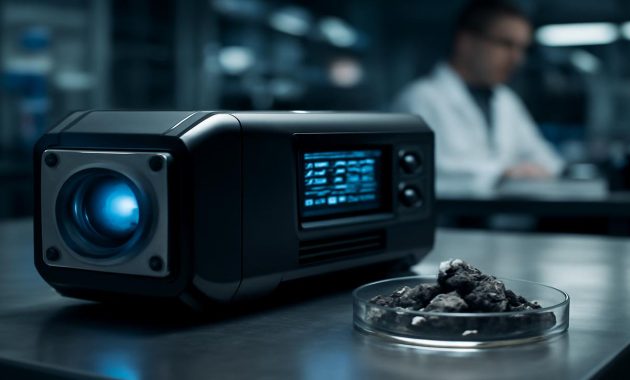
The beam appears first as a pale seed of light, barely brighter than a star. Then, with a soft mechanical whine, it sharpens—thin, white, almost invisible until it touches a steel plate on the far side of the room. The metal glows cherry red, then orange, then white-hot in a pinprick circle the size of a coin. There’s no roar, no crackle of gunpowder, no plume of smoke. Just a quiet hum, the faint smell of burnt metal, and a chill that runs through the visiting delegation watching from behind a pane of glass.
The Day the Air Itself Seemed to Change
The demonstration took place, according to those who were there, in a nondescript building on the outskirts of a Chinese tech park where the sidewalks smell faintly of solder and machine oil. Outside, electric scooters whispered down tree-lined streets. Inside, in a cooled laboratory lit by the sterile wash of LED panels, engineers in grey lab coats wheeled out something that looked uncannily ordinary. A rugged briefcase. Military green. About the size of a carry-on bag.
It sat on a metal table like any other piece of hardened field gear you might expect to see in a border outpost or a disaster zone. No exposed optics, no threatening barrel. Just a handle, some recessed switches, and a small, inert warning label: “HIGH-ENERGY OUTPUT. DO NOT LOOK INTO APERTURE.” A translator joked that this was “China’s new flashlight.” Nobody laughed.
When the case opened, it did not reveal a tangle of wires or a byzantine assembly of lenses. The guts were surprisingly compact—tightly packed modules of glassy ceramics and polished metal, a squat cylindrical core nestled among miniature cooling channels, fiber couplers, and a battery block the size of a paperback novel. The engineers hovered around it with the calm pride of people who have seen this a hundred times and still know it should not, by any reasonable standard, be possible.
On the wall, a display flickered to life, showing a power readout climbing and stabilizing. “Portable solid-state laser platform,” one of the engineers said through the interpreter. Not a prototype anymore, he added. A product. Ruggedized, field-ready, and built around something that made the visiting scientists swallow hard: a rare earth element that China did not just refine, but largely controlled from ground to finished crystal.
Where Fire Meets Earth: The Secret Inside the Beam
Lasers are, at their heart, about persuading atoms to dance in unison. Conventional systems rely on familiar players—neodymium, ytterbium, or erbium are some of the usual suspects, tucked into glass or crystal hosts and coaxed into emitting neat columns of coherent light. But the portable device quietly warming that steel plate was rumored to be driven by something else, something more exotic plucked from the periodic table’s lesser-visited depths.
Nobody in the room uttered its name on the record. But documents and whispers point to a lanthanide dopant—a rare earth ion chosen not just for its luminous properties, but for a very particular quirk: it thrives at power densities that make most other materials crack, cloud, or melt. It is the kind of element that refuses to behave in the lab unless it is grown, polished, and treated with a very precise, almost artisanal expertise. An expertise that, in this particular composition, happens to be almost entirely Chinese.
Rare earth metals have a personality, if you can call it that. They are fussy. They require acids that bite through gloves, temperatures that turn furnaces dull red, and purification steps that stretch on like ritual. Out on the mines in Inner Mongolia or in the subtropical hills of southern China, ore that looks like any other rock is torn from the earth, crushed, soaked, leached, separated. What emerges at the end of this long industrial river is a powder so pale it looks innocent. But press it, grow it, coax it into the precise crystal structure—and it can bend light like a spell.
The new laser’s secret dopant, Chinese researchers say obliquely in their academic papers, offers “exceptional thermal stability and high quantum efficiency” in portable architectures. Translated into the language of people who have to carry things up mountains or into conflict zones: more power, less cooling, smaller packages. You can make the box lighter. You can put it on a tripod, or the back of a vehicle, or into the hands of a small squad moving quietly through forest or desert.
And there’s the twist that made Western observers shift uneasily: the crystal recipe and the supply of that rare earth metal—at this level of purity, at this industrial scale—sit squarely inside China’s existing chokehold on the global rare earth chain.
A World Dependent on Invisible Elements
To most people, rare earth elements still feel like fiction—a vague category of minerals that occasionally flash through headlines about trade wars and smartphones. But they are buried in our lives: in the magnets that make wind turbines turn, in the phosphors that painted the old CRT screens, in the polished little hearts of guidance systems and medical scanners. They do their work in silence, tucked away where nobody can see them, but nothing quite replaces them when they’re gone.
Walk through a modern city and you are walking through rare earth shadows. The sharp buzz of an electric bus: magnets full of neodymium and dysprosium. The clean glow of LED streetlights: europium and terbium. The satellite dish turning on a cramped rooftop, the drone humming over a construction site—all of it rests, somewhere in its innards, on metal that had to be persuaded out of stubborn ores, half a world away.
China learned this story early and well. By the time other countries were congratulating themselves on software revolutions and financial engineering, China was quietly perfecting the art of digging, dissolving, and refining the obscure. Processing plants rose in dusty plains where the wind carried an acid tang. Engineers iterated on separation columns and solvent extraction steps the way Silicon Valley iterated on algorithm tweaks. The result was a quiet near-monopoly—not so much on the existence of rare earth deposits, but on the ability to turn rough, mixed ore into the crystalline, ultra-pure forms high-tech systems require.
That kind of control does not just appear on trade graphs. It surfaces in quiet moments like that laboratory demonstration, when a visiting researcher realizes that even if their home country finds similar deposits, the years needed to build the refining capacity, grow comparable crystals, and tune their defects into submission will stretch into the next decade. It is one thing to own the forest. It is another to know how to turn a single tree into a Stradivarius.
Why the West Can’t Just “Build Its Own”
In press briefings and policy papers, Western officials like to talk about “strategic autonomy.” If push came to shove, the implication goes, their nations could simply pour money into rare earth mining, call up a few universities, and spin up their own supply chains. On paper, it sounds straightforward. The earth is vast. The elements are known. Engineers are clever.
But chemistry has its own kind of inertia. Decades of offshoring heavy industry did more than close a few mines; it allowed entire branches of practical knowledge to converge elsewhere. The process of turning raw ore into laser-grade crystal is not written cleanly in any single manual. It sits in the accumulated instincts of technicians who have run the furnaces for twenty years, in the feel of the slurry as it thickens, in the tiny deviations in color during sintering that aren’t captured in any official spec sheet.
For the West, rebuilding that capacity would mean more than cutting a ribbon in front of a new facility. It would mean relearning how to live with the mess and danger of heavy rare earth processing: ponds of chemically spiked tailings, hot acids, the unglamorous grind of regulation and remediation. It would mean accepting that the clean, minimalist surfaces of high-tech societies have always hidden someone else’s pollution behind the horizon. Now, to catch up, that pollution might need to come home.
Meanwhile, the Chinese engineers rolling their green briefcase down the lab corridor have a different relationship to this reality. To them, the portable laser is not a magic leap but a logical step, the latest fruit hanging from a tree they have spent half a century pruning. Their research papers describe long chains of experiments with language that feels almost sedate: “optimized host matrices,” “enhanced dopant solubility,” “improved thermal conductivity.” But behind those phrases lies a blunt truth: you cannot optimize what you do not control.
So when Western analysts say they “can’t copy” the new laser—at least not in the near term—they do not mean it is protected by some mythical science. They mean that the combination of material, manufacturing depth, and patient iteration is not something that can be conjured with funding alone. Time, it turns out, is as strategic a resource as any element.
Inside the Box: What Makes This Laser Different
The engineers eventually allowed some visitors a closer look, though not a disassembly. What they could see was striking enough. The laser’s core was sealed, but its surrounding systems spoke volumes: ultra-compact liquid cooling channels instead of bulky radiators, batteries that suggested hours of operation instead of minutes, and passive thermal spreaders clearly designed to let the device fire repeated pulses without overheating.
Some of the details have made their way into open literature. The laser, according to these reports, operates in a wavelength that slices efficiently through fog, smoke, and dust—conditions that usually scatter or soak up light beams. Its rare-earth dopant reportedly maintains high efficiency at elevated temperatures, meaning the whole system does not need to be kept as cold or as delicately balanced as Western equivalents.
Imagine, for a moment, standing on the deck of a patrol boat on a winter sea, salt spray hanging in the air like a constant veil. Traditional optics struggle in this shimmering soup. But a beam tuned like this one can keep its focus, reaching out to disable a small drone’s sensors or melt through the thin skin of a hostile reconnaissance device before it can close the distance. The same applies to a dusty desert checkpoint or a jungle clearing buzzing with quadcopters.
In the language of defense planners, this is a “counter-UAS capability” in a box small enough to sling over a shoulder. In more mundane, physical terms, it is simply a source of startlingly precise thermal energy, portable and quiet, its presence revealed only by the faint whiff of scorched material wherever its beam comes to rest.
| Feature | Chinese Portable Laser | Typical Western System |
|---|---|---|
| Core Material | Proprietary rare-earth doped crystal with high thermal stability | Conventional Nd:YAG or fiber lasers with common dopants |
| Form Factor | Briefcase-sized, man-portable unit | Vehicle-mounted or large tripod systems |
| Cooling Requirements | Compact integrated cooling, tolerant of higher temperatures | Bulkier cooling for lower thermal thresholds |
| Supply Chain Control | Rare earth sourcing, refining, and crystal growth largely domestic | Dependent on imported refined rare earths and specialty crystals |
| Copying Difficulty | High, due to material know-how and processing dominance | Easier to replicate among industrialized nations |
Nature, Power, and the Quiet Edge of Control
There is a temptation, when we talk about lasers and rare earths, to let the story collapse into pure geopolitics—graphs of export quotas, speeches in parliaments, anxious memos crossed out and rewritten. But beneath all that, something more intimate is at play: a relationship with the physical world that has tilted, slowly, in one direction.
The elements involved are as old as the planet, forged in dying stars long before any border was drawn. They settled into the crust in patterns that do not care about national flags. Yet the decision to dig here and not there, to tolerate the acid and the sludge for the promise of phosphors and magnets and now compact lasers, has woven human culture into geology in a very specific way.
Stand at the lip of a rare earth mine at dawn and the scene feels oddly serene. Pale dust hangs in the still air, softening the horizon. Trucks crawl like beetles along terraced walls. Somewhere down below, water churns in vats that smell metallic and sour. It is not an obvious birthplace for something as clean and surgical as a laser beam, but that is the paradox: our most precise technologies often rise from our least glamorous engagements with the earth.
China’s new portable laser is, on one level, just another expression of that entanglement. Ore to oxide, oxide to crystal, crystal to coherent light: a long chain of transformations that turns rock into control over space. When a soldier or technician lifts that green briefcase and feels its weight, they are, in a sense, holding a condensed geography—a piece of the earth’s crust, rearranged until it can etch its will onto distant surfaces.
For the West, watching this unfold is like realizing someone else has quietly mastered a dialect of nature you thought you still shared. The physics textbooks are the same. The equations for stimulated emission have not changed. But the practical fluency—how to speak to these particular atoms, in this particular crystal, at this particular scale—belongs, for now, to someone else.
The Race to Catch Up, or to Reroute
In response, there is movement. New rare earth projects are being discussed from the Arctic to Australia. Partnerships are forming around alternative materials: ceramic lasers that use more common elements, photonic architectures that promise similar power in different wavelengths, even nonlinear optics that could twist light in ways that bypass the need for the rare dopant at the heart of China’s briefcase.
Yet every one of these paths carries its own time cost. Mines must be permitted and built. Communities near proposed processing plants must decide whether they are willing to host industries long considered too dirty to keep at home. Researchers must try, fail, adjust, and try again with new crystals, new glasses, new composite hosts that might—if they are lucky—come within striking distance of that hard-to-replicate Chinese material.
There is also the quiet question of whether the West can, or should, reclaim the whole chain. Perhaps, some argue, the answer lies not in mirroring China’s approach but in changing the game: investing so heavily in recycling, substitution, and new photonics that dependence on any single rare earth, from any single supplier, becomes less acute.
But those are strategies measured in years and decades. Meanwhile, on the ground, the reality is starker. Somewhere in a training field in northern China, recruits may already be lining up to practice with the new device. They will learn how to power it up, how to track a jittering drone against a bright sky, how to compensate for wind and humidity and the shimmer of heat. For them, the rare earth wizardry deep inside the box will be just another piece of issued equipment—a tool, reliable and unremarkable, as long as it works when needed.
And when their beam cuts cleanly through a target, there will be no visible link back to the remote valleys and chemical tanks where the enabling element began its journey. Nature, in this story, is both the source and the silence beneath a sharp, man-made edge.
Listening for the Future in a Whisper of Light
Back in that demonstration room, long after the visitors had been escorted out, the lab lights were dimmed. Technicians moved through the glow of instrument panels, shutting down systems in the unhurried rhythm of the end of a shift. On the table, the laser briefcase looked once more like any other piece of gear—uninspired, a little scuffed, almost boring.
Outside, the night wrapped the tech park in a cool hush. Far beyond the city’s edge, under skies washed faintly with the Milky Way, the rare earth in that laser’s core lay scattered in untapped seams, locked in stone that may never be mined. Stars, which are themselves colossal nuclear furnaces, burned down their own stocks of exotic elements in silence.
Someday, perhaps, the West will unveil its own impossible-seeming device—a laser built from a different cocktail of atoms, or from engineered materials that owe more to computational design than to the quirks of natural ore bodies. When that happens, someone else will stand in a chilled room, watch a white-hot dot bloom on some distant surface, and feel the same mix of awe and unease.
Until then, the story of China’s portable laser is also the story of how thoroughly we are now entangled with the hidden corners of the periodic table. We have learned to coax light from crystals so specialized that they exist only at the meeting point of geology and national will. We have turned soil and solvent into strategic leverage.
Somewhere between the lab bench and the open sky, between the silent mines and the humming briefcase, lies a lesson we are still struggling to grasp: when you control the materials that shape light, you do not just own a technology. You hold, however briefly, a certain way of seeing—and changing—the world.
Frequently Asked Questions
What is special about this new Chinese portable laser?
It combines high power with true portability, reportedly using a rare earth–doped crystal that tolerates high temperatures and power densities. This allows a compact, briefcase-sized device to deliver performance that usually requires larger, better-cooled systems.
Why can’t Western countries easily copy it?
Copying the basic physics is possible, but replicating the exact material—its rare earth dopant, ultra-pure crystal growth, and mature processing chain—is difficult. China has decades of experience and dominant capacity in refining and producing such rare-earth-based optical materials.
What role do rare earth metals play in lasers?
Rare earth ions act as the “active centers” in many solid-state lasers, absorbing energy and re-emitting it as coherent light. The choice of ion and host crystal determines the laser’s wavelength, efficiency, and thermal behavior.
Is this technology only for military use?
While many applications discussed are defense-related, similar laser architectures can be used in communications, industrial cutting, remote sensing, and scientific instruments. The same core capabilities can migrate across civilian and military domains.
Can other countries reduce their dependence on Chinese rare earths?
Yes, but it takes time. Options include developing new mines and refineries, investing in recycling, and researching alternative materials or device designs that need fewer constrained elements. Each path involves significant cost, technical hurdles, and environmental considerations.