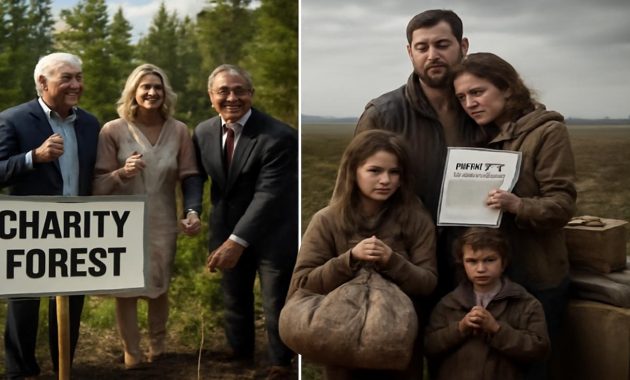
The morning the last cow left the Carter farm, the sky was the color of watered-down milk. A single truck grumbled down the frozen dirt lane, exhaust curling into the January air as if the land itself were sighing. Tom Carter stood at the gate, cap in his hands, watching the animals he’d raised from wobbly calves disappear in a clatter of hooves and steel. A clipboard man from the government had been there the week before, apologizing in that polished way they teach you in offices far from dirt floors and broken fence posts. New eco-taxes, he’d said. New emissions thresholds. New costs that made it impossible to keep the herd. “Nothing personal. It’s climate policy.”
Tom didn’t answer. He’d already run the numbers. He knew before the man spoke that it was over. The figures on the page were louder than any apology. But as the truck turned onto the main road, tires slipping on the thin crust of ice, he saw something else. Across the valley, on the hill that used to be his uncle’s barley field, a uniform line of tiny plastic tubes glinted in the pale sunlight like teeth. Inside each tube, a sapling funded by a charity with a glossy video campaign. The land now belonged to a billionaire’s climate foundation. What had once fed a town was being replanted as a “restoration forest” dedicated to saving the planet.
When Saving the Planet Stops Feeding the People
Walk through any capital city today and you can taste the urgency in the air. Posters scream about carbon footprints and net-zero goals. Politicians pose with electric cars and recycled sneakers. You’re told, over and over again, that we’re in a race against time—that every ton of carbon, every acre of forest, every policy tweak could tip the scales between survival and catastrophe.
That urgency is real. Oceans are warming, rivers shrinking, forests burning in places that used to be too wet to burn at all. The climate crisis is not an abstraction; it’s an ache in the lungs of children breathing wildfire smoke, a line of salt creeping into coastal wells, a withered stalk in a farmer’s hand where a healthy crop should be.
But step away from the billboards and the well-lit conference halls, and another story emerges—one whispered in auction barns, cramped kitchens, and the back corners of rural post offices. It’s the story of how climate “solutions” are landing on the backs of people who have the least power to shape them. Of how eco-taxes designed in glass towers are crushing families who live in drafty farmhouses. And of how land that once belonged to those families is being transformed into photogenic “charity forests” by the very billionaires who helped drive the crisis in the first place.
In this story, the planet still matters. The crisis is still real. But so is the quiet exodus of rural life, pushed along by policies that measure carbon more carefully than they measure people.
The New Green Gold Rush
Climate has become the business opportunity of the century. You can see it in the gleam of corporate sustainability reports, in the breathless language of “green investment portfolios,” in the steady thump of venture capital flowing into anything with a leaf-shaped logo.
There’s a name for this now: climate capitalism. It’s the idea that we can innovate, trade, and profit our way out of planetary breakdown. Solar panels and wind farms, yes. But also carbon markets, “nature-based solutions,” and a whole alphabet soup of offsets, credits, and derivatives.
These markets don’t float in empty space. They land somewhere. And increasingly, they are landing on fields, hills, and wetlands that once fed people. Behind every credit traded on a glowing screen, there is a piece of land, a community, a history.
| Climate Mechanism | Who Usually Profits | Common Rural Impact |
|---|---|---|
| Carbon Credits & Offsets | Large corporations, financial firms, big landowners | Land consolidation, loss of local control, speculative land prices |
| Eco-Taxes on Fuel & Inputs | States with higher revenue, carbon-credit intermediaries | Higher production costs, farm closures, transport hardship |
| Corporate “Rewilding” Projects | Billionaires, conservation NGOs, investment funds | Displacement of farming, reduced access to common lands |
| Green Infrastructure Funds | Urban investors, multinational firms | Profit extraction from rural resources, few local jobs |
When governments announce bold new eco-taxes—on fuel, fertilizer, emissions—they often frame them as neutral tools. Polluters pay. The market responds. The planet cools, eventually. But “polluters” is a broad word. It can mean a private jet logging ten transatlantic flights a month. It can also mean a dairy farmer whose tractor drinks diesel because there is no rural bus, no train, no electric alternative that works in a snowstorm on a 5 a.m. milking run.
On paper, the tax is the same per liter. In reality, it’s a different world. For the wealthy, it’s a line item. For the rural poor, it’s the difference between running the tractor or delaying the harvest. Between driving to town for groceries or stretching what’s in the pantry another week.
Eco-Taxes and the Tightening Noose on Rural Life
Picture a winter kitchen in a remote village. The windows sweat from the steam of a pot of stew; boots drip thawing snow by the door. On the table, a stack of bills slides between calloused fingers. Fuel tax. Vehicle tax. A new levy tied to farm emissions. Each piece of paper is small, but together they form a wall.
Eco-taxes rarely arrive alone. They come alongside new reporting requirements, new measurements, new inspections. A small farm that once survived on a careful balance of weather, luck, and stubbornness now has to survive on spreadsheets as well. Every cow, every liter of fuel, every patch of soil must be quantified and justified.
For big operations with accountants and consultants, this is a headache but not a catastrophe. For families running a few hundred acres with a single shared computer and a spotty internet connection, it’s overwhelming. There’s no department to hand this off to. There’s just the hour between sunset and sleep, when someone who has already spent the day in mud and machinery sits down to decode regulations written in a language that feels deliberately opaque.
Then comes the realization: complying will be expensive. Not complying will be more expensive. The eco-taxes on fuel alone might tip the scales. Add in the cost of new equipment to reduce emissions, and the math breaks in half.
But here’s the quiet twist: while small farms buckle under these pressures, those with deep pockets see opportunity. Land values in many rural regions are rising, not because of the promise of crops or cattle, but because of the promise of carbon. Buy enough acres, plant enough trees, rebrand it as a nature sanctuary or carbon project, and suddenly you’re not just an investor—you’re a savior.
Charity Forests on the Bones of Farms
On the hillside where Tom once watched his uncle’s barley turn gold every summer, everything now is straight lines and plastic sleeves. The billionaire who bought the land never sets foot here, of course. He appears on screens instead—at climate summits, on magazine covers, in sleek videos filmed on drone-studded estates—talking about “giving back” and “restoring what humanity has lost.”
His foundation’s newest project is the “charity forest” now crawling up the valley. There was a launch event in the city. Photos of smiling volunteers in brand-new boots, pushing spades into soft soil. A string quartet. A hashtag. Tree-planting as performance.
On the ground months later, the wind claws at rows of infant trees encased in plastic guards that squeal when rubbed by branches. The earth feels oddly empty beneath them. No tractor ruts. No scattered straw. No hoofprints at the stream. The land is still, but it’s the stillness of vacancy, not rest.
Of course, trees can be good. Forests cool the air, hold soil, shelter birds. Replanting damaged woodlands is essential in a century of storms and droughts. The problem is not the tree itself. It’s the story attached to it—the way these forests are marketed as clean moral victories while obscuring what had to give way for them to exist.
No one at the gala mentioned that this land used to pay a family’s mortgage. No one spoke about the kids who once crouched in these fields pulling stones from the dirt, or the grandmother who watched thunderheads rolling in from this very hilltop, calculating whether the storm would hit the wheat or pass by. If you listen closely, you can still hear those ghosts in the dry grass.
The billionaire’s advisors had run their models. Forest here, wetland there. The carbon numbers looked excellent. The offset potential was enormous. The project would allow companies to claim they were “carbon neutral” while continuing business as usual. In the glossy brochure, the valley was presented as a blank canvas, an empty space waiting to be redeemed.
But it wasn’t empty. It was only emptied—by a century of policies that hollowed out rural economies, by markets that squeezed producers to the bone, and now, finally, by eco-taxes that made traditional farming untenable just as climate finance came shopping for acreage.
The Vanishing Human From Climate Narratives
Listen to the way we talk about climate solutions in the corridors of power. We speak in gigatons, baselines, mitigation pathways, marginal abatement costs. The language is bloodless by design. It turns burning forests into red patches on a map, failed harvests into a curve on a chart, displaced families into nameless “migrants” in a forecast.
In that language, a small rural household doesn’t stand a chance. It is statistically insignificant—just one dot in a model, easily shifted from “farming” to “restoration area” with no sense of heartbreak or history. When we prioritize global efficiency above all else, it becomes strangely easy to trade away people who don’t show up to the meetings.
Take the phrase “marginal land.” Economists love it. It suggests fields that are less productive, soils that are thin, areas that might be better used for nature-based solutions. But if you stand on so-called marginal land at dawn, you may well find a farmhouse with smoke lifting from the chimney, a child waiting for a school bus, a dog barking at birds in the hedgerow. Marginal to whom?
The same pattern repeats with eco-taxes. In a spreadsheet, raising carbon prices on fuel seems elegant and fair. But the spreadsheet doesn’t see that the only grocery store within an hour’s drive closed three years ago, that the bus route was cut last winter, that an old pickup is the lifeline between a rural family and the rest of the world. There is no column for “is there another option?” Only for revenue and reductions.
Meanwhile, in cities, wealthy residents celebrate their low-carbon lifestyles. They order organic vegetables delivered by courier, attend tree-planting days on repurposed estates, give to foundations that promise to plant a tree for every flight they take. They pay the eco-taxes with little discomfort and applaud the outcomes. The climate crisis becomes another arena in which wealth can buy comfort—and redemption.
What Would a Fair Climate Transition Look Like?
None of this is an argument for doing nothing. The storms are still coming. The seas are still rising. If anyone understands how the climate has changed, it’s the people who work the land—who can tell you how the frost dates have shifted, how the spring rains have grown erratic, how pests arrive earlier and stay longer.
The question is not whether we act, but how—and for whom.
A fair transition would start by asking: who has actually benefited from the activities that drove the crisis? Whose factories, fleets, and fortunes filled the sky with carbon? And who is now being asked to pay first and hardest to undo that damage?
It would mean building climate policies that distinguish between survival emissions and luxury emissions. Burning diesel to run a tractor that harvests food for a region is not the same as burning jet fuel for a weekend trip on a private plane. Heating a drafty farmhouse in February is not the same moral category as air-conditioning an empty second home in the city all summer. Yet our taxes often treat them as though they are.
A just approach would cushion rural communities rather than corner them. If eco-taxes make fuel more expensive, then part of that revenue should circle back in direct support: grants for energy-efficient machinery, subsidies for local processing facilities so that value stays in the region, investment in reliable public transport that actually reaches the countryside, and in broadband that allows farmers to participate in modern markets without a two-hour drive.
It would also mean giving rural people a real stake in restoration rather than casting them as obstacles to it. Community-owned forests, agroforestry systems that blend trees with crops or livestock, farmer-led carbon projects where locals set the rules and keep most of the benefits—these are not utopian fantasies. They exist, scattered around the world like seeds waiting for rain.
Above all, it would mean resisting the seduction of simple stories. No more pretending that planting trees on former farmland is always and automatically virtuous, regardless of who loses their home to make room for the saplings. No more celebrating “net-zero” strategies that depend on pushing vulnerable people off the map so that companies and billionaires can buy moral clean slates.
Holding Two Truths at Once
We live in a time that hungers for easy heroes and villains. It would be simple to cast every billionaire planting charity forests as a cartoonish profiteer, every eco-tax architect as a detached technocrat with a calculator instead of a heart. The reality is more tangled. Many of the people driving these policies genuinely believe they are doing the right thing. Some grew up rural themselves and carry their own ghosts.
But good intentions don’t erase impact. The climate crisis demands that we hold two truths at once: that we must act fast, and that harm done in the name of fixing harm is still harm. If the price of reducing emissions in one column is the erasure of rural families in another, then the math is wrong, no matter how good it looks at a distance.
There is another way to tell this story. Imagine Tom standing not at a gate watching his last cow leave, but in a meeting at the town hall, sitting alongside neighbors and local officials and, yes, even a representative from that billionaire’s foundation. Imagine a conversation where his knowledge of the land is as valued as any consultant’s slide deck. Where the question is not “How can we buy you out?” but “How can we keep you here while the land heals?”
Maybe the outcome would still include trees. But maybe they would be woven into a living landscape of crops, grazing, hedges, orchards, windbreaks. Maybe carbon credits would be sold, but under terms set locally, with profits shared and livelihoods secured. Maybe a portion of the eco-tax revenue would repair the road that washes out every spring, keeping the school bus running and the grocery truck arriving.
Scaling that vision would be messy and slow. It would lack the clean lines of a charity forest photo op. It wouldn’t fit neatly into the stories that make billionaires look like saviors. But it would feel more like justice—and more like a world in which both people and planet get to stay.
Outside Tom’s old farmhouse, the January sky is still pale. But if you walk far enough down the muddy lane, past the empty barn and the fields that will soon bristle with saplings, you come to a bend in the river where willows lean over the water. Their roots clutch the bank, holding it in place against the current. It’s what roots do: they bind living things to the ground, keep soil from washing away.
We need climate solutions with roots like that—anchored in communities, wrapped around real lives, refusing to let the future be washed clean of the people who have tended the land the longest. Until then, the climate crisis will remain, for some, another chance to profit—and for others, another reason to pack the last box and close the farmhouse door behind them.
FAQ
Are eco-taxes always harmful to rural communities?
No. Eco-taxes can be useful tools for reducing emissions if they are designed fairly. The problem arises when they are applied uniformly without considering that rural residents often have fewer alternatives to fossil fuels and rely heavily on vehicles and machinery. Fair eco-taxes usually include rebates, targeted support, or exemptions for essential activities and low-income households.
Is planting forests on former farmland always a bad idea?
Not always. Restoring forests can bring major climate and biodiversity benefits, especially on highly degraded or erosive land. It becomes problematic when tree-planting projects displace existing communities, erase local food production, or funnel most financial benefits to distant investors instead of the people who live with the land.
What is meant by “climate crisis profiteers”?
The term refers to individuals, corporations, or funds that primarily seek financial or reputational gain from climate policies or projects, without fairly sharing benefits or addressing the root causes of the crisis. This can include using offsets to avoid reducing actual emissions, buying up cheap rural land for carbon schemes, or branding these moves as charity while communities lose control.
Can carbon markets ever work in favor of rural families?
Yes, if they are structured to put local people first. Community-managed carbon projects, transparent pricing, fair contracts, and support for small landholders can ensure that farmers and rural residents receive a meaningful share of revenue. However, this requires strong regulation, local organizing, and safeguards against predatory contracts.
What could policymakers do differently to support a just climate transition?
They could design eco-taxes that protect essential rural needs, return a significant share of revenue to affected communities, and invest heavily in rural infrastructure and clean technology. They could prioritize policies that keep people on the land—such as agroforestry, regenerative agriculture, and community-owned renewables—rather than encouraging mass sell-offs for large-scale carbon projects.