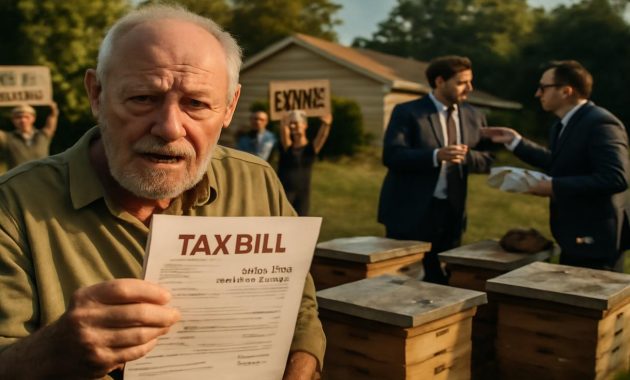
The first time the bees arrived, they came on a soft May morning, humming like a distant engine. The old man watched from his porch, coffee cooling in his hand, as the beekeeper rolled up the gravel drive in a dusty pickup, the back stacked with white wooden boxes that smelled faintly of wax and smoke. It was meant to be a small favor between neighbors—an easy kindness in the countryside where favors are still a form of currency. That was before the letters from the county, before the public hearings and the lawyers and the tax assessments that made even the calmest people in town start talking through their teeth.
The Quiet Favor That Started It All
Richard Dalton had worked forty years and retired early, arguably the way retirement brochures imagine things. His money had come from selling a chain of auto parts stores, not flashy start-ups or volatile tech, and it had given him something steady: a comfortable nest egg and a hundred and fifty acres of rolling meadow, scrubby woods, and a creek that ran cold even in July.
His land sat just outside a small town that only had one stoplight and a hardware store that still cut keys by hand. For years, that land had been his refuge—a place for walking the dogs, clearing brush, and reminding himself that he had time now. Time to breathe. Time to watch seasons move like chapters instead of weekends.
So when his neighbor, a lanky woman named Claire who kept chickens and a tomato jungle of a garden, mentioned that a local beekeeper needed some extra space for a few hives, it sounded charming, even wholesome.
“They’re quiet,” she’d said. “Good for the wildflowers. He just needs a corner. Barely noticeable. You’ll like him.”
And that’s how the beekeeper arrived—on a handshake, a half-smile, and no paperwork.
The beekeeper’s name was Aaron. He wore a faded ball cap, had hands nicked with old cuts, and spoke with the unhurried rhythm of someone who spent most days listening to insects rather than people. He walked the edges of Richard’s land with an almost reverent quiet, boots pressing down dandelions and reed canary grass, gaze always low and thoughtful.
“Just here,” he said, pointing toward a sunny edge of the meadow near the tree line. “Far enough from your house. The bees will like that sumac and clover. They won’t bother you.”
“Fine with me,” Richard replied, half-distracted, already imagining jars of amber honey on his kitchen counter, gifts for the grandkids and for the woman at the post office who always asked how his dogs were doing. Of all the decisions he’d made as a businessman—leases, contracts, lawsuits—this one felt impossibly simple. Just a bit of land. Just some boxes of bees.
The sound they made, once settled, was a thick, living hum. In the evenings, as the sun dropped and the air cooled, it drifted across the field—a sound you more felt in your chest than heard with your ears. It made the quiet seem richer somehow. He told himself he had done a small good thing.
The Hidden Edge of “Agricultural” Land
The favor might have stayed a quiet, neighborly secret if not for the county’s love of forms. One afternoon, months after the bees first arrived, Richard found a flat, official envelope in his mailbox. It came printed with the county seal—a running deer and two oak leaves—and carried the instantly recognizable tone of government: polite but unmistakably serious.
He opened it at the kitchen table, the dogs watching hopefully for the sound of food instead of paper.
It was a notice of “preliminary reassessment.” His property, the letter said, had been identified as “potentially involved in agricultural activity.” This might affect his property tax status. There would be a review. Additional documentation would be requested. Failure to respond could result in loss of any preferential assessment or, confusingly, the imposition of one.
He frowned. He wasn’t a farmer. He paid his taxes on time and didn’t claim special exemptions. That had always seemed cleanest.
Two weeks later, a second letter arrived. This one was thicker. Inside was a questionnaire about land use, a form referencing “agricultural classification,” and a polite suggestion that he might be eligible—via an “apiary operation under agreement”—for a special tax status as agricultural land, which generally carried a significantly lower assessment.
He stared at the form. Somewhere in the back of his mind, an old memory stirred—snippets from a town hall a few years back where people had argued about “ag exemptions,” timberland, and “rich folks gaming the system.” He hadn’t cared much then. He wasn’t part of it.
Now his name, his parcel number, were on forms that used the same words.
He called the county office. After two transfers and a wait underscored by tinny classical music, he reached a woman named Denise.
“So, you’re hosting beehives?” she asked, after he explained.
“I suppose. A few boxes. They’re not mine.”
“Doesn’t really matter who owns them,” she said. “The use is what counts. Beekeeping is agricultural activity under state law. Your land’s use may qualify for agricultural assessment. It’s routine. We just need to know how much of the parcel is in that use.”
Routine, she called it. But that word turned out to be misleading, like calling a storm “a bit of weather.”
When Numbers Turn Neighbors Into Opponents
By winter, what had started as routine had become something that people in town argued about in grocery aisles and at the end of church services. The bees themselves were hardly mentioned anymore. It was all about numbers—big ones.
Because here’s how it worked: Agricultural land, even land used only seasonally, could be taxed at a much lower rate than “residential” or “vacant” land. The idea was to protect farmers, keep working land from being carved up into subdivisions. But the rules about what counted as “agricultural” were a tangle of old language and newer interpretations.
In this tangle, beekeeping had become an unexpected thread.
The county assessor’s office, eyeing a growing list of properties claiming agricultural status with only a handful of beehives to show for it, decided to tighten its scrutiny. Someone had pulled up aerial photos, cross-referenced them with tax records, and noticed that a number of large tracts—owned not by old farm families but by retirees, investors, and absentee landlords—had suddenly become “agricultural” courtesy of a scattering of hives along their edges.
Richard’s land was on that list. But what no one in that office seemed to fully anticipate was how public it would all become.
The reassessment added nearly six figures in implied “benefit” over a decade to his tax picture, depending on how the classification ended up. For some in town, hearing that number in a public meeting made something in their jaws clench.
“So he hosts a few boxes of bees and pays less than we do on our half-acre?” a woman named Marla snapped at one hearing. “How is that fair? Some of us are scraping by. Some of us aren’t retiring on acreage.”
Across the room, Aaron the beekeeper sat rigid in his chair, cap twisted in his hands. He hadn’t wanted any of this attention. All he knew was that he needed places for his hives, places with enough blooms and away from pesticides. Hosting arrangements were common: a bit of honey for the landowner, a safe corner of field for the bees.
He had not expected zoning maps projected onto a wall, his hives represented as yellow dots that made people’s voices rise.
Lawyers, Loopholes, and the Question of Fairness
Lawyers arrived not long after the second public meeting. They didn’t come with pitchforks, but with briefcases full of precedent, case law, and highlighted sections of state statutes.
Richard, who had once prided himself on avoiding legal battles when he could, found himself sitting in a paneled conference room forty miles away, listening to a property tax attorney explain the difference between “bona fide agricultural use” and “incidental land use.” She spoke in carefully measured sentences, as if every word might later be read aloud in court.
“The law is on your side,” she concluded. “You are not doing anything improper by allowing an apiary. If the land is used for a qualifying agricultural purpose, then the classification is valid. The county is attempting to shift policy without legislative change. We can push back.”
What she didn’t say, but what hovered in the air between them, was that a six-figure swing in long-term tax exposure made this a fight worth having—for someone in his financial position, at least. For the lawyer, it was billable hours. For him, it was a matter of principle and, if he was honest, irritation. He didn’t like being painted as the villain over a few bee boxes he barely noticed anymore.
Out in town, the story took on a more jagged edge as it traveled from porch to bar to social media. People rarely repeated the nuances of statutes. They repeated what stung.
“He’s using bees to dodge taxes.”
“If I put a chicken in my yard, do I get a break too?”
“Must be nice to have a lawyer and call it ‘principle.’”
Meanwhile, the beekeeper found himself wedged in an uncomfortable middle seat between wealth and resentment.
“I never told him about tax breaks,” Aaron said, more than once, voice tired. “I just needed a place for the hives. The ag thing… that’s how counties usually treat bees. It helps small folks like me stay afloat too, you know? If landowners get something, they’re more likely to say yes when I ask.”
But nuance rarely survives the journey from one angered person to another. The debate wasn’t really about him anymore. It was about what people thought retirement and responsibility should look like when you had more money than your neighbors, and more land, too.
When the Land Itself Becomes a Battlefield
By the time spring came around again, the meadow was a battlefield in everything but name. Official-looking survey flags dotted the edges: fluorescent pink and orange, whipping in the wind like small, silent arguments.
County appraisers, clipboards in hand, walked the property boundaries with measuring wheels, making notes about “active use” areas versus “undeveloped passive use.” Drones buzzed overhead—contracted out for aerial imagery—adding a mechanical whine to the bees’ steady hum.
The land, which once had meaning only to the people who walked it, was now a mosaic of categories. Here, the “apiary cluster.” There, “adjacent support land.” Beyond that, the “remainder subject to standard residential valuation.” Each label came with a number, and every number came with an argument attached.
One of the great ironies was that, biologically, the bees saw none of these lines. They flew a couple of miles out in every direction, indifferent to parcel maps and tax codes, visiting backyard zinnias and ditch-side milkweed with the same persistent focus.
But people are not bees. Where the insects saw a seamless landscape, humans saw ownership and advantage and inequity.
At a particularly tense hearing, a retired schoolteacher stood up, her voice shaking not with age but with anger.
“I don’t begrudge anyone their comfort,” she said, looking over at Richard. “You worked for it. Fine. But when the tax system lets those most able to pay less by reclassifying land with a technicality, the rest of us make up the difference. We pay for the roads, the school buses, the county nurses. That’s not about bees. That’s about fairness.”
Later, when her words were printed in the local paper, a single phrase stuck out and found its way into conversations all over town: “not about bees.”
And yet, it was still a little bit about bees.
| Aspect | Before Beehives | After Beehives |
|---|---|---|
| Land Classification | Residential / Vacant | Mixed with Agricultural (apiary) |
| Tax Assessment Focus | House and total acreage value | Portions of land revalued as “working” ag land |
| Community Perception | Quiet retiree with open land | “Rich landowner using a loophole” (in some eyes) |
| Neighbor Relations | Friendly favors, informal agreements | Tense, lawyered, discussed at public hearings |
| Ecological Impact | Wildflowers, but little managed habitat | More pollinators, but more human conflict |
The Cost of “Harmless” Favors
Some conflicts you feel most sharply not in the courtroom or at the hearing, but in the small absences afterward. The missing wave from a neighbor who now pretends not to see you. The way conversation dies the moment you walk into the diner. The subtle, heavy silence when your name comes up at the barber shop.
For Richard, the cost of his “harmless” favor came packaged in those absences. He stopped lingering in town after errands. He drove a little farther away to buy groceries where the cashier didn’t know his parcel number by heart. The dogs still loved the land without reservation, romping down to the creek as though property classifications were as imaginary as human boundaries on a map.
One evening, he walked out to the hives at dusk. The boxes were stacked neatly, their white paint now weathered and streaked. Bees drifted in, fat and slow from the day’s work, their bodies dusted with pollen.
He found Aaron there, adjusting a lid, smoking the entrance lightly.
“You okay?” the beekeeper asked, without turning.
“Doesn’t feel like this was worth all the trouble,” Richard said quietly. “For either of us.”
Aaron shrugged. “Depends on what you mean by worth it. Bees are doing good out here. Yields are up on nearby orchards. Wildflowers are thick. But people…” He paused, finally looking over. “People are complicated.”
“You thinking of moving them?”
The beekeeper’s face creased in something like pain. “I might have to. I’m getting calls. Some landowners don’t want to be ‘that property’ in the papers. Others do, but for the wrong reasons—they’re chasing the tax status, not helping the bees. Your place was one of the few that felt… simple.”
They stood there for a long moment, listening to the hum combine with the soft rush of the creek below.
“If you move them,” Richard said at last, “it doesn’t end this mess. The county’s still after their numbers. Neighbors are still mad. We’re already in it.”
“Yeah,” Aaron replied. “But maybe it won’t get worse.”
It was a strange calculus: weighing the health of a local pollinator population against the temperature of a tax debate. But that’s what it had come to, in this corner of the world, in this particular year.
What Happens When Systems Lag Behind Values
If you strip away the personal details—the bees and the meadow and the names—you’re left with a story that could be happening in a dozen other counties, under a dozen other pretexts. Solar panels instead of bees. Conservation easements instead of apiary contracts. Short-term rentals instead of barns.
The underlying question is always the same: Who is the tax system really built to serve, and how quickly can it adjust when the ground shifts beneath it?
Property tax law in many places was written for a world where land was either clearly a farm, clearly a home, or clearly a business. But modern life spills over those neat lines. A retiree with some extra land can support a working beekeeper and also, unintentionally or not, benefit from incentives meant to keep multi-generational farmers afloat. Investors can plant a few rows of something or host livestock part-time and claim the same treatment. Counties strapped for revenue see their tax base thinning and push back, often clumsily.
In that gap between old rules and new uses, resentment grows fast.
Some taxpayers looked at the Dalton property and saw a wealthy man bending the system. Others saw a county wielding its power selectively, focusing on a handful of high-profile parcels instead of fixing the underlying laws. Still others saw something more granular: a chance for pollinators, soil, and open space to coexist with human needs, if only the incentives were designed with more precision and less loophole.
But legal change is slow. Personal anger is fast.
The hearings stretched on. Compromises were floated—a cap here, a phase-in there, a stricter definition of “active agricultural use” that might spare small-scale beekeepers while making it harder to claim acreage that never saw a hoofprint or root system.
Meanwhile, out in the meadow, goldenrod bent in the late-summer breeze. The bees, indifferent as ever, flew their routes. They found clover in poorer yards, wild berries along the creek banks of people on both sides of the argument. They stitched the landscape together in ways the humans clearly couldn’t.
Lessons From a Land War Over Bees
In the end, there was no neat resolution, no triumphant headline about justice served. The county adopted a more detailed set of criteria for agricultural assessment, tying tax breaks more tightly to measurable production and clearer documentation. The change blunted some of the most blatant abuses without erasing the gray areas entirely.
Richard’s land kept a partial agricultural classification—the hives counted, but only on a smaller slice of the acreage. His tax bill went up compared to what the lawyer had hoped, down compared to what the loudest critics wanted. A compromise, which meant that almost no one walked away fully satisfied.
Some neighbors resumed small talk. Others didn’t. He learned to live with the partial chill.
Aaron kept some of his hives on the property but moved others to a patchwork of smaller lots—back corners of nurseries, the edge of a fallow field two towns over. He added one more line to the long list of things he now had to explain to nervous landowners: “No, this won’t put you on some blacklist. No, I’m not here to game your taxes.”
The bees, as ever, went on.
If there’s a lesson in a story like this, it’s not that rich retirees are villains or that tax officials are petty or that neighbors are inherently jealous. It’s that our systems rarely keep up with the subtle, shifting ways we now use land—and that when money, identity, and morality knot together, even something as small and beautiful as a beehive can become a trigger.
A quiet favor between neighbors can, under the right pressures, turn into a land war that leaves everyone a little more suspicious, a little more careful about saying “yes” the next time someone knocks on their door asking for a corner of field or an unused shed.
But there is another, softer lesson too, waiting out there among the clover and the sumac. It’s in the way the bees ignore property lines, taxes, old grudges, and new resentments, working the landscape as a single, shared thing. They move from the rich retiree’s meadow to the modest backyard of the woman who spoke out at the hearing, then on to the teacher’s garden and the ditch along the county road where wild asters bloom in defiance of mowers.
To the bees, every flower is simply part of the same place. The borders, the numbers, the arguments—they’re all ours. The question, looking out over a piece of contested ground, is whether we can remember even a fraction of that larger view when the next “harmless” favor comes along.
FAQ
How can a few beehives affect property taxes?
In many regions, beekeeping qualifies as an agricultural activity. If a property hosts hives under a formal or informal agreement, parts of that land may be reclassified as agricultural, which often comes with lower tax assessments compared to standard residential or vacant land.
Was the retiree doing anything illegal by allowing beehives on his land?
Based on how most agricultural and property tax laws work, simply allowing beehives is not illegal. The controversy arises over how broadly or narrowly tax officials interpret “agricultural use” and whether the spirit of the law—usually to support working farms—is being respected.
Why were other taxpayers so angry in this situation?
Many residents felt that wealthier landowners were getting tax advantages they themselves couldn’t access, effectively shifting more of the tax burden onto smaller homeowners. Even if the practice is technically legal, it can feel unfair, especially in communities where people are already struggling with rising property taxes.
Do beekeepers often rely on other people’s land?
Yes. Many beekeepers, especially small or independent ones, depend on scattered sites: farms, orchards, and private properties where they place hives in exchange for honey, pollination services, or small fees. These arrangements are common and usually low-conflict—until tax or zoning issues get involved.
How could conflicts like this be avoided in the future?
Clearer laws and guidelines could help, such as specifying minimum levels of production, acreage, or documentation to qualify for agricultural tax status. Transparent communication between landowners, beekeepers, and tax authorities early on can also prevent misunderstandings and resentment later.
Are bees themselves ever a legal problem for neighbors?
Occasionally, yes. Disputes can arise over stings, fears of allergies, or concerns about hive density. Most regions have basic rules or best practices for hive placement, but in many cases, it’s neighborly agreements—not formal law—that keep the peace.
What does this story say about modern retirement and land ownership?
It highlights how retirement today often intersects with complex systems—tax law, conservation, agriculture—in ways that can surprise people. Owning large tracts of land can be both a privilege and a responsibility, with choices about “harmless” favors or land use carrying social and financial consequences far beyond what a retiree might expect.