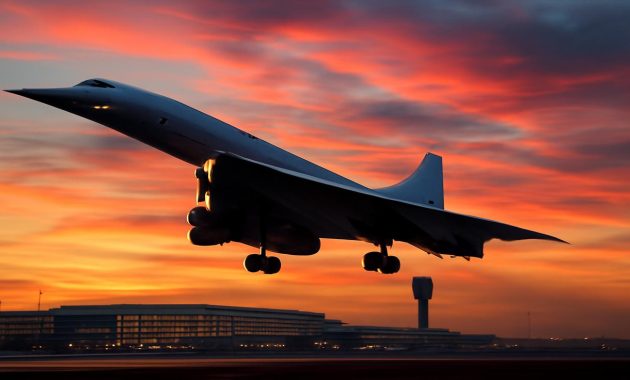
The first time you see it, you don’t quite believe it. A needle of white slicing through the haze at dawn, its nose tipped down like a bird evaluating a landing. The air along the runway trembles; cameras rise like a small forest of metallic stems. For a heartbeat, everyone holds their breath. Not because a plane is landing. Because a legend is returning. Concorde—yes, that Concorde—is back, its sinuous silhouette shimmering against the sky, promising again what it once swore to the world: that distance is just a problem of speed, and speed is a problem we can solve.
The Day the Sky Got Smaller
If you sit with someone who flew Concorde in its heyday, their eyes soften in a way that makes time vanish. They talk about that peculiar stillness before takeoff at Heathrow or Charles de Gaulle, the feeling of being strapped into something that looked more like a space-age dart than a passenger jet. They remember the cabin—narrow, yes, but humming quietly with the clinking of glasses and murmured conversations. And then there was the moment of crossing Mach 1, the speed of sound, somewhere high above the Atlantic where clouds stop looking like clouds and start to resemble ripples of chalk smeared over endless blue.
It was more than just a flight. It was a flex of human possibility. London to New York in about three hours and a change. Breakfast in Europe, a business lunch on Manhattan’s 5th Avenue, and home before the late news. The world felt suddenly smaller, more negotiable, like a map you could fold into your pocket.
And then, as abruptly as if someone had flipped a cosmic switch, it ended. In 2003, Concorde’s final commercial flight glided back to Earth and into history, its future sealed by a deadly crash, rising fuel costs, tightening environmental rules, and a shifting sense of what aviation should be. The silver dart that once outran the planet’s rotation speed across time zones became a museum piece, a story parents told their kids as they pointed at the sleek, silent shape behind a rope barrier.
Now, the story is taking an unexpected turn. The year is 2026, and the sky is about to get smaller again.
Whispers of Thunder: How Concorde Found Its Way Back
The idea that the original supersonic passenger aircraft would return always sounded like wistful nostalgia. Engineers and aviation fans dreamed; airline accountants winced. The obstacles were obvious: eye-watering fuel consumption, the teeth-rattling roar of afterburners, and the infamous sonic boom that banned Concorde from flying supersonic over land in many parts of the world. And yet, the shape of that impossibly thin delta wing never left our imagination.
What changed was less a single breakthrough and more a convergence of them. In the two decades since Concorde retired, the world of aviation quietly evolved. Engines became more efficient. Composites and advanced alloys replaced heavier metal structures. Computer modeling allowed engineers to sculpt airflow with a precision that would have been science fiction in the 1960s. And above it all, an urgent new master arrived: the climate.
Any talk of reviving a supersonic passenger jet in the 21st century had to dance with a hard truth. A world that is already warming cannot afford to indulge in speed for speed’s sake. The return of Concorde, then, isn’t a simple reunion tour of an old rock star. It’s a reimagining. A promise that if we are to pierce the sound barrier again, we have to do it with more humility—and a lot more engineering discipline.
So the designers went back to the drawing board. The legend would remain, but almost everything else would have to grow up. The aim: preserve the spirit of Concorde—its daring, its grace, its statement that the sky is an invitation, not a ceiling—while confronting the realities of noise, emissions, and economics head-on.
A Familiar Shape, A New Soul
Stand near one of the reborn Concordes on the tarmac and the echo of the past is unmistakable. The long, slender fuselage. The elegant droop-nose pivoting down for taxi and landing. The delta wing fanning out like a stingray’s fin. But looming under that familiar silhouette is an invisible revolution.
The engines, once famous for their blazing afterburners, are now quieter, more efficient, and more complex in their software than some early spacecraft. Instead of brute-force thrust, they rely on precision control, variable inlets, and clever ways of shaping the exhaust to cut noise and waste. The airframe materials—lightweight composites and advanced alloys—sip less fuel by saving weight, while computer-optimized contours nudge the shock waves into better behavior, softening the boom that once scattered complaints along coastlines.
Inside, the cabin no longer feels like a narrow executive shuttle from another century. There’s still an intimate feeling—you won’t confuse this with a double-decker wide-body—but the designers have leaned into comfort. Larger windows, calibrated lighting that follows circadian rhythms, supersonic-suited in-flight entertainment, and a layout that makes you feel less like cargo and more like a guest in a moving, whispering lounge at 60,000 feet.
What hasn’t changed is the sense, once you’re strapped in and the engines spool up, that you’re participating in something audacious. Humans are not supposed to move this fast, not strictly speaking. But we do. And in Concorde’s return, that defiant streak in our species is alive again—tempered now, but not extinguished.
Slicing the Atlantic in Half—Again
Let’s talk about the numbers that make this all feel unreal. On a map, New York and London look far apart in a way your eyes can measure. Over 3,400 miles of ocean. At typical subsonic cruise speeds, you’re in for a seven-hour journey, shifting in your seat, counting clouds, negotiating with sleep and stiffness.
Step aboard the revived Concorde, and the physics rearrange themselves around you. Cruising at around Mach 2—twice the speed of sound—you chew through those miles in roughly half the time. Three hours and some change. The Atlantic turns from an epic stretch of blue into something more like a broad river.
From your window, the Earth curves on the edges if you pay attention. The sky above you is not the cheerful sapphire of mid-altitude flight; it is a deeper, more velvety blue, edging toward black. Airplanes below look like slow-moving patient creatures, while you move in a different tempo entirely, straddling time zones so quickly your wristwatch becomes more suggestion than authority.
The intimate scale of the cabin feeds something the sprawling wide-bodies cannot: a sense of narrative. You don’t just arrive somewhere; you make an entrance. The flight itself is the story: the subtle flex as you accelerate through Mach 1, the gentle feeling of being pressed back a little more than usual, the Captain’s voice—steady, almost understated—announcing you’ve just broken the sound barrier, as though slipping past a rumor.
| Route | Conventional Flight Time | Concorde (2026) Estimated Time |
|---|---|---|
| London – New York | ~7 hours | ~3 hours 15 minutes |
| Paris – New York | ~7 hours 30 minutes | ~3 hours 30 minutes |
| London – Toronto | ~7 hours 45 minutes | ~3 hours 40 minutes |
From a purely practical standpoint, the return of supersonic travel compresses not just itineraries, but possibilities. A transatlantic day trip is no longer an absurdity; it’s a line item in a busy week. Yet the emotional impact goes far beyond clock math. There is something deeply stirring in the notion that you can chase the sun across the ocean and almost keep pace, that you can leave a city bathed in morning light and arrive to find the day hardly aged.
Speed Meets a Planet in Peril
But if you listen closely around the edges of the excitement, you’ll hear another sound: questions, low and insistent. What does it mean to bring back supersonic passenger flight in an age of climate crisis? Can we really afford the carbon cost of cutting travel times in half when the atmosphere is already groaning under the weight of our choices?
These are not the kinds of questions that can be answered by nostalgia or romance. They force the engineers and airlines behind Concorde’s return to show their math. More efficient engines are part of that equation, as are lighter structures and smarter flight profiles. Some flights talk about blending sustainable aviation fuels into the mix, scraping down the overall emissions per passenger-kilometer.
But honesty matters here. Even with improvements, a supersonic flight demands more energy than a slower one. The physics are unforgiving. The promise, then, isn’t that Concorde 2026 is magically green, but that it is far less reckless than its ancestor—and woven into a broader shift in aviation where efficiency, not just glamour, is a defining metric.
Perhaps the most hopeful part is cultural. The Concorde that returns is doing so under harsher scrutiny than the one that first dazzled the 1970s. Every new aircraft is now judged against a higher bar of responsibility. In that sense, the world has grown up. If supersonic travel is to have a future, it must serve more than the thrill of speed; it must fit inside a story where humanity learns to move quickly and wisely on a fragile world.
The Sonic Boom, Softened
Then there is the matter of the boom—the sharp, rolling thunderclap that once made supersonic jets persona non grata over much of the world’s landmass. The original Concorde was forced to reserve its party trick for long stretches over the ocean, slipping quietly beneath the speed of sound when land appeared beneath its shadow.
Emerging research and design tweaks now promise something different: the possibility of a “soft” boom, a thump rather than an explosive crack. By carefully shaping the aircraft’s fuselage and wings, engineers can redistribute shock waves, spreading them out so that the sound reaching the ground feels more like distant thunder than a whip crack above your roof.
It’s not magic, and regulations will still be tight. Communities under flight paths remain understandably wary of any new source of overhead disruption. Yet there is a quiet wonder in this too: the idea that even shock waves, the invisible bruises in the sky left by our speed, can be taught better manners.
The Human Side of Supersonic
Lost in the talk of engines and emissions, there’s another layer to the return of Concorde: the way it rearranges the texture of human lives. Travel, after all, isn’t just logistics. It’s emotion—reunions, departures, hopes slid into suitcases, the inward bracing for change every time you walk down a jet bridge.
Imagine a future where an artist in London can accept a last-minute invitation to open a gallery in New York and still be home in time to tuck their child into bed. Where a researcher can attend a crucial meeting across the ocean and be back at their lab the same evening, experiments uninterrupted. For high-stakes diplomacy, urgent medical collaborations, time-critical business decisions, the ability to knit continents closer in hours instead of a long day might redefine what is possible.
And then there’s the wonder—children pressed to windows at airports, watching that impossibly slender bird nose downward and taxi past more ordinary aircraft like a ghost of the future. Pilots who grew up with posters of Concorde on their bedroom walls now trained to fly the real thing, hands steady on the controls of a dream they once traced with sticky fingers.
Inside, passengers slide into seats that feel less like status symbols and more like front-row tickets to a science-fiction future we somehow managed to make real decades late. There is a champagne sparkle to it all, yes, but also an almost reverent quiet. You are not meant to be here, human nerves and thoughts and fragile bone, racing through the thin upper air at twice the speed of sound—and yet, you are.
A New Symbol in the Sky
Every era chooses its own icons. For much of the 20th century, the jet airliner was one of them: a shining arrow of progress, stitching post-war continents together with contrails and convenience. In the early 21st, as we confront the costs of that mobility, planes have come to symbolize our excess as much as our connection.
The returning Concorde hovers between those stories. It is a symbol of something we almost abandoned: the audacity to go faster, higher, stranger. But as it roars—more softly now—back into our skies, it carries new meaning. It says that speed must answer to scrutiny, that innovation is responsible not just for what it can do, but what it chooses not to do.
In a way, Concorde’s comeback is less about proving we can outrun sound and more about proving we can outgrow our own worst habits. That we can revisit our boldest machines and ask them to be better versions of themselves. That progress isn’t a straight line but a loop, a conversation between past and future.
Some will see only extravagance: the privilege of a few to cross oceans in less time while many still struggle to move at all. That critique matters. The challenge for airlines and policymakers will be ensuring that the technologies born in the rarefied arena of supersonic luxury trickle down—quieter engines, cleaner fuels, smarter aerodynamics improving the planes that carry most of us.
Yet even critics might find a small sliver of awe in the simple fact of it: a plane first imagined in the analog age, resurrected and reimagined in the digital one, carving again through the sky as both déjà vu and prophecy.
Looking Ahead From 2026
As 2026 approaches, the countdown to Concorde’s return feels less like a single event and more like a hinge in time. The test flights will draw flocks of spectators to fences and rooftops. Aviation forums will hum with diagrams and speculation. Environmental groups will demand transparency and accountability. Children who never saw the original Concorde in motion will grow up in a world where the phrase “supersonic passenger flight” is no longer a piece of history, but a line on departure boards.
Will supersonic travel become common, or will it remain a streamlined outlier, more symbol than staple? No one can say for sure. Economics, regulations, and public opinion will write that story over the next decade. What’s clear is that the decision to bring Concorde back cracks open a door we thought was shut.
We stand, once again, on the edge of a runway, staring at a white dart of possibility. The engines rise to a howl that lives more in your chest than in your ears. The nose lifts. The wheels leave the ground. And just like that, the sound barrier is not a limit but a suggestion, an invisible line we have learned, carefully and imperfectly, to cross.
In a century defined by both crisis and ingenuity, maybe this is what the new Concorde really offers: not an escape from the world’s problems at twice the speed, but a reminder that the same restless creativity that built this impossible machine can also be turned toward healing the planet it flies over.
As the aircraft climbs, the horizon bends, and somewhere, high above the clouds, the long, slender shape tips its nose toward the future, chasing sunlight once more.
Frequently Asked Questions
Is the returning Concorde the same aircraft as the original?
No. The 2026 Concorde is a modernized evolution inspired by the original design. It carries forward the signature features—supersonic speed, delta wing, droop nose—but uses updated materials, avionics, and engines to meet today’s safety and environmental standards.
How fast will the new Concorde fly?
The new iteration is designed to cruise at around Mach 2, roughly twice the speed of sound, similar to the original Concorde. This allows transatlantic crossings, such as London to New York, in a little over three hours under typical conditions.
Will it still create a loud sonic boom?
The aircraft will still generate shock waves when flying faster than sound, but its shape and flight profiles are optimized to reduce the intensity of the boom. Overwater routes will remain the primary supersonic corridors, while overland segments are expected to be flown at subsonic speeds or under stricter regulations.
Is the new Concorde more environmentally friendly?
Compared with its predecessor, yes. It benefits from more efficient engines, lighter structures, and potentially the use of sustainable aviation fuels. However, supersonic travel inherently consumes more energy than conventional subsonic flight, so it is not a zero-impact solution and remains under close environmental scrutiny.
Who will be able to fly on Concorde when it returns?
Initially, Concorde is expected to serve premium markets and high-demand routes, with ticket prices reflecting the specialized nature of supersonic travel. Over time, if technology scales and costs decrease, some of its innovations may filter into wider commercial aviation, potentially making faster travel accessible to more people.