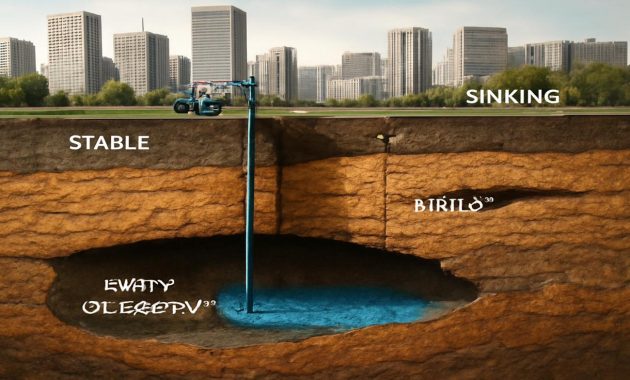
On some nights, when the streets quiet down and the last commuter train rattles past, certain cities sigh. You can’t hear it, of course, but it’s there—in hairline cracks on a kitchen wall, in a misaligned doorway that no longer closes, in the way a streetlamp leans just a little more each year. The ground itself is sinking, almost imperceptibly, as if the city were slowly exhaling after a century of hard labor. And beneath those streets, in the dark geology that once fueled the modern world, humans are now doing something unexpected: pouring water back into the empty spaces left behind by oil.
The Day the Ground Began to Move
The first time Elena noticed it, she was standing in her sixth-floor apartment in eastern Mexico City, trying to hang a new painting. The nail went in at what looked like a perfect 90 degrees, but when she stepped back, the frame seemed off, tilted, as if the wall itself were subtly warped. She frowned, measured again, adjusted. A week later, a fine crack appeared, zigzagging from the ceiling like a thin white scar.
Her neighbors shrugged. “The whole neighborhood is like this,” the woman downstairs said. “It’s the ground. It’s always moving.”
In Mexico City, in Jakarta, in Shanghai, in Houston and parts of Saudi Arabia, this quiet downward drift has become a defining feature of urban life. It doesn’t come with the drama of an earthquake. There’s no single moment you can point to, no sudden jolt. Instead, the city bows, millimeter by millimeter, year by year. And one of the reasons is something we’ve spent the last century pulling out of the earth at a furious pace: oil and the brackish water that comes with it.
What’s surprising today is not just that this extraction can make cities sink—it’s that, in some places, engineers have figured out how to slow, and sometimes nearly stop, that sinking. The trick involves turning the entire oil field into a kind of underground sponge and then re-wetting it, one calculated gulp at a time.
How an Oil Field Becomes a Hollow Lung
To understand why engineers are now pumping water back underground, you have to start with what happens when we take fluids out in the first place. Oil reservoirs are not empty caverns of black liquid; they’re tight, granular rock—sandstone, limestone, fractured carbonates—whose tiny pores are filled with a mixture of oil, gas, and water. Think of a dense, soaked sponge, not a hollow cave.
For millions of years, that sponge has been pressurized by the weight of the rock above it and by the fluid pressure of whatever occupies its pores. The day drilling rigs arrive, that balance begins to change. Every barrel of oil brought to the surface is accompanied, in many fields, by several barrels of salty formation water. Pressure drops. The grains of rock lose some of the support they once had from the fluid wedged between them. Very slowly, they rearrange themselves into a more compact structure, like a book whose pages are being tightly pressed together.
At the surface, this rearrangement shows up as subsidence: the land sinks because the rock beneath it shrinks. In some coastal cities built over oil and groundwater reservoirs, this sinking has been measured not in millimeters, but in meters. Neighborhoods that were once safely above sea level now watch storms creep higher over seawalls. Foundations twist. Floodwaters take longer to drain. What began as an industrial activity at the edge of town turns into a citywide, creeping hazard.
In places like Long Beach, California, or the vast oil and gas fields beneath parts of the Gulf Coast and the Middle East, this process didn’t go unnoticed. Surveyors saw harbor pilings suddenly standing “taller” relative to a falling shoreline. Engineers started to map the changes. It became clear that certain pockets of the subsurface—a depleted segment of an oil field here, a heavily pumped aquifer there—corresponded neatly to the bull’s-eyes of sinking land above.
The Idea: Put Something Back
The leap from diagnosis to remedy required a small act of conceptual bravery. If taking fluids out made the ground sink, what if you put something back in?
By the middle of the twentieth century, oil engineers were already experimenting with waterflooding—not for saving cities, but to coax more oil from stubborn rock. By injecting water into certain wells, they could maintain pressure in the reservoir and sweep more oil toward production wells, increasing yield. But in time, another benefit appeared: where pressure and fluid volume were sustained, the land above subsided more slowly. In some regions with careful management, the sinking nearly halted.
The oil field, in other words, could function like a vast, hidden hydraulic system propping up the surface of the city.
Cities Riding on Pressurized Stone
Walk through a business district in a sinking city and the signs are subtle but everywhere. Stairways collect puddles that never quite go away. Bridges sit more awkwardly over canals. Drainage ditches that once had a healthy slope toward the sea now look nearly flat. To live in such a place is to inhabit a slow-motion topographical story, in which gravity is always winning, tugging you, your apartment, your office tower, infinitesimally downward.
In some of the world’s energy capitals, the response has turned the entire subsurface into an engineering project. Consider the image: under the towers, freeways, and suburbs lies a honeycomb of wells connecting to ancient rock thousands of meters below. Some wells suck hydrocarbons up; others push water down. The whole system is monitored like a patient in intensive care—pressure gauges, satellite measurements of ground level, tiltmeters, geological models recalibrated every few months.
The goal is not just to get the last drop of oil from the rock, but to keep the surface—where millions of people live—stable enough to function. The ground becomes less a passive foundation and more an active machine, tuned and adjusted in real time.
Water injection, when done at a massive scale, can delay or greatly reduce subsidence. It’s not magic; it’s simple mechanics. Fluids in the pores help carry some of the load that would otherwise crush the rock. Restore a portion of that fluid and pressure, and the grains don’t compact as much. The sponge swells, or at least resists further collapse.
There is a quiet marvel in the fact that skyscrapers, bridges, and highways may be riding, quite literally, on human-managed pressurization of stone deep below—cities floating, in a sense, on re-inflated rock.
The Underground Negotiation
Of course, it’s a negotiation, not a perfect fix. Engineers must decide: how much water can we inject without cracking the rock, without triggering small earthquakes, without pushing fluids into zones where they might contaminate freshwater aquifers? How do we balance the economic imperative of producing oil against the physical need to maintain pressure?
They run numerical models that simulate how each tiny patch of reservoir rock will behave as more water comes in and more oil goes out. They incorporate satellite-based InSAR measurements that can detect ground movement on the scale of millimeters. They compare the predictions with reality, adjusting injection rates like a pilot working the controls during turbulence.
In some regions, these underground negotiations have led to dramatic change. Places that were once poster children for subsidence have stabilized. Ports that had started to warp are now watched, nervously but optimistically, as their piers and quays settle into a slower, less alarming rhythm.
What the Numbers Whisper
Subsidence is a story best told in numbers: centimeters per year, degrees of tilt, bars of pressure regained or lost. It’s also a story that only makes sense when those numbers are put in conversation with each other. Below is a simplified snapshot of how this can look when cities and fields embrace water injection versus when they do not.
| Scenario | Annual Subsidence Rate | Reservoir Management | Typical Consequences |
|---|---|---|---|
| Aggressive extraction, little or no water injection | Up to several cm per year | Rapid pressure loss, high compaction | Frequent flooding, infrastructure damage, costly retrofits |
| Moderate extraction with partial injection | Millimeters to 1 cm per year | Partial pressure support, focused around urban areas | Manageable ground movement, targeted reinforcement |
| Carefully balanced extraction and large-scale injection | Near-zero to a few mm per year | Active pressure maintenance, continuous monitoring | Stabilized cityscape, lower long-term adaptation costs |
These rows, in reality, represent different choices over decades. A city whose subsurface is managed like a patient’s vital signs will look and feel different from one where extraction happened first and questions came later.
The Sound of Pumps in the Night
If you could stand, for just a moment, at one of those injection wells deep in an industrial quarter at the edge of a city, you’d hear a low, mechanical heartbeat. Pumps thrumming, valves hissing, the faint rattle of steel against steel. The air smells of oil and damp concrete. Under your feet, hundreds of meters down, chilled or ambient-temperature water is being threaded into old pathways once filled with hydrocarbon mixtures. Some of it is treated seawater, some recycled produced water—the same brine that came up with oil in earlier years and has been cleaned, analyzed, reconsidered.
In a control room nearby, a small team watches numbers on screens: pressures, flow rates, tiny color-coded maps of the field. They know that turning a valve too quickly could send a pressure wave through the rock; shutting things down abruptly could let parts of the reservoir relax and compact. The work is slow, iterative, and often invisible to those who benefit most—office workers in distant downtown towers, families in low-lying suburbs.
Yet the connection is intimate. When the pumps maintain the right pressures, a warehouse district doesn’t flood after the next heavy rain. A subway line doesn’t have to be closed for emergency repairs because the tunnel floor has shifted. When the pumps falter, the consequences might not be felt for years, until a future engineer frowns at a graph showing a subtle but unmistakable acceleration in the city’s downward drift.
Water as a Second Chance
There is something almost poetic about water playing this role. For decades, water was considered a nuisance in the oil business—an unwanted companion to the more profitable black liquid. Operators spent fortunes separating it, disposing of it, keeping it out of pipelines and refineries. Now that same water is being reconsidered as a stabilizing agent, a way to give the subsurface a second chance at equilibrium.
This doesn’t mean the rock goes back to exactly how it was. Some compaction is irreversible. Grains that have already rearranged themselves, pores that have collapsed, fractures that have closed—those won’t spring open like a sponge in a sink. But by adding volume and pressure back into the system, engineers can slow further damage. In the language of medicine, it’s not a cure, but a powerful form of symptom management.
In some of the world’s biggest cities whose fates are entwined with old oil fields, that management can make the difference between viable long-term habitability and a future of constant, expensive adaptation.
The Cost of Holding Still
It’s tempting to see water injection as a kind of elegant redemption arc: we took from the earth, now we give back, and the land steadies. But underneath that story lies a more complex ledger of costs and risks.
Water doesn’t simply vanish once injected. It moves. It can push other fluids along, sometimes into places we’d prefer them not to go. If mismanaged, injection can increase the risk of induced seismicity—small earthquakes triggered by changes in subsurface pressure. In some places, regulators now watch injection projects as closely as they watch drilling campaigns, demanding detailed geological models before each new phase begins.
Then there’s the question of water itself: where does it come from, how is it treated, what energy is used to move it? In an age of intensifying drought and water scarcity, the idea of pumping vast quantities underground has to be weighed against every other demand on that resource. Increasingly, operators turn to saline water from the deep subsurface or the sea rather than competing with municipal or agricultural supplies. Even then, the treatment and pumping require energy, which carries its own climate and economic costs.
Meanwhile, water injection addresses only one strand of the subsidence problem. In many megacities, the bigger culprit is not oil extraction but groundwater pumping for drinking water and industry. Engineers can stabilize an oil field and still watch districts above a depleted aquifer sink faster than ever. The earth, in other words, keeps a multi-column ledger, and balancing one column doesn’t erase the red ink in another.
Living with a Managed Planet
Still, there is a broader story unfolding here—one in which humans are learning, awkwardly and imperfectly, to manage Earth systems at scale. We’ve already spent centuries altering the atmosphere, carving into rivers, flattening forests, and tapping underground reservoirs of fuel and water. Water injection in old oil fields is part of a newer chapter, in which at least some of that engineering is directed not only at extraction, but at protection.
This doesn’t absolve us of the consequences of fossil fuel use or erase the climate impacts already in motion. But it does hint at a future in which our relationship with the subsurface becomes more reciprocal, more nuanced. Oil fields might be repurposed as geothermal reservoirs, as carbon storage sites, as pressure-managed buffer zones that help hold the line against sinking land.
Cities built on top of such fields will, in that case, become test beds for a strange new kind of urban resilience—one that depends not just on seawalls and green spaces, but on the quiet, constant choreography of fluids in rocks we’ll never see.
Questions We Will Keep Asking
One evening, years after Elena first noticed that crooked picture frame, she stands on her balcony and looks out across the smog-softened skyline. Somewhere beneath her feet, in a patchwork of ancient volcanic deposits and deeper sedimentary layers, pressures are shifting. Some of that shift is inevitable; some of it, perhaps, is being moderated by distant injection wells she’ll never know exist.
The city feels—at least tonight—solid enough. But she’s aware now that this solidity is something negotiated, not guaranteed. She’s heard the news stories about subsidence and infrastructure adaptation plans, about engineers tracking the ground’s micro-movements by satellite.
The story of pumping water into empty oil fields to delay land subsidence is, in many ways, a story about buying time. Time for coastal defenses to be built, for buildings to be reinforced, for societies to transition away from a fossil-fueled economy that made such subsidence possible in the first place. Time, perhaps, for a new relationship with the ground itself—one in which we recognize that the surface we walk on depends on the invisible decisions we make far below.
And as more cities, perched uneasily over spent reservoirs and thirsty aquifers, begin to feel themselves slowly descending, the questions sharpen: How much intervention is enough? Who benefits, and who bears the risk? How do we balance the technical ability to “hold still” with the moral urgency to change the behaviors that made movement inevitable?
For now, in a handful of sprawling urban landscapes, the answer involves the methodical thrum of pumps, the cool rush of water into ancient pores, and a planet that, even as it warms and shifts, is being quietly, persistently, asked to hold us up a little longer.
FAQ
Does pumping water into old oil fields really stop land from sinking?
It usually doesn’t stop subsidence completely, but it can significantly slow it. By restoring some of the lost fluid pressure in the rock, water injection reduces further compaction and delays additional sinking.
Is this the same as fracking?
No. Hydraulic fracturing (fracking) is designed to create new fractures in rock to release hydrocarbons. Water injection for pressure maintenance typically uses lower pressures aimed at stabilizing the reservoir, not cracking it open.
Can water injection cause earthquakes?
In some circumstances, changes in subsurface pressure from injection can contribute to small earthquakes, especially near existing faults. That’s why injection projects are heavily monitored and regulated in many regions.
Where does the injected water come from?
Most projects use treated “produced water” that came up with oil, or saline water from deep formations or the sea. The aim is to avoid using freshwater that people or farms depend on.
Is land subsidence only caused by oil extraction?
No. In many cities, excessive groundwater pumping is a bigger factor. Subsidence can also result from mining, natural compaction of sediments, and other human activities that change subsurface pressures.
Will this technique work in every city?
It only helps where subsidence is directly linked to depletion of an oil or gas reservoir that can be re-pressurized safely. Cities sinking mainly due to groundwater loss need different solutions, such as reducing pumping and restoring aquifers.
Is water injection a long-term solution?
It’s better understood as a bridge: a way to reduce damage and buy time. Long-term resilience still depends on cutting fossil fuel use, managing groundwater responsibly, and designing cities that can live with water rather than constantly fight it.