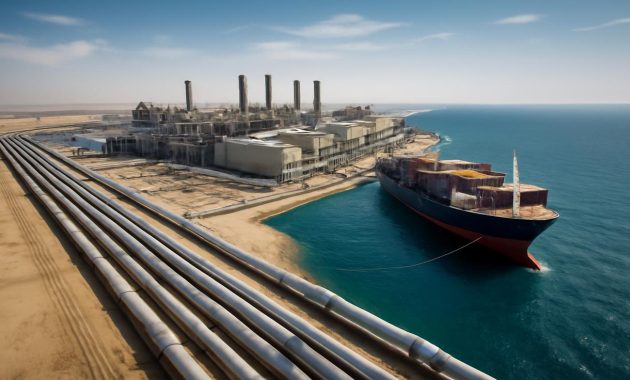
The first thing you notice is the sound. Not crashing surf or a rushing river, but the deep, almost industrial hum of turbines and pumps somewhere behind a maze of pipes. The air smells faintly of metal and brine, hot and saline, as if the sea itself were being boiled down to its essence. Outside, the Arabian sun blazes over the Gulf, turning its surface into a sheet of hammered silver. Inside the cavernous desalination plant on the Saudi coast, the sea is being undone—salt stripped from water, droplet by droplet, to keep cities alive hundreds of kilometers away.
The Illusion of Endless Water
From the window of an airplane descending toward Dubai or Jeddah, it can almost look like a magic trick. Perfectly green golf courses stitched into the desert. Artificial lakes glinting amid the beige sprawl. Fountains, resort pools, palm-lined boulevards misted by invisible irrigation systems. It’s easy—almost seductive—to believe that water is no longer a problem here, that technology has overruled geography.
Saudi Arabia and the United Arab Emirates, two of the driest nations on Earth, now host some of the most water-intensive lifestyles you can imagine. They’ve built a civilization on the edge of the empty quarter, powered by fossil fuels and cooled by air conditioning, and lubricated by one quiet, relentless flow: desalinated seawater.
Yet behind this impression of abundance lies a more complicated, quieter story. Despite an arsenal of desalination megaprojects—the sprawling plants lining the coasts of the Red Sea and the Arabian Gulf, the billions invested in membranes and thermal systems, the buzzwords of “water security” and “resilience”—both countries still import billions of dollars’ worth of fresh water each year.
On paper, the numbers appear paradoxical. Saudi Arabia is among the largest producers of desalinated water on the planet. The UAE, too, has some of the world’s biggest and most advanced desalination plants, and is planning even more. So why are supertankers and cargo ships still arriving with bottled water, beverages, and “embedded” water in the form of food, all to quench the thirst of nations that seemingly turned the sea itself into a tap?
The Desert That Drinks Like a Metropolis
Part of the answer lies in how these countries use water—and how quickly their demand has grown. Consider this: a few generations ago, most people in the Arabian Peninsula lived in small coastal towns or nomadic communities, tracking rare rainfall and rationing every drop from scarce wells. Today, Riyadh and Dubai are megacities, their silhouettes bristling with towers, malls, and air-conditioned villas. Their residents live on water budgets that would look luxurious even by European standards.
Average per capita water use in both Saudi Arabia and the UAE is often estimated to be several times higher than in many European countries. Each long shower, each load of laundry, each cooled office tower and manicured garden, adds up. Add in industry—petrochemicals, aluminum smelters, construction—and water consumption becomes a quiet giant, hiding in cement and steel, in electricity and export products.
Urban growth has been dizzyingly fast. In the span of a lifetime, populations exploded, cities sprawled, and expectations rose. Water had to keep up. Desalination plants answered that call, roaring to life along hundreds of kilometers of coastline. Yet even they have limits. Maintenance, energy costs, seasonal variation, and the physical capacity of pipes and plants all act as invisible governors on the flow.
And, of course, desalinated water doesn’t come cheap. It is energy-hungry and infrastructure-heavy. Every liter pushed inland, away from the coast, carries an invisible price tag of steel, fuel, and carbon.
Desalination: A Miracle with a Shadow
Walk along the shores near a major plant and you see one of desalination’s most immediate side effects: the outfall pipes, pushing dense, warmer, saltier water back into the sea. To turn seawater into drinking water, you must do something with the brine. That brine, rich with salt and sometimes chemical residues from cleaning processes, sinks and spreads along the seafloor, altering local ecosystems in quiet, persistent ways.
Then there is the energy. Many of the region’s older desalination plants are thermal, meaning they boil seawater and condense the steam. It is a process born in an age of cheap oil and gas, when fuel seemed effectively limitless. Newer plants increasingly rely on reverse osmosis—pushing seawater through incredibly fine membranes at high pressure. It’s more efficient, but still energy-intensive, especially at the scales demanded by big cities.
For years, the Gulf monarchies used their surging fossil fuel wealth to subsidize this technological fix. Water bills often didn’t reflect the true cost of desalination. The tap might run freely, but behind it, power plants and refineries worked overtime. As awareness of climate change grew, the contradiction sharpened: the very thing sustaining life in the desert—energy-intensive desalination—is also tangled up with the emissions problem shaping the planet’s future.
And still, it is not enough. Because not all water demand can—or should—be met by seawater turned into drinking water. Some needs are more easily, more cheaply, or more safely met by another strategy: import it.
Invisible Rivers: Water That Arrives by Sea and Sky
When most people think of “importing water,” they imagine tankers carrying liquid, huge steel hulls filled with potable water sloshing across oceans. That does happen on a small scale, but it’s not the main story in Saudi Arabia and the UAE.
The real imported water moves in more inconspicuous ways. It’s inside every orange shipped from a distant farm, every bag of rice, every bottle of soft drink or mineral water stacked in supermarket aisles from Jeddah to Sharjah. Economists and hydrologists call this “virtual water” or “embedded water”—the water used elsewhere in the world to grow, process, and manufacture the products that arrive in the Gulf.
By outsourcing water-intensive production, these desert countries have reduced pressure on their own scarce resources. When Saudi Arabia began phasing out domestic wheat cultivation—a once-proud symbol of self-sufficiency—it was essentially acknowledging that growing water-hungry crops in one of the driest places on Earth didn’t make long-term sense. Instead, it became a major importer of grain, buying not just calories, but the water that grew them, from places where rain still falls generously.
The UAE followed a similar path, transforming itself into a global trade hub, where ports bustle with containers bearing food, beverages, and manufactured goods. In the arithmetic of water, each shipment is like a river flowing into the country without a single cloud passing overhead.
This is not a secret policy. It’s a deliberate strategy. And it’s massive.
| Type of Water Flow | How It Arrives | Typical Use in KSA & UAE |
|---|---|---|
| Desalinated Water | Piped from coastal plants | Urban drinking water, industry, services |
| Imported Bottled/Packaged Water | Ships, trucks, air cargo | Household consumption, hospitality, retail |
| Virtual Water in Food | Global food imports | Staple grains, meat, fruits, processed foods |
| Virtual Water in Goods | Imported manufactured products | Consumer goods, construction materials |
Put simply, Saudi Arabia and the UAE may stand proudly at the forefront of desalination technology, but their real water lifelines extend far beyond their shores, intertwined with global trade routes and foreign fields.
Why Megaprojects Still Aren’t Enough
So why not just build even more desalination capacity and be done with it? In the Gulf, where grand projects define ambition—from palm-shaped islands to futuristic cities—it might seem like the natural next step. And indeed, both countries are planning or constructing new plants, many powered in part by renewables, boasting advanced membranes, and promising greater efficiency.
But desalination, no matter how advanced, faces structural constraints:
- Energy Costs: Even with solar and wind integration, the energy footprint remains huge. Scaling indefinitely would demand equally massive energy infrastructure.
- Environmental Limits: Brine discharge can degrade marine habitats, and intake systems may harm coastal ecosystems. More plants mean more ecological stress.
- Geographic Reach: Coastal plants feed coastal cities relatively easily, but pumping water inland—to Riyadh, for example—requires long pipelines, pumping stations, and continuous maintenance.
- Economic Trade-Offs: Investing billions more into desalination alone might yield less benefit than balancing supply projects with conservation, efficiency, and imports.
There’s also resilience to consider. A nation dependent solely on gargantuan plants clustered along its coasts is one storm, one marine pollution disaster, one prolonged power failure away from serious stress. Imports diversify the risk. Virtual water allows the Gulf states to store their water security, in a sense, in multiple climates and political systems, rather than in one fragile coastline.
Yet that, too, carries its own vulnerability: global supply chains. In a warming world, droughts, heatwaves, and political tensions can threaten those moving rivers of trade. When you rely on other people’s rain, you quietly inherit their weather and their politics.
Groundwater Ghosts and Vanishing Oases
Behind the glittering narrative of desalination megaprojects lies another, quieter water story—one written underground. For decades, Saudi Arabia and parts of the UAE drew heavily on fossil groundwater: ancient aquifers that filled over thousands of years during wetter climatic periods. These are not like rivers that refill every winter. Once drained, they do not return on any human timescale.
The rush to grow food at home, especially in the late twentieth century, accelerated the drawdown. In Saudi Arabia, pivot irrigation circles bloomed across the desert, green discs visible from space, drinking deep from those fossil reserves. For a moment, it looked like the desert itself had been tamed.
But wells began to drop. Pumps had to go deeper. Some small farms went dry. In villages that once relied on springs and palm-shaded oases, locals watched the waterline retreat. The cost of each additional cubic meter rose, and the reality became too stark to ignore: this was a one-time liquid inheritance being spent faster than it could be replenished.
In response, both Riyadh and Abu Dhabi shifted strategies. The megaprojects on the coasts weren’t just about providing more water for growing urban populations; they were also an attempt to take pressure off those ancient aquifers. Cutting agricultural subsidies, encouraging imports, and investing heavily in desalination was, in part, an admission that the old path was unsustainable.
Still, the ghosts of that groundwater remain in the policy debates and in the cultural memory. For some, importing food—and the water it represents—feels psychologically like vulnerability. For others, continuing to mine fossil water feels like a slow-motion self-sabotage. Between these poles, a delicate balance is being negotiated in real time.
A Future Written in Drops, Not Floods
On a sticky summer evening in Dubai, in a rooftop café where the air-conditioning hums as steadily as the traffic below, a waiter refills glasses from a chilled bottle of imported mineral water. Down the coast in Abu Dhabi, a family in a villa sprinkles their garden just after sunset. In Riyadh, in a new high-rise office, a motion-sensor faucet flicks on, spills cold water onto a gleaming ceramic sink, and shuts off the second the hands are withdrawn.
Each of these moments holds a story about how the next chapter of water in the Gulf might be written. Because while megaprojects and trade agreements dominate headlines, the texture of water use is changing in smaller, quieter ways.
Governments are experimenting with tiered tariffs—charging more for excessive use while keeping basic needs affordable. Smart meters, leak detection systems, and public awareness campaigns are slowly rewriting the social contract with water. Turning off the tap while brushing teeth might sound trivial, but multiplied by millions in a region where per capita consumption is among the highest in the world, it adds up.
There is growing interest in treating wastewater not as a nuisance, but as a resource. Recycled water now irrigates parks, cools buildings, and feeds certain industries. In some Gulf cities, a glass of drinking water may be only a few handshakes away from a sophisticated system of treatment and reuse.
And then there’s the energy transition. As Saudi Arabia and the UAE talk more about solar farms, green hydrogen, and net-zero pathways, the possibility emerges of desalination decoupled, at least partially, from fossil fuels. A world where seawater is turned into fresh water by sunlight itself, not by burning ancient hydrocarbons, may sound like science fiction, but pieces of it already exist along their shores.
None of this completely erases the paradox: countries that lead the world in manufacturing freshwater from the sea and still import billions in water and water-rich goods. But perhaps the paradox is not a flaw in the system—it is the system. A hybrid strategy, spread across technology, trade, and behavior, is how the desert survives in the twenty-first century.
Living with the Paradox
Stand again on the shoreline by a desalination plant, where the hum of machinery is thick as the heat, and look out toward the horizon. Somewhere far beyond your view, rain is falling on fields that will grow the wheat, fruit, and feed that will feed the Gulf. Somewhere else, springs and rivers fill the bottles that will stock supermarket shelves from Dammam to Dubai.
Water for Saudi Arabia and the UAE is no longer just a local story of wells and wadis. It is a global one, stretching from Canadian lakes to Indian rivers, from European factories to Brazilian farms. Desalination megaprojects are one dramatic part of that story—industrial cathedrals where the sea is remade—but they are not the whole tale.
These desert nations have built an intricate, often fragile web of solutions: vast plants powered by gas and sun; ancient aquifers tapped with modern pumps; tankers brimming with bottled water; and invisible rivers of virtual water coursing through trade routes. The cost of maintaining that web—environmental, financial, political—is only beginning to be fully reckoned with.
Yet there is something quietly hopeful, too, in this complexity. It suggests that no single miracle will save us, here or anywhere. Not desalination alone, not imports alone, not conservation alone. Instead, survival in an age of heat and scarcity will depend on weaving many imperfect solutions together and learning, drop by drop, to live within their limits.
In the end, the story of water in Saudi Arabia and the United Arab Emirates is not just about technology, or wealth, or even climate. It is about imagination: the collective ability to see that the glass on the table, sweating under desert heat, is filled not just with liquid, but with choices—past, present, and yet to come.
Frequently Asked Questions
Why do Saudi Arabia and the UAE import water if they have massive desalination plants?
They import water because desalination, while powerful, is expensive, energy-intensive, and geographically limited. Importing bottled water and, more importantly, importing food and goods that contain large amounts of “virtual water” can be cheaper and more sustainable than producing everything domestically in a very dry climate.
What is “virtual water” and why is it important for these countries?
Virtual water is the water used to produce a product—like wheat, meat, or manufactured goods—even though that water never physically crosses the border. For Saudi Arabia and the UAE, importing food and goods is essentially importing the water needed to make them, which reduces pressure on their own scarce water resources.
Is desalination environmentally harmful?
Desalination has environmental impacts, especially if not carefully managed. It consumes a lot of energy, often from fossil fuels, and produces concentrated brine that can harm marine ecosystems if discharged improperly. Newer technologies and regulations aim to reduce these impacts, but they cannot eliminate them entirely.
Are groundwater resources in Saudi Arabia and the UAE running out?
Many of the aquifers tapped in the past are fossil aquifers, meaning they refill extremely slowly, if at all. In some regions, groundwater levels have dropped significantly. This is one reason both countries have reduced water-intensive farming and shifted toward imports and desalination.
Can renewable energy make desalination fully sustainable?
Renewable energy can greatly reduce the carbon footprint of desalination, and both Saudi Arabia and the UAE are investing heavily in this direction. However, challenges remain: brine management, infrastructure costs, and ecosystem impacts still need careful management, even if the electricity becomes clean.
Will these countries ever be water self-sufficient?
Complete self-sufficiency is unlikely and may not be desirable. Relying solely on domestic water sources in such arid climates would be extremely costly and environmentally damaging. A mix of desalination, groundwater protection, recycling, conservation, and strategic imports is a more realistic long-term path.
How can ordinary residents in the Gulf help with water sustainability?
Residents can help by reducing waste—shorter showers, fixing leaks, choosing less water-intensive landscaping, and supporting efficient appliances. Small actions, when adopted at scale in high-consumption societies, make a significant difference in how much pressure falls on desalination plants and fragile groundwater reserves.