The dish begins, as the best stories do, with almost nothing. A sack of potatoes with a bit of soil still clinging to their skins. An onion, papery and unassuming. A knob of butter, a splash of cream, a wedge of cheese forgotten on the second shelf of the fridge. You don’t plan a legend with ingredients like these; you plan to get through a Tuesday. And yet, by the time the oven door opens and the heat rushes out in a fragrant wave, this humble collection will have become the kind of dinner people remember long after the plates are scraped clean.
The Market, the Forest, and the Fridge
Imagine it’s late afternoon and the light is doing that soft-gold thing it saves for the end of the day. Maybe you’ve walked back from a market, or maybe you’ve just rummaged through your kitchen the way a squirrel rummages through leaves. Either way, what you have isn’t impressive in the grand sense: potatoes, onions, maybe a leek if you’re lucky. A few cloves of garlic, a sprig or two of thyme, a dusty jar with the last of the nutmeg, a half-used block of cheese. A carton of cream that expires next week.
On the counter, these ingredients are separate, quiet, almost shy. Potato flesh is damp and pale. Onions release a sharp green-smelling sting when you slice into them. Garlic starts out harsh, then softens on your cutting board as if it knows what’s coming. The butter, cool and firm, waits. And yet already, your kitchen is transforming: scraping, tapping, the soft thunk of your knife against the wooden board. The world outside your window could be doing anything — rushing, scrolling, worrying — but in front of you, the rhythm is slow and deliberate.
This oven dish doesn’t demand the showy luxury of rare spices or long shopping lists. It belongs to the same family as forest paths and worn cookbooks: it rewards whoever shows up and pays attention. You slice a potato into thin coins and notice how they cling to each other, still damp from rinsing. You trace the concentric circles inside the onion as you cut it, like tree rings recording the seasons. You inhale the sharp, piney aroma of thyme as you strip the leaves from their slender stems. Ordinary things, experienced closely, become a kind of quiet magic.
The First Layer: Building a Little Landscape
You reach for the baking dish — not the pristine one at the back of the cabinet, but the trusted friend with faint scorch marks on its edges and a tiny chip on one corner. Its weight feels familiar in your hands. This dish has seen other meals: bubbling lasagnas, caramelized root vegetables, the occasional experimental bake that never made a repeat appearance. Tonight, it’s going to carry something simpler, and somehow bolder.
First comes the butter. You run it lazily along the inside, letting it melt slightly from the warmth of your fingers. The surface becomes glossy, like a pond just before sunset. A fine dusting of salt, a twist of black pepper. This is the unspoken promise to every ingredient that follows: you will be taken care of here.
You lay down the first layer of potatoes, overlapping them in soft fans. There’s something strangely peaceful about this: slice, place, overlap, repeat. The rows build gently, like terraces on a hillside. Between the layers you tuck wisps of onion and garlic, a scattering of thyme, the occasional snowflake of coarse salt. Every time you add a layer, you pause a moment to look, to smell. This is not just cooking; it’s assembling a small landscape — uneven, honest, and alive with possibility.
You can hear the faint rustle of the potato slices as they slide over each other, the sticky whisper of onion against ceramic. Outside, maybe there’s the sound of rain on glass, or kids in the next room negotiating over toys. But in the dish, a quiet order is forming. What began as a pile on the counter is becoming something intentional, something almost architectural.
The Secret Rivers of Heat and Cream
Then comes the moment that changes everything. A small saucepan on the stove, the low sigh of gas or the gentle orange of an electric coil. You warm cream with a splash of milk, a smashed clove of garlic, a bay leaf if you have it. Steam starts to rise, carrying a scent that is both comforting and hopeful — like walking into a house where someone’s been cooking for hours.
You grate the cheese, listening to its faint rasp against the metal. It falls in soft little curls, pale and fragrant. Then, carefully, you stir some of it into the warm cream, watching it disappear, strand by strand, into a smooth, velvety cloud. A pinch of nutmeg, barely there but essential — like a friend’s hand on your shoulder that you don’t notice until it’s gone and you miss it.
When you pour this mixture over the layered potatoes, it flows into all the invisible spaces, finding its way into every gap and corner. From above, your dish looks almost the same; from within, everything has changed. The cream settles in, quiet and patient, waiting for the heat of the oven to wake it up.
And that’s the secret of this humble oven dish: it isn’t about showing off. It’s about transformation. About the way simple ingredients, given time and warmth, become something larger than themselves. The heat will move through the dish like slow rivers, softening edges, deepening flavors, blurring the lines between potato and onion and cheese until they are part of one another.
Into the Heat: The Alchemy of Waiting
The oven is already preheating, its interior glowing softly. You slide the dish in and the door closes with a gentle thud. Immediately, your kitchen changes. The hum of the oven becomes a kind of heartbeat. You tidy the counter, rinse the cutting board, but your attention keeps drifting back: Is it bubbling yet? Can you smell it?
After a while, you do. First, slowly: a hint of butter, a ghost of garlic, the earthy sweetness of potato waking up. Then, more insistently. The scent wraps itself around you, settles into the corners of the room, sneaks under doorways. It’s the kind of smell that makes people wander into the kitchen and lean casually against the counter, pretending they’re just passing through.
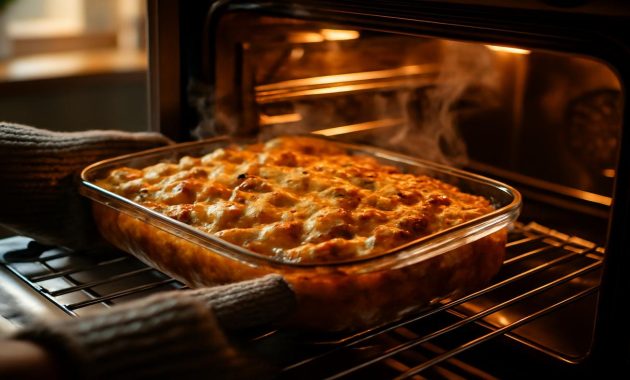
You peek through the oven window. Inside, the surface has started to blister and brown, tiny craters of bubbling cream and cheese rising and falling. Along the edges, the sauce has thickened into a caramel-colored ring that clings to the sides of the dish like a tide line. The potatoes, once rigid coins, have become tender, their edges just beginning to curl and crisp.
This is the part no recipe can write down for you: the watching, the waiting, the subtle negotiation of time. Another five minutes? Turn the heat down a little? Cover with foil or let it go? You read the dish the way you’d read the sky before a storm, alert to small signals — the exact shade of golden, the sound of the bubbling, the way the aroma deepens from bright dairy to rich, roasted comfort.
When you finally pull it from the oven, the rush of heat fogs your glasses or warms your face. The surface is a wild, textured crust of gold and amber. Tiny beads of butter shimmer on top like dew caught in morning light. You want to dive in with a spoon, but you wait. The dish, like any good story, needs a moment to settle before anyone touches it.
A Dish Meant for Passing and Sharing
On the table, the oven dish becomes the quiet center of the room. It doesn’t sparkle or tower; it doesn’t need to. It simply sits there, solid and inviting, radiating warmth. You could surround it with a simple green salad, a bowl of peas, maybe a sliced tomato dressed with oil and salt. But even alone, this dish feels complete, like a sentence that doesn’t need anything added to it.
Someone reaches for the serving spoon and breaks the surface. There’s a soft crackle as the browned top gives way, followed by a slow collapse inward as the layers are revealed. Steam billows up, carrying all the things you smelled earlier in the kitchen, now magnified. On the plate, the potatoes slump into each other, glossy and tender, edges freckled with brown. The sauce pools slightly around them, thick and clinging.
The first bite is always quiet. People look down at their plates, then up at each other, as if to confirm what they’re tasting. The potatoes hold their shape but yield easily, giving way to a creamy interior that tastes richer than the sum of its ingredients. The onions have melted into sweetness. The garlic is no longer sharp, just a warm undercurrent. The thyme, the nutmeg, the cheese — none of them shouts. They’re a small choir, harmonizing.
Conversation resumes, but with a new ease. Plates are passed. Someone goes back for seconds “just to get a bit more of that crispy corner.” Someone else scrapes the spoon carefully around the sides of the dish, chasing the deeply caramelized bits. This is not a meal that inspires small, careful bites; it invites generosity, both in portions and in spirit.
Why Simple Oven Dishes Stay in Our Memory
Later, when people talk about this dinner, they might not remember every detail of the day. They might forget what was on the radio or what time everyone arrived. But they’ll remember the way the house smelled when they walked in. The way the table felt crowded, but comfortably so. The way that one oven dish anchored the whole evening.
This is the quiet power of simple food: it refuses to be intimidating. No one sits down in front of potatoes in cream and feels judged. There is no test to pass, no hidden technique to decode. It’s the culinary equivalent of someone opening the door wide and saying, “Come in, you’re exactly who we were waiting for.”
The ingredients themselves carry a kind of collective memory. Potatoes stored in a cool, dark corner, waiting out the winter. Cows on wet pastures, turning grass into cream. Onions pulled from dirt, their roots still wiry. Cheese aged on wooden boards in quiet, cool rooms. Everything that ends up in the dish has already lived one kind of story — you’re simply giving them a chance to tell a new one together.
People remember this kind of dinner not because it’s elaborate, but because it makes them feel anchored. In a world of fleeting notifications and constant updates, here is something that asks nothing more from you than to sit, to hold a warm plate steady in your hands, to chew slowly and talk freely. It’s memorable in the way a long walk is memorable: simple, but somehow restorative.
Small Twists, Same Warm Heart
What’s beautiful about a dish like this is how easily it bends toward your own life. One evening, you might tuck thin slices of mushroom between the potatoes, letting their foresty perfume deepen the whole bake. Another time, you might scatter in pieces of cooked chicken, or shreds of leftover roast, turning the dish into a complete meal in one pan. You could change the cheese — sharp cheddar for punch, Gruyère for nuttiness, a bit of blue for drama.
In autumn, maybe you slip in coins of parsnip or slivers of celeriac, letting their pale sweetness join the mix. In spring, you might stir through a handful of peas or chopped chives at the very end, their green brightness cutting through the richness. The core stays the same: layers, heat, patience. But around that core, you can write your own seasonal variations.
Even the way you serve it can shift the story. A wide family-style dish in the center of a crowded table. Small individual gratins, one for each guest, their tops puffed and bubbling like little landscapes of their own. A reheated square for lunch the next day, eaten standing at the counter while the kettle boils, tasting somehow even better for having rested overnight.
However you adapt it, the spirit remains constant: this is food that invites you in rather than holding you at arm’s length. It’s a recipe that forgives small mistakes — uneven slicing, a bit more cheese, a longer bake than intended — and turns them into character rather than flaws. What matters most is not precision; it’s presence.
When the Pan Is Almost Empty
Eventually the dish is mostly scraped clean, the once-proud layers reduced to a scattering of browned edges and a faint smudge of sauce along the bottom. Someone runs a piece of bread around the last of it, unwilling to let even a streak of flavor go to waste. The room is a little louder now, the air a little warmer. Glasses are half-full, chairs pulled closer together.
You carry the empty or nearly empty baking dish back to the kitchen. It’s heavier now with its crusted edges and baked-on cheese, but there’s a certain satisfaction in that weight. This pan did its job tonight. It turned a handful of ingredients — things you might have walked past a dozen times in your pantry — into the background music of a shared evening.
Much later, when the house has quieted and the leftovers are tucked into the fridge, you might catch a lingering note of roasted potato and butter as you turn out the lights. It’s a reminder that the best meals don’t just end when the plates are cleared. They leave a faint echo — in the air, in the stories retold, in the particular way everyone said goodbye at the door.
And the next time you see a sack of potatoes and a forgotten hunk of cheese, you’ll know what they can become. A simple oven dish that starts with almost nothing, and ends with a dinner everyone remembers — not because it was perfect, but because it was warm, generous, and entirely enough.
Quick Reference: Building the Remembered Oven Dish
If you like having a loose guide to keep nearby, here’s a simple reference you can adapt to your own kitchen and seasons:
| Element | Simple Choice | Possible Variations |
|---|---|---|
| Base | Thinly sliced potatoes | Potatoes + parsnips, sweet potatoes, celeriac |
| Aromatics | Onion, garlic | Leeks, shallots, a pinch of chili, bay leaf |
| Creaminess | Cream + milk | All cream for richness, stock + a little cream for lighter version |
| Cheese | Hard melting cheese | Cheddar, Gruyère, Comté, a hint of blue or goat cheese |
| Herbs & Spice | Thyme, nutmeg | Rosemary, sage, chives, smoked paprika, black pepper |
| Add-ins | None (keep it simple) | Cooked chicken, ham, mushrooms, greens, peas |
Frequently Asked Questions
Can I make this dish ahead of time?
Yes. You can assemble the layered potatoes, onions, and cream mixture several hours in advance, cover, and keep it in the fridge. When ready, bring it closer to room temperature for 20–30 minutes, then bake. You can also fully bake it, cool, and reheat gently the next day; the flavors deepen with time.
What potatoes work best?
Waxy or all-purpose potatoes (like Yukon Gold or similar yellow varieties) hold their shape and give a creamy texture. Floury potatoes will work but may break down more, becoming softer and more rustic.
Do I have to use cream?
No. Cream gives the most luxurious result, but you can use a mixture of milk and stock, or evaporated milk, and adjust the cheese slightly for richness. Just avoid very low-fat liquids, which may curdle or feel thin.
How thin should I slice the potatoes?
Thin, even slices are key for tender layers — about 2–3 mm thick. A mandoline makes this easy, but a sharp knife and a bit of patience work well too. Try to keep thickness consistent so everything cooks at the same pace.
What if the top is browning too quickly?
If the surface is getting dark before the potatoes are fully tender, loosely cover the dish with foil and continue baking. Remove the foil for the last few minutes to restore crispness and deepen the golden color.
How do I know when it’s done?
The most reliable test is a small knife or skewer inserted into the center: it should slide in with almost no resistance. The top should be golden and bubbling, and you should see the edges sizzling gently.
Can this be a full meal on its own?
Absolutely. It’s wonderfully satisfying solo, especially with a bright side salad. If you’d like more protein, fold in cooked chicken, ham, or beans between the layers, or serve it alongside simple roasted vegetables or a piece of grilled fish or meat.