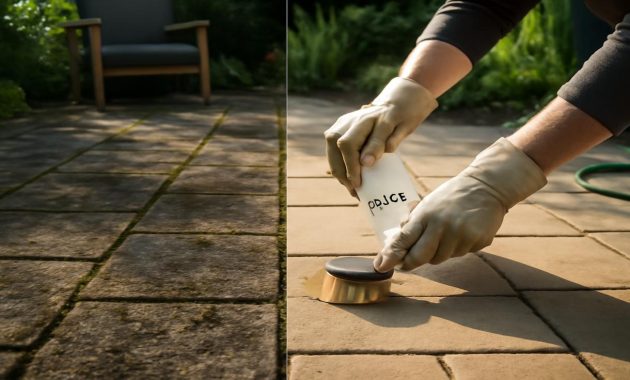
By late winter, your patio can start to look like a forgotten courtyard in an overgrown ruin—stone darkened to near-black, slick with algae, patched with lichen, spattered with last summer’s barbecue ghosts. You step out with a cup of coffee, glance at the slabs and bricks under your feet, and feel that quiet twinge of guilt: I should really do something about this. But the thought of hours bent over with a stiff brush, or the roar and mist of a pressure washer, is enough to send you right back indoors.
The morning you decide to do almost nothing
Imagine this instead: an early, pale morning. The garden is still waking up—birds stitching song along the fence, a neighbor’s kettle whistling somewhere over the hedge. You wander out in your slippers, noticing how the paving stones seem almost sticky-dark in the corners, the way the path to the shed has turned a deep green, slick when it rains. You tap the stone with your toe and think, Surely there’s an easier way.
There is—and it starts with the way you look at dirt.
Most of what blackens patios and garden paths isn’t deep, embedded grime. It’s a thin ecosystem: algae, mildew, moss spores, and grime from fallen leaves and air pollution. These are light, soft, almost shy—if you treat them right. The trick is to stop imagining that you need brute force and start imagining you’re giving your patio the equivalent of a long, lazy spa treatment. You’re not attacking it. You’re persuading it.
So, instead of wrestling with heavy machines, you gather a few gentle things: a watering can, a soft broom, a bucket, maybe a spray bottle, some white vinegar, a scoop of washing soda or baking soda, a dash of gentle washing-up liquid, and if you like, a bit of table salt. All the ingredients you’d happily store in your kitchen, not under lock and key in a chemical shed.
Understanding what you’re really fighting
Down at the surface level of your patio, life is busy. On shaded paths, microscopic algae throw a green veil over the stone, especially where water lingers. In damp, north-facing corners, small islands of moss gather, soft underfoot but treacherously slippery. Over months and years, fallen leaves break down into a thin film of tannin-rich grime that stains and darkens porous slabs and bricks.
You see it as “blackening.” To the paving, it’s simply time made visible.
Here’s the quiet secret: most of these layers want to come off. They’re not cemented in place; they’re clinging, fed by moisture and shade. Which means you’re not trying to grind them away. You’re just changing the conditions so they can’t hold on.
That’s where low-effort methods shine. You give a little time to soaking, a little chemistry from gentle household ingredients, and gravity plus weather does almost all the work. Think of it less as cleaning and more as soft negotiation.
The “almost no effort” toolkit
Before we wander outside together, it helps to lay out a few simple tools and ingredients, the sort most people already have tucked behind a cupboard door:
- A stiff outdoor broom (not a wire brush, just a solid yard brush).
- A watering can with a rose, or a garden sprayer.
- A bucket and an old mop or soft brush.
- White vinegar.
- Washing soda (sodium carbonate) or baking soda (sodium bicarbonate).
- A small amount of mild washing-up liquid.
- Optional: table salt for stubborn moss in cracks.
You also need two more things that cost nothing: patience and weather. A dry forecast for a day or two is your best friend. Warmth helps. So does a light breeze. Instead of fighting the elements, you enlist them.
The lazy slow-soak method: letting time do the hard work
Start on a day that feels kind from the outset—no driving rain, no scorching sun. Step onto your patio and look closely. Not as a homeowner judging a job undone, but as a quiet inspector, tracing dark rivulets where rainwater always runs, seeing where slime has a foothold, spotting the tired grey of old lichen spots on stone.
This is your map.
Into your bucket, pour warm water and stir in a good scoop of washing soda or a few generous tablespoons of baking soda. Add a brief, shy squirt of washing-up liquid—just enough to give the solution a bit of slip, to help it spread and creep into pores. If you use vinegar instead, remember: it’s mildly acidic, so don’t mix it directly with soda. Think of them as alternate routes, not teammates in the same bucket.
Now—and this is where the “almost no effort” begins—you pour. Slowly. Over a small area at a time: a couple of square meters, perhaps. The solution spreads, seeps, soaks. You might encourage it with a soft sweeping motion, just enough to make sure every patch of stone gets its gentle bath.
And then you walk away.
That’s it. You let the liquid sit there for twenty minutes, thirty, maybe an hour if the clouds are kind and the sun isn’t too fierce. In that time, the solution is loosening the thin film of life clinging to the surface. Algae begin to lift. Grease relaxes its grip. Fine dust and organic stains soften. You can almost imagine the patio releasing a long-held breath.
When you return, armed with your broom, you won’t be scrubbing in the old, punishing way. Instead, it’s more of a lazy, wide-armed sweep. Long, gentle strokes, guiding loosened dirt toward the path’s edge. The broom bristles catch what the solution has already unhooked. The air smells faintly cleaner, a little mineral and soapy, like the aftermath of gentle rain on dry stone.
A quick rinse with a watering can of clean water, and you’re finished for that section. Move on, or don’t—this is a method built for people who like to do things in easy, unhurried slices of time. You can wander back inside, leave the paving to dry, and later that day, or the day after, you’ll notice it: a shade lighter, a little more of the original color returning underfoot.
Vinegar mist and the slow fade of algae
Vinegar comes into its own in the shaded, particularly green corners: along the fence line, under the drip of a gutter, in those corners where the sun never really bothers to visit. There, slick green algae and faint mildew form a kind of ghostly glaze.
Mix equal parts white vinegar and water in a spray bottle or garden sprayer. On a dry day, when no rain is due for several hours, mist the affected areas until they’re thoroughly damp but not streaming. The smell pricks your nose for a moment—sharp, kitchen-clean—but it fades as the solution sinks in.
And then, again, you leave it. Overnight, if you like. Over the next days, algae begin to yellow, then brown slightly, losing their hold. The surface goes from slippery to powdery, and once again, a soft pass with a broom is plenty to lift the dead growth away.
Used this way, vinegar behaves almost like an invisible gardener, quietly editing the surfaces while you’re busy elsewhere. You’re not on your knees, scouring. You’re just giving nature a nudge in a different direction.
Paths, cracks and the quiet victory over moss
Garden paths have their own personality. They meander between beds, collect puddles, gather the dust of potting soil and last year’s mulch. In the hairline cracks between slabs and bricks, moss settles in like an uninvited but oddly charming guest. It’s beautiful in the right place, but on steps and narrow paths, it can be treacherous.
Heavy-handed methods rip moss out in clumps, only to leave it regrowing stronger. A softer, lazier way is to gradually change the environment so that moss stops feeling so welcome.
For tight joints between pavers, sprinkle a thin, deliberate line of dry baking soda or a mix of baking soda and table salt. Do this on a dry day and keep pets away from the area while the salt is present. The crystals sit there almost invisibly, quietly disrupting the tiny, damp world moss needs. Over days, the lush green shrivels to a pale, dusty texture, losing its lush grip.
At that point, a pass with the broom is all it takes. The moss brushes free, the cracks look sharper, cleaner, and what’s left behind is dry and unfriendly to new spores. You haven’t spent an afternoon kneeling with a knife or scraper; you’ve simply let chemistry and time erode moss’s comfortable little kingdom.
For wider, softer carpets of moss on stone, the same vinegar spray works well. Lightly soak, leave, then brush. Very little effort, but a satisfying change in texture underfoot—you’ll feel stone again, not sponge.
A quick reference you can actually use
Here’s a simple overview of what tends to work best where, keeping things light and low-effort:
| Problem | Best Low-Effort Method | How Often |
|---|---|---|
| General blackened patio slabs | Warm water + washing soda or baking soda + tiny bit of detergent, pour and soak, then light sweep and rinse | Once or twice a year |
| Green algae on shaded paths | Vinegar and water spray, leave to dry, then sweep | Every few months in damp seasons |
| Moss in cracks between pavers | Dry baking soda or baking soda + salt in cracks, wait, then brush out | Once or twice a year, or as needed |
| Oily barbecue or dining stains | Concentrated washing-up liquid, warm water, short soak, light scrub with soft brush | After spills / end of summer |
| Lichen spots on older stone | Repeat vinegar soaks over weeks, gentle brushing each time | A few sessions per year |
Small gestures, big difference
Cleaning, in this quiet, modern sense, isn’t about heroic weekend marathons. It’s about small, almost casual gestures woven into your time outdoors. You head out to deadhead a few roses, notice the path looks a bit green along the edges, give it a lazy sprinkle of soda or a quick spritz of vinegar. Tomorrow, or next week, you sweep. None of it feels like a project. It feels like tending.
When you stop seeing your patio as a stubborn, filthy job and start seeing it as a slow conversation between weather, stone, and you, the pressure falls away. Instead of demanding “perfect” in a single exhausting day, you give the space a series of kind, light touches—each one tilting it a little closer to clean.
There’s another, gentler reward here: the way the garden smells when you pour warm, mildly soapy water over stone; the sound of the broom’s bristles on paving; the satisfaction of watching a tide of grey-brown rinse drift toward a drain. The work is small, but the sensory reward is surprisingly large.
Later, when the stone dries, you’ll catch the transformation at the edges. The color is truer. The path feels less treacherous. The patio seems to invite a chair and a glass and a book again. And you’ll remember: this didn’t cost you your back, or your entire Saturday, or the whine of a machine.
Keeping it easy: prevention without fuss
If you want things to stay cleaner with almost no extra effort, think not in terms of rules, but in tiny, lazy habits stitched into what you already do.
- Autumn leaves: When you’re out to admire the last colors, give the patio a quick sweep. Not an obsessive one—just enough to stop leaves settling into a clog of future stains.
- After rain: On mild days following big downpours, stroll the path with your broom and sweep any standing puddles toward a drain. Less lingering water means less algae.
- Move pots occasionally: Slide planters and containers a little to one side now and then. The stone beneath gets a chance to dry and breathe, instead of becoming a permanent wet patch of blackening growth.
- One-corner rule: When you go out to water or sit outside, take thirty seconds to look at one square meter of paving or path and ask, “Does this need a little something?” If yes, sprinkle, pour, or spray. Over a season, these tiny attentions add up.
In this way, your patio and paths never quite cross that line into “hopeless.” They hover instead in that quietly satisfying zone of “lived-in, tended, and welcoming.”
When to embrace imperfection
Not every dark mark is a failure. Some are simply the story of your garden told in mineral and time. Old stone will always carry faint shadows of lichen, soft freckles where nature has insisted on art. Clay bricks may keep a whisper of the seasons in them, deepening in tone with each year. There’s a difference between dangerously slick, slime-dark surfaces and the gentle patina of age.
The point of these almost-effortless methods isn’t to erase every trace of the past, but to bring back safety and comfort: paths that don’t glisten treacherously after rain, patios that feel fresh enough to eat on, sit on, stretch out on barefoot. Within that, you can choose your level of “perfect.”
Some people, after discovering how easily algae gives up under a vinegar mist, go on a joyful crusade and reclaim every slab to nearly-new brightness. Others stop at “good enough,” welcoming a few islands of pale lichen as part of the garden’s older soul.
Either way, you’ve traded the story of dread and effort for one of gentle persuasion. You’ve learned that blackened doesn’t mean doomed; it means ready for a quiet, gradual rescue.
Next time you open the back door and see the dark film of winter on your patio, you won’t sigh and think of all-day scrubbing. You’ll think of a bucket, a kettle, a short walk with a broom, and the simple pleasure of letting time, weather, and a few household friends do most of the work for you.
FAQ
Do these methods really work as well as pressure washing?
For most everyday blackening, algae, and light grime, yes—just more slowly. Pressure washers give instant results but can damage pointing, soft stone, and nearby plants. The soak-and-sweep approach takes a bit more time to show full results, but it’s gentler and easier on your body and your garden.
Is vinegar safe for plants around my patio and paths?
Vinegar can scorch leaves and harm delicate plants if heavily sprayed on them. Used carefully on stone surfaces, with controlled spraying and minimal runoff into beds, it’s generally fine. Avoid soaking soil near prized plants and rinse any accidental splashes from foliage.
Can I use these methods on wooden decking too?
Some parts, yes—but with caution. Washing soda can be too strong for some deck finishes, and standing water can damage wood. For decking, use a weaker solution, apply sparingly, and always rinse well. A soft brush is safer than a stiff one on wood.
Will baking soda and salt damage my paving or metal fixtures?
Used in modest amounts and rinsed occasionally, baking soda is generally safe for most paving. Salt can contribute to corrosion on nearby metals and, in excess, can harm nearby plants and soil life. Keep salt use light and localised, and avoid repeated heavy applications.
How often should I do a full patio clean?
For many gardens, once or twice a year is enough for a full, gentle clean—often in early spring and again in autumn. Between those times, small, targeted treatments in problem areas will keep your patio and paths from sliding back into full blackening.
What if my patio is still patchy after the first treatment?
That’s normal, especially on older or very porous stone. Think of it as peeling back layers. A second or third light soak-and-sweep a week or two apart usually evens things out. Gradual improvement is kinder to the materials than one aggressive session.
Can I walk on the patio while the solutions are soaking?
You can, but it may be slippery, especially with detergent or vinegar present. It’s safer to treat one area at a time, leave it to soak undisturbed, and avoid walking over it until you’ve given it a quick rinse or sweep.