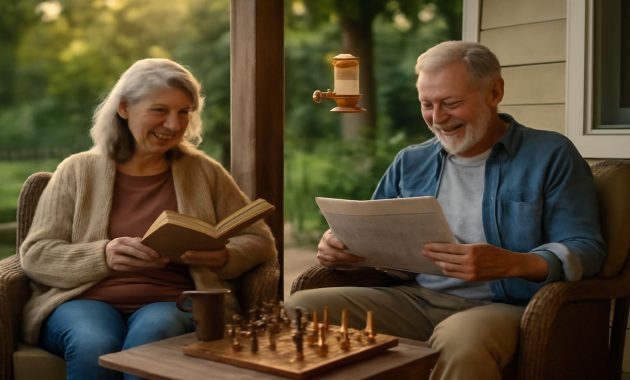
The old woman on the park bench has no idea she’s gone viral in my mind. She’s not recording herself, not tracking steps on a watch, not curating a moment for anyone else’s feed. She’s eating an orange, slowly. The kind of slow that feels almost rebellious in a world that moves at the speed of a scroll. A thin stream of juice runs down her thumb; she laughs softly, wipes it on her jeans, and keeps talking to the man beside her, who’s listening like there’s nowhere else he’d rather be.
They’re in their seventies, maybe. Their phones are nowhere in sight. They’re not “optimizing their morning”, not playing a mindfulness podcast at 2x speed. They’re just…here. Present. Content. And as I watch them, there’s this quiet, uncomfortable thought rising inside me: They might actually be happier than most of us.
Spend enough time around people in their 60s and 70s who are truly alive—still laughing, still curious, still grounded—and you start to see patterns. Little rituals. Old-school habits that look almost outdated beside our notifications and algorithms, yet somehow, make a life feel more whole. These aren’t grand philosophies or life hacks you’d put on a productivity app. They’re smaller than that. Simpler. But in their simplicity, they’re radical.
The Slower Mornings That Refuse To Be Optimized
Ask someone in their twenties about their morning and you might hear about wearable data, half-drunk coffee gone cold on the desk, a commute punctuated by urgent email checks. Ask someone in their seventies with a light in their eyes, and you hear a different story.
There’s the retired teacher who still wakes up at six “because the sunrise is free, and I’d be silly to miss it.” There’s the carpenter who makes coffee in a battered moka pot and watches the steam curl like incense. There’s the woman who writes three lines in a notebook every morning—nothing profound, just “how the sky looks today, what I’m grateful for, and one person I love.”
They’re not trying to squeeze maximum efficiency from the dawn; they’re trying to feel it.
Their habits aren’t glamorous, but they are deeply sensory: the clink of a spoon in a chipped mug, the soft pad of slippers on wooden floors, the cool touch of a doorknob as they step outside to test the weather with bare skin instead of a forecast app. They start their day by arriving in it, not by being hurled into it by a buzzing rectangle.
And in that unhurried beginning, stress loosens its grip. There’s room for a thought to finish, for a mood to settle, for a mind to wander without being yanked back by a notification. They’re not rejecting technology; they just don’t hand it the keys to their nervous system before sunrise.
Habit #1: Unhurried, Device-Light Mornings
People in their 60s and 70s who seem quietly happy often share this habit: mornings with minimal tech and maximum presence. They might eventually check the news or their phone, but not before coffee is savored or the sky is noticed.
In a world where younger generations often start the day with a flood of content—doomscrolling before brushing their teeth—these elders practice something like gentle resistance. The first voice they hear in the day is usually their own, or that of someone sitting across the table, not a stranger yelling in a 10-second video.
That little decision, repeated for years, becomes a kind of invisible architecture around their mental health. It’s not flashy enough to appear in health apps, but it quietly shapes how they feel about the hours ahead.
Conversations That Don’t Multitask
Somewhere along the line, conversation became something we do with one eye on a screen—half-present, half-elsewhere. But watch an older person who has lived through decades of dinners, arguments, reconciliations, losses, and birthdays, and you’ll see a different style of talking.
They sit. They face you. They wait. They let silence stretch a little, not rushing in to fill it with jokes or commentary. They ask, “And then what happened?” and you realize it’s not a prompt—it’s curiosity.
There’s a retired bus driver who holds court in a small-town café every Tuesday. Same corner table, same chipped sugar jar. People drift in and out—neighbors, former coworkers, the occasional curious teenager—and he listens to each of them like they’re the headline of the day. He’s not, by any stretch, “online famous.” Yet in that two-hour window, he is utterly connected.
Habit #2: Full-Attention Conversations
A common thread among content elders: they protect the sanctity of a face-to-face chat. Phones stay in bags or pockets. Eyes meet eyes. Stories are allowed to unfold in real time, with missteps, tangents, and laughter that can’t be edited.
While tech-driven youth often juggle multiple conversations across platforms, older adults might have fewer—but deeper—talks. The payoff is intimacy: the feeling of being known, not just “seen.” It’s a social diet rich in fiber, not just sugar.
It’s not that younger generations don’t crave this; they do. But habits form around what’s easy, and it’s simply easier to react with an emoji than to sit still and listen while someone searches for the right word. Elders have had a lifetime to practice the art of not interrupting, the slow nod, the chest-deep chuckle. Those micro-skills make them magnets for genuine connection.
The Old Rhythms of Using the Body
When we talk about “staying active” in later life, the image that often comes up is gym membership, yoga classes, or brisk walks tracked by watch. But many people in their 60s and 70s who seem quietly joyful move their bodies in ways that look almost…old-fashioned.
There’s the man who still sweeps his own driveway with a straw broom, pausing every so often to chat with neighbors. The woman who tends a modest vegetable garden, squatting slowly between rows, feeling for the right firmness of a tomato with her fingertips. The grandfather who insists on carrying the groceries—“at least the lighter bags, leave me my pride.”
These aren’t workouts. They’re woven into the small fabric of living.
Habit #3: Everyday Movement Instead of Exercise Hype
Happy elders often move in low-intensity, high-frequency ways. They walk to the nearby store. They take the stairs if their knees allow. They rake leaves, stir pots, knead dough, repair hinges. Their muscles stay written into the story of their homes and neighborhoods.
Meanwhile, younger generations might sit for 10 hours and then try to rescue the day with a 45-minute high-intensity class. The body doesn’t always love that bargain. Elder habits, formed before step-counters and workout influencers, lean into consistency over spectacle.
And there’s another layer: movement as meaning. Watering plants isn’t just burning calories—it’s tending something alive. Walking to a friend’s house isn’t just exercise; it’s anticipation. These tasks stitch the body to a purpose beyond self-improvement, which is a subtle but profound fuel for happiness.
Making, Repairing, and the Quiet Pride of Hands
Ask someone in their seventies about something they own, and chances are they’ll say, “I’ve had this for years,” with a particular softness. There’s the sweater mended at the elbows, the table refinished instead of replaced, the pot with a blackened bottom and a thousand meals in its memory.
The modern world, especially for tech-driven youth, leans hard into replacement: upgrade the phone, swap the shoes, toss the broken thing and let a new one appear at the door. There’s very little intimacy with objects, and even less with the process of making or fixing them.
Older generations came of age in a time when “DIY” was less a weekend project and more a requirement. That necessity ripened into competence, and competence ripened into confidence.
Habit #4: Craft, Repair, and Long-Term Attachment to Things
Many content older adults engage in some sort of making or mending: knitting, woodworking, sewing, baking, fixing small appliances, crafting birdhouses, building model ships, painting watercolors. Even those who claim “I’m not artistic” often have at least one thing they can do with their hands that produces a visible result.
The feeling of bringing something into the world or saving it from the trash bin is quiet but potent. While younger people might chase dopamine through likes and shares, elders get a steadier satisfaction from the physical presence of their efforts—a pie cooling on the counter, a repaired lamp glowing in the corner, a chair that no longer wobbles.
These simple acts of creation and repair whisper a powerful message: I can influence my surroundings. I am not just a consumer of finished products and finished experiences.
Time as a Circle, Not a Race
In hyper-digital culture, time is a resource to be maximized. To-do lists expand like invasive vines. If you’re not achieving something, you’re “wasting time.” Yet listen to the unhurried stories of people in their 60s and 70s and you’ll hear a different theology of time.
They talk about seasons: “When the lilacs bloom, I know it’s time to…” Or “Every winter, I reread that book.” Or “We always meet on the first Sunday of the month.” Their lives are ringed like tree trunks by recurring rhythms: holidays, anniversaries, reunions, markets, fishing seasons, volunteer days.
Instead of racing forward, their time loops gently, giving them something to look forward to that isn’t a new gadget release or a content drop.
Habit #5: Rituals and Seasonal Traditions
Happy elders often keep small, repeating rituals. It might be baking a specific bread every New Year. Calling an old friend on their birthday, without fail. Planting bulbs in the fall, trusting in the spring. Gathering grandchildren for a Sunday meal, phones forgotten in another room.
These rituals don’t ask to be shared online. They don’t care who is watching. But they add bone structure to the year—a sense of familiarity and meaning that doesn’t vanish when a platform, trend, or device falls out of fashion.
Younger generations often swim in novelty but thirst for tradition. Elders, by simply continuing what they’ve always done and inviting others into it, become an anchor point in a world spinning faster every year.
Side‑by‑Side: How Elder Habits Quietly Outperform Tech-Driven Living
It’s tempting to think these timeless habits belong to some lost era, but they’re very much alive. To see just how they stack up against typical tech-driven lifestyles, it helps to lay them next to each other.
| Elder Habit | Typical Tech-Driven Youth Habit | Likely Emotional Result |
|---|---|---|
| Unhurried, device-light mornings | Checking phone immediately on waking, rapid app-hopping | Elders: calmer baseline mood Youth: early spike in stress, comparison, information overload |
| Face-to-face, full-attention conversations | Fragmented messaging, multitasking during chats | Elders: deeper connection, feeling known Youth: wider networks, but more loneliness |
| Everyday movement (walking, chores, gardening) | Long sitting periods + short intense workouts | Elders: sustainable energy, less pressure Youth: fitness bursts, but more guilt and inconsistency |
| Crafting, repairing, using hands | Click-based tasks, content consumption | Elders: tangible pride, sense of capability Youth: mental fatigue, intangible output |
| Rituals and seasonal traditions | Constant novelty, trend-chasing | Elders: stability, anticipation Youth: excitement, but more restlessness |
Nine Timeless Habits Hiding in Plain Sight
If you watch closely, you’ll notice these nine patterns again and again in the lives of content older adults. They don’t all practice every habit, and they certainly don’t do them perfectly. But the themes repeat, like a chorus you start to hum along to.
- They greet the day slowly. A cup of something warm, a look out the window, a moment to notice their own thoughts before anyone else’s intrudes.
- They give conversations their full weight. Phones aren’t invited to the table, and neither is the need to rush the story.
- They move because life asks them to. Walking, bending, lifting, and stretching are baked into daily tasks, not just gym appointments.
- They keep their hands in the world. Kneading, sewing, sweeping, planting, sanding—tactile verbs that remind them they exist beyond a screen.
- They honor rituals, however small. A weekly call, a Sunday meal, a birthday letter written by hand instead of typed in a rush.
- They invest in a few deep relationships. Not thousands of “followers,” but a handful of people they’d call at 2 a.m. if the world fell apart.
- They tolerate boredom and silence. Waiting in line without pulling out a phone, sitting on a porch with nothing “to do” except notice the light shifting on the street.
- They accept imperfections—in themselves and others. They’ve had time to see that rough edges don’t always need smoothing, and that some messes can stay unsolved without ruining the day.
- They look backward and forward with softer eyes. Regrets exist, but so does gratitude for having made it this far. The future is shorter, which makes the present sharper, more vivid, less negotiable.
None of these habits requires a certain birth decade. They’re accessible right now, to a 19-year-old student, a 34-year-old parent, a 45-year-old executive. Yet older people tend to live them more fully because they’ve been stripped, over time, of the illusion that life is endless and everything can be “caught up on later.”
Why They Might Actually Be Happier
Underneath these habits is a quiet philosophy that stands in contrast to the tech-driven mindset many younger people are pulled into.
Tech culture often whispers: More. Faster. Newer. Broader reach. Constant engagement.
Elder habits answer: Enough. Slower. Deeper. Familiar. Present engagement.
One is built on the fear of missing out. The other is built on the joy of not missing what’s right in front of you.
When you hold an old ceramic mug that’s been with you through decades of mornings, it’s hard not to feel a sense of continuity. When you sit across from a friend you’ve seen cry, age, heal, and fall apart again, the conversation doesn’t need to perform. When your body knows how it feels to sweep, stir, walk, and plant without apps, you trust it more. When your year is marked by small, reliable rituals, you don’t panic as much when the world throws a new crisis onto your screen.
The people in their 60s and 70s who carry these habits are not living in a fairy tale. They deal with failing joints, grief, health scares, financial limits, the disorienting pace of change. But many of them meet these realities with a resilience that doesn’t come from youth or gadgets; it comes from the muscle memory of living slowly and deeply.
They have learned, often the hard way, that life is less about having more options and more about noticing the one moment you’re actually in.
Which raises a question that lingers long after the park bench empties and the orange peel dries in the trash can: if these habits are so simple, why wait until our sixties and seventies to claim them?
FAQ
Are older people really happier than younger generations?
Research in many countries suggests a “U-shaped” happiness curve: people tend to be relatively happy when young, dip in midlife, and then become happier again in later years. Not every individual follows this pattern, but many older adults report greater contentment, acceptance, and emotional stability than they felt in their 30s and 40s.
Do I have to give up technology to live like this?
No. Most content elders use technology—they video call grandkids, browse the news, send messages. The key difference is that tech serves their life rather than running it. Adopting their habits usually means setting boundaries around devices, not rejecting them entirely.
How can a younger person start practicing these nine habits?
Start small. Choose one habit—like device-light mornings or one tech-free conversation per day—and commit to it for a couple of weeks. Once it feels natural, add another. The goal isn’t perfection; it’s gradually giving more of your attention to what actually nourishes you.
What if my life is too busy for slow rituals and long conversations?
Busyness is real, but many elder-style habits fit into existing time. You can drink your coffee without your phone, walk part of your commute, repair one small item instead of replacing it, or create a weekly 15-minute ritual call with a friend. These shifts are modest but cumulative.
Isn’t it easier for retired people to be relaxed and present?
Retirement removes certain pressures but introduces others: health worries, financial constraints, loneliness. The elders who seem most at peace often built these habits long before they stopped working. You don’t need retirement to slow your mornings, honor rituals, move daily, or listen deeply; you can start weaving those into the life you already have.