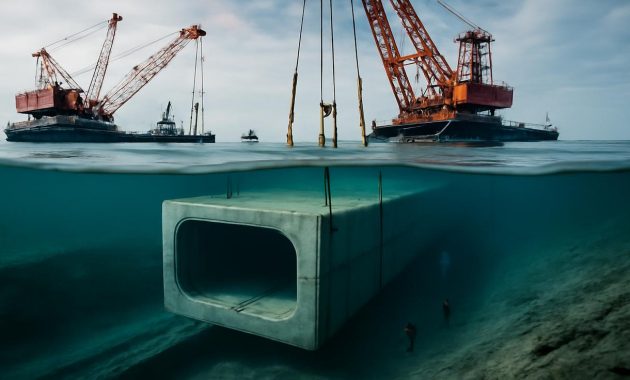
The water looks innocent from the ferry deck—a flat sheet of gray-blue glass broken only by the white wakes of passing ships and the wind-whipped chop near the shore. Somewhere beneath that restless skin, under the murky, shifting weight of the Baltic Sea between Denmark and Germany, engineers are quietly rearranging the limits of what we think is possible. They are slicing a highway and a railway straight through the seabed, not by drilling a tunnel from each side, but by carefully lowering giant hollow concrete “lego blocks” onto a trench in the ocean floor. If all goes to plan, this will soon become the world’s longest immersed tunnel. If all goes wrong, it could become the most expensive underwater argument in modern engineering.
Engineers at War with the Water
Out here on the Fehmarnbelt, the sea looks timeless. But if you stand on the Danish coast early in the morning, when the mist still hugs the water and the cry of gulls bounces between the dunes, you can see the future taking shape. Cranes rise like skeletal trees on the horizon. Barges inch slowly across the water, dragging equipment that looks both monumental and strangely fragile against the open sky.
This is the Fehmarnbelt Fixed Link: an 18-kilometer immersed tunnel connecting Rødbyhavn in Denmark to Puttgarden in Germany. When it’s finished, drivers will cross what was once a 45-minute ferry ride in about ten minutes. Trains will blitz under the sea in just seven. It promises faster freight routes, simpler holidays, fewer emissions from idling ferries. On paper, it’s a sleek new artery for Europe.
But inside project offices from Copenhagen to Berlin, things are not sleek at all. The building method—the very decision to make this an immersed tunnel rather than a bored one—is splitting the engineering world into tribes. Some praise it as a rare moment of bold pragmatism; others see it as an environmental gamble dressed up in PowerPoint slides and optimism.
To understand the arguments, you have to picture what the tunnel really is. Not a single continuous tube, but a chain of colossal concrete segments, each up to 217 meters long—longer than two football fields laid end to end—constructed in a purpose-built dry dock, floated out like gigantic bathtubs, then slowly sunk and aligned on the seabed.
Each segment is hollow, a quiet cathedral of reinforced concrete. Inside, future lanes of traffic and rail tracks will hum with life. Outside, during construction, every centimeter counts. A misalignment of just a few millimeters could ripple into structural nightmares. So engineers nurse these segments as if they were newborns. Sensors trace any movement. Divers and remotely operated vehicles double-check every joint. On the sea surface, tugboats and winches fight waves, currents, and gusting winds to hold each piece exactly where it needs to be.
The Argument in the Concrete
On one side of the debate stand the immersed tunnel loyalists. They have history on their side: the Øresund Link between Denmark and Sweden includes an immersed tunnel; the famous BART Transbay Tube under San Francisco Bay is immersed; so is the Busan–Geoje Fixed Link in South Korea. This isn’t experimental technology, they argue. It’s a mature, proven method—just executed here on a scale we’ve never seen.
Immersed-tunnel advocates pull out numbers like a magician revealing cards. An 18-kilometer bored tunnel under the seabed would require monstrous tunnel-boring machines (TBMs), custom-designed for the geology and water pressure, and would involve working blindly through layers of soft clay, sand, glacial deposits, and ancient rock. Any mistake could flood the TBM, trap workers, or damage the tunnel lining. That’s not scaremongering; it’s lived experience from other undersea projects around the world.
With immersion, they say, you build in daylight. You cast each segment in a clean, controlled dock on land. You can see every flaw, every crack, every steel bar. You test the segments, repair what’s wrong, then float them out and lower them like precision cargo. If something goes wrong, you stop, back up, and fix it. The risk profile changes. The sea is still an enemy, but a familiar one, attacking from the outside, not seeping through unknown geological layers from within.
Then there’s time. A bored tunnel this long, in this geology, could drag out for years beyond schedule. TBMs can only chew forward so fast, and they don’t love surprises. Immersed construction runs several processes in parallel—dredging the seabed, building segments, preparing portals. It’s like assembling a puzzle from many directions at once.
But across the conference table sit the critics—engineers and environmental specialists who eye the seabed trench like a wound. To place the segments, you need a trench up to 60 meters wide carved into the bottom of the Fehmarnbelt. That means dredging millions of cubic meters of sediment, much of it fine material that easily clouds the water and drifts with the currents. To them, this isn’t a technical problem; it’s an ecological one, with stakes that can’t be measured only in money and schedules.
What Lies Beneath: Ecology Meets Engineering
If you could drain the Fehmarnbelt and walk along its exposed floor, you’d see more than mud and sand. You’d see eelgrass meadows catching sunlight and cradling juvenile fish. You’d see glacial boulders draped in seaweeds, mussels clinging in thick colonies, the slow glide of porpoises in the water above. You’d see a seafloor that looks inert but behaves like a breathing organ in the Baltic’s fragile body.
The Baltic Sea is almost enclosed, connected to the Atlantic only by narrow straits. That makes it slow to flush out pollution and slow to recover from disturbance. When engineers talk about dredging a trench the length of a small country’s coastline, marine biologists hear something else: a long, bright stripe of habitat disruption.
To build the trench, gigantic cutter-suction dredgers and trailing suction hopper dredgers roam the project area. Their roar is muffled by water, but not to marine life. Noise pulses through the sea, layered on top of ship traffic, naval exercises, and the subtle acoustic signatures of a busy human world. Suspended sediment clouds the light. Filter-feeding animals get a sudden diet of grit instead of plankton. Fish accustomed to clear water find themselves in a snowstorm of disturbed particles.
Project planners counter with a flurry of mitigation measures: seasonal restrictions to protect spawning periods, turbidity limits, sensitive-area buffers, artificial reefs to compensate for lost rocky habitats, extensive environmental monitoring. Screened dredging heads. Optimized trench slopes to reduce erosion. The language is clinical, but the intentions are serious: do what needs to be done, but do it with as much care as possible.
Still, critics argue, an immersed tunnel enforces a trade-off: less underground uncertainty, more surface disturbance. A bored tunnel would have kept most of the violence locked away deep in the sediment, leaving the sea’s skin smoother. Yes, TBMs come with their own risks and CO₂ footprint, but the visible wound on the seafloor would have been narrower, the dredging footprint smaller.
In private, some engineers admit that both sides are right in different ways. The choice of method isn’t about a perfect solution; it’s about which imperfection you can live with—and who has to live with it most directly: marine life, coastal communities, or taxpayers decades from now.
How to Sink a Mountain of Concrete
On a summer afternoon at the construction harbor on Lolland, Denmark, the air smells of wet cement, diesel, and sea salt. This harbor did not exist a few years ago; it was carved out and built solely for the tunnel. It is, in effect, a factory for underwater mountains.
Here’s how an immersed tunnel comes to life.
First, engineers pour the base slab of a segment in a gigantic casting basin. They build up reinforced concrete walls, then cap it with a roof, forming a hollow prism divided into separate galleries: two for road lanes, two for rail tracks, one for technical systems and emergency access. The interior, for now, is cavernous and empty, echoing with the clatter of rebar and scaffolding. It feels less like a tunnel than like the bare hull of a ship.
When a segment is complete and its concrete has cured, the basin is slowly flooded. The segment, carefully balanced with ballast, begins to float. Tugboats nudge it out, like midwives guiding a child into the world. There is no applause, just the constant crackle of radios and the watchful gaze of engineers on deck, on shore, and in control rooms lit by rows of screens.
The seabed, meanwhile, has been prepared like a meticulous bed. Dredgers have carved the trench to exact depth and shape. Survey vessels have scanned the contours again and again. A bedding layer of gravel has been laid where necessary to give the segment something solid to rest on.
Out on the belt, the floating concrete colossus is positioned above its final resting place. Ballast tanks fill slowly, and the segment begins to sink. Cables and winches running from barges hold it in a harness, guiding its descent by the centimeter. The water closes over it, and from the surface it vanishes—just another patch of restless sea—while below, it inches down through the green gloom.
At the bottom, divers and sensors check its alignment against the previous segment. Pull it a little this way, nudge it that way. Hydraulic jacks press the two ends together, water is pumped out of the joint, and rubber gaskets begin the quiet task of holding back an entire sea. Grout fills the gap. Over it all, the ocean moves on as if nothing happened.
| Feature | Immersed Tunnel | Bored Tunnel |
|---|---|---|
| Construction Environment | Segments built in dry dock, sunk in open water | Excavation deep underground with TBMs |
| Key Risks | Seabed disturbance, alignment, joint watertightness | Geological surprises, TBM failure, water ingress |
| Environmental Impact | High dredging footprint and turbidity at seabed | Smaller seabed footprint, more subsurface disturbance |
| Access During Construction | Good access in dry dock; limited once submerged | Access mainly via shafts and TBM itself |
| Typical Length Range | Short to medium; Fehmarnbelt pushes upper limit | Well-suited to very long alignments |
The Human Scale of a Giant Project
Even from afar, projects like this often look like abstractions: numbers on a budget sheet, lines on a map, a news headline about “the world’s largest immersed tunnel.” But walk along the edge of the construction harbor at dawn and the giant becomes human-sized.
There’s the diver warming his hands on a thermos before dropping into the black water to inspect a segment joint. The surveyor squinting at a tablet, reconciling satellite coordinates and sonar readings. The crane operator, alone in a glass box high above the site, nudging hundreds of tons of steel with wrist movements that look almost delicate.
Inside a temporary office building, engineers argue around a 3D model projected on a wall. Someone taps the screen where the tunnel curves gently under the shipping lane. “Here,” she says, “this is where we can’t afford any settlement. If we over-dredge, we’ll spend months compensating.” Another gestures toward the portal on the German side: “And this interface with the rail network—if we slip in our schedule, the knock-on effects will ripple across Europe’s freight timetables.”
It is here, in these rooms and along these muddy tracks, that the method debate sharpens. The people who have to make the choices are not arguing from theory. They are arguing from experience: projects that went right, and projects that nearly didn’t.
A civil engineer who once worked on a major bored tunnel remembers nights of waiting for TBM readings to stabilize, uncertain if the machine was pushing safely through complex strata or inching toward a catastrophe. “With immersion,” he says, “at least most of your nightmares are above ground before you sink them.”
An environmental engineer, looking at the same model, shakes her head. “Our nightmares are in the plumes,” she replies. “It’s not the concrete that keeps me awake—it’s the sediment clouds we can’t fully control and the species that don’t read mitigation plans.”
When the Sea Forgets
Fast-forward in your mind to a winter day five, ten, twenty years from now. The tunnel is open. Snow dusts the Danish fields; the German coastline is a pale band to the south. You drive down the gently sloping ramp, the light behind you dissolving into the tunnel’s amber glow.
Above your head, millions of tons of water press down on concrete you will never see. The road hums; ventilation fans thrum softly. A train passes in a parallel tube, a streak of sound and vibration separated from you by thick walls and layers of engineering decisions made long ago. You might think about what’s above you, or you might simply check your phone at the next service station and carry on, unimpressed. As far as you’re concerned, this is just a shortcut—and shortcuts, by definition, feel ordinary.
Up on the surface, the sea has its own way of forgetting. The dredgers have long since gone. The trench has been backfilled and armored. Soft sediments settle into new patterns. Algae colonize fresh surfaces. Fish and invertebrates return, though perhaps not exactly as before. Over generations, the tunnel becomes an invisible part of the seascape’s story—neither villain nor savior, just another human inscription on a restless planet.
For the engineers, though, the tunnel will always be a memory with sharp edges. The arguments about method—immersed versus bored, trench versus TBM—will echo into future projects. Their lessons will show up in the margins of technical guidelines, in the side comments at conferences, in the quiet confidence or doubt on the face of someone asked, “Should we build the next one this way too?”
The world’s largest immersed tunnel isn’t only a feat of construction. It is a stress test of how we choose to shape our infrastructure in an era when every big decision runs headlong into questions of ecology, climate, and the limits of what landscapes can absorb. Its building method is tearing engineers apart not because one camp is wrong and the other is right, but because both are staring at different faces of the same uneasy truth: there are no more innocent megaprojects.
Stand again on that ferry deck. Look down at the indifferent water. Somewhere below, an 18-kilometer chain of concrete is creeping into place, link by submerged link. It is bold, flawed, ingenious, and troubling all at once. And whether you admire it, question it, or both, you’re witnessing a turning point in how we burrow our way through the planet—not just with machines and concrete, but with our conflicting visions of what progress under pressure should look like.
Frequently Asked Questions
Why is the Fehmarnbelt tunnel considered the world’s largest immersed tunnel?
It earns that title because of its length—around 18 kilometers—combined with its immersed construction method. While there are longer underwater connections, this will be the longest tunnel built from prefabricated segments sunk into a seabed trench.
What is the main difference between an immersed and a bored tunnel?
An immersed tunnel is built from large segments cast in a dry dock, floated out, and sunk into a prepared trench on the seabed. A bored tunnel is excavated underground using tunnel-boring machines, with the tunnel lining built as the machine advances.
Why did engineers choose an immersed tunnel instead of using tunnel-boring machines?
The choice reflects a balance of factors: the local geology, the shallow depth of the Fehmarnbelt, construction time, cost, and technical risks. Immersed construction allows much of the work to be done in controlled conditions on land, reducing some of the uncertainties associated with deep, long bored tunnels.
How does the construction affect marine life?
The main impacts come from dredging the trench: increased turbidity (cloudy water), noise from heavy machinery, and temporary loss or alteration of habitats on the seabed. Mitigation measures aim to reduce and monitor these effects, but some disturbance is unavoidable.
Will the sea environment fully recover after construction?
The seabed will not return to exactly its original state, but many functions and habitats can re-establish over time. Recovery depends on local conditions, how well mitigation measures work, and how marine species adapt to the new seafloor configuration and structures.
Is an immersed tunnel safe in the long term?
Immersed tunnels around the world have operated safely for decades. Safety depends on the quality of design, construction, waterproofing, monitoring, and maintenance. The Fehmarnbelt tunnel is being designed with modern standards for structural integrity, fire safety, and emergency evacuation.
When will the tunnel open to traffic?
The Fehmarnbelt tunnel is planned to open in the early 2030s, though exact dates can shift with construction progress, regulatory approvals, and unforeseen technical challenges.