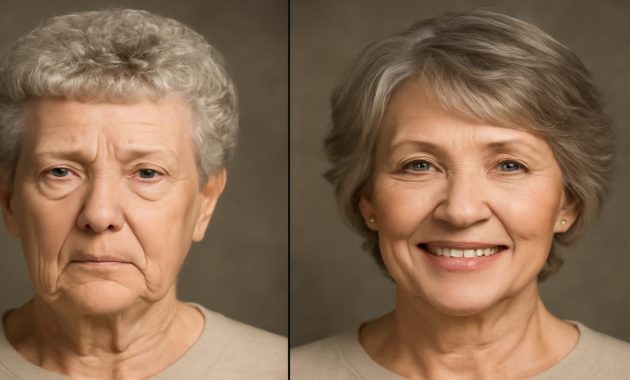
The first thing I noticed when I walked into the tiny, sunlit salon was the silver. It shimmered everywhere: coiled in foils, swept into soft bobs, clipped up while color processed. Silver, pewter, moonlight white—hair that had lived through decades and had absolutely no intention of fading quietly into the background. At the center of it all stood Marta, a 63‑year‑old hairdresser with steel-gray curls and lipstick the color of ripe cherries. She was laughing with a woman in her seventies as clumps of perfectly set curls, stiff with hairspray, fell to the floor like old expectations.
The “granny” hairstyle no one really wants—but so many still wear
“This,” Marta said, lifting a section of tight, uniform curls she’d just chopped off, “is the mistake that ages the face more than anything else after 70.” The client in her chair, a retired teacher named Louise, watched in the mirror with wide eyes as years of routine fell away. For thirty years, Louise had requested the same thing: “Just the usual roller set.”
“The usual roller set” is exactly what many hairdressers mean when they talk about the classic “granny” hairstyle—hair permed or set into identical, helmet-like curls, then frozen into place with enough hairspray to survive a gale. You can picture it instantly: short, rounded, with no real movement, the same all over the head, sometimes a little too short on top, sometimes suspiciously even around the ears. Neat, yes. Practical, sure. Flattering? Not so much.
Marta leaned closer to me and whispered, “We did that in the 60s and 70s because women wanted something that lasted a whole week. They’d come every Friday to get set for Sunday. It wasn’t about beauty; it was about maintenance and habit. But today, when a woman over 70 asks for that same look, it almost always makes her face look older, heavier, and tired.”
The biggest mistake, according to her, isn’t gray hair, or short hair, or even wrinkles—it’s stiffness. Hair that doesn’t move, doesn’t breathe, and sits on the head like a plastic cap drags everything else down with it: features, expression, energy. “As we age,” she said, “our faces soften. We lose a bit of bone definition, and the skin becomes more delicate. Hair needs to compensate with lightness and softness, not weight and rigidity.”
The real reason the “granny” cut ages the face
It’s easy to imagine that turning 70 flips a secret switch that demands you drastically shorten your hair and set it once a week, forever. But hair doesn’t know your age; it only knows how you treat it. The traditional set-and-spray “granny” style is rooted in a different era—one of weekly salon visits, rigid beauty rules, and hair that was meant to stay in place, not move naturally.
On a practical level, that style has three built-in problems that tend to age the face:
- Uniform volume everywhere. The head becomes one rounded shape, which can exaggerate fullness in the cheeks and jaw while flattening the top of the head.
- No softness around the face. Hard, fixed curls or short, blunt edges leave the forehead, temples, and jaw exposed in a harsh way, making lines and sagging more noticeable.
- A helmet effect. Hair that doesn’t move signals “old-fashioned” before you even speak. Movement equals vitality; helmet hair equals decades past.
“People think gray or white hair is what makes them look old,” Marta said, combing through Louise’s freshly washed strands. “But I see women with beautiful silver hair that looks modern and alive. It’s not the color, it’s the silhouette and texture. The most aging look is a tight, rounded, overly set shape that ignores who you are today.”
She showed me a photo on her phone of a client in her late seventies. In the “before” shot, the woman’s hair was permed into dense curls—same shape front, back, and sides, each curl crisp and separate. Her cheeks looked fuller, her chin softer, her eyes almost hidden. In the “after” shot, the curls had been loosened into airy waves that skimmed her cheekbones and opened up her eyes. The length was barely different, but the effect was startling. She looked like herself, ten years younger—but more importantly, ten times more present.
“Notice how the movement goes up and out?” Marta pointed. “The hair lifts the face. That’s what you want after 70. Anything that pulls the eye downward or wraps the head in a uniform curve is going to age you.”
The quiet power of movement, softness, and light
Most of the women in the salon that day had hair that whispered rather than shouted. Fine gray strands that floated when they turned their heads, soft waves that skimmed collars, layered bobs that swung as they laughed. Nothing immovable, nothing lacquered into submission. The space buzzed with low conversation, the faint hiss of hairdryers, the earthy scent of herbal shampoos. There was an odd lightness in the room—a sense that everyone here was in on a secret: age doesn’t decide your style; you do.
“When I cut hair for women over 70,” Marta said, “I think of light. Where do I want light on the face? The eyes, the cheekbones, the jawline. Then I build the haircut around that.” She lifted a section near Louise’s temples and snipped lightly, the scissors making a soft, satisfying click. Small, airy pieces fell like feathers. “Shorter pieces around the face can blur hard edges and create a veil. It’s like soft-focus for the skin.”
There is a sensory poetry to hair as we age. Strands change texture; once-thick hair can become finer, more fragile, or coarser around the crown. Some women lose density at the front, others at the temples. Oddly, the old “granny” cut ignores all of this. It imposes the same style on every head, regardless of texture, face shape, lifestyle. It’s a one-size-fits-none solution trying to force hair and face into a rigid idea of “neatness.”
In contrast, styles that flatter after 70 have a few things in common:
- Strategic volume. A little lift at the crown or around the part line instead of puffiness all around.
- Soft edges. Wispy or textured ends around the face instead of harsh, straight lines.
- Visible movement. Layers, gentle waves, or even a slight flick at the ends so hair doesn’t sit in one solid block.
- Respect for the hair’s natural pattern. Working with natural texture—curl, wave, or straightness—rather than forcing it into a weekly set.
“Your hair should look like it could move even when you’re standing still,” Marta said as she rough-dried Louise’s hair with her fingers instead of a round brush. “If it looks too perfect, too curled, too sprayed—that’s when we drift into granny land.”
How one small change erased years from Louise’s face
By the time the cut was finished, there was a small silver mountain of hair at the foot of the chair. Louise ran her fingers tentatively through what was left, as if afraid it might evaporate. “It’s… softer,” she said, surprised. Her reflection stared back with new curiosity. The hair that framed her face now fell in gentle, uneven waves, not a single curl like a row of question marks.
Instead of the round, helmet-like shape she had worn for decades, her new style followed the slim shape of her neck, then opened slightly at the ends. Marta had kept the length above the shoulders—still practical, still easy—but allowed a few layers to break up the uniformity. Around the temples, she left slightly longer strands that curved toward the cheekbones, skimming over the fine lines at the side of the eyes.
“Look at your jawline,” Marta said, tilting the mirror so Louise could see herself from the side. “Before, the roundness of your hair made your jaw look softer. Now the hair is falling along that line instead of fighting it. It’s like a little scaffolding for your bone structure.”
The difference wasn’t dramatic in the way a makeover show loves—no shocking chop from long to pixie, no bold dye. It was subtler, like letting sunlight into a room that had always been lit by a single low lamp. Her skin looked warmer. Her eyes seemed larger. The deep grooves from nose to mouth were still there, of course—they had earned their place—but they were no longer the first thing you saw.
“This is the thing most women don’t realize,” Marta said quietly to me as she smoothed a light styling cream over Louise’s ends. “Trying to freeze yourself in time—literally freezing your hair into a style that hasn’t changed since 1985—doesn’t make you look younger. It makes time more obvious. Updating your hair to move with your face as it is today—that’s what gives you freshness.”
She turned to Louise. “Next time someone offers you a roller set, say no,” she teased. “Tell them you want lift, softness, and movement—not a helmet.” Louise laughed, the sound bright and delighted, like she’d just learned a mischievous secret.
The tiny decisions that make the biggest difference after 70
You don’t need to abandon everything you love about your hair to avoid the “granny” effect. The most effective changes are often gentle, focused, and deeply personal. Sitting in that salon, watching one woman after another swivel toward the mirror with a look of cautious hope, I started noticing patterns in the advice Marta gave.
| If you usually… | Try instead… | Why it helps |
|---|---|---|
| Get a weekly tight roller set with lots of hairspray | A soft blow-dry with a round brush or fingers, plus a light mousse or cream | Adds movement and reduces the helmet effect that can age the face |
| Cut hair to one blunt length all over | Subtle layers, especially around the face and crown | Creates lift and softness where the face most needs it |
| Keep hair very short and tight to the head | A slightly longer, textured pixie or soft crop | Prevents the “shorn” look and adds femininity and ease |
| Insist on the same cut you had 20+ years ago | Ask for a consultation focused on face shape and current lifestyle | Aligns your hair with who you are now, not who you were then |
| Use strong, stiff styling products | Switch to flexible-hold sprays, creams, or foams | Keeps the style but lets the hair move and breathe |
“The danger is not short hair or gray hair,” Marta told another client, brushing loose silver strands off the cape. “The danger is default hair—doing something just because you’ve always done it, or because you think you’re ‘supposed’ to at your age.” She asked each woman the same questions: How do you spend your days? Do you like styling your hair, or do you want to wash and go? How do you feel when you look in the mirror right now?
Some shrugged and admitted they’d stopped really looking. “I just make sure it’s tidy,” one said. Tidy, it turns out, is the sneakiest path to the “granny” effect. Tidy can become flat, rigid, lifeless. Instead, Marta encouraged words like soft, light, easy, fresh. “If your hair feels like a chore, we’ve done something wrong,” she said. “It should feel like clothing you love to wear—comfortable, but it gives you a little spark.”
She also pushed back against the idea that longer hair is absolutely off-limits after 70. “Longer, thin, uncut hair can drag the face down, yes,” she admitted. “But a shoulder-length, layered cut with movement can be stunning on an older woman. What ages you is not length; it’s weight without shape—or one solid, over-shaped helmet.”
What your hair is really saying about you—at any age
As the afternoon light shifted in the salon, turning the mirrors into pools of soft gold, I watched one more transformation. A woman in her late seventies, wearing a neatly pressed navy cardigan and sensible shoes, sat anxiously in Marta’s chair. “Nothing too crazy,” she murmured. Her hair was the classic picture of the “granny” style: tightly permed, evenly rounded, sprayed into a perfect dome.
“Tell me what you don’t like,” Marta said gently.
The woman hesitated, fingers twisting in her lap. “I feel… bulky. Like my head is too big. And my eyes look small. But it stays nice all week, so…” Her voice trailed off.
“Would you like to see your eyes again?” Marta asked with a little smile. “And your neck?”
An hour later, the dome was gone. In its place: a soft, light shape that curved gently at the nape and lifted at the crown. The curls weren’t erased; they were softened into natural waves, allowed to fall instead of stand at attention. Costume hair had become character hair.
When she looked in the mirror, the woman’s eyes filled—not with horror, but with recognition. “I look like me,” she whispered. “I haven’t seen this me in a long time.”
That, perhaps, is the most insidious part of the old “granny” style. It doesn’t just age the face; it can mute the person. It tells the world, “I’ve settled. I don’t expect to be looked at closely anymore.” But the truth is, we never stop being visible to the people who love us—or to ourselves. Gentle hair that moves, frames, and supports the face says something entirely different: “I am still here, fully.”
Hair after 70 can be many things: silvery and wild, cropped and chic, wavy and playful, straight and sleek. It can be white as a winter sky or streaked with pewter and charcoal. It can be cut every four weeks or allowed to grow a little and tied back loosely. But if there’s one thing it doesn’t need to be, it’s a helmet locked in the past.
The worst mistake, the one that really ages the face, isn’t simply a curl pattern or the length of a cut. It’s choosing a hairstyle that refuses to move—literally and metaphorically—with the life you’re living now.
FAQs: Hairstyles after 70 and the “granny” effect
What exactly is the “granny” hairstyle effect?
The “granny” hairstyle effect is that dated, overly set look: short, rounded, tightly permed or roller-set hair that forms a helmet-like shape with little to no movement. It tends to age the face by creating a heavy, uniform silhouette that emphasizes sagging and minimizes the eyes and cheekbones.
Is short hair always more aging after 70?
No. Short hair can be incredibly flattering and modern after 70—think soft pixies, textured crops, or layered bobs. What feels aging is hair that’s too short, too tight to the head, or styled into a rigid, uniform shape without softness or movement.
Does gray or white hair automatically make me look older?
Not at all. Many women look vibrant and stylish with naturally gray or white hair. What matters more is the cut, shape, and texture. Soft, well-placed layers and movement often look younger than any color treatment paired with a stiff, outdated style.
How can I ask my hairdresser to avoid the “granny” look?
Use words like “soft,” “natural,” “movement,” and “light.” Ask for subtle layers, especially around the face, and avoid phrases like “roller set” or “tight perm all over.” You can also say, “I don’t want a helmet; I want my hair to move and frame my face.” A good hairdresser will understand.
Is it okay to keep some curls or waves?
Absolutely. Curls and waves can be beautiful and youthful at any age. The key is softness: looser curls, relaxed waves, and styles that fall naturally rather than sitting as identical, rigid ringlets all over the head.
What if I don’t like styling my hair every day?
Tell your stylist you want a low-maintenance cut that still has movement and shape. Many modern cuts for women over 70 are designed to air-dry nicely with just a little product, like a light mousse or cream. The goal is an easy shape that looks intentional, not overworked.
How often should I update my haircut after 70?
You don’t need a dramatic change every year, but it’s helpful to reassess your style every couple of years or when your hair texture or face shape changes noticeably. A small tweak—adding face-framing layers, adjusting length, or softening the outline—can make a big difference without feeling drastic.