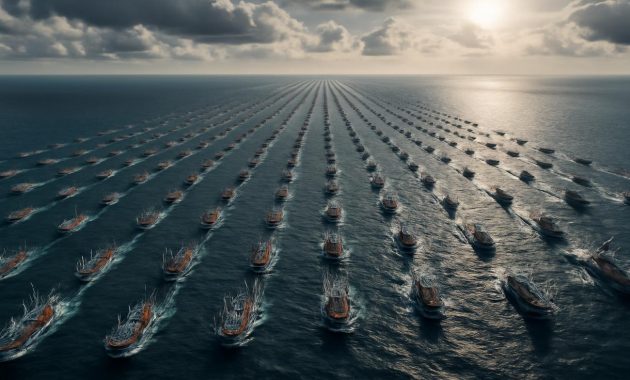
By the time the sun pulled itself over the horizon, the sea already looked wrong.
Not storm-wrong, not shipwreck-wrong—just wrong in the quiet, simmering way that makes your skin tighten before your mind can explain why. From the shore, the water off China’s eastern coast had always been a restless blue plane broken by the occasional hull or wandering freighter. But that January morning, it was different. There was a line. A pale, flickering suggestion at first, like heat haze over a road. Then, as the light sharpened, the line resolved into shapes. Hundreds of them. Small, distant. All in formation.
Fishing boats.
The Morning the Ocean Became a Wall
People along the coastal villages remember it by the sound more than the sight. Engines droning in overlapping waves, a mechanical beehive spreading across the water. In ports that usually woke up in a staggered rhythm—one boat leaving at dawn, another mid-morning, a third not at all—suddenly everything moved at once.
No one had announced it publicly. There were no glossy press conferences or triumphant posters. Just orders, passed quietly through captains and cooperatives, radio channels and local offices: be ready in January; there will be fuel; there will be escorts; there will be compensation.
By the time most of the world had turned its attention to holidays and winter headlines, China had mobilized roughly 1,400 fishing vessels and pushed them out in a line that stretched close to 200 miles—an artificial barrier across a restless, contested sea.
From above, the satellites would later capture it as a faint scar on the water—a staggeringly long string of dots, each emitting its own whisper of light at night. From sea level, it felt like something much older: a wooden wall, a ghost of the Great Wall itself, laid flat on the surface of the ocean.
What Do You Call a Wall Made of Boats?
There isn’t really a word for it. The ocean doesn’t like straight lines. It likes spirals and currents, swirling schools of fish, storm systems that refuse to color within the borders of maps. A 200-mile linear formation is a language it does not naturally speak.
Yet there it was—a kind of floating fence. Not a solid barricade you could touch, but a dense enough presence that other ships noticed. Other crews hesitated. Other governments watched. The boats were ordinary in design: steel hulls, flaking paint, small crews with calloused hands and weathered caps. But in quantity, arranged in such deliberate geometry, they became something else entirely.
On their decks, men and women moved in familiar rhythms—coiling nets, boiling water for tea, shouting over the engine roar. They threw lines, tested gear, checked radios. Some cast their nets in the usual pattern; others didn’t bother, aware that the fish were almost incidental. The real catch was presence. Occupation. A message written not in ink but in fiberglass and diesel, on a canvas of saltwater.
| Feature | Approximate Figures | What It Means at Sea |
|---|---|---|
| Number of vessels | ~1,400 boats | Enough to create near-continuous visual presence across the horizon. |
| Barrier length | Up to 200 miles | Multiple hours of sailing just to move from one end to the other. |
| Average boat size | 20–40 meters | Small enough to be “civilian,” large enough to be strategically visible. |
| Primary role | Declared: fishing Implicit: maritime presence |
Blurs the line between economic activity and security strategy. |
| Time of deployment | Mid-winter (January) | Off-season for many fisheries, peak season for quiet moves. |
The Calm, Calculated Chaos of the “People’s Fleet”
On paper, they are just fishermen. At sea, they form what many analysts have come to call a maritime militia: a civilian-looking arm of state strategy. The boats are registered as commercial vessels. Many have legitimate catch records and seasons. Their crews know real hunger and real storms. They also know that when a call comes—from a cooperative leader, a local official, sometimes a man in uniform—they don’t ask many questions.
One captain—let’s call him Liu—has been fishing for thirty years. He can read a sky faster than most men can read a text. He knows when a fog means danger and when it just means delay. But even he had never seen anything like the orders that winter.
“We go together,” he was told. “All of us. You will be paid. You will report your position. And you will stay.”
Stay where? That part came later.
Devices were installed on some boats—new radios, fresh AIS transponders, sometimes even reinforced hull fittings. Fuel subsidies appeared, as if by magic, in accounts that previously required pleading and paperwork. When Liu asked another captain what it all meant, the man only shrugged.
“We’re still fishing,” he said. “Just… not only fish.”
How to Draw a Line No One Can See on a Map
The ocean has borders, but they are imaginary, lines drawn by humans and treaties, not waves. Push beyond 12 nautical miles and you leave territorial waters; at 200, you brush the edges of exclusive economic zones. For most people, these distances are abstractions. For coastal states, they are power, pride, and sometimes powder kegs.
China’s 1,400-boat maneuver was as much cartography as it was seamanship. By concentrating that many vessels in a single swath, the state did something deeply symbolic: it thickened its claim, like a painter going over a faint pencil sketch with heavy ink. No flags had to change. No guns had to fire. The map, softly, bent toward the boats.
Other countries knew what they were seeing. Coast guards in neighboring states watched the radar screens light up, tiny green blips multiplying until they became a cluster dense enough to look like weather. Patrol ships altered their routes, threading cautiously between the fringes of the new “wall,” wary of incidents that might escalate faster than anyone wanted.
To a satellite analyst staring at grainy images on a cold January morning, the 200-mile barrier looked like an exercise in density. To a fisherman in a neighboring country, it looked like a locked door in a place that had always been a public hallway.
The View from the Waterline
Imagine approaching that barrier from the open sea. The swell rolls under your hull. The wind is steady. At first the horizon seems empty. Then, a speck. Two, five, ten. Small boats, sitting oddly still, their bows all pointed at subtle angles but essentially aligned, like teeth in a jaw.
Radio chatter overlaps in a language you may not speak. Some boats flick on deck lights even in the day, as if to say: we are here, watching. Nets hang drying, but you don’t see much actual trawling. The men aboard smoke, stare, and—if you come close enough—reach for cameras or binoculars.
None of them point weapons. No warning shots. No shouted threats. When you edge nearer, someone might wave you away, not with the stiff posture of a naval officer, but with the casual annoyance of a neighbor telling you your dog has wandered onto his lawn again.
How do you argue with that? How do you object to a cluster of fishing boats simply… existing… in a space everyone wants to claim?
Fish, Flags, and the Quiet Violence Beneath
Every net cast in these waters pulls up more than mackerel or squid. It hauls in history and politics, centuries of grievances and unspoken lines drawn through salt and current. Yet the ocean itself, stubbornly indifferent, just keeps moving. It doesn’t care whose emblem flaps in the wind. It does care, in its own physical way, about what 1,400 engines and endless miles of synthetic netting do to its body.
With so many vessels out there, you start to feel the strain in subtle ways. Fish stocks that were already pressured find themselves hemmed in by constant noise and netting. Sea turtles, sharks, and seabirds encounter not an open migration corridor, but a sprawling maze of hulls and lines. The seabed, where bottom trawlers drag their heavy gear, records each pass like a bruise.
The barrier may not be made of concrete, but it behaves, ecologically, like infrastructure. It channels movement. It discourages passage. It changes behavior—of animals and of people.
Local Chinese crews grumble in private that there are fewer fish than there used to be, but the policy logic comes from higher up: sovereignty now, sustainability later. For fishermen from other countries, “later” may be too late. Their boats, smaller and less politically shielded, think twice before crossing into the long shadow of this artificial wall.
When a Net Is Also a Border
Stand on the deck of one of those 1,400 boats on a gray January afternoon and you’ll see something oddly intimate about this massive geopolitical theater. Someone is mending a net by hand. A kettle rattles on a single-burner stove. Clothes flap on a line. There’s a smell of diesel and instant noodles, fish guts and cold metal.
The men on board talk about home, about debt, about the last big storm that nearly took their cousin’s boat. They are, in many ways, ordinary workers entangled in extraordinary strategy. They lace their cigarettes with resignation.
“If they tell us to go, we go,” one crewman says, eyes on the darkening horizon. “If they tell us to stay, we stay. The sea is big, but not bigger than the state.”
Their presence turns an invisible boundary into something you can bump a hull against. You could push through this barrier, if you really wanted to. But every scrape of fiberglass on fiberglass, every near-collision, would mean photographs, headlines, statements. The wall works because it invites trouble while pretending to be too mundane to cause it.
The World Wakes Up to the Wall
Outside China, newsrooms eventually picked up the story: a quiet January deployment, a 200-mile stretch of fishing vessels, new tension in old waters. Analysts used phrases like “gray-zone tactics” and “civilian front line.” Politicians demanded explanations; admirals drafted contingency plans.
But on the water, the reality stayed stubbornly human. A Filipino crew, skirting the edge of the formation, found themselves lit up by the blinding beams of three Chinese boats, their laughter tinny and echoing over loudspeakers. A Vietnamese captain weighed his fuel reserves against the extra days he’d need to detour. A South Korean research vessel logged “dense fishing activity” and moved its experiments farther offshore.
The ocean, that old stage of exploration and romance, had quietly become one of the most crowded and surveilled spaces on Earth. The 1,400-boat barrier was not the first such maneuver, nor would it be the last. But its scale—its audacity in sheer length and coordination—felt like a new chapter. A reminder that power no longer marches only on land or flies overhead. It drifts, too, in small hulls painted with chipped blue paint, flying flags that can be raised or denied depending on the day’s talking points.
Whose Sea Is It, Anyway?
Ask a mapmaker, and you’ll get one answer: lines, coordinates, treaties. Ask an admiral, and you’ll get another: fleets, alliances, firepower. Ask a fisherman, and it becomes simpler and more complicated at once.
“The sea belongs to whoever can afford to stay on it,” one veteran from a neighboring country says. “Fuel, repairs, permits, protection—if you have those, the water is yours. If you don’t, it pushes you back to shore.”
In that sense, the 1,400-boat operation was an enormous, expensive way of saying: we can afford to be here. Day after day. Week after week. Long enough for others to get tired, to recalculate, to give up.
The sea does not recognize the statement. But other humans do. And in the end, it is humans who draw the maps.
The Ocean Remembers Longer Than We Do
Winter turned slowly toward spring. Storms rolled through, battering the barrier and occasionally scattering sections of it. Boats limped back to port for repairs; replacements took their place. Some returned with full holds, others almost empty. Official statements emphasized “normal fishing activities” and “traditional grounds.” Unofficially, everyone understood that something had shifted.
Decades from now, when younger fishermen listen to their elders talk, the January of the 1,400 boats will likely surface as one of those hinge moments—when the old idea of the sea as an open, shared space quietly gave way to something more fenced, more patrolled, more choreographed.
The ocean will carry the scars in its own language. Fish that used to migrate along certain paths will adjust or vanish. Coral and seagrass, already strained by warming waters and acidification, will feel the added pressure of intense, sustained activity above. The memories will be chemical, biological, sedimentary.
For now, though, the memory is still human. A line of boats, stretching farther than the eye could follow. The low thrum of 1,400 engines under a pale January sky. A barrier no one saw coming until it was already there, remaking the sea one small hull at a time.
Frequently Asked Questions
Why did China deploy 1,400 fishing boats to form a 200-mile barrier?
The deployment served multiple purposes at once: it reinforced China’s maritime claims by establishing a continuous civilian presence, signaled political will to neighboring countries, and blurred the boundary between ordinary economic activity and strategic positioning. Using fishing boats allowed China to project influence with a “softer” face than a traditional naval buildup.
Is this barrier considered a military action?
Formally, no. The vessels are registered as civilian fishing boats, not warships. However, many analysts describe such actions as “gray-zone” tactics—neither pure civilian activity nor open military confrontation. The presence of state support, coordination, and sometimes security escorts gives the operation a strongly strategic character.
How does a line of fishing boats affect other countries in the region?
Other countries face increased risk and complexity when operating near the barrier. Fishing crews may be intimidated or deterred, coast guards must navigate around dense clusters of vessels, and any collision or confrontation risks diplomatic escalation. Economically, local fishers can lose access to traditional grounds they’ve used for generations.
What impact does this kind of operation have on the marine environment?
Large, concentrated fleets intensify pressure on already stressed fish stocks, disrupt migration patterns, and increase bycatch of non-target species such as turtles and sharks. If bottom trawling is involved, it can damage seafloor habitats. Noise, light pollution, and waste from many vessels in a confined area also alter marine ecosystems.
Could other countries copy this strategy?
Yes, and some already have on smaller scales. Any coastal state with a significant fishing fleet could use it to assert presence in disputed waters. That possibility worries environmentalists and security experts alike, who see a future where heavily militarized “civilian” fleets crowd fragile seas, raising the risk of conflict and ecological collapse.
Is there any way to regulate or limit such deployments?
Existing international law focuses on armed conflict and clear military vessels, leaving gray areas around state-backed civilian fleets. Strengthening regional agreements, improving transparency of vessel ownership and subsidies, and enhancing cooperative fisheries management could help. Ultimately, however, it requires political will from all parties to treat shared seas as more than strategic chessboards.