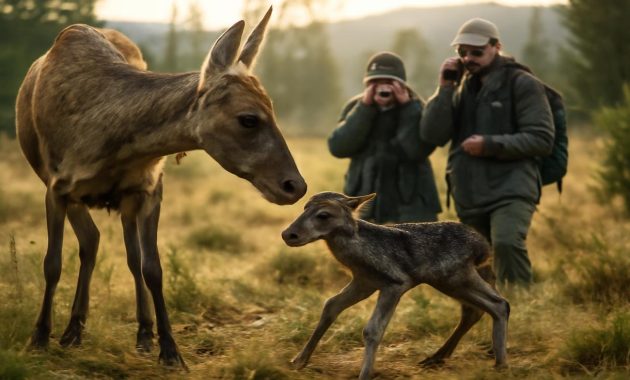
The news arrived the way wild stories usually do: in a half‑disbelieving phone call, just before dawn, when the sky is still trying to remember what color it’s supposed to be. A field ranger, voice shaking, whispered into the satellite line, “We think we’ve seen it. The calf. It’s here. It’s alive.” For a second, nobody in the research station said anything. A few coffee cups hovered in mid-air. Someone laughed, a short, nervous sound. Because it couldn’t be true. Not after a hundred years. Not after a century of empty records, of survey grids with nothing but wind and dust recorded in the “observations” column. But the ranger insisted. He’d watched them—mother and newborn—slip like ghosts from the reeds at the edge of the river, where the fog stitched the water to the land.
The Day Doubt Cracked Open
By the time the sun broke through the thin cloud cover, the research team was already packed into a shuddering jeep, rolling toward the wetlands that had become the last, fragile refuge of a species once declared “functionally extinct in the wild.” The animal had many names, depending on who you asked and which language they carried in their mouth. To the regional communities, it was an old relative, a river spirit with hooves. To zoologists, it was the last impossible case—the kind of file that gathered dust in archives and served as a cautionary tale in university lectures.
Once, this animal had shaped rivers and meadows. Hoof prints carved pathways where seeds traveled, water pooled, and other lives found purchase. Then came the century that tried to forget it: hunting, draining of wetlands, new borders on old lands, pollution that crawled up the food chain with quiet, ruthless efficiency. People said they would come back, of course. “We’ll fix this,” they promised—after the next war, after the next election, after the next economic boom. But the seasons kept turning, and the last confirmed wild birth faded into an entry in a leather-bound logbook dated one hundred and three years ago.
In the last few decades, breeding programs in fenced reserves and sanctuaries managed to keep a small population alive. They were micro-managed lives: veterinary checks, assisted reproduction, controlled diets, GPS collars transmitting their every movement to a constellation of patient satellites. The animals survived. But survival in captivity is a different verb than survival in the wild. It is life bracketed by fences and protocols, life outsourced to human hands.
So even as conservationists worked and hoped and wrote grant reports filled with cautious optimism, a hardened layer of disbelief settled over the idea of a wild-born calf. It wasn’t just doubt about the animal—it was doubt about ourselves. Were we still capable of stepping back enough, of repairing enough, that a species we’d almost erased could begin to trust the world again with its offspring?
Stepping Into the Wetland’s Breath
The jeep stopped where the road surrendered to mud. From there, they walked. Each step was a soft negotiation with the earth, reeds brushing their legs, dragonflies lifting like tiny scraps of metal from the pools. The air smelled of silt and green things decomposing into next year’s soil. Somewhere, a heron clicked its beak. A frog announced itself with a bored, rubbery croak.
“Here,” the ranger said, dropping his voice, as though the reeds themselves might be listening. He pointed to a patch where the river took a slow, looping curve. It was easy to miss: a narrow corridor through the taller grasses, where stems were bent but not broken. A faint track, no wider than a doorway, leading down to a sandy bank.
There were hoof prints, fresh enough that a thin film of water still glinted in their hollows. One set was larger, deeper. The other, barely there—small, cautious, the steps of something new to the world and not yet convinced of its welcome. The team knelt as if they’d stumbled into a chapel. No one wanted to be the first to speak. The disbelief that had been a shield, a slow, rational defense against disappointment, suddenly felt like a burden too heavy to hold.
Someone raised binoculars. The reeds shivered. And then, as though the land itself exhaled, they appeared.
The mother stepped out first, muscles rippling under a coat that shone damp in the morning light. This was not an animal invented by fairy tales. She was solid, breathing, her flanks scarred by years of quiet struggle—barbed wire, perhaps, or an old predator’s teeth, long gone now from this patchwork landscape. At her side, leaning in with that wobbly, puppylike uncertainty of the very young, stood the calf.
There was a moment when the world narrowed to a single tiny ear flick, to the soft clumsy sway of a new life learning how to belong to gravity. The calf’s fur still held that faint fuzziness of the not-quite-dry, as though the wild itself had only just finished sculpting it. It inhaled, nostrils flaring, then bumped its muzzle gently into the mother’s chest, reassured by the steady drum of her heart.
Behind the binoculars, a scientist began to cry in quiet, astonished hiccups. Another person, hardened by years of fieldwork and failure, simply whispered, “No way,” over and over, as though the phrase might keep everything from dissolving if spoken enough times.
When Science Forgets How to Believe
Disbelief in zoology is not the loud, opinionated kind. It is a quieter creature, closer to self-preservation than cynicism. You learn it after too many promising signs—mysterious tracks, blurry photographs, faint calls in the night—turn into misidentifications or hopeful illusions. You learn it in the language of peer-reviewed caution and statistical probability. You learn it every time a habitat map shows shrinking colors, every time a model suggests a point of no return has already been crossed without fanfare.
In classrooms and conferences, students are taught critical thinking, skepticism, the discipline of doubt. It’s necessary. Science needs guardrails. But somewhere along the way, doubt can become a habit of the soul. The idea that a vanished animal might one day step back into our field of vision begins to feel uncomfortably close to wishful thinking. Better to say “highly unlikely” than to risk the embarrassment of hope.
The birth of this calf cracked that habit down the middle.
“The last time this species bred in the wild, my grandfather wasn’t even born,” one of the senior researchers said, voice hoarse, as they watched from a careful distance. “We’ve been carrying this absence for so long we started to treat it as a law of nature rather than a consequence of our choices.”
In the years leading up to this moment, conservation efforts on the ground had looked, from afar, almost mundane. Fences were pulled down in some places, rerouted in others. Polluted inflows were cleaned. Small dams were removed to let old floodplains breathe again. Local communities were hired as guardians and guides, their ancestral knowledge finally recognized as data of a different but equal kind. A handful of captive-bred individuals were cautiously released, fitted with tracking collars and monitored like fragile, moving experiments.
What nobody could fully predict was the moment when these scattered, patient actions would intersect with something far older: an animal’s own decision to risk bringing new life into a world that had once turned on it. That decision is not visible in graphs. There is no line item in a budget labeled “return of trust.” And yet, here it was, on four wobbly legs by the riverbank.
The Calculus of a Newborn in the Wild
Later, back at the station, notebooks crowded with shaky sketches and hurried measurements, the team tried to turn awe into data. They estimated the calf’s age—likely less than forty-eight hours. They scanned through years of camera-trap photos to see if they could match the mother’s markings to an individual previously recorded near one of the release sites. They overlaid GPS data, rainfall histories, vegetation maps. Science, once again, did what it does best: it tried to turn a miracle into information.
But even in the numbers, a story was emerging—one made of timing and thresholds and the narrow corridor between survival and collapse. Over the past decade, water quality in this wetland had improved just enough for certain plants to return. Those plants had drawn insects, which had drawn fish, which had drawn birds and mammals. Piece by piece, the food web had begun to knit itself back together. Not perfectly, not completely, but enough.
The mother, researchers realized, had not chosen this place by accident. The bend in the river offered shelter from the prevailing winds and a quick escape into deeper water if threatened. The surrounding reeds disguised scent and movement. Ancient instincts, dulled but not erased by generations of disturbance, had guided her here to give birth.
The calf, in its first hours, had already begun the subtle work of reweaving a lost relationship. Each step pressed old seeds into the mud. Its small body would soon carry burrs and pollen, connecting one clump of vegetation to another. If it survived, its grazing patterns would start reshaping the grass height, making space for other species that relied on short, cropped lawns to nest or hunt. One life, radiating consequences.
And yet, the danger was immense. One flood in the wrong season, one illegal hunting party, one spill of agricultural chemicals upstream could end this delicate experiment before it truly began. That knowledge sat like a stone in the stomach of every person who had watched the calf take its first halting steps.
The Fragile Arithmetic of Hope
In the days that followed, the calf became an invisible center of gravity. Patrol routes were quietly reorganized to keep an eye on the area without intruding. Calls crackled across radios in muted, coded language—no one wanted to advertise the exact location until they understood what protections were realistically possible.
The local community, once cautious about conservation projects that had too often arrived with promises and left with disappointment, gathered in small, excited clusters to share what they’d seen. Some had caught a glimpse at dusk: a flash of small, pale flanks against the receding light, a tail flick, the unmistakable awkward bounce of a young body still learning its own dimensions.
Across the region, disbelief fractured into something more complicated. Pride. Fear. Responsibility.
| Aspect | Before Wild Birth | After Wild Birth |
|---|---|---|
| Population Status | Captive, aging, no confirmed natural breeding in wild for 100 years | Evidence of wild reproduction, early signs of population resilience |
| Conservation Outlook | Defensive, focused on preventing total extinction | Cautious optimism, potential for long-term rewilding |
| Local Perception | Skeptical, memories of the species mostly stories | Renewed cultural pride and sense of shared guardianship |
| Scientific Attitude | Dominated by doubt and worst‑case scenarios | Rebalanced with lived evidence of recovery |
| Ecosystem Function | Partially restored, missing key herbivore role | First steps toward re-establishing natural grazing dynamics |
In interviews, scientists found themselves reaching for unfamiliar words. “It changes the narrative,” one said. Another, usually precise to the point of severity, allowed herself a smile. “It’s not a happy ending,” she cautioned, “but it might be a beginning we didn’t dare write into the story.”
That shift matters. Conservation efforts are often starved not only of funds but of imagination. When the future is drawn only in shades of decline, it becomes harder to persuade societies to invest in care, in time, in long-term thinking. A wild-born calf doesn’t fix policy gaps or erase decades of damage—but it punctures the fatalism that says nothing we do will matter. It proves that living systems, given even a sliver of room, will attempt to heal.
The River Remembers
Weeks passed. The calf grew into its legs, its movements a little less precarious each day. Camera traps, carefully positioned at a distance that would not intrude on its life, occasionally caught its image: eyes bright, coat thickening, once seen kicking its heels in a brief, exuberant hop before splashing into the shallows. Those who watched the grainy footage later felt an ache behind their ribs that was hard to name.
“We almost erased this,” one field biologist murmured in the darkened monitoring room, the only light coming from the glow of screens. “And yet it’s still here—playing.”
The wetland itself seemed to lean into the change. It’s tempting, and perhaps unscientific, to say the place felt different, but many noticed it. Flocks of waders began to linger longer on their migrations. Small mammals, once scarce, left more tracks between the sedges. The water, tested regularly, showed a gradual increase in oxygen levels. Life, in all its layered indifference and interdependence, was responding not to a single calf but to the accumulated work and patience that had made space for that calf to exist.
In nearby villages, elders told renewed versions of old stories. Children learned to identify the animal not just from faded drawings in schoolbooks but from recent sketches and, if they were particularly lucky, from a far-off glimpse at dusk. The species stepped out of the museum of memory and back into the category of neighbor.
With that came a more grounded kind of belief. Not the naive certainty that everything would now be fine, but an understanding that this new life had bound them all, once again, to the health of the river, the quality of the soil, the decisions made in offices far upstream and in kitchens closer to home.
Living With the Miracle
“We are at the fragile stage where stories can either protect or expose,” a conservation coordinator explained during a quiet community meeting. “If the birth becomes a legend that spreads faster than our protections, curiosity might drive too many people into the calf’s territory. But if we keep it a secret, we might miss the chance to build a stronger circle of guardians.”
So they tried something different. Instead of a media storm, there were careful conversations. Instead of turning the calf into a symbol to be consumed by headlines, they treated it as a responsibility. This animal did not need spectacle. It needed time, shelter, and a future with fewer emergencies.
In the years ahead, there will be more hard decisions. Which areas to prioritize if the population grows. How to balance tourism with respect. How to keep the animals wild when the human instinct is to draw closer, to witness, to touch the miracle we almost lost. The story of this calf is not a tidy redemption arc; it is, like all real ecologies, messy, contingent, always on the move.
But on that first morning by the river, none of those questions yet had teeth. There was only the soft slap of water against the bank, the whisper of reeds, the steam of breath in the cool air, and the sight of a mother nudging her newborn into the shallows, teaching it how to be at home in a world that had very nearly forgotten it.
In that brief span of time, disbelief—so long a defense against grief—gave way to something quieter and more demanding. Not blind faith. Not optimism on autopilot. Just a clear, steady acknowledgment: the living world is capable of more recovery than our models sometimes allow, if we can learn to give it space, patience, and repair instead of constant harm.
The calf shook its head, sending a spray of droplets into the sun. Somewhere, a camera clicked. Somewhere else, a notebook closed around a sentence that would later become a line in a report, a paragraph in a paper, a footnote in a policy. But here, on the river’s edge, far from the abstractions, an old future had just been reborn on wobbly legs.
Frequently Asked Questions
Why is a wild birth after 100 years such a big deal in zoology?
Because it shows that a species once considered effectively lost in the wild can still recover natural behaviors and reproduction if habitat and conditions improve. It is evidence of genuine ecosystem healing, not just survival in captivity.
Does this mean the species is now safe from extinction?
No. One wild-born calf is an important milestone, but it does not guarantee long-term survival. The species remains vulnerable to habitat loss, pollution, poaching, and climate change. Continued protection and careful management are essential.
How do scientists confirm that a birth is truly wild and not human-assisted?
Researchers look at tracking data, veterinary records, and field observations. If the mother has not been handled, treated, or moved by humans in the relevant timeframe, and there is no evidence of intervention, the birth is classified as wild.
What changes usually make wild breeding possible again?
Key factors include restored habitat, clean water, sufficient food, reduced disturbance, and safe corridors for movement. Often, it is the cumulative effect of many small, steady conservation actions over years.
Why is local community involvement so important in protecting such animals?
People living closest to the habitat are the first to notice changes and the most affected by conservation decisions. When they are partners—guides, rangers, stewards—protection becomes more effective, more just, and more likely to last.