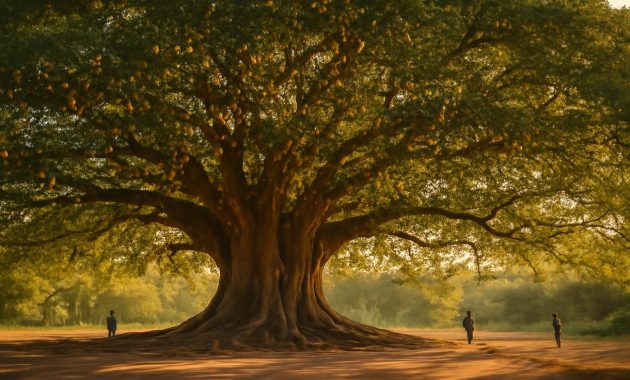
The first thing you notice is the sound. Not the quiet, cathedral hush you expect from a forest, but a soft, continuous rustle, as if hundreds of hands are brushing against thousands of leaves all at once. The ground is dappled with shade, a green-gold mosaic that tilts and shimmers as the wind moves. You walk beneath an arch of branches so dense they swallow the sky, and you think, without doubt: this is a forest.
Only it isn’t.
What surrounds you is a single living being—one colossal tree that has split itself into so many trunks and arms and roots that your brain insists on calling it a grove. It stretches over 8,500 square meters, stands up to 20 meters tall, and in a good year produces around 80,000 fruits, enough to feed villages. It is at once ordinary and impossible, built of familiar bark and leaves yet assembled on a scale that feels mythic. You can put your hand on any trunk and say, confidently, “this tree,” and somewhere deep below your feet, that trunk connects to all the others. One root system. One organism. One quiet giant masquerading as a forest.
The First Step Into a Single-Tree Forest
The air changes as soon as you step under its canopy. Outside, the sun is sharp and white; inside, it softens into a gentle, green-filtered light, as if someone turned down the volume of the day. The temperature dips a few degrees. Your skin registers the difference before your mind does—cooler, moister, calmer.
You walk between what look like independent trees: some as wide as an embrace, others thin and youthful, their bark still smooth. The ground is uneven with roots that rise and twist, merging and splitting like frozen waves. Here and there, a root surface breaks through the soil, curls briefly into daylight, then disappears again, continuing its hidden journey beneath the forest-floor leaf litter.
It feels like walking through a community. Each trunk has its own posture; some lean over companions, some stand straight, some bend at improbable angles. You begin to think of them as individuals—until someone invites you to touch two trunks at once.
“Same tree,” they say with a small smile.
You press your palm against one trunk, fingers spread, and rest your other hand on a second, a few meters away. The bark is cool and faintly rough under your skin. There’s no magical spark, no obvious clue that this is one body, shared. But knowing changes everything. You imagine signals traveling through vessels under the bark, a slow exchange of water, sugars, and subtle chemical messages, like whispers threading through the dark soil and wood: grow here, withdraw there, send strength to that limb, fruit now.
The Underground Architecture of a Giant
This single-tree forest exists because of two things: patience and strategy. Some trees, when cut, die. Others, when wounded, respond by sending up new shoots from their roots or their buried trunk. Over time, those shoots can become trunks in their own right, anchored to the same original root system. In certain species, that capacity is not just a backup plan; it’s the primary way to grow a dynasty.
Picture an old central trunk, perhaps now hollow or broken, surrounded by its own offspring, each connected by a living web below ground. One trunk falls in a storm; the root network barely flinches. Another is felled for wood; the organism responds with more shoots, more branches, more green. Instead of one vulnerable spire, you get many stems, each sharing resources, each part of a collective body that behaves like a single, sprawling, resilient tree.
Over decades—sometimes centuries—that network spreads outward, advancing slowly, almost imperceptibly, a few handspans at a time. A circle of new trunks forms where older branches once cast shade. The “forest” expands, not by seeding new individuals, but by extending itself. What you see above ground is only the visible fraction of a quiet, determined conquest.
When Abundance Hangs From Every Branch
Stop for a moment and look up. The branches form layers, like overlapping canopies in a rainforest. High above, the topmost leaves drink full sunlight. Below, nearer your head, are the fruits—suspended, clustered, countless. Their color will depend on the species and the season: they might glisten deep purple, glow golden, blush red, or rest in unripe greens. But it’s the volume that stuns you.
On an average harvest, this single organism yields around 80,000 fruits. Think of that number not as an abstract figure but as weight and smell and sound. For weeks, there is the heavy perfume of ripening fruit, sweet and overripe at the edges, mixing with the sharper scents of leaves, sap, and damp soil. When the first fruits drop, they land with soft thuds on the leaf litter or splash into baskets and bins. Birds arrive. Insects celebrate. People gather.
From ground level, it looks like every branch is working overtime. Up above, the tree has turned sunlight, water, and the quiet chemistry of photosynthesis into food, into nourishment, into something you can hold in your hand and bite into. Every fruit is a small miracle: sugars shaped by light, vitamins stored like sunlight condensed, seeds hidden at the core, tiny promises of future trees that, in this case, may never be needed for survival because the parent knows another trick: it can clone itself.
A Harvest That Feeds More Than Stomachs
Harvest time here is not just about collecting food; it’s about renewing a relationship with a living landmark. Families spread out beneath the canopy, working in shade that their grandparents knew and their great-grandparents knew before them. Children learn to recognize which fruits are ready—testing for softness, checking color, twisting gently instead of yanking. Ladders rest against sturdy trunks that have quietly thickened over many human lifetimes.
Conversations echo among the stems: jokes, stories, songs. Someone points out a hollow where an owl sometimes sleeps. A child discovers a beetle that looks like a moving gem. Old stories surface: of storms so fierce they thought the whole “forest” would blow away, of drought years when this tree still bore enough fruit to matter. There are whispered assurances that as long as this tree stands, the community is anchored.
At the end of the day, crates and baskets stack up like small, colorful hills: 80,000 pieces of fruit, give or take—a river of sweetness and nutrition captured in solid form. Some will be eaten fresh, some dried or fermented, some turned into jam, juice, or paste. Some will be sold in nearby markets. The tree doesn’t know about markets or money. It knows only that, when conditions are right, it fruitfully fills the space it occupies—with shade, with habitat, with food.
A Forest That’s Really One Body
The mind resists the idea, at first. We are used to counting trees the way we count people—one body, one number. Forests, in our mental model, are plural places: many trunks, many crowns, many separate beings sharing a patch of land.
But here, the forest is singular. One root network. One genetic individual. Many faces.
The illusion of plurality comes from the way the tree has divided its labor. Instead of a single main trunk trying to reach all resources, the organism has multiplied stems to occupy space more efficiently. Each trunk captures light from a slightly different angle, anchors against wind, and explores soil pockets for water and minerals. If one trunk faces pests or injuries, others can shoulder the task of feeding the whole system.
Below ground, all those roots are entangled into a single vascular network. Resources flow where they are needed. If some part of the canopy is drenched in light, it can photosynthesize more sugars and share them with shaded parts. If one cluster of roots sits in a particularly moist patch of soil, it becomes a fountain, sending water outward through the shared veins. This is not cooperation between strangers; it is self-care on the scale of a landscape.
The Hidden Power of Clonal Giants
This strategy—growing not just taller but wider, not just older but more numerous in form—creates some of the most enduring organisms on Earth. We tend to be impressed by solitary giants: redwoods scraping the sky, baobabs swollen with water. But clonal trees play a quieter game, winning not by spectacle, but by resilience.
Fire can scorch one section; the rest survives underground, ready to resprout. Grazing animals can nibble shoots; the root system simply tries again. Human axes can cut trunk after trunk; as long as the core network remains alive, it will send up new growth. The organism’s identity is not tied to any single visible part. It is distributed, like memory in a neural network.
Standing inside such a tree, framed by a dozen trunks that are all variations of the same self, you’re reminded that the boundaries of a living being are sometimes wider—and stranger—than our categories allow. We are used to asking: where does one individual end and another begin? Here, the answer is: much farther out than you thought.
Life Beneath a Living Roof
Beneath this immense canopy, an entire world has assembled itself in layers. The ground is a quilt of decaying leaves and fallen twigs. The soil is darker here, richer, laced with fine roots and the white threads of fungi. Every step releases a faint, earthy aroma: wet minerals, rotting wood, the quiet industry of decomposition.
Listen long enough and you begin to hear the rhythms: the soft rustle of lizards in the litter, the insistence of small birds foraging in the branches, the almost inaudible click of insects meeting, parting, eating. Spiderwebs span the gaps between twigs, jeweled with dew in the early morning. A butterfly drifts through a shaft of light, hovering for a moment before vanishing deeper into the green.
All of this—every feather, every antenna, every flick of movement—depends, in some way, on the tree’s existence. Its leaves provide food for insects and shade that moderates temperature. Its flowers attract pollinators, and its fruits feed animals from the tiniest ants to the cleverest mammals. Even its dead wood becomes home to fungi and burrowing creatures.
A Microclimate Built by One Tree
On hot days, the temperature beneath the canopy can be several degrees cooler than the open land around it. The tree, through the simple act of moving water from soil to sky, creates its own climate bubble. Water taken up by roots travels invisibly through the trunk and into the leaves, where it evaporates into the air as tiny vapor streams. Multiply that process across thousands and thousands of leaves, and the effect is palpable: cooler, more humid air, gentler light, less brutal wind.
For humans, that means a place to work and rest. For animals, it means refuge during extremes—shade when the sun is fierce, shelter during storms, a stable haven when the land around swings wildly between wet and dry, hot and cold. For seedlings of other plants, it can be either an obstacle (less light) or a protective nursery (less moisture loss).
All fashioned by a single organism that looks, at a glance, like many.
Measuring a Giant: Numbers That Tell a Story
Numbers can sometimes flatten mystery, but here they add a layer of awe. To appreciate this tree not only as an experience but also as a living system, consider a few key measures.
| Feature | Approximate Value | What It Means |
|---|---|---|
| Covered Area | 8,500 m² | Roughly the size of a small neighborhood block, all occupied by one organism. |
| Maximum Height | Up to 20 m | As tall as a 6–7 story building, forming a dense green ceiling. |
| Annual Fruit Yield | ~80,000 fruits | Food for local people, wildlife, and a small economy built on one tree. |
| Trunks Visible | Dozens to hundreds | They appear separate, but all are branches of the same living individual. |
| Root System | Single, interconnected | A shared underground network moves water, nutrients, and energy. |
These numbers sketch the silhouette of the giant, but the lived reality is in the details: the way light falls through a particular gap in the leaves, the feel of rough bark under your fingertips, the smell of crushed leaves when someone brushes past a low branch.
Why Single-Tree Forests Matter in a Changing World
It would be easy to treat this tree as a curiosity, the botanical equivalent of a record-holder: biggest this, most that. But it is more than a spectacle. It’s a living model of how life can adapt, endure, and transform space in the face of disturbance.
In a warming world with unpredictable storms, rising heat, and shifting rainfall, resilience matters. A single, towering trunk is majestic, but vulnerable: one lightning strike, one chain saw, one disease, and it can be gone. A many-bodied, clonal tree spreads its bets. Damage in one location doesn’t spell disaster for the whole. Diversity of form—many trunks, many branches at different heights—creates flexibility in how it uses light, water, and space.
These giant individuals also remind us that conservation isn’t just about counting species; it’s about protecting remarkable, irreplaceable lives that hold stories of centuries within them. Cut down a tree like this and you don’t just lose shade and fruit. You erase a living archive of droughts endured, storms survived, years of abundance and scarcity marked in its wood and growth rings and scars.
Living With a Giant, Not Just Visiting One
For the people who live near such trees, this is not an abstract lesson. The tree shapes their routines and their sense of home. It may mark seasons more reliably than calendars: the first buds signaling the end of the cold, the heavy droop of ripe fruit announcing harvest time. It provides economic security—fruit to sell, wood from fallen limbs to use, a gathering place that requires no ticket, no reservation.
In return, people protect it, prune it carefully, clear away invasive plants from its base, and pass down stories about how their elders cared for it. The relationship is not always gentle; branches are cut, fruits are harvested; humans take. But there’s a recognition that taking must be balanced with tending. A tree that feeds so many cannot be left entirely to chance.
To stand beneath such a giant is to feel not just small but also connected—to the land, to time, to other beings that move in the same space. Your own life, measured in decades, suddenly feels brief next to a living thing that might have watched the landscape change again and again, all while quietly extending its reach, leaf by leaf, root by root.
Leaving the Forest That’s Only One Tree
Eventually, you step back toward the light. The canopy thins; the trunks spread out; the cool green glow warms toward ordinary daylight. Outside, the tree’s boundary is hard to see. There is no fence, no obvious line where the organism ends. Grass and shrubs appear, then other trees, separate and younger. You turn back for a final look, searching for a single, definitive trunk, the “real” tree at the center. But the illusion holds. It still looks like a small forest.
Yet you know better now. You know there is one circulatory system under that patch of earth, one great pulse of water and nutrients moving through a body too large to grasp in one glance. You know that in the next season, tens of thousands of fruits will swell on those branches, the product of countless days of silent work transforming sunlight and soil into something edible, sharable, life-giving.
And maybe, as you leave, you carry a different question with you. Not “how can something so big be only one tree?” but “how many other living beings, in how many other places, are larger, older, and more complex than we have learned to see?”
In a world that often prizes speed and novelty, this sprawling, patient giant offers another way of being: spread out, deeply rooted, quietly generous, and undeniably alive—no matter how many trunks you try to count.
Frequently Asked Questions
Is it really possible for a “forest” to be a single tree?
Yes. Some tree species can clone themselves through roots or shoots, creating many trunks that remain connected underground. Over time, these clonal stands can cover large areas while still being a single genetic individual with one shared root system.
How can one tree produce around 80,000 fruits in a harvest?
Because this tree has many trunks and an extensive canopy, it supports an enormous number of flowering branches. With enough light, water, and nutrients, those branches can set tens of thousands of fruits in one season, all powered by a single, integrated root network.
Are clonal trees like this common?
Clonal growth is common in plants, but reaching such vast sizes is rare. Many shrubs, grasses, and some trees spread clonally, yet only a few individuals around the world become truly gigantic, covering thousands of square meters while remaining one organism.
Why are single-tree forests important for local communities?
They provide shade, food, wood from fallen branches, and a stable meeting place. A large, productive tree like this can support local diets, small-scale trade, and cultural traditions tied to harvests and seasonal changes.
How can such a tree be protected?
Protection usually involves preventing unnecessary cutting, avoiding soil compaction around roots, managing pests, and respecting the space the tree needs to grow. Community care—through pruning, monitoring, and traditional rules—often plays a crucial role in helping these giants endure.