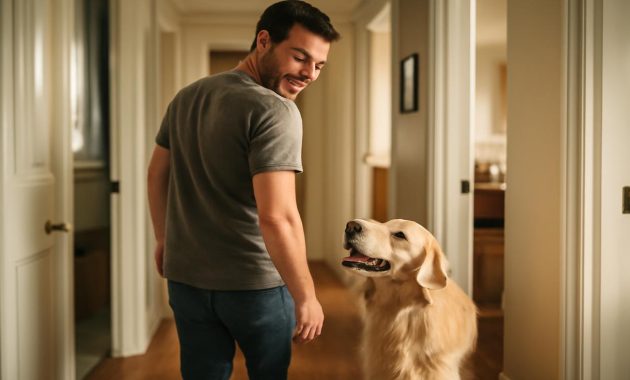
The click of your laptop keys barely rises above the hush of the afternoon, and yet you can feel eyes on you. You glance down. There he is again—your dog, curled at your feet, chin resting on your sock, watching you with quiet gravity. A few minutes ago, he trailed you to the kitchen. Before that, to the bathroom. This morning, he followed you from bed to coffee pot with the devotion of a tiny, furry moon orbiting your personal planet. You step; he steps. You sit; he sighs and settles. You close the door; he waits outside like a small, patient shadow. If your dog follows you everywhere, you already know: this is more than habit. It feels like a wordless relationship written in footsteps and eye contact, in the soft rhythm of breathing beside you.
The Quiet Gravity Between You and Your Dog
If you live with a shadow-dog, you know the choreography well. You stand from the couch, and there’s a rustle of fur as your dog lifts his head, gauges your direction, then hops down to pad after you. Maybe the nails tap lightly on hardwood as he trails you down the hall. Maybe you feel the warmth of his presence as he waits just outside the shower, as if guarding the threshold between your world and the echoing tile universe where human beings disappear behind curtains of water.
Nature writers often talk about “companions in landscape”—creatures who help us see our surroundings differently. A dog who follows you everywhere turns your entire home into a living landscape of connection. The hallway becomes a migration route. The kitchen doorway becomes a boundary line he will not cross until you invite him. The soft circle of his body on the bathmat transforms an ordinary morning into something intimate and strangely wild—like being tracked by a small, loyal wolf who has decided that your survival is now his life’s work.
But beneath the charm—and sometimes the mild exasperation—of being followed everywhere, there is a story unfolding. It’s a story of attachment, instinct, learning, and sometimes anxiety. The way your dog shadows you is a kind of language. And once you start to listen, you realize: he isn’t just following you. He’s telling you who you are to him.
The Science of a Shadow: Why Dogs Attach to Us
In the wild, canids rely on closeness. Wolves move as a unit, trotting together across snowfields and forest floors, reading each other’s bodies in glances and subtle shifts of pace. Distance can be dangerous. A pack that spreads too far apart becomes vulnerable. When dogs evolved alongside humans, they pulled that ancient rule forward into our living rooms: stay close to the source of food, shelter, and safety.
To your dog, you are not just the human who fills the bowl. You’re also the moving center of his world—the compass point that tells him where comfort, warmth, and security live. When he trails you from room to room, he’s doing something that feels instinctively wise. You are his pack. If the pack moves, he moves.
Over time, this instinct has become laced with something else: attachment that looks remarkably like love. When dogs follow their people, studies show there’s often an oxytocin bump on both sides—the same bonding hormone that strengthens relationships between human parents and children. Your dog watches you, sniffs you, leans against you, tracks your footsteps, and his brain quietly lights up with chemical confirmation that being near you is good, safe, and right.
And then there’s learning. Puppies quickly figure out that good things happen when they stick close to their humans—treats appear, doors open, leashes clip on for walks, soft voices say their names. Following you is an ongoing experiment with a very consistent result: proximity pays off.
“Velcro Dog” or Just Deeply Bonded?
People sometimes joke about having a “velcro dog”—a dog who seems firmly attached at all times. But not all stickiness is the same. Some dogs simply have a strong preference for your company. They follow you because it’s more interesting and rewarding to be where you are than anywhere else. Their body language, though, stays soft and relaxed—loose wagging tails, easy breathing, the ability to rest deeply once you stop moving.
Others carry a tension in their following. They stick to you like a lifeline—startle when you stand up, pant when you walk toward the door, pace when you’re out of sight. That kind of following isn’t just devotion; it can be a sign of unease or anxiety. The difference matters, because what your dog needs from you in each case is slightly different.
Reading the Signals: What Your Dog’s Following Really Means
On a quiet evening, watch the way your dog moves when you stand up. Does he stretch luxuriously first, a long bow with a groan, then amble after you? Or does he spring to his feet as if jolted, eyes wide, body tight? When you leave the room, does he saunter behind you, or does he rush to keep you in sight, almost frantic if a door swings shut between you?
The meaning of your dog’s following lives in the details of his body language. Think of it like reading weather signs in the sky. The same clouds can mean stillness or storm, depending on how they move.
| Type of Follower | Common Signs | What It Often Means |
|---|---|---|
| The Gentle Shadow | Loose body, soft eyes, quiet trot, can settle easily | Healthy attachment, curiosity, enjoyment of your company |
| The Guard | Positions between you and doors/windows, alert ears | Protective instinct, watching over you and the territory |
| The Worrier | Pacing, panting, whining, can’t relax if you move | Anxiety, fear of separation or being alone |
| The Opportunist | Appears most in kitchen or meal times, watchful eyes | Food motivation, hoping for dropped snacks or treats |
| The Student | Attentive, bright eyes, loves training cues | Looking to you for guidance, ready to learn and engage |
Often, your dog is a blend of these types. Maybe he’s a Gentle Shadow in the living room, a hopeful Opportunist in the kitchen, and a low-key Guard when someone knocks at the door. What they all share is the same core message: you matter. Your movement, your presence, your routines—they form the spine of his day.
Comfort, Curiosity, and the Fear of Missing Out
Sometimes the answer is charmingly simple. Your dog may follow you everywhere because he has a serious case of FOMO: fear of missing out. From his point of view, anything could happen at any time—treats, walks, visitors, a game with the squeaky toy, the mysterious rattle of the leash that means adventure. To miss these things would be a small tragedy. So he hedges his bets and follows you, just in case this is the moment the magic happens.
There’s also the gravitational pull of comfort. Dogs are masters at pattern recognition. If lying near you usually leads to soft words, ear scratches, or just the kind of quiet company that makes the room feel stable, they’ll seek that out again and again. Even your scent, lingering on the sofa cushion or the rug under your desk, works like a living trail of reassurance.
For some dogs, that comfort has a sharp edge. If your dog starts to panic the moment you pick up your keys or close the bathroom door, his following isn’t about curiosity anymore—it’s about keeping you in view at all costs. In those moments, his shadowing behavior is less a love letter and more an alarm signal. It’s his way of saying: “When you disappear, I don’t know if I’ll be okay.”
When Devotion Turns into Anxiety
You may not remember the first moment it shifted. One day, your dog simply seemed extra clingy. Then you noticed the whining when you walked to the mailbox. The scratched door. The chewed edge of the rug you didn’t think much about at first. Over time, the following started to feel less like companionship and more like desperation.
Separation-related anxiety is like a knot that tightens whenever distance appears between you and your dog. It’s not just that he prefers your company. It’s that your absence feels unbearable. Dogs who struggle this way often show signs even before you leave: pacing when you grab your coat, trembling when you put on shoes, hovering anxiously as you move from room to room.
In your presence, that can look like constant following with a body that never truly softens—a dog who startles when you shift in your chair, as if every move might be the start of your leaving. It’s exhausting for them, and it can be emotionally draining for you.
If you see this in your dog, it’s not a failure on your part—and it’s not a sign that your dog is “spoiled” or manipulative. It’s a sign of distress. It often grows from a mix of genetics, life history, routine changes, and sometimes trauma. Think of it as your dog’s nervous system being stuck in the “don’t let them out of your sight” mode.
Addressing this kind of following usually means gently teaching your dog that small moments of distance are survivable and even safe. Short, low-key absences, calm returns, cozy safe spaces, and sometimes help from a veterinary professional or behaviorist can all weave a new story for your dog—one where your leaving doesn’t mean the end of the world, just the temporary closing of a door.
Breeds, Backstories, and Built-In Velcro
Some dogs arrive wired for closeness. Many herding breeds, like border collies and Australian shepherds, have been shaped for generations to watch humans closely and respond quickly to their cues. Companion breeds—cavalier King Charles spaniels, bichon frisés, toy poodles, among others—have a history wrapped tightly around laps and living rooms. For them, following you isn’t a quirk; it’s a job description.
Then there are the rescue stories. A dog who has been abandoned, bounced between homes, or left alone too long may cling especially fiercely once they find a person who feels safe. Following you from room to room becomes their way of saying: “You came back. Please don’t vanish again.”
Knowing your dog’s breed tendencies and history doesn’t lock him into a fate, but it can explain his intensity. It allows you to meet him where he is—not scolding him for following, but slowly teaching him that your love doesn’t evaporate just because you’re in another room.
How to Gently Loosen the Velcro (Without Breaking the Bond)
You don’t have to choose between a dog who adores you and a dog who can handle being alone. In fact, the healthiest relationships—human or canine—balance attachment with independence. Your dog can be both your devoted shadow and a creature who knows how to nap contentedly when you’re not within reach.
One of the kindest things you can do is invite independence in small, safe ways. Start in the comfort of your own home, in moments that feel low-stakes. Scatter a few treats in another room, then walk away. Encourage your dog to investigate without hovering. When he chooses to follow you less intensely, reward that quiet bravery with calm praise or another treat in the space he moved into.
Create pockets of coziness that don’t rely entirely on your physical presence—a bed by a sunny window, a chew toy that appears only at quiet times, a puzzle feeder that turns solo moments into treasure hunts. These things teach your dog that good experiences can happen without his nose pressed to your heel.
Turning Following into a Conversation
Following doesn’t have to be something that simply happens to you. It can become an intentional part of how you and your dog communicate. Instead of always letting him decide where to be, you can gently shape the ritual.
Try adding a cue to your movements. When you leave the living room, say, “Come on,” inviting him along. When you want him to stay, ask for a “Wait” or “Stay,” then step out of sight for just a second. Return, reward, and build slowly. This turns your comings and goings into a predictable pattern your dog can understand, instead of a string of surprising disappearances.
You can even turn shadowing into a game of trust. Walk into another room and place a treat on his bed. Call him to you there, praise him when he lies down, then step away for a few seconds. Come back, reward. Over time, your dog learns that sometimes, following you means listening to your cues rather than physically sticking to your side—and that staying put can be just as rewarding as trotting along behind you.
Finding the Beauty in Being Followed
In the rush of daily life, it’s easy to experience your dog’s constant presence as a kind of background noise—always there, always underfoot, sometimes mildly in the way. But there’s another way to see it: as a quiet, living testimony to the bond you’ve built.
Every time your dog chooses the floor beside your chair over the soft emptiness of another room, he’s casting a vote. This, he says, is where the story is. This, right next to you, is where life feels most worth living. Even if you’re just sorting laundry or scrolling through emails, to him, it’s the center of the universe.
There’s a wildness in that devotion, a lingering echo of pack animals trailing across ancient landscapes. You and your dog may be traveling only from couch to sink to bed, but the instinct is the same: stay together, move as one, trust the one you follow.
So the next time you stand up and feel that familiar presence fall into step behind you, you might pause for half a heartbeat. Feel the hush of his paws on the floor, the quiet rustle of fur, the small huff of his breath as he lies down again when you stop. In a world that pulls us in a thousand directions, there is something extraordinary about a creature who looks at all the possible places he could be—and chooses, again and again, to be exactly where you are.
Frequently Asked Questions
Is it normal for my dog to follow me everywhere?
Yes. Many dogs naturally follow their favorite person from room to room. As long as your dog’s body language is relaxed and he can rest calmly, it’s usually a sign of healthy attachment and interest in your activities.
How can I tell if my dog’s following is caused by anxiety?
Watch for signs like panting, pacing, whining, trembling, or inability to relax when you move away or prepare to leave the house. If your dog seems distressed rather than simply attentive, anxiety may be playing a role.
Can I make my dog less clingy without hurting our bond?
Yes. You can encourage independence through short, positive separations, teaching “stay” or “wait” cues, and creating cozy spaces and activities your dog can enjoy alone. Done gently, this strengthens trust rather than weakening your relationship.
Do some breeds follow people more than others?
Absolutely. Herding, working, and companion breeds are often especially people-focused and may shadow their humans closely. However, any individual dog—regardless of breed—can become a devoted follower based on personality and life experience.
Should I be worried if my senior dog suddenly starts following me more?
A sudden change in behavior, especially in an older dog, is worth noting. Increased following can sometimes be related to changes in vision, hearing, confusion, pain, or anxiety. A check-in with your veterinarian can help rule out medical causes.
Is it okay to let my dog follow me into every room, even the bathroom?
That’s a personal choice. If you’re comfortable with it and your dog isn’t showing signs of anxiety when separated, it’s not harmful. If you’d like more boundaries, you can gradually teach your dog to wait calmly outside certain doors using gentle training and rewards.
When should I seek professional help about my dog’s following behavior?
If your dog becomes distressed when you move away, damages things when left alone, has accidents in the house only when you’re gone, or seems unable to relax unless you’re in sight, it may be time to talk with your veterinarian or a qualified behavior professional for guidance.