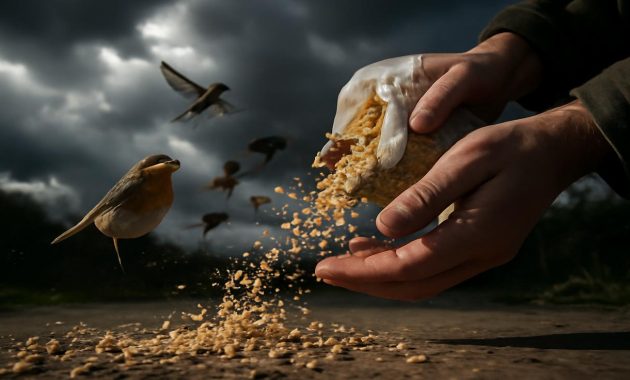
The first time you notice a robin in winter, it’s often just a flash of russet-red against dull branches, like a stray ember that somehow escaped the fireplace and landed in the garden. It cocks its head, as if listening to something under the soil, then darts to a bare patch of ground, delicate and determined all at once. That little bird looks self-sufficient, almost jaunty. But what we don’t see, most of the time, is how thin the margin between life and death can be for a robin when the weather turns cruel.
When the temperature plunges, the robin’s bright chest still glows in the gloom, but everything else in its world goes dark and hard and sparse. Soil freezes. Worms vanish deeper underground. Insects stop moving. A robin needs to eat up to 40 percent of its body weight in food every single winter day just to survive the cold night ahead. And that is where you and one very ordinary item in your kitchen cupboard suddenly become the difference between struggle and survival.
The Quiet Emergency Happening at the Bird Table
Every winter, especially when a sudden cold wave sweeps in, wildlife rescue lines start to crackle with the same worried calls: “I’ve found a robin in my garden, it looks puffed up and slow, what should I do?” The RSPCA, watching the weather maps and the temperature graphs, knows what that means long before the calls begin. To them, a cold snap is not simply a patch of bad weather; it’s an invisible emergency for small birds like robins.
Unlike some larger birds that can store significant fat, robins live almost hour to hour. A single, harsh night without enough calories can weaken them fatally. The RSPCA has been urging people for years to put out food for wild birds, but when a serious cold wave is on the way, the message becomes sharper, more urgent, more specific: if you have robins in your garden, you need to act quickly. And the good news is that what they are asking for is astonishingly simple—no fancy bird food mix, no expensive specialist seed. Just an easy-to-find, low-cost kitchen staple that might already be sitting on your shelf.
Step into your kitchen and open the cupboard where you keep baking ingredients or basic dry goods. Somewhere in there is a bag or tub that could mean everything to the robin singing from your fence post. Flour? No. Rice? Definitely not (uncooked rice is no good for robins). The RSPCA’s winter hero is something fattier, energy-dense, wonderfully cheap, and as unassuming as it gets.
The Kitchen Staple That Could Save Their Lives
The staple the RSPCA urges people to scatter before a cold wave is plain, unseasoned kitchen fat—most commonly cheap suet or lard, often sold for pennies as a humble block on the supermarket shelf. Not the fancy flavored stuff, not the gourmet version, just the basic, white, solid cooking fat that your grandparents probably used long before olive oil became fashionable.
To our eyes, a lump of lard or suet is hardly appetising. To a robin facing a night of freezing wind, it is liquid daylight waiting to happen. Fat is the most efficient fuel a bird can eat when it needs to build up an emergency store of energy. While seeds and crumbs are useful, they cannot match the sheer calorie punch of pure fat. The RSPCA knows this, and that’s why, as the forecast starts muttering about frosts and icy blasts, they push out a simple plea: if you do one thing for the robins in your garden, let it be this.
Even better, you don’t need bird-specialist suet blocks. The plain blocks of suet or lard in the baking aisle are just as good, as long as they are unsalted and unseasoned. No herbs, no spices, no onion or garlic, no crispy bits. Birds’ tiny kidneys cannot handle excess salt, and their bodies are not made to process everything we happily put into our own dinners. But a plain, cheap block of fat—kept simple and clean—is like a compact, high-energy survival kit delivered straight to their beaks.
And the way you offer it matters just as much as what you offer. You’re not serving a three-course meal; you’re shaking out lifelines across the frozen ground.
How to Scatter Life-Saving Fat for Robins (Safely)
Imagine you’re the robin now: small body, fast heartbeat, feathers fluffed up against the wind. The ground is hard and unforgiving; there are no soft, damp patches where worms might surface. You hop into your usual feeding spot, heart racing a little faster: will there be anything today?
Here’s how to make sure the answer is yes, in a way that is both safe and irresistible:
1. Choose the Right Fat
Pick up an inexpensive block of plain suet or lard from the supermarket—no added salt, no seasoning, no meat scraps mixed in. Check the label: it should list just “beef suet” or “lard,” nothing else. If in doubt, err on the side of the simplest option. If you already have an untouched block in your cupboard, even better. Keep it cool until you’re ready to use it, especially if your kitchen is warm—the texture will be easier to handle.
2. Crumble, Don’t Clump
Robins are ground-feeders. They love to forage on flat or gently sloping surfaces. Take the block of fat and crumble a portion in your hands into pea-sized pieces—small, irregular nuggets. If it’s very hard, you can grate it or chop it with a knife and then break it up further with your fingers. Avoid leaving a single big lump out: robins and other small birds prefer manageable bites, and smaller pieces are easier for multiple birds to share. Scattering also stops bolder species from monopolising one big piece.
3. Scatter Where Robins Already Forage
Look around your garden or balcony: where do you usually see your robin? Often they’ll patrol the base of shrubs, low walls, pots, or the edges of beds. Scatter the crumbled fat on a clean, open patch of ground where you can keep an eye out but the bird still feels safe—close to cover, not out in the wide open like a runway for predators. On balconies or small spaces, a low tray or shallow dish filled with crumbled fat works well.
4. Add a Little Variety (But Keep It Simple)
On especially hard days, you can mix the fat with a few safe, high-energy extras: crushed, unsalted peanuts; a handful of oats; or small amounts of grated mild cheese (never mouldy). The fat helps bind these bits together, turning them into a sort of winter trail mix for birds. Avoid bread as a main component; it fills birds up without providing enough nutrition, much like living on crackers alone.
5. Refresh Daily During the Cold Wave
During a cold spell, make a small daily ritual of it: each morning, step outside and scatter a fresh pinch or two of crumbled fat. Remove anything that looks old, wet, or contaminated, and clean any trays regularly with hot water. This stops bacteria building up. You don’t need to overwhelm the ground with food; just a modest daily offering can be exactly what a robin needs to get through the night.
| For Your Robin | Good Choices | Avoid |
|---|---|---|
| Main winter energy boost | Plain suet or lard, crumbled | Salted, seasoned, or flavoured fats |
| Extra treats | Unsalted peanuts (crushed), oats, grated mild cheese | Bread as main food, fatty meat scraps, mouldy food |
| Where to feed | Ground, low trays, sheltered spots near shrubs | Greasy feeders that can coat feathers, exposed open lawns |
| How often | Little and often, refreshed daily in cold weather | Huge piles left to spoil over several days |
What Happens Inside a Robin on a Freezing Night
On a still winter evening, when the air feels almost metallic in your lungs and the stars look brittle and sharp, your robin is making a quiet calculation: do I have enough fuel to see the morning? We rarely think of birds this way, but under those soft feathers is a body running hot, fast, and perilously close to empty.
Robins, like many small birds, have an extraordinarily high metabolic rate. Their hearts can beat more than 300 times a minute, faster if they’re stressed or cold. To keep their tiny engines running as the temperature drops, they burn energy at a furious pace. By late afternoon on a bitter day, a robin may already have used up most of what it ate at dawn. If it can’t top up—quickly and efficiently—it faces the night with dangerously low reserves.
That’s where fat is so crucial. Carbohydrates and proteins provide energy, yes, but fat is concentrated survival: gram for gram, it delivers more than twice the energy. When a robin pecks up one of those crumbled pieces of suet or lard, its body can convert that bite into warmth, movement, and the thin insulating layer of fat that might make the difference between waking at first light or not waking at all.
Scientists studying winter bird survival talk about “energy balance” and “thermal stress,” but if you watch a robin feeding just before dusk in freezing weather, you can see those academic terms become reality. The bird is almost frantic, purposeful, laser-focused on getting as much good food as it can, as quickly as possible. You might notice how it prefers certain foods over others, homing in on the highest-energy pieces you’ve scattered. It’s not greed. It’s instinct honed by thousands of winters: pick the food that burns slow and bright.
By the time you draw the curtains and turn on the heating, that robin has already found a roosting spot—tucked into dense ivy, sheltered under a low evergreen, or nestled deep in a hedgerow. It puffs up its feathers to trap air and insulate its body. Outside, invisible to you, that little body quietly consumes the energy you left out in the morning, drop by drop of stored fat, until the horizon softens and another day begins.
One Small Act, Wider Than One Small Garden
It’s easy to think of the robin in your garden as a solitary character, a single, self-contained story. In reality, each robin you see is part of a much larger pattern of survival playing out across the country. When the RSPCA calls on people to scatter suet or lard before a cold wave, they’re not imagining a few lucky birds; they’re picturing a patchwork of gardens, balconies, and tiny yards forming an informal, nationwide feeding network.
In one street, someone hangs fat balls and puts out seed, drawing in tits and finches. Next door, another householder crumbles lard on a patio slab for a shy robin and a blackbird. Across town, a balcony becomes a winter lifeline for an urban bird that has never known a hedgerow. Each small, individual effort stitches together into something bigger: a buffer against extreme weather that wild birds simply did not evolve to face at the speed our climate is shifting.
Winter has always been a test, but recent years have seen wild swings—mild spells followed by sudden, brutal freezes. Birds feel those lurches acutely. Food sources appear and vanish overnight. Insects hatch too early or not at all. Ground that was soft yesterday is rock-hard today. Our gardens, once incidental, now play a much more active role in whether local wildlife bends or breaks under these pressures.
Robins, with their confiding nature and bright breast, become the ambassadors of that story. When you respond to the RSPCA’s call and scatter that simple kitchen staple, you’re not just “feeding the birds.” You’re acknowledging that your small square of the world matters—and that, in winter especially, it can be transformed into a place where wild, beating hearts have a fighting chance.
Listening for the Robin’s Knock
There’s a particular sound some people begin to notice, once they start feeding robins regularly in cold weather. Not song, not the sharp ticking alarm call, but a subtle flutter and tap near the window at about the same time each day. The bird has learned your routine. It knows when you usually step out, crunching across the frosty path, handful of food in your palm.
If you haven’t yet responded to the RSPCA’s plea, the next cold forecast is your invitation. You don’t need a big garden, or specialist feeders, or a lifetime membership to a bird society. You only need to open your cupboard, pull out that cheap, plain block of fat, and say yes to a few minutes of care each day while the weather is unforgiving.
Scatter it on the ground. Watch from the window as the robin appears—tentative at first, then bolder, perhaps joined by a blackbird or a dunnock. Notice how quickly the pieces disappear, how focused the birds are. Realise, as you sip something warm indoors, that your small act is out there in the cold, being transformed, crumb by crumb, into survival.
And when spring eventually softens the edges of your mornings, when the robin’s song shifts from thin winter calls to richer, more confident verses, you’ll know that you weren’t just a spectator. You were part of the story, woven quietly into the robin’s memory of a hard season weathered and overcome.
FAQs About Feeding Robins Suet or Lard in Cold Weather
Is it really safe to feed robins suet or lard from the supermarket?
Yes—as long as it’s plain, unsalted, and unseasoned. Check the label and avoid anything with added salt, herbs, spices, or meat chunks. Simple blocks of beef suet or lard are best.
How much should I put out each day?
A small handful of crumbled fat is usually plenty for a typical garden. During very cold spells, you can increase this slightly, but it’s better to feed little and often than to leave large amounts that could spoil.
Can I just put out my leftover cooking fat from the pan?
It’s not recommended. Cooking fat from pans often contains salt, meat juices, seasoning, and burnt residues that can be harmful to birds or coat their feathers in grease. Stick to clean, unused blocks of plain suet or lard.
Should I stop feeding once the cold wave is over?
You can reduce fat-based foods once temperatures rise, but continuing to offer a small amount of suitable bird food—like seeds, mealworms, or occasional bits of fat—helps robins and other birds recover from the winter’s strain. Just avoid overfeeding with fatty foods in mild weather.
Will feeding robins make them dependent on me?
No. Wild birds naturally continue to forage and explore multiple food sources. Your feeding supplements what they find, especially in extreme conditions. If you need to stop, do so gradually rather than suddenly during the coldest weeks.
Can I feed other birds the same fat?
Yes. Many garden birds, including tits, blackbirds, and starlings, benefit from plain suet or lard in winter. Just ensure everything you put out meets the same basic rules: no salt, no seasoning, no mould, and offered in clean conditions.
What if I don’t have a garden—can I still help?
Absolutely. A balcony, window ledge, or shared courtyard can all host a small tray or shallow dish with crumbled fat and other suitable foods. Even the smallest feeding spot can become a crucial stopover for a hungry robin in a harsh winter.