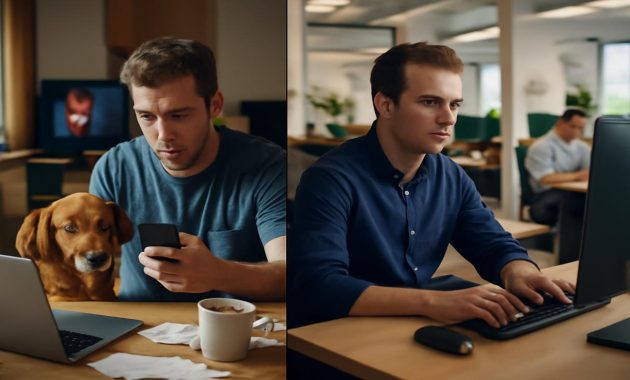
The first thing you notice isn’t the silence. It’s the hum. Laptops, air purifiers, the refrigerator working a little too hard because someone keeps opening it between emails. Outside the small apartment window, sunlight drapes itself over empty streets—the commute that never happened. Inside, a woman in sweatpants stares at her screen, cursor blinking over a half-formed sentence while three chat apps glow with unread messages. Her coffee is cold. Her attention is fractured. Somewhere, a manager looks at a dashboard and wonders, not for the first time, how a workforce that seems so “busy” can be getting so little of the important work done.
The Myth We Fell in Love With
Remote work came wrapped in language that sounded almost utopian. Freedom. Flexibility. Autonomy. No more claustrophobic trains, no more plastic-wrapped lunches eaten at gray desks under colder lights. The world shut down, and with it, the illusion that “real work” required fluorescent ceilings and lanyards. Productivity, the pundits promised, didn’t live in buildings; it lived in people. Give them Wi‑Fi and Slack, and they’ll give you the world.
For a while, we believed it. We repeated phrases like ritual: “I’m actually more productive at home,” “We’ve proven we don’t need offices,” “Work is what you do, not where you go.” They felt so good to say, like we were outsmarting an old system that had never quite fit. Managers liked the cost savings; employees liked working in leggings. Companies downsized leases and posted glossy thinkpieces about the “future of work.”
But slowly, quietly, something else was happening. That hum in the apartment grew sharper. The once-thrilling emptiness of the day began to feel like a long hallway with doors that never fully opened. Teams drifted out of rhythm. Projects that had once sparked in whiteboard sessions started to feel like homework done at the last minute—alone, disconnected from any shared heartbeat.
We didn’t notice the rot at first, because it didn’t show up as chaos. It showed up as what looked like order: full calendars, steady pings, long email threads. It showed up as “busy.” What slipped away was harder to count: the half-formed ideas, the quick clarifications, the sharp edges of focus that happen when you sit beside another human being all leaning in the same direction.
The Day the Office Energy Died
Walk into an office that’s alive, and you feel it before you see it. The door opens and a low murmur meets you—conversations stitched with laughter and urgency, keyboards rattling, footsteps crossing corridors like currents in a shared river. Whiteboards are scarred with old ideas; sticky notes wilt by the corner of a monitor. Someone rounds the corner with too many coffees, balancing them like a hopeful offering. It’s a living organism, not just a workplace.
Now imagine trying to compress all of that into a 30-minute video call. You schedule it. People appear as rectangles, framed by bookshelves or blank walls. Some cameras are on, some off. A grid of faces, each living in a different temperature, a different light, a different level of distraction. The sound cuts out for a moment. Someone says, “You’re on mute.” Someone else loses Wi‑Fi. The clock ticks louder than the conversation.
We tried to tell ourselves this was “just as good.” That collaboration could be boiled down to scheduled appointments, that creativity could be screen-shared. But look closely at how real work used to move before we scattered to our homes. The best ideas rarely arrived on command. They slipped between meetings, surfaced while walking to lunch, resolved themselves at the corner of a colleague’s desk with, “Hey, quick question.” Problems were ambushed in hallways. Misunderstandings were dissolved by a raised eyebrow and a two-minute chat.
In remote life, those frictions—the ones that make teams smarter, faster, tighter—have to fight to exist. A “quick question” becomes another meeting request. A passing idea gets postponed until “we can find time to discuss.” The hallway is gone, replaced by a digital queue where everything waits its turn. By the time that idea gets its slot on the calendar, the electricity has leaked out of it.
And then there’s simple presence: that strange, quiet pressure of sitting near others who are deeply engaged. You look up, see teammates hunched in concentration, and something in you aligns. Your focus sharpens. You stay with the hard thing a little longer. Try as we might, a tiny circle next to someone’s name that says “Active now” doesn’t summon the same gravity.
When Home Becomes the Worst Kind of Office
The dream version of remote work was always painted in soft edges: a long, farmhouse table by a sunlit window; birdsong outside; a mug of something warm at your elbow. In that picture, you close the laptop at four and go for a walk among trees. The truth, for most, looks different: a kitchen table straining under the weight of work and life, a couch that doubles as a desk, an inbox that refuses to stay neatly in “work hours” because the boundary dissolved the moment your office moved into your bedroom.
Attention, it turns out, is a fragile thing. At home, it’s stalked from every direction. Laundry sighs in the other room. A package arrives mid-call. Kids thump overhead. A neighbor decides this is the perfect moment to mow the lawn. Your phone, no longer banished to a drawer, lights up like a small slot machine with social updates. When your mind hits resistance on a hard task, the path of least resistance is only a few steps—or a few taps—away.
In the office, the architecture of the space itself creates a kind of guardrail. You show up; you cross a threshold. The world narrows to a few, clear purposes: build, decide, solve, create. You might still get distracted, sure. But the social and physical cues around you—others working, meeting rooms booked, the quiet hum of shared effort—keep tugging you back to the central channel.
At home, that channel competes with a dozen others. You’re not just an employee; you’re a parent, a partner, a roommate, a caretaker, a short-order cook, a reluctant IT technician, all inside the same four walls. The result isn’t balance. It’s bleed. Your mornings start earlier “just to get ahead,” your evenings stretch later “because no one’s watching the clock,” and yet, the core work—the deep, meaningful, value-driving work—shrinks into smaller and smaller pockets between interruptions.
Ironically, remote work often leads to more hours and less output. People sit in front of their screens longer, but much of that time gets chewed away by task-switching, digital miscommunication, and the emotional weight of being perpetually “kind of” at work and “kind of” at home, never fully inhabiting either.
The Productivity Illusion: Busy, But Not Moving
Companies, hungry for validation that remote is working, reach for whatever numbers they can. Log-in times. Messages sent. Meetings attended. Activity trackers that pulse with reassuring charts. It’s comforting to look at dashboards that say: Your people are online. Your people are active. Look at all the motion.
But motion is not momentum. A day full of back-to-back calls can hide the fact that nothing hard got pushed forward. A hundred Slack messages can conceal a decision that would have taken five minutes in person but now drags on for a week. The subtle craft of doing the right work, in the right order, together, gets replaced by a culture of constant digital presence. We perform availability instead of practicing effectiveness.
This illusion shows up starkly when you compare how work actually feels to the people doing it:
| Aspect | Remote Reality | In‑Office Reality |
|---|---|---|
| Communication | Endless messages, misread tone, delayed replies | Quick clarifications, rich non‑verbal cues |
| Decision‑Making | Scattered threads, multiple tools, slow convergence | Real‑time debates, whiteboards, faster alignment |
| Focus | Household distractions, blurred boundaries | Structured environment, social pressure to stay on task |
| Learning & Mentorship | Formal calls, fewer organic “over‑the‑shoulder” moments | Shadowing, eavesdropping on how things really get done |
| Team Culture | Fragmented, reliant on forced virtual socials | Shared rituals, inside jokes, visible energy |
What the table can’t fully capture is the mood behind the metrics. A remote worker can attend every meeting and respond to every ping and still feel strangely detached, like they’re watching their own job through glass. In the office, you don’t just see tasks; you see stakes. You see the tension when a deadline looms, the relief when something lands well, the unspoken encouragement when someone is clearly struggling and a teammate quietly steps in.
Those layers of human feedback shape behavior in ways no productivity tool can. They make priorities feel real instead of abstract. They provide the subtle, constant course corrections that keep teams from drifting off into side projects, misunderstandings, and duplicated work—all of which have become easier to hide and harder to detect in remote settings.
Why Companies Must Lead Us Back
Left to our own devices, many of us would keep choosing the path that feels easier in the moment: stay home, skip the commute, log in from the couch. It’s understandable. The office asks something of us—time, effort, social energy. Home offers a softer landing. But leadership isn’t about offering only what feels good today; it’s about building what will still be standing—and thriving—five years from now.
Remote work has revealed something uncomfortable: when every day becomes a choose-your-own-adventure, discipline erodes. Coordination falters. Culture thins. The collective standard lowers bit by bit, not because people are lazy, but because we are wired for convenience, comfort, and immediate rewards. In-person work, with all its minor frictions, creates a container strong enough to hold higher expectations.
Forcing a return to the office sounds harsh until you consider the alternative. A slow fade into mediocrity rarely announces itself. It arrives disguised as “flexibility.” It hides in lowered hiring bars because it’s harder to train and integrate new people remotely. It seeps into strategy sessions where no one quite feels the same urgency because they’re all peering into their own private rectangles. It shows up in customer experiences that feel a little sloppier, a little slower, a little less sharp than they used to.
Companies that insist on in-person work aren’t being nostalgic or controlling; they’re protecting the conditions that make excellence possible. They’re choosing to prioritize:
- Real-time collaboration that doesn’t need to be scheduled into oblivion.
- Mentorship that happens by osmosis, not only via calendar invites.
- Cultures where values are visible in everyday behavior, not buried in slide decks.
- Teams that can turn on a dime because they share a physical, emotional, and mental space.
Yes, some people will resist. They’ve reorganized their lives around remote work. They’ve moved farther out, taken on caregiving responsibilities, built new rhythms. Those realities deserve empathy and thoughtful accommodations where possible. But the core direction cannot be negotiated if what’s at stake is the long-term health of the company—and the careers that live within it.
Sometimes leadership means saying: “We know this is harder in the short term. We’re asking anyway, because we believe your best work, and our best future, lives in a place we share—not in a thousand separate rooms.
Reclaiming the Office as a Place Worth Going To
Of course, dragging people back into dead, joyless offices just to recreate the worst of pre‑pandemic life is its own kind of foolishness. The call to return cannot be a return to mindless face-time and rigid 9-to-5 for its own sake. If companies want people back, they must make the office feel again like an ecosystem designed for doing meaningful, satisfying work together.
That means rethinking the space: fewer endless rows of desks, more rooms where ideas can stretch their legs; quiet nooks for deep focus; welcoming communal areas where spontaneous conversations don’t feel like an intrusion, but a feature. It means honoring the commute by making in-office days rich with collaboration—the meetings that matter most, the decisions that need everyone’s full attention, the work that is markedly better when done side by side.
It also means revisiting the deal between employers and employees. If the office is where we gather to do our sharpest thinking, solve the hardest problems, and build the deepest bonds, then it should also be where people feel the most supported in their professional growth. Clearer feedback, more visible recognition, real opportunities to learn by watching others operate under pressure—these are the currencies of the modern office, far more valuable than free snacks or ping-pong tables.
There’s a deeper, quieter benefit too: when you leave your home to go to the office, and then you leave the office to go home, you reclaim the ancient rhythm of crossing thresholds. You give your mind markers: Now I arrive. Now I build. Now I depart. Now I rest. That simple, physical ritual can restore a sense of closure that remote work has smeared into a 24‑hour gray blur.
What We Lose If We Stay Apart
Stand in an office at the end of a long, hard day. The lights are softer now, the room a little emptier. A few people linger by a desk, decompressing over the presentation that almost went sideways but didn’t, in the end. Someone tosses out an idea for next week, half‑joking, half‑serious, and you can feel it catch in the air—one of those sparks that might actually turn into something. There is a shared tiredness, but also a shared pride: we did something together today.
Try doing that on a video call. You click “Leave meeting” and, in an instant, everyone is gone. The room collapses. Your triumphs land in silence; your frustrations echo in the same space where you eat, sleep, worry, and scroll. You close the laptop and stare at the same wall. The day dissolves without a trace of ceremony.
Remote work takes away the small theater of work—the entrances and exits, the gathered energy, the collective exhale. Over time, that matters. Humans are storytelling creatures. We make sense of our efforts through shared narratives: “Remember when we stayed late to fix that launch?” “Remember how we solved that bug on the whiteboard in five minutes?” Those stories don’t stick as easily to days spent alone, flattened into an endless series of emails and calls.
What we lose, if we stay apart, is more than productivity. We lose the texture of working life: the sensory memory of the room where it happened, the feeling of walking out into the evening knowing that others are stepping out beside you, all a little changed by the day you just made together. We lose the informal apprenticeship that teaches a junior employee not just what to do, but how to be—how to disagree, how to negotiate, how to read a room. These are not items you can download from a shared drive.
Companies should force a return to the office not because they crave control, but because they understand something that, deep down, many of us already know: we do our best, most lasting work in the presence of others. We sharpen one another. We carry one another. We surprise one another. No amount of bandwidth can fully replace the current that runs between people sharing the same air, the same table, the same whiteboard, the same long day.
One day, maybe, technology will catch up to the mystery of that current. But right now, it hasn’t. Right now, the hum inside that small apartment is not the sound of peak productivity; it’s the sound of a lone worker slowly drifting away from the beating heart of the team they used to feel with all five senses. If we care about building companies that endure—places where people can do the best work of their lives—we have to call them back. Back to the noise. Back to the corridor conversations. Back to the rooms where work feels real because we are, unmistakably, in it together.
Frequently Asked Questions
Is remote work always bad for productivity?
No, there are exceptions. Some highly self-disciplined individuals and certain roles that require long, uninterrupted stretches of solo work can thrive remotely. The argument is not that remote work never works, but that at scale—across whole companies and diverse teams—it tends to erode focus, collaboration, and culture over time.
What about hybrid models? Aren’t they a good compromise?
Hybrid can work if it’s intentional and office days are mandatory, coordinated, and designed around collaboration. The problem arises when “hybrid” becomes code for “come in if you feel like it,” which fragments teams and prevents the office from regaining its role as a reliable center of gravity.
Can’t digital tools replace in-person collaboration?
Digital tools are powerful amplifiers but poor substitutes for physical presence. They’re great for documenting decisions and enabling asynchronous work, but they struggle to replicate serendipitous conversations, rapid-fire brainstorming, nuanced negotiation, and informal mentorship that happen naturally in shared spaces.
How should companies handle employees who moved far away during remote work?
Leaders should respond with empathy and clear timelines. Transitional support—relocation assistance, phased return plans, or role adjustments—can soften the impact. But if in-person work is essential to the company’s future, the expectation of proximity must ultimately be firm, even when the short-term conversations are difficult.
What can employees gain from returning to the office?
Beyond improved focus and clearer separation between work and home, employees gain richer mentorship, faster learning, stronger networks, and more visibility for their contributions. These factors compound over time, often accelerating career growth in ways that are much harder to access from behind a screen at home.