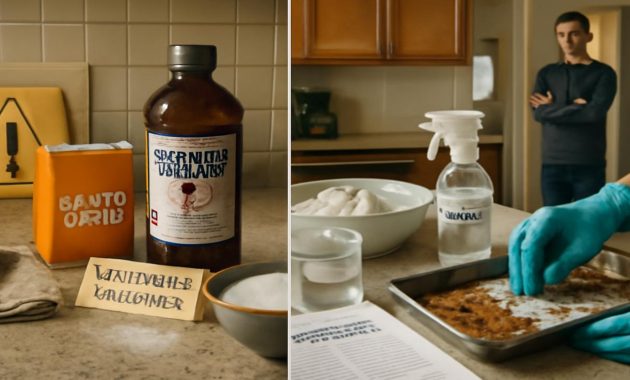
The first time I smelled it, I thought something in the house was burning. Not the sharp, panicked scent of smoke, but a faint tang—like a swimming pool had wandered into my kitchen and gotten lost among the dish towels and grocery lists. On the counter: a chipped ceramic bowl, a teaspoon of baking soda, a glug of hydrogen peroxide. My neighbor, sleeves rolled up, was stirring the thickening paste with the care of someone mixing a potion they weren’t entirely sure was legal. “It’s amazing,” she whispered, as if the grout might be listening. “This stuff cleans everything.”
The Kitchen Experiment That Got Out of Hand
It started, as so many domestic revolutions do, with a social media video. A pair of anonymous hands sprinkled baking soda into a sink, poured on hydrogen peroxide, and in a series of quick, satisfying cuts, years of grime seemed to vanish. The camera panned over gleaming tiles, whitened sneakers, a shining bathtub. The soundtrack was bright and triumphant. The caption read: “Natural. Safe. Life-changing.”
Within weeks, people everywhere were trying it. Kitchen counters foamed. Bathroom floors fizzed. Old cutting boards, stained with beet juice and turmeric, were suddenly reborn in white, glowing glory. In laundry rooms, carefully measured liquid detergents were being quietly nudged aside as old boxes of baking soda and brown bottles of hydrogen peroxide—usually reserved for the occasional scraped knee—began to earn a permanent place in the front row.
But as the trend spread, so did a different kind of chatter. Toxicologists and chemists started clearing their throats. Dermatologists weighed in. Dentists, who had been quietly watching their patients’ teeth come in a few shades whiter and a lot more sensitive, began to sound worried.
“There’s a reason we don’t hand out 3% hydrogen peroxide and a bag of baking soda and tell people to go wild,” one dental researcher noted dryly at a conference. “The line between helpful and harmful is not as wide as the internet would like you to think.”
Inside the Fizz: What’s Really Going On?
The power of this duo is not a myth. Hydrogen peroxide (H2O2) is a mild disinfectant; it breaks down into water and oxygen, and in the process, releases reactive oxygen species—tiny molecular wrecking balls that rip apart the membranes and DNA of bacteria, viruses, and fungi. Baking soda, or sodium bicarbonate (NaHCO3), is an alkaline powder that can gently scrub, deodorize, and alter pH.
When you mix them, something interesting happens. The baking soda helps stabilize the breakdown of hydrogen peroxide, slowing and directing the release of oxygen. Add a little friction from a toothbrush, sponge, or scrub brush, and you’ve built a low‑tech, high-energy cleaning system in your own hands. To your grout, it feels like a friendly hurricane.
New research has been especially enthusiastic about two things: antimicrobial power and stain removal. Studies have shown that hydrogen peroxide can kill a broad swath of microorganisms on surfaces, and when combined with the mild abrasiveness of baking soda, it becomes particularly good at lifting stains from porous materials—like tile grout, cutting boards, and some fabrics. In controlled conditions, it looks almost miraculous.
And that’s the catch: controlled conditions.
At home, “controlled” usually means, “I eyeballed it and hoped for the best.” And that, experts say, is where danger tends to creep in—quietly, invisibly, right under the comforting fizz.
The Invisible Line Between “Helpful” and “Too Much”
The danger of this combo isn’t usually the kind of danger that makes headlines. It doesn’t explode like a chemistry experiment gone wrong, and it doesn’t release clouds of deadly gas by itself. Instead, it’s more subtle, and in some ways, more unsettling—because it plays out over time.
Hydrogen peroxide, even at the low 3% sold in pharmacies, can irritate skin, eyes, and mucous membranes. Higher concentrations—sometimes bought online for “more powerful” cleaning—are much more corrosive. Baking soda, on its own, is fairly benign in small amounts: you bake with it, you deodorize your fridge, you sometimes sprinkle it on a carpet. But its alkalinity, especially when left on surfaces or skin for extended periods, can start to cause dryness, redness, or chemical burns.
Mix them, and you get something that feels safe because it foams like soap and smells a bit like cleanliness itself. But the mix doesn’t magically make either ingredient gentler. It simply makes them more efficient—and sometimes, that efficiency goes too far.
Consider whitening toothpaste. Many commercial formulas already combine stabilized peroxide with mild abrasives, carefully tested and regulated. Dentists know how easily this balance can go wrong. At home, though, DIY recipes have sprung up: “Just mix baking soda and hydrogen peroxide into a paste and brush every day!” In practice, that can mean scraping away at enamel, disrupting the protective biofilm of the mouth, and irritating gums. It looks whiter—at first. Later, people start noticing sensitivity to hot and cold, aching gums, and dark “cracks” where enamel has thinned.
“It’s like using sandpaper and bleach on your teeth,” one exasperated dentist told a patient. “Would you do that to something you loved?”
Where the Research Gets People Excited
Despite the warnings, scientists are not dismissing this duo. In fact, many are intrigued. When handled with respect, baking soda and hydrogen peroxide together really do seem to be a small, humble powerhouse.
Researchers studying sustainable cleaning methods have highlighted this pair as a promising alternative to harsher chemical blends. Their breakdown products—water, oxygen, and sodium salts—are far less worrisome than the residues left by many conventional disinfectants. For households trying to reduce synthetic fragrances, dyes, and complex chemical cocktails, this simple combo can feel like a revelation.
Some lab tests have found that the mixture can significantly reduce microbial counts on kitchen surfaces. Others show that it can help degrade certain organic compounds, from stains to biofilms, with surprising effectiveness. There are even early explorations into specialized formulations for hospitals, food prep facilities, and water-safe cleaning where residues are a concern.
But the operative word here is “formulations.” Carefully measured, pH-balanced, stabilized, and tested versions—not whatever lands in a cereal bowl on someone’s countertop because they were in a hurry and the kids were asking for snacks.
The Divide at Home: Miracle Paste or Menace?
This is where households begin to split. On one side, you have the evangelists: people who have conquered mold in their bathroom corners, revived beloved sneakers, and erased tea stains from mugs that looked permanently haunted. They speak of the mix in glowing terms and pass on their homemade ratios like family recipes.
On the other side, you have the skeptics: the ones who ended up with discolored grout, bleached towels, stinging hands, or a pet who licked the residue off the floor and needed an emergency vet visit. Their stories are less glamorous, but no less real.
Sometimes, the divide cuts right through the same home. One partner mixes a bubbly bowl of cleaning paste; the other hovers nearby, waving printed warnings from professional associations. The smell of peroxide hangs in the air along with an unspoken question: if this is so powerful, why are we doing this unsupervised in our pajamas?
Part of the emotional pull here is nostalgia. Baking soda and hydrogen peroxide feel familiar, almost quaint. They remind people of simpler times, of grandparents who swore by “old-fashioned” remedies. The fizz is reassuring; it feels alive. There’s a deep satisfaction in using something that appears humble yet works like magic, especially in an age when cleaning product labels read like chemistry textbooks.
But nostalgia doesn’t give you immunity from chemistry. A burn from an “old-fashioned” substance still hurts like any other.
What You Can Safely Do—And Where Experts Draw the Line
Experts aren’t telling people to banish these ingredients from their homes. Far from it. Used wisely, they can be part of a thoughtful, lower-impact cleaning routine. The key, they say, lies in moderation, protection, and a healthy respect for limits.
Think of the following as a practical snapshot—where science tentatively nods “okay, if you’re careful” and where it firmly shakes its head.
| Use | Experts Generally Say | Key Cautions |
|---|---|---|
| Cleaning tile grout or tubs | Occasional use is usually fine | Wear gloves, ventilate, rinse thoroughly; don’t leave paste sitting for hours. |
| Whitening sinks, cutting boards | Generally acceptable | Rinse extremely well, especially on food-contact surfaces. |
| Teeth whitening at home | Strongly discouraged | Risk of enamel damage, gum irritation, increased sensitivity. |
| Skin treatments (masks, spot “bleaching”) | Not recommended | Chemical burns, irritation, pigment changes are possible. |
| Laundry stain removal | Cautiously, in small test areas | May bleach colors, weaken fabrics; rinse well and avoid delicate materials. |
Across the board, professionals repeat a few mantras: never ingest the mixture, never use it in concentrated forms, don’t mix it with other chemicals like vinegar, ammonia, or bleach, and don’t treat it as a replacement for well-tested medical or dental products.
Yet even with these cautions, they understand the appeal. There is something undeniably empowering about standing at your sink with two common pantry items and feeling like you’re harnessing invisible forces. The trick, they suggest, is to keep that sense of power grounded in reality instead of wishful thinking.
The Strange Comfort of the Fizz
If you step back for a moment, there’s something almost poetic about how this household trend has unfolded. In a world overflowing with complexity, supply‑chain diagrams, and multi-syllabic labels, people are reaching for things they can name, spell, and buy for a few dollars at a corner store. Baking soda. Hydrogen peroxide. Simple. Understandable. Fizzing away under the kitchen light like a tiny science fair experiment you can actually control.
That fizz taps into something deeper than cleanliness. It’s the visible reassurance that “something is happening.” We watch the bubbles form and pop and feel, in a small, satisfying way, that problems are being solved. Stains are dissolving. Germs are dying. The house is being defended against entropy, one micro‑eruption of oxygen at a time.
But nature doesn’t recognize our need for reassurance. To the cells of your skin and gums, to the fibers of cotton towels and colored fabrics, to the invisible ecosystems of your home, this duo is not a comforting ritual. It’s chemistry—unmoved by intentions, unpersuaded by online testimonials.
This is where the real story lies: not in the question of whether baking soda and hydrogen peroxide are good or bad, but in how willing we are to live in the gray space between miracle cures and blanket bans.
Learning to Live with Powerful Little Potions
So where does that leave us—standing in the kitchen, spoon in hand, at the edge of a bowl of fizzing possibility?
Maybe it leaves us somewhere more interesting than “always” or “never.” Somewhere slower, more observant. A place where we can appreciate the genuine strengths of this mixture without turning it into a homegrown marvel that slices, dices, whitens, disinfects, and saves the planet in one go.
It might look like this:
- You pull on gloves before scrubbing, not because you’re paranoid, but because you respect your skin.
- You use the mixture in small, targeted ways—on stubborn grout lines, on a stained mug—not as an all-purpose spray for every surface in your home.
- You resist the urge to use it on your body: not on your teeth, not on your face, not on that stubborn patch of skin you wish were lighter or smoother.
- You keep it away from children and pets, not because it’s a cartoon villain, but because curiosity and chemistry aren’t always a good mix.
- You remember that “natural” doesn’t mean “gentle,” and “powerful” doesn’t always mean “better.”
In a way, the baking soda and hydrogen peroxide craze is a tiny mirror of how we navigate the modern world. We’re drawn to simple promises and visible results, to the satisfying drama of a chemical reaction we can witness with our own eyes. But the real measure of wisdom is not in how many bubbles we can produce—it’s in how many questions we’re willing to ask before we start stirring.
Yes, this duo is powerful. Yes, the new research is fascinating. Yes, the range of uses can feel almost shocking. And yes, experts are right to sound alarms when that power drifts from tile grout to tooth enamel, from stained sinks to bare skin.
Standing in that space between possibility and precaution—bowl in one hand, common sense in the other—might just be the most important DIY skill we learn.
FAQ
Is it safe to brush my teeth with baking soda and hydrogen peroxide?
Most dental professionals advise against it, especially as a daily habit. The mix can erode enamel and irritate gums over time. If you’re interested in whitening, it’s safer to use products specifically formulated and tested for teeth, or to consult a dentist.
Can I use the mixture on my skin for lightening or acne?
Dermatologists generally do not recommend this. Hydrogen peroxide can disrupt skin healing and cause irritation or burns, while baking soda can upset your skin’s natural pH and barrier. Over time, this can worsen skin issues rather than help them.
Is it okay to clean my kitchen with baking soda and hydrogen peroxide?
Used occasionally and carefully, yes. It can be effective on cutting boards, sinks, and grout. Wear gloves, keep the area ventilated, avoid mixing with other chemicals, and rinse surfaces thoroughly—especially anything that comes into contact with food.
Can I mix baking soda and hydrogen peroxide with bleach or vinegar?
No. Mixing household chemicals can create dangerous reactions. Hydrogen peroxide and bleach together can release oxygen so rapidly that pressure builds up and containers may rupture, and other combinations can form irritating or toxic gases. Use each product separately and rinse in between if needed.
Is the mixture safe for pets?
Pets should not ingest or walk through it. If you use it on floors or pet-related surfaces, rinse very well and let everything dry completely before allowing animals back into the area. If a pet licks or drinks the mixture, contact a veterinarian.
Does this combo replace commercial disinfectants?
Not entirely. While it can reduce microbes on surfaces, its effectiveness depends heavily on concentration, contact time, and how it’s used. Commercial disinfectants are tested under strict conditions; DIY mixes are not. Think of this duo as a useful tool, not a guaranteed replacement for every situation where disinfection is important.
How should I store baking soda and hydrogen peroxide at home?
Keep hydrogen peroxide in its original, opaque bottle, tightly closed, away from heat and direct light. Store baking soda in a dry, sealed container. Do not pre-mix large batches of the paste; make only what you need, use it promptly, and discard leftovers rather than saving them.