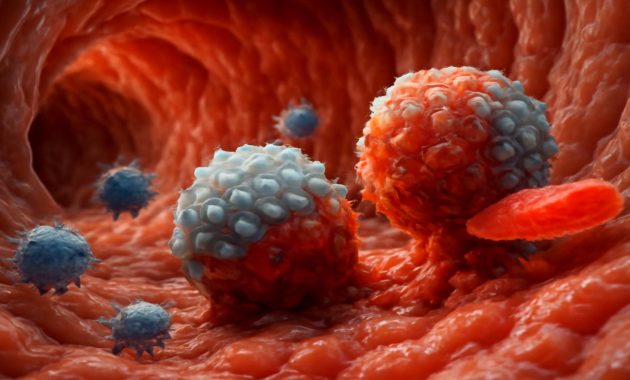
The first time a pathologist sliced a thin curl of colorectal tumor and laid it carefully on a glass slide, they saw something that didn’t quite make sense. Under the microscope’s cold white light, immune cells were there—little sentinels of the body’s defense system clustered at the edges of the tumor—and yet, the cancer had grown anyway. It was as if the immune army had marched right up to the battlefield… and then simply stopped. For years, this was the unsettling mystery at the heart of colorectal cancer: why does a disease sitting in one of the body’s most immune-rich environments so often escape the very system designed to destroy it?
The Tumor in a Crowded Neighborhood
To understand what makes colorectal cancer so strange, you have to picture where it lives. The colon is not a sterile hallway. It’s a bustling marketplace, a crowded street full of invisible strangers: trillions of bacteria, swirling chemicals from food, immune cells patrolling like beat cops on a busy corner.
Every meal you eat becomes part of this daily drama. Fiber, fat, plant chemicals, and food additives are broken down into a chemical soup that constantly washes over the cells lining the colon. Here, the immune system can’t afford to be jumpy. If it attacked everything that looked even slightly suspicious, you’d be in constant, painful inflammation. So over millions of years, our bodies have learned to tread carefully in this space—hyper-alert, but also weirdly tolerant.
Colorectal cancer grows up in this tense neighborhood of watchfulness and restraint. And that turns out to be a key part of the mystery. This cancer doesn’t just appear in a random tissue—it evolves in a landscape where the immune system has been trained to be polite, almost gentlemanly, even when perhaps it shouldn’t be.
The Immunotherapy Puzzle
In the early 2010s, a new kind of cancer treatment swept through the headlines: immunotherapy. Instead of poisoning tumors or cutting them out, these drugs coaxed the patient’s own immune system to go on the attack. It was a revolution for some cancers. Patients with advanced melanoma and certain types of lung cancer who had run out of options suddenly watched their tumors melt away. Words like cure, rarely spoken in oncology wards, quietly crept back into the conversation.
But when scientists tried the same approach in most colorectal cancer patients, something disconcerting happened: not much. For a small fraction of people whose tumors carried a particular genetic signature called “microsatellite instability-high” (MSI-H), immunotherapy worked astonishingly well. For the majority—those with “microsatellite stable” (MSS) tumors—the drugs did almost nothing. It was like turning a key in a lock that wasn’t there.
On paper, this made no sense. Many colorectal tumors have mutations galore—molecular quirks that should, in theory, make them look foreign enough to the immune system to be flagged and destroyed. And yet they weren’t. The immune system seemed to recognize them, even send in a few troops, but never fully declare war. What was happening between these cells and their would-be attackers?
The Strange Quiet at the Tumor’s Edge
When researchers began mapping immune cells inside colorectal tumors, they found a striking pattern. Immune cells crowded at the outskirts, as if a crowd leaned up against a fence, watching something just beyond their reach. Deeper inside the tumor, where you might expect a chaotic battle, there was… silence.
It wasn’t that the immune system didn’t see the tumor. It saw it and still backed off. That single unsettling observation drove scientists to look harder—not just at the tumor cells themselves, but at the environment they were building around them: the fog of molecules, the remodeling of blood vessels, the shape of the microbiome, the whispered instructions exchanged between immune cells and cancer cells like coded messages.
Cracking the Code of Immune Evasion
Slowly, and then all at once, the pieces began to fall into place. Colorectal cancer, it turned out, doesn’t rely on a single trick to disarm the immune system. It builds an entire ecosystem designed to bend the rules.
The “Cold” and “Hot” Tumor Divide
Immunologists began using a new language to describe what they were seeing: “hot” tumors and “cold” tumors. Hot tumors are inflamed, full of active T cells—exactly the kind that immunotherapy can rally. Many colorectal cancers, particularly MSS ones, are “cold”: low in T cells, low in inflammation, quiet as a library.
Imagine trying to stage a protest with no one in the town square. Immunotherapy drugs work by lifting molecular “brakes” from immune cells that are already present and riled up. But if those cells never arrive in force, releasing the brakes doesn’t help. The crowd never gathers.
A Table of Clues
As researchers dug deeper, they discovered a handful of powerful strategies colorectal tumors use to keep themselves under the radar or out of reach.
| Colorectal Cancer Strategy | What It Does to the Immune System |
|---|---|
| Creates a “cold” tumor core | Blocks T cells from entering the tumor, leaving them stuck at the edges. |
| Recruits suppressor cells (Tregs, MDSCs) | Sends in immune cells that actually shut down other immune responses. |
| Overexpresses immune “off switches” | Uses checkpoints like PD-L1 and others to tell T cells to stand down. |
| Hijacks the microbiome | Cultivates bacteria that fuel chronic, muting inflammation and tumor growth. |
| Remodels blood vessels and tissue | Builds a dense, twisted landscape that’s hard for immune cells to navigate. |
This combination of tactics means colorectal cancer isn’t just hiding a single identity badge—it’s actively negotiating a cease-fire, restructuring the terrain, and jamming the radio signals the immune system uses to coordinate an attack.
The Gut Microbiome: An Unlikely Accomplice
Of all the accomplices in this story, the gut microbiome may be the most surprising. The colon is the crowded city of bacteria, fungi, and viruses that scientists once considered mere passengers. Now we know they’re more like permanent residents, shaping everything from digestion to mood—and, crucially, how the immune system behaves.
Some bacterial species seem to nudge immune cells into a constant low-level simmer of inflammation. On the surface, that sounds like it should help fight cancer. But chronic, smoldering inflammation can actually feed tumor growth, like embers quietly heating a pot until it boils over. Other microbes can blunt immune reactivity, encouraging tolerance in a place that’s already trying hard not to overreact to every foreign molecule from food.
In certain colorectal tumors, researchers have found distinct microbial signatures—clusters of bacteria that don’t just live alongside the tumor but may collaborate with it. Some microbes can produce chemicals that damage DNA, encouraging the kinds of mutations tumors feast on. Others secrete molecules that whisper to local immune cells, “Stand down, nothing to see here.”
And perhaps most intriguingly, gut bacteria can influence how well immunotherapy works. In some early studies, patients with specific gut microbial patterns were more likely to respond to checkpoint inhibitors. Change the microbes, and you may change the conversation between tumor and immune system.
Why This Cancer Breaks the Rules
So what, exactly, has been “solved” in this mystery? Not in the neat, single-answer way a detective closes a case, but in the messier, biological sense: scientists now have a clear, layered explanation for why most colorectal cancers so stubbornly resist immune attack.
A Tumor Shaped by Its Environment
Unlike tumors that arise in relatively quiet tissues, colorectal cancer is born in a place already steeped in immune caution and microbial negotiation. From its first rogue divisions, it is bathed in chemical messages that say, “Keep peace at all costs.” The cancer learns these rules—and bends them.
It gradually rewires its surroundings: recruiting regulatory T cells and myeloid-derived suppressor cells that shut down attack lines; turning on molecules that function as “do not kill” signals to any T cell that dares to approach; remodeling the tissue so that immune cells struggle to penetrate its core. It is not invisible. It is protected.
Meanwhile, the gut microbiome adds a moving layer of influence. Some microbes stoke a kind of inflammation that paradoxically exhausts immune cells instead of empowering them. Others help maintain a façade of uneasy harmony, in which the immune system senses danger but never quite tips into decisive action.
All of this makes colorectal cancer an outlier in the age of immunotherapy. It breaks the apparent rule that more mutations equal better immune recognition. Instead, its rules are written in the language of place, community, and ecology.
The MSI-H Exception
That’s why the MSI-H subset of colorectal cancers is so striking. These tumors are riddled with mutations from a broken DNA repair system, and they behave differently. They generate so many abnormal proteins—so many flags of foreignness—that they can pierce through the “be polite” culture of the colon. Immune cells are drawn in. The tumors become hotter. When given checkpoint inhibitors, many of these patients see powerful responses, proof that when the immune system is allowed to fully wake up, it can still do its job.
In a sense, MSI-H tumors obey the immune rulebook that other cancers follow. MSS tumors, which make up the majority, are the ones that break it—hiding behind a more elaborate, environment-driven defense.
Turning Knowledge into New Weapons
Knowing why colorectal cancer slips past immune defenses is only half the story. The other half—and the one that matters most to patients sitting in quiet exam rooms—is what we do with that understanding.
From Cold to Hot
One of the biggest challenges now is figuring out how to turn “cold” colorectal tumors into “hot” ones that immunotherapy can recognize and amplify. Researchers are experimenting with combinations that sound almost like recipes: a dash of radiation to stir up inflammation, a targeted therapy to strip the tumor of suppressive molecules, a checkpoint inhibitor to free T cells, maybe even a microbiome tweak to shift the immune tone of the gut.
Early clinical trials are testing approaches like:
- Pairing chemotherapy or radiation with immunotherapy to create controlled tissue damage that alerts T cells.
- Targeting specific signaling pathways inside tumor cells that create a hostile landscape for immune infiltration.
- Using vaccines made from a patient’s own tumor mutations to give the immune system a sharper “wanted” poster.
- Experimentally reshaping the microbiome with diet, probiotics, or fecal microbiota transplants to make the gut more conducive to immune activation.
None of these alone is likely to be a magic bullet. But together, they sketch a future in which colorectal cancer treatment isn’t just about blasting the tumor—it’s about rewriting the rules of its entire neighborhood.
A New Way of Seeing the Disease
This shift—from seeing colorectal cancer as a clump of misbehaving cells to understanding it as an ecosystem—changes how scientists design trials and treatments. It encourages them to measure not only tumor shrinkage, but also how many T cells manage to slip past the tumor’s borders, whether the mix of gut microbes changes over time, and which suppressive signals rise or fall during therapy.
It also reframes prevention. Diet, exercise, and lifestyle have long been linked to colorectal cancer risk, but the microbiome and immune context give those choices new biological detail. Every plate of food feeds not just you, but also the microbes that may subtly tune your risk, your inflammation, and the readiness of your immune system to act—or not.
Living with a Solved Mystery
Standing at a lab bench or sitting in a clinic, the story of colorectal cancer today feels less like a locked-door mystery and more like an unfolding ecosystem map. The big revelation is not a single hidden culprit, but a network of influences: the immune system’s cautious rules in the gut, the tumor’s clever rewiring of its surroundings, the microbiome’s quiet, constant commentary.
For patients, this can sound both hopeful and frustrating. Hopeful, because mysteries that once left doctors shrugging now have names, mechanisms, and, increasingly, strategies to counter them. Frustrating, because biology rarely offers the clean, decisive breakthroughs we crave. Instead, it gives us mosaics of partial solutions, incremental gains, and combinations that work for some and fail others.
Yet if you zoom out, there is something quietly radical in what scientists have uncovered. They have shown that even a cancer that seems to defy immune rules is still, at its core, part of a conversation with the body. The rules aren’t broken so much as bent, reinterpreted, rewritten by context. And anything that can be rewritten can, at least in theory, be revised again.
Somewhere right now, another thin slice of colorectal tumor is being placed on a glass slide. Another researcher is staining it, peering through the microscope, not just counting cancer cells, but tracing the arcs of T cells, the subtle patterns of blood vessels, the signatures of microbes encoded in nearby tissue. They’re no longer asking why doesn’t the immune system see this? Instead, they’re asking a more precise question: Where, exactly, in this landscape did the conversation break down—and how can we start it again?
Frequently Asked Questions
Why does colorectal cancer respond poorly to immunotherapy compared to some other cancers?
Most colorectal cancers create a “cold” immune environment with few active T cells inside the tumor. They also recruit suppressive immune cells and express molecules that act as off-switches for any T cells that arrive. Because checkpoint inhibitors mainly work by unleashing already-engaged T cells, these cancers often don’t respond well unless they are the MSI-H subtype, which naturally attracts more immune attention.
What is the difference between MSI-H and MSS colorectal cancer?
MSI-H (microsatellite instability-high) tumors have defects in DNA repair that lead to many mutations and abnormal proteins, making them more visible to the immune system. MSS (microsatellite stable) tumors have fewer such changes and are better at staying under immune radar. Immunotherapy is far more effective in many MSI-H cases than in MSS ones.
How does the gut microbiome influence colorectal cancer and immunity?
The gut microbiome shapes how immune cells behave in the colon. Certain bacteria can promote chronic, low-level inflammation that fuels tumor growth, while others can dampen immune responses and foster tolerance. Microbial communities can also influence how well immunotherapies work by affecting immune readiness and signaling.
Can diet really change colorectal cancer risk through the immune system?
Diet alters the composition and behavior of gut microbes, which in turn affect inflammation, DNA damage, and immune tone in the colon. High-fiber, plant-rich diets tend to support microbial communities that generate beneficial compounds, while certain processed foods and high red-meat intake are associated with patterns that may increase risk. These effects are indirect but meaningful over time.
What new treatments are being explored based on these immune insights?
Researchers are testing combinations of therapies that aim to “heat up” cold tumors: pairing immunotherapy with chemotherapy, radiation, targeted drugs, vaccines, and microbiome interventions. The goal is to increase T-cell infiltration, reduce suppressive signals, and reshape the tumor ecosystem so that the immune system can mount and sustain a real attack.