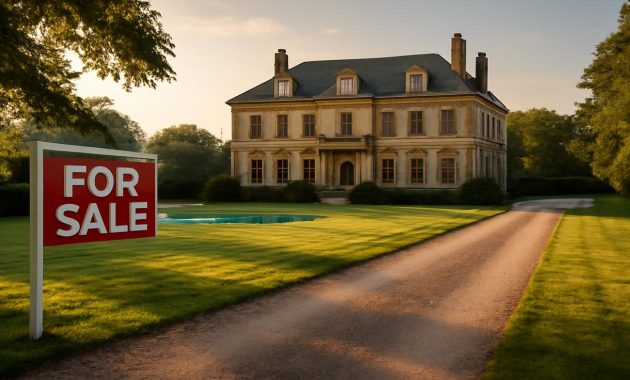
The drive up to the estate feels like entering a story you were never quite meant to read. The lane is narrow and shaded, the kind of country road where sunlight falls in moving patches and the air smells faintly of wet leaves and old stone. At the end of it—after a final curve that hides everything until the last second—the house appears: pale, sprawling, improbably calm for a place currently at the center of a simmering scandale immobilier.
It looks, if we’re honest, like the kind of countryside dream people paste onto mood boards: eight bedrooms, a long rectangular pool glimmering behind clipped yew hedges, and lawns that seem to run out into the folds of distant hills. It is the sort of property the word “estate” was invented to describe—except this one comes with a royal family’s shadow stitched into its rafters, and a tangle of questions about who paid for what, and why.
An Estate That Was Never Meant to Feel Ordinary
From the gravel underfoot to the old oak door, everything about the house whispers careful curation. The stone façade has that honeyed color that comes only with age and weather—centuries of rain polishing it, summers bleaching it, winters etching hairline cracks into its surface. Ivy climbs the sunniest wall, stopping just short of the second-floor windows, as if someone instructs it with quiet, loving discipline. A royal family doesn’t do accidental charm; it is all as calculated as a public smile on a palace balcony.
Step inside, and the air cools. There is a faint trace of beeswax and dried lavender, mixed with something metallic and old, like antique keys. The entrance hall is wide, each footstep sounding taller than you are. To the left, a formal sitting room where generations of royal cousins, discreet friends, and tightly controlled lovers have undoubtedly sat with tea, brandy, or gossip. To the right, a more modest library, the kind that tries to look informal while still performing a certain taste—spines in deliberate shades, armchairs big enough to swallow you, a ladder that invites you to touch books you never will.
And yet, for all its beauty, nothing about it feels free anymore. Every cornice, every molding carries a question: who really owns this? Who has the right to sell it? And what does it mean when a royal retreat—built on old privilege and newer money—suddenly appears on the open market like any other luxury listing?
The Uncomfortable Echo in the Hallway
The current stir began, as these things often do, with a single, glossy photo buried among countless property listings. Just another country house with “discreet history,” the description claimed. But there are some places that cannot hide, no matter how euphemistic the brochure. Locals recognized the tree line; a certain old stone well in the corner of one image gave the rest away. Within hours, whispers turned to headlines: a royal family’s country estate—long rumored to be partly financed through a labyrinth of shell companies and friendly oligarchs—was on the market.
The term scandale immobilier started appearing beneath photographs of the pool and the sweeping staircase, pairing the seductive glamour of the property with the grit of alleged financial improprieties. There were suggestions of undervalued land purchases, sweetheart arrangements with developers, and renovation costs that somehow slid off official accounts like rain off slate roofs. The story slipped past the decorative plaster and burrowed into the foundations, asking whether the walls themselves had been mortgaged against the public’s trust.
That is the tension you feel as you walk deeper inside: the house is beautiful, but the silence carries opinion. The dining room, with its long table and polished silver, now looks like a stage where conversations about “discretion” and “offshore arrangements” might have floated between the candles. The portraits of distant royals watching from the walls seem less like ancestors and more like witnesses.
Eight Bedrooms, A Pool, And A Price Tag Upshadowed By Questions
The broker’s language is hushed yet precise: eight generous bedrooms, each with en-suite bathrooms; a master suite overlooking the lawns and pool; staff quarters discreetly tucked away; and landscaped grounds designed for both privacy and spectacle. It is the sort of checklist that turns wealthy city dwellers into weekend country fantasists.
Upstairs, sunlight filters through thin curtains in the main bedroom, pooling warmly over a four-poster bed. You can almost hear the clink of breakfast china, the rustle of newspapers, the half-whispered updates from aides about what can and cannot be said in public. In another room, a floral wallpaper bears the subtle fading of old summers: windows left open, light pouring in, the drone of bees from the orchard. Imagine the conversations that unfolded here—about marriages, mistakes, rearranged trips to avoid scandals that now seem tame compared to this one.
The pool, down a short gravel path, is serene in that curated way: turquoise tile, limestone terrace, a handful of white loungers lined up like punctuation marks. Around it, the hum of the countryside: insects, distant tractors, the quiet thrum of life that does not care who signs the deed. If you stay still long enough, you notice how the surface of the water mirrors the clouds, holding a sky that has watched this family through wars, abdications, divorces, and now, financial probes.
It is all deeply, dangerously appealing. This is the paradox of estates like this: we condemn the privilege, yet we’re drawn to the vision of life they represent. To buy a house like this is not just to acquire rooms and land; it is to purchase entry into a story. And this story, right now, has a very public twist.
Whispers in the Grass: Locals, Legacy, And Unease
In the nearest village, the estate is not an abstraction. It is the distant shape on the horizon, the employer of gardeners and cleaners, the host of quiet hunts and charity teas. You can hear its name in the murmur of the pub in the early evening: spoken with a mixture of nostalgia, irritation, and, lately, a kind of bruised amusement.
One farmer remembers when the estate’s fences first went up around land his father’s cattle used to cross freely. Another recalls her grandmother’s stories of serving in the house’s kitchen, carrying heavy trays up back staircases while carriages arrived at the front. There is a sense that the place has always been slightly out of reach—yet undeniably woven into the local soil.
The scandale immobilier hasn’t exactly surprised them. Rumors drift more easily in the countryside than city people imagine; sound travels in open fields. People talk about the sudden renovation of the pool house a few years ago, the convoy of builders who arrived without explanation, the whispers of “foreign money” that were laughed off at the time. Now, with the estate publicly for sale, those murmurs have hardened into questions.
At the same time, there is something like grief. Whatever your opinion of the royal family, having their estate here meant the village mattered to someone powerful. There were Christmas drives for local charities, summer fêtes attended by lesser-known cousins, occasional appearances that made headlines and boosted tourist numbers. Selling the house feels, to some, like being quietly let go.
The Allure and Arithmetic of a Royal Retreat
On paper, the estate can be reduced to dimensions, fixtures, and approximate values. That is how the scandal is being investigated: in ledgers and contracts, in the blunt columns of numbers that do not care about romance. Yet it is almost impossible to understand the property’s hold on people—buyers, critics, neighbors—without acknowledging the emotional calculus at work.
Consider the features as an agent might present them to a prospective buyer:
| Feature | Details |
|---|---|
| Bedrooms | 8, all en-suite, with countryside or garden views |
| Pool | Heated outdoor pool with stone terrace and pool house |
| Grounds | Extensive gardens, orchard, and woodland walks |
| Outbuildings | Staff quarters, stables, and converted barns |
| Heritage | Former royal family retreat with long-documented lineage |
It all looks so reasonable, lined up like that. It’s easy to forget, reading tidy descriptions, that behind each row lies a separate, messy story: the gardener who spent half his life coaxing the rose garden into perfection; the groom who slept in the stables during a snowstorm to keep the horses calm; the royal niece who used the pool at dawn, when the estate was still half asleep and the scandal had not yet found its way to the gate.
And then there is the arithmetic of image. A royal association inflates value in ways property statistics can’t fully capture. Sellers count on that sheen; buyers justify higher offers with phrases like “provenance” and “legacy.” The moment that legacy becomes tangled with allegations of misused funds or questionable land deals, everyone has to recalculate—how much is magic worth when the spell is cracked?
Rooms That Remember More Than They Reveal
Walk through the kitchen in the late afternoon and you catch the house at its most honest. The big range cooker still smells faintly of roasted meats and baked fruit. Wide windows look out onto a walled garden where herbs grow in neat rows; beyond them, the green unrolls toward the horizon. Here, less ceremony, more life. You can imagine the clatter of pots during a family weekend, the measured pace of staff preparing formal dinners, the half-muttered news of “trouble in the papers” exchanged over chopping boards.
The back staircase—narrower, steeper, less polished than the grand one—holds its own archive of footsteps. Staff moving silently, teenagers escaping receptions, guests carrying secrets up to their rooms. It is the route you take if you want to feel how the house functions beneath the display. If walls absorb emotion, these ones have taken in centuries’ worth of worry, affection, resentment, and compromise.
There is a small sitting room at the far end of the first floor, away from the main bedrooms. The furniture is simpler; the view, arguably better. You can see the line of the drive, the sweep of trees that shelter it, and the shimmer of the pool beyond. This, perhaps, is where someone once sat with a folder of documents, signing off on decisions that would later be pored over by investigative journalists: transfers, restorations, whispered promises that “no one will ever ask where this came from.”
Scandale Immobilier: When Stone, Status, And Scrutiny Collide
The phrase has an almost cinematic ring to it: scandale immobilier. But for the people now painstakingly tracking money trails, and for a royal family that must decide what it can bear to disclose, it is not a script—it is a structural test.
At its heart, this controversy is about more than one estate. It touches on the old, uneasy question of what royalty owes those it represents. Is a country house like this a private luxury, funded entirely by personal wealth? Or does it blur into the category of “national heritage,” especially when its image has been leveraged in soft-power campaigns, charity galas, and public narratives of stability and continuity?
Investigators are reportedly examining whether public funds, preferential treatment, or closely connected donors played a role in shoring up the estate’s finances. Renovations that seemed innocuous now look significant: new roofs, improved pool heating systems, refitted guest suites. These are no longer just aesthetic choices; they are clues.
Meanwhile, the listing still stands—polished photographs, careful descriptions, the price available only “on application,” as if the number itself might give away too much. Somewhere between the asking price and the auction of public patience lies the true cost of keeping up appearances.
Buying A Story, Inheriting A Storm
Who will buy this place? It is a question that hangs over the estate like mist. There will be interest—of course there will. Some buyers will see only the opportunity: an address that whispers of royalty, land they can reshape, a pool for sunset gatherings in late July. They will imagine children racing over the lawns, guests trailing laughter along the terrace, new chapters written over the old.
But purchasing this house now also means inheriting its narrative at a particularly raw moment. The scandal won’t vanish the day the ink dries. The village will remember. The newspapers will revisit. The name of the estate, once shorthand for privilege and rural grace, will remain a footnote in discussions about ethics and entitlement.
Perhaps the next owners will choose transparency as their own kind of luxury: opening the gardens occasionally to the public, restoring the walled orchard with local volunteers, allowing the house to breathe a little more freely. Or they may close the gates more tightly than ever, adding new cameras to the old stone, extra codes to the front door.
For now, the estate sits in a strange suspension. The royal family steps back, lawyers lean forward, and the fields roll on, innocent of documentation. The pool gathers leaves overnight and gives them back in the morning. Sunlight still lands softly on the stairs, unaware that the future of the house it warms is being decided in rooms far away, where the language is all about liability and precedent, not birdsong and light.
What Remains When The Motorcade Is Gone
Eventually, the royal cars will stop coming. The last staff members still loyal to the family’s country rituals will hand in their keys. Someone will stand in the entrance hall, perhaps an agent or a new owner, and listen to the echo of their own footsteps where once there were so many.
And yet, the land will keep its quiet counsel. Roe deer will still pass through the outer edges of the property before dawn. Owls will continue to work the night air above the orchard. The old trees will keep their rings of years, indifferent to who pays the gardener who tends them.
The scandale immobilier will, one day, move from headline to history, another entry in the long catalog of how power has tried—and failed—to fully separate its comforts from its responsibilities. What will endure is more elusive: the way morning fog collects in hollows on the lawn; the way the house glows amber in the last light of day; the way a certain hush settles over the pool at dusk, when the horizon and the water and the sky all seem briefly to agree.
Maybe that is the real tension at the heart of this story. A royal estate is both symbol and shelter, both asset and sanctuary. When it comes up for sale, the spreadsheets and the scandals take center stage. But underneath them, something older and quieter still holds: stone that has outlived its patrons, trees that have watched titles change hands, land that does not recognize crowns or courts—only the seasons turning, and the simple fact of being here, long after the last motorcade disappears around the bend.
FAQ
Why is this royal family country estate being sold?
The estate is reportedly being sold amid increasing scrutiny over how it was financed and maintained. Allegations of irregular property deals and questionable renovation funding have made continued ownership politically and reputationally costly for the royal family.
What does “scandale immobilier” mean in this context?
“Scandale immobilier” refers to a real estate scandal—in this case, concerns about whether public influence, hidden donors, or complex financial structures were used to support a private royal retreat.
Is the estate considered public heritage or private property?
Legally, it is treated as private property. Symbolically, however, its royal association blurs the lines, raising public questions about transparency, funding, and accountability that would not arise with an ordinary country house.
How many bedrooms and amenities does the estate have?
The estate has eight en-suite bedrooms, extensive landscaped grounds, a heated outdoor pool with a pool house, staff quarters, stables, and several outbuildings, along with established gardens and woodland walks.
Will the new owner face reputational risks?
Yes, anyone purchasing the property now inherits not only the house and land but also its public narrative. While the scandal centers on the previous ownership, media and local memory are likely to keep the story alive for some time.