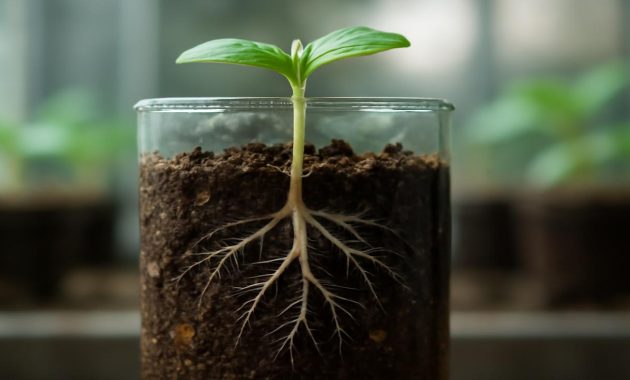
The first time I noticed it, I was kneeling in the dirt behind my apartment, hands cold from an early spring that hadn’t quite decided to be warm. I’d tucked a packet of wildflower seeds into the soil two weeks earlier and, like an impatient child, had been checking every morning for that magical “before and after” moment. One day: blank brown soil. The next: life. Except that when the first green finally appeared, it wasn’t the triumphant spray of petals or even the familiar shape of leaves. It was a tiny, wobbling loop of stem forcing its way up, dragging a split seed coat like a helmet. I almost missed it, that fragile hinge between invisibility and obvious growth. But there it was, trembling in the wind. And standing over that shy arc of green, I realized: everything that plant would one day become—its flowers, its seeds, its ability to survive droughts or storms—was being scripted in this overlooked stage.
When Plants Are Busy “Becoming” Instead of “Being”
We tend to measure plants by what we can plainly see: the trees towering above rooftops, the vegetables swelling on their vines, the meadows lit up with color. These are the billboard moments of a plant’s life, the mature stages that look good in photos and seed catalogs.
But long before a plant becomes photogenic, it is busy becoming something far more important: resilient.
This happens in a narrow window that gardeners often rush through and scientists sometimes reduce to a diagram: the early establishment stage. It starts the moment a seed absorbs water and swells awake, and it ends when that small plant is self-sufficient enough to weather a few bad days without collapsing. It’s a brief chapter, but it’s packed with quiet decisions—about roots and leaves, energy and risk—that will define how well that plant endures heatwaves, pests, floods, and long, thirsty summers.
Walk through a forest after a storm and look closely at the ground. Among the fallen branches and soggy leaves are thousands of tiny seedlings, some standing, some snapped, some yellowed and listing sideways. Statistically, most of them won’t make it. Their survival odds are decided less by what tree they might one day become and more by what happened during these delicate opening weeks.
In human time, it’s like the difference between decorating a house and pouring its foundation. The foundation is messy, invisible, and not much to look at. But everything else is sitting on it, whether we notice or not.
The Underground Drama You Never See
If you could press your face against the soil the way you might press it against an aquarium glass, the early growth of a seedling would rival any nature documentary. Tiny roots push forward, not randomly, but as if sensing an invisible map of moisture, air, and nutrients. The young plant is spending almost all its early energy underground, building what amounts to a life-support system.
In these first days and weeks, roots are not just growing—they’re negotiating. They are feeling their way between soil particles, avoiding compacted zones, and reaching toward microscopic pockets of water. They form partnerships with fungi, those thread-like mycorrhizae that extend the reach of roots in exchange for a steady sugar diet. They learn the boundaries of poor soil and rich soil, of wet patches that might suffocate them and dry patches that might shrivel them.
Meanwhile, aboveground, the seedling is almost comically modest: a couple of baby leaves, pale and soft, just enough to begin the work of photosynthesis. It looks vulnerable because it is. A harsh sun, a peck from a bird, an overeager slug—any of these can erase weeks of hidden effort. But if the plant has invested well below the surface, it stands a better chance of bouncing back.
This is where resilience is born. Not in the dramatic moment of surviving a drought, but in the quiet design decisions the plant makes long before: should it invest more in deep taproots or spread out shallow feeders? Should it build thick, small leaves that lose less water, or broad, thin ones that capture more light but dry out faster? Every choice uses up the limited energy packed in that original seed.
Why Early Stress Echoes for a Lifetime
Plants carry memories, but not in the way we do. They don’t remember last summer’s heatwave as an event with a date and time. Instead, they remember in tissues, in chemistry, in the shape of their growth. Early stress—too little water, too much crowding, sudden cold—can leave signatures that last for years.
Researchers have watched what happens when seedlings are pushed a bit outside their comfort zones. A young plant exposed to short bouts of mild drought, for example, tends to become thriftier with water later in life: it develops deeper roots, thicker leaf cuticles, more efficient stomata (the tiny pores that breathe in carbon dioxide and breathe out water vapor). The plant doesn’t know the future; it’s betting that “what happened before might happen again.”
On the other hand, stress that’s too intense or too early can permanently stunt a plant. A seedling repeatedly flooded before its roots can breathe, or scorched by heat before it has enough leaf area to recover, may survive in name only—alive but feeble, easy prey for disease and insects.
The overlooked establishment stage is when these “memories” and bets are laid down. It’s when a plant is calibrating its survival strategy: hoard resources or grow fast, dig deep or spread wide, invest in defenses now or gamble on rapid expansion. All of this happens while we’re still peering at the soil, wondering, “Is anything happening yet?”
The Hidden Mathematics of Survival
If you scatter a handful of seeds in a meadow, you’re making a quiet wager. Some will never germinate. Some will attempt to grow, then fail. Others will emerge, struggle, and die in their first month. Only a few will become the sturdy plants you remember later, the ones that persist through late frosts and dim winters.
To understand how important early establishment is, think in numbers rather than individuals. Ecologists often talk about recruitment—the process by which new individuals successfully join a population and stick around. Most plant populations rely on this steady trickle of successful recruits to replace those that die each year. When recruitment fails—not at flowering, not at seed production, but at this earliest stage—entire plant communities begin to thin and shift.
In a grassland, if seedlings of deep-rooted native grasses fail to establish but shallow-rooted weeds succeed, the landscape subtly rewrites itself. It becomes less drought-resilient, more prone to erosion, more vulnerable to abrupt changes. Change the story at the seedling stage, and you eventually change the character of the whole ecosystem.
We often frame resilience as a trait: this species is resilient; that one is fragile. But resilience is also a math problem written in soil and seasons. It’s the sum of many small successes in early establishment, repeated year after year across a landscape.
| Stage of Plant Life | What We Notice | What Really Determines Resilience |
|---|---|---|
| Seed | Size, color, storage life | Stored energy, protective coat, genetic diversity |
| Early Seedling (Establishment) | Tiny cotyledons, fragile stem—easy to overlook | Root depth and spread, partnerships with fungi, response to first stresses |
| Mature Plant | Flowers, fruits, size, shade | Earlier root architecture, early tissue quality, “memory” of youth conditions |
| Old Age | Decline, hollows, broken limbs | Cumulative effect of decades of stress, starting from establishment |
The Seedling Lens: Climate Change in Slow Motion
Now picture that same overlooked stage on a planetary scale.
As the climate shifts, plants are quietly trying to renegotiate their childhood. Springs are arriving earlier—or sometimes not at all. Rains slosh down in sudden, violent storms instead of soaking in slowly. Heat comes in record-breaking bursts that feel more like walls than waves.
For a mature tree, a single heatwave might mean some scorched leaves and a lean year of seed production. For a seedling that just broke through the soil yesterday, that same heatwave can be a lifetime-ending event. And when that happens not just to one seedling but to millions across a region, year after year, forests and grasslands begin to age without replacement.
In some regions, saplings of long-lived species are failing to establish beneath their parents. The adults still stand, giving the comforting illusion of stability, but there’s a missing generation beneath them. It’s like walking into a town where everyone is over sixty: stable for now, but with a countdown quietly ticking.
Ecologists are tracking this shift not just by counting trees, but by watching seedlings. Are they surviving their first summer? Are their roots reaching far enough before the next drought? Are they forming partnerships with soil fungi and microbes, or has the soil community itself been disrupted by fire and heat? The answers to these questions tell us more about the future of an ecosystem than the current height of its canopy.
The Gardens We Tend, The Futures We Shape
This isn’t just an abstract story attached to faraway forests. You can see the same principle in a backyard bed or a balcony planter.
Consider two gardeners sowing the same kind of tomato seeds. One impatiently floods the soil, lets it dry out completely, then floods it again. The other keeps the soil gently moist, not soggy; they shelter the seedlings from harsh midday sun during the first week and gradually “toughen them up” by exposing them to wind and cooler nights. A month later, both gardens might look similar at a glance: rows of cheerful seedlings, green and hopeful.
But come midsummer, when a heatwave rolls in and water restrictions tighten, the difference starts to show. The seedlings raised with a careful eye on their early establishment usually have deeper roots, thicker stems, and a quiet composure in the face of stress. The others droop first, invite pests, and yield less fruit. Same seeds. Same climate. Different childhoods.
We often talk about gardening as an art of nurturing, but it’s also an art of early decision-making: spacing seedlings so their roots aren’t forced into a constant fight; resisting the urge to overfertilize when they’re young, which can push them into lush, weak growth; noticing how they respond to the first cold snap or hot day and adjusting conditions accordingly. In those moments, we’re not just coaxing plants to grow; we’re shaping the kind of resilience they’ll carry into adulthood.
Learning to Look Earlier, and Closer
If this early stage is so important, why do we ignore it? Partly because it’s subtle. A seedling doesn’t announce its long-term fate in flashing colors. It just sits there, small and earnest, while the real drama happens at its feet and in its cells.
Paying attention at this stage means learning to notice things we’re not used to watching:
- The way a young plant leans toward light, then straightens as its roots anchor more firmly.
- The slow darkening of leaf color as it shifts from relying on stored seed energy to making its own food.
- The slight thickening at the base of the stem, a sign that it’s investing in standing up to wind and rain.
- The pattern of roots when you gently ease a seedling from its pot: spiraling desperately, or reaching outward with curiosity.
There’s a humility that comes with this kind of noticing. We realize that by the time we’re applauding a towering tree for surviving a wildfire or a drought, we’re really applauding choices it made long ago, in a damp crack of soil, as a tiny, trembling thing that could have so easily gone unnoticed.
What the Overlooked Stage Can Teach Us
Standing again over that first wildflower seedling, years after I scattered its parents’ seeds, I think about how much of life—plant or human—hinges on brief, quiet windows when almost no one is watching.
The establishment stage of a plant’s life is not glamorous. It doesn’t fill our vases or shade our houses. But it is the crucible of resilience. It decides which plants endure and which fade. It shapes the stability of ecosystems, the success of restoration projects, the yields of our gardens, and the futures of our forests under a changing climate.
Next time you sow a seed, pause before you walk away. The soil may look flat and empty, but beneath that surface, the most important chapter of that plant’s biography is about to begin. Watch it. Protect it. Learn from it. Because in those first trembling weeks, resilience isn’t a buzzword or a theory—it’s a root tip, searching for water in the dark, deciding how deep it’s willing to go to stay alive.
Frequently Asked Questions
Why is the early seedling stage so critical for plant resilience?
During the early seedling stage, a plant builds its root system, forms alliances with soil microbes, and “learns” how to respond to stress like drought, heat, or crowding. These early investments and responses shape how well it can cope with future challenges throughout its life.
How long does the establishment stage usually last?
It varies by species and environment, but for many annuals and garden plants, the establishment stage lasts from germination until the plant has several sets of true leaves and a stable root system—often a few weeks to a couple of months. For trees and perennials, the establishment phase can span several seasons.
Can I actually influence plant resilience in my garden?
Yes. Providing consistent moisture (not flooding and drying), avoiding overcrowding, gradually exposing seedlings to outdoor conditions, and maintaining healthy, living soil all improve root development and stress responses. These practices help seedlings become more resilient adults.
Does early stress always make plants stronger?
No. Mild, temporary stress can sometimes “train” plants to become more efficient and conservative with resources. But severe or prolonged stress—especially right after germination—can permanently stunt growth or kill seedlings. The key is balance: supporting healthy growth while not creating harsh shocks.
What should I look for to know if a seedling is establishing well?
Signs of good establishment include steady, not rushed, growth; a sturdy, thickening stem; healthy green leaves without major yellowing or spotting; and, when gently checked, a root system that extends outward rather than circling tightly. A well-established seedling also recovers quickly from minor setbacks like transplanting or a hot day.