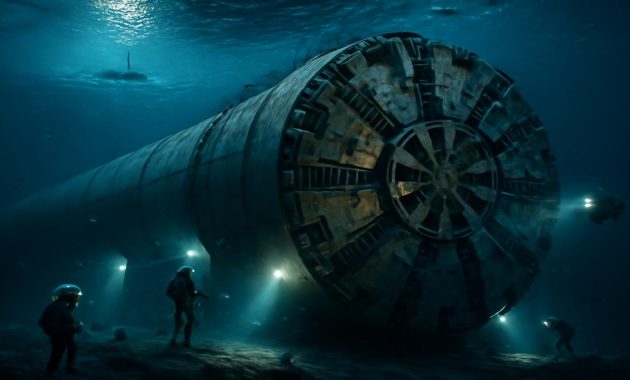
The first time you hear it, it sounds like the opening line of a science fiction novel: engineers have quietly confirmed that construction is underway on an underwater rail line designed to connect entire continents through a vast deep sea tunnel. You picture sleek trains gliding in darkness beneath roaring oceans, the pulse of human movement stitched through the cold, crushing quiet of the abyss. Yet the story is real, and it’s already begun—down there, far below the waves you might have looked at a thousand times without ever imagining what could someday move beneath them.
A Line Drawn Through the Deep
On a gray morning in early autumn, a small research vessel bobs on a choppy sea. The sky is low and bruised, the wind tasting of salt and metal. On deck, a cluster of engineers, geologists, and divers gather around a laptop, the screen glowing dimly in the damp air. A slow-moving blue line snakes its way across a digital ocean floor—an early segment of the tunnel route. Every meter of that line is a quiet rebellion against the limits of distance and depth.
The project has been whispered about in engineering circles for years: a transcontinental underwater rail network stretching across key ocean basins, linking major hubs on different continents via high-speed trains sealed in pressurized, reinforced tunnels. Now, after decades of theory, simulation, and political arm-wrestling, the whispers are gone. Drilling rigs have deployed. Survey subs trawl the darkness. Steel and concrete are on the move.
“We’re threading a needle through the planet,” one of the lead engineers tells me, shouting over the thud of waves against the hull. There’s a gleam in her eyes that’s equal parts exhaustion and awe. “Except the needle is thousands of kilometers long, and the thread has to survive pressure that would crush a submarine.”
How Do You Build a Tunnel Under an Ocean?
To understand the audacity of this project, you have to imagine the sea not as a shimmering surface but as a world turned upside down. Picture jagged undersea mountains, plunging trenches deeper than the height of the Himalayas, and plains of fine silt that billow like smoke at the slightest disturbance. Here, sunlight never arrives. Temperatures hover just above freezing. At depths of 4,000 meters, the pressure is more than 400 times what you feel at sea level—enough to crumple ordinary steel like paper.
The engineers’ solution is a kind of layered choreography. Rather than boring a single, fragile tube through the seabed, the design calls for a composite system: sections of tunnel bored directly into more stable bedrock beneath the ocean floor, connected to massive prefabricated tube segments lowered and anchored into excavated trenches in shallower zones. In the deepest waters, the structure transitions into a neutrally buoyant, pressure-resistant tube secured to the seafloor with tensioned anchors, flexing just enough to ride out tectonic shifts and undersea currents.
Along its length, the tunnel is divided into two primary rail tubes and an emergency service conduit in between, all encased within a thick outer shell. Layers of high-performance concrete, advanced alloys, and flexible composite membranes form a controlled microclimate inside: breathable, temperate, still. The contrast to the pitch-black, high-pressure water just beyond the wall could not be more dramatic.
The trains themselves will run on magnetic levitation in many segments, gliding at speeds that make long-haul flights look sluggish. Yet speed isn’t the only promise. The whole system is being designed to run on low-carbon energy fed from coastal grids and offshore renewables, the rails acting as veins not just of people, but of power and data.
The Quiet Thunder of Machines Below
Official announcements speak in the language of policy and infrastructure: “connectivity,” “trade corridors,” “logistical resilience.” Out on the open water, the reality is more visceral. Below the ship, a drilling platform hovers like a metal island, its legs anchored to the seabed. Far beneath it, a tunnel boring machine—an enormous steel cylinder the length of a city block—pushes its way through ancient rock.
Inside that machine, the atmosphere is a strange blend of factory floor and lunar mission. Fluorescent light glints off hydraulic pistons. The air is thick with the scent of oil, dust, and wet stone. Workers in orange coveralls stand before control consoles, watching as the cutterhead, bristling with teeth of hardened steel and tungsten, slowly grinds forward. Each rotational lurch is a muffled growl swallowed by rock.
Every advance of a few meters is logged, mapped, analyzed. Sensors embedded in the machine’s shell monitor pressure, temperature, vibration. From this cramped, roaring space, data flows upward via fiber-optic cables to the ship above, and onward to control centers on distant shores. The tunnel may one day feel like a seamless, smooth ride to passengers, but its birth is all noise and friction.
“Sometimes you can feel the geology changing through your fingertips,” a veteran boring machine operator explains during a brief break. “The sound shifts. The resistance on the cutterhead changes. You hit a new layer and suddenly it’s like biting into bone instead of bread.”
A New Geography of Connection
On maps pinned to conference room walls in coastal capitals, the route looks like a series of careful arcs spanning the borderlines of continents. Early phases prioritize economically dense regions: think fast routes that undercut air travel times between major transoceanic cities, while subsequent branches extend like fingers to secondary hubs. Over time, planners imagine a mesh—multiple underwater lines crisscrossing seas, shortening journeys that, for centuries, took weeks by ship.
The implications are sweeping. Freight that currently crawls across oceans on fuel-hungry container ships could move silently beneath the surface, slashing transit times and emissions. Travelers might board a train at dusk on one continent and wake up beneath a different sky, having never left the ground, never felt the shudder of turbulence or the dry, stale air of a long-haul cabin.
For coastal communities, the tunnel portals become new hearts of activity: multimodal stations where ships, trains, and local transit braid together. Some ports may transform from loading docks for heavy fuel ships to clean, electrified gateways, humming with the steady rhythm of arriving and departing underwater trains. The sea, long perceived as a barrier, begins to feel more like a seam.
| Aspect | Current Ocean Travel | Deep Sea Tunnel Rail |
|---|---|---|
| Typical Passenger Route | Intercontinental flights or multi-day sea voyages | High-speed overnight or same-day train journeys |
| Environmental Footprint | High aviation emissions, heavy fuel shipping | Powered by low-carbon electricity and renewables |
| Weather Sensitivity | Delays from storms, waves, jet streams | Largely insulated from surface weather |
| Experience of the Journey | Open sky and ocean vistas, but long and tiring | Enclosed, quiet, continuous movement at speed |
| Infrastructure Lifespan | Decades for ships and aircraft fleets | Century-scale design for tunnels and rail systems |
Listening to the Ocean While We Build Beneath It
No one can talk seriously about carving a tunnel under the sea without confronting the ocean itself—the living one, not the abstract blue smear on a map. On the research vessel’s lower deck, a biologist unspools a cable over the side, lowering a cluster of hydrophones into the water. On her laptop, the graph of ambient sound flickers and sways: clicks of distant dolphins, the low moan of ocean swells against a continental shelf, the hum of nearby ship engines.
This tunnel is being watched as closely by marine scientists as by engineers. Construction in sensitive undersea environments carries obvious risks: noise that can confuse or injure marine mammals, sediment plumes choking delicate filter feeders, vibrations jarring ecosystems attuned to subtle changes. The project’s permits hinge on strict environmental monitoring and adaptive construction methods.
Where possible, boring happens deep within bedrock to minimize disturbance to seafloor habitats. When prefabricated segments must be placed in trenches, silt curtains and controlled dredging aim to keep plumes narrow and brief. Heavy construction is timed, in certain regions, to avoid peak breeding or migration periods for vulnerable species. Sound-dampening mounts and adjusted drilling frequencies work to reduce acoustic shock.
Still, the questions persist: How much disruption is acceptable? Who gets to decide what level of risk to deep-sea corals, to whales, to the slow-growing communities on the abyssal plains is justified by faster human travel? On deck, as a misty rain begins to fall, the sea feels wide, old, and impossibly patient. It has been here for billions of years, reshaping coastlines and swallowing mountains. Our tunnel, however vast, is a thin scratch on its floor.
Inside the Tunnel: Senses Rewired
Picture yourself decades from now, stepping onto a platform at the edge of a continent. The station feels more like an airport wing fused with a subway hub: high ceilings, soft indirect lighting, long digital displays showing departure times and pressure status, a distant vibration beneath your feet. Outside, the sea crashes against a breakwater. Inside, the air is cool, steady, almost scentless.
When the train arrives, it does so with a whisper rather than a roar. Magnetically levitated, it glides into the station on cushions of controlled magnetism, the whoosh of displaced air channeled through vents. You board through wide doors; the cabin is oddly spacious, the windows narrow and more symbolic than scenic. There is nothing to see but the lit interior and, occasionally, abstract streaks of service lighting tracing the tunnel walls.
As you accelerate, your body feels the push, but gently—like being drawn along a subtle, horizontal gravity well. There is no sky to glance at for a sense of direction, no horizon to orient you. The awareness of depth comes not from sight but from imagination: the thought of kilometers of rock and water stacked above you, layer upon layer, a heavy silence enveloping your slim capsule of light.
Yet the design of the cabin works quietly against claustrophobia. Lighting mimics circadian rhythms, shifting from warmer hues to cooler ones across the journey. Real-time projections display your position beneath the ocean, transforming abstract bathymetric maps into slowly animating ribbons of contour lines and glowing trench outlines. Small panels display live feeds from remote cameras near undersea vents or coral gardens—reminders that you are not only under the sea, but inside it.
Conversation in the aisle is hushed, more out of reverence than necessity. The soundscape is a soft blend of air handling, the faint buzz of electronics, and the distant thrum of propulsion systems. You might read, sleep, or simply lean back and feel the peculiar comfort of hurtling through the deep, your senses narrowed, your world reduced to this moving room and the knowledge that continents are sliding closer together with each passing minute.
Risk, Reward, and the Thin Line of Trust
Of course, not everyone is ready to embrace this future. For every voice of awe, there is a voice of caution, or outright alarm. Critics point to the obvious hazards: seismic activity along undersea fault lines, the difficulty of maintaining and evacuating a structure buried under kilometers of water, the geopolitical tensions that can arise when critical infrastructure straddles borders deep below the international waters line.
Engineers respond with layers of redundancy: segmented tunnel sections with automated pressure doors, multiple independent power and ventilation systems, emergency pods and refuge chambers spaced along the route. Advanced sensors will watch for minute shifts in rock stress, micro-leaks, or aberrant vibration patterns, feeding into AI-driven early warning systems designed to slow or halt trains long before passengers ever sense trouble.
Nonetheless, stepping into a tunnel that vanishes under the open ocean will require a particular kind of trust. Trust in calculations scribbled on whiteboards a generation earlier. Trust in welds made by unseen hands. Trust in maintenance crews who will work in the dim industrial spaces just beyond the passenger cabins, where the tunnel briefly shows its raw, mechanical face.
For some, that trust will be easier to grant when contrasted with the all-too-familiar vulnerabilities of our current systems: crowded airports, aging aircraft, shipping lanes choked with massive container ships that occasionally shutter entire trade routes when something goes wrong. The deep sea tunnel offers a different narrative: one of stability, of sheltered movement, of human-made certainty in a world of rising seas and intensifying storms.
A Story Still Being Written
Standing on the ship’s aft deck as the day sinks into a smeared, metallic dusk, it’s tempting to see this project as a clean technological triumph: a line drawn boldly between continents, a signature of human ingenuity on the canvas of the Earth. But the story is messier, more organic. It is a story of negotiations between nations, of budget overruns and unexpected geological surprises, of late-night arguments in planning rooms about route alignments and environmental trade-offs.
In the years to come, sections of tunnel will open one by one, each unveiling framed by speeches and ribbon-cuttings. People will share first-ride videos: faces lit by cabin lights, voices hushed as they announce, “We’re under the ocean right now.” Later, the novelty will fade. The tunnel will become part of the background hum of the world—like the internet, like GPS, like the invisible grid of flight paths arching through the sky.
Yet for those who remember the early days—who stood on vessels like this one watching the first drilling rigs vanish into fog—the sense of wonder may never fully disappear. They will remember the sound of waves slapping metal while, far below, a machine the size of a building gnawed its way forward in darkness. They will recall the way the screen on the control console traced a growing line beneath an animated ocean, pixel by pixel, a new geography being written in secret.
Someday, a child might fall asleep on a train in one hemisphere and wake up in another, treating the crossing of oceans as casually as a subway ride across a city. If they press their palm against the cabin wall and listen, they may hear nothing but the steady, padded rush of air. But if someone tells them the story—of pressures that could crush them in an instant, of lifeforms that glow in permanent midnight, of mountains and canyons and plains of silt—then perhaps they will sense, just faintly, the enormity of the world pressing in all around their slim, shining tunnel.
And maybe that is the deepest promise of this undertaking: not merely to shorten distances, but to redraw how we feel them. To take the old notion of “overseas” and, quite literally, bring it underground—into a shared corridor where continents meet in the quiet, pressurized dark, and where every passing train is a small, bright affirmation that even the deepest divides can, eventually, be crossed.
Frequently Asked Questions
Is the underwater rail tunnel really under construction already?
Yes. While many details remain closely managed by participating governments and engineering consortia, key pilot segments and initial mainline sections are already in active construction. This includes seabed surveys, tunnel boring in coastal bedrock, and the fabrication of deep-sea tunnel segments.
How deep will the tunnel go beneath the ocean?
Depth varies by route, but some sections will lie several kilometers below the surface, either bored into rock beneath the seabed or suspended just above it. Designs account for extreme pressure, temperature, and long-term structural stability at these depths.
How fast will the trains travel?
Planned operating speeds are comparable to or faster than existing high-speed rail, with many sections using magnetic levitation to reach speeds that can significantly cut current intercontinental travel times, particularly when compared to ocean shipping and some flight routes.
Is it safe to travel through a tunnel under the ocean?
Safety is a central design priority. The system includes multi-layered tunnel walls, segmented compartments with pressure doors, redundant power and ventilation, extensive monitoring, and regular emergency exits and refuge areas. As with any major infrastructure, ongoing maintenance and strict standards are crucial.
What about the environmental impact on marine life?
The project is being developed under stringent environmental regulations. Measures include deep rock tunneling where possible, controlled dredging, sound-dampening technologies, timing construction to avoid sensitive breeding or migration periods, and long-term monitoring of marine ecosystems. Even so, impacts are inevitable, and there is active debate about how to balance ecological risk with the project’s potential benefits.
Will this replace air travel and shipping?
It is unlikely to replace them entirely. Instead, the deep sea tunnel network is expected to complement existing modes, taking over some high-density passenger and freight routes where rail can be faster, cleaner, or more reliable, while air and sea transport continue to serve other needs.
When might regular passengers be able to use these underwater trains?
Timelines differ by route and phase, but the earliest sections could see limited passenger service within a few decades, with a gradual expansion into a broader intercontinental network over a longer horizon. This is a century-scale project, evolving in stages rather than appearing all at once.