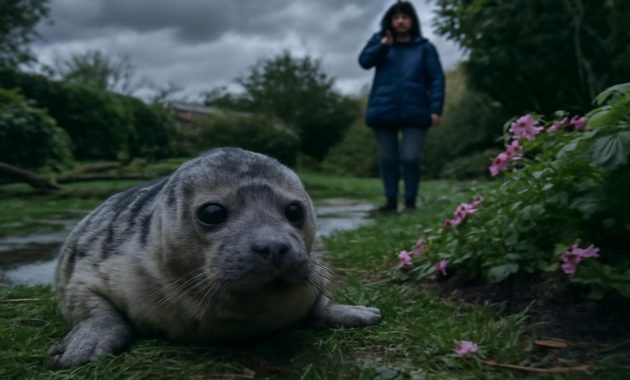
The seal pup was curled beside a terracotta flowerpot, the last place anyone expected to find a creature of the Atlantic. Dawn hadn’t quite worked up the courage to color the sky yet; everything was grey, washed in that half-light that makes you question what you’re seeing. At first, the homeowner thought it was a forgotten garden cushion, soaked and slumped against the low stone wall. Then it moved—awkwardly, like a sleepy child—and let out a thin, unexpected cry that sliced through the quiet Cornish morning.
Outside, the garden smelt of salt and wet soil. Seaweed tangled in the rose bushes. A plastic garden chair lay on its side, wheels of a wheelbarrow stuck in a newly formed trench where stormwater had surged through. Overnight, Storm Chandra had torn along the Cornish coast, flinging waves over the cliffs, rattling windows, and turning normally tame coves into frothing cauldrons. Yet the strangest aftermath was here, in this small, ordinary garden a mile from the sea, where a misplaced pup blinked up at humans as if asking, quite reasonably: “Where am I?”
The Night the Sea Came Inland
The storm had been named two days before it hit—a neat, almost elegant moniker: Chandra. It sounded gentle, celestial even, as if the storm might simply bring a few theatrical clouds and some dramatic sunsets. But by midnight, anyone living within earshot of the ocean knew Chandra was not a soft-spoken visitor.
Windows hummed in their frames. The wind came in muscular bursts, snatching at roof tiles and pushing dense, salty air through the tiniest gaps. In the villages along the Cornish coast, people lay awake, counting the seconds between gusts, listening for the ominous clatter of garden furniture or bins rolling down the road. Out beyond the harbor walls, the sea was in full revolt: waves heaved themselves up and over, smashing white and luminous against the rocks.
Somewhere within that chaos, a grey seal pup became separated from its mother.
Grey seals are no strangers to drama. They haul out on wave-battered rocks and rear pups on storm-pocked shores. But there’s a difference between wild Atlantic drama and the sort of violence a named storm brings. Swells run higher, currents twist in confused spirals, and even the most experienced adult seals are tested. For a pup, still learning what its flippers are for, such a night is a brutal initiation.
No one saw the pup’s journey that night. We can only piece it together from the clues the morning left behind: a broken gap in a fence beside a flooded lane, a slick trail of sand and seaweed across a patch of tarmac, and the improbable final resting spot in a sheltered corner of a Cornish back garden, framed by a bird feeder and a patch of bedraggled lavender.
“There’s a Seal in the Garden”
By the time the family woke, the worst of the wind had passed. You know the particular hush after a storm—the odd mix of relief and hangover. The air feels rung out. The world looks rearranged.
In this house on the fringes of a small Cornish town, the kettle clicked on, and someone drew back the kitchen curtains. There, beyond the glass, amid scattered debris and flattened daffodil shoots, was the hesitant rise and fall of a small, mottled body. Two huge dark eyes stared back with that uncanny seal expression that seems at once ancient and completely guileless.
“There’s a seal in the garden.” It’s the kind of sentence you say twice because the logic part of your brain refuses to process it the first time around. But there it was. Whiskers. Flippers. Soft, pale fur mottled with darker patches. A fat little comma of a creature resting on the slabs by the backdoor.
The family did what so many people now instinctively do when wild animals appear where they shouldn’t: they reached for a phone, not for a photograph, but for help. In Cornwall, that means calling the local wildlife rescue line or the charity that has become, over the years, an emergency service for the region’s marine life. On mornings like this—after a storm has thrown the coastal rulebook into the sea—the volunteers expect their phones to erupt.
“Stay back,” the voice on the line advised. “Don’t touch it. Keep pets indoors. We’re on our way.”
So the family watched, from behind double glazing, as the unexpected guest shifted slightly, revealing the soft, pale fur of a pup that had recently shed its natal coat. Old enough to be in the water. Too young to be alone in a storm like last night’s.
Reading the Pup’s Story in Its Fur
When the rescue team arrived—hi-vis jackets bright against the murky morning, equipment cradled in practiced arms—they looked first, not at where the pup was, but at what it was telling them with its body.
Grey seal pups are almost absurdly expressive if you know how to look. This one’s ribs were faintly visible under its fur. There were small abrasions along its flippers, likely from scraping over rough ground or being washed against rocks. Sand clung in gritty patches to its whiskers. Its eyes, though, were clear. The pup lifted its head curiously as the rescuers spoke in low voices, as if recognizing that, for the first time in several tumultuous hours, the world had quieted.
For people who work with stranded seals, each rescue is part triage, part detective work. How far has the animal traveled? Is it dehydrated? Injured? Emaciated? Does it simply need rest, or intensive care? In this case, the verdict was quick: the pup wouldn’t survive if left where it was. The garden might feel safe for the moment, but it was a dangerous limbo—too far from the sea, too close to dogs, roads, and people who might not know how to keep their distance.
As one rescuer gently unfolded a specialized seal stretcher, another talked calmly to the family, explaining why it was so important they hadn’t tried to push the animal toward the road or back to the beach themselves.
| What You See | What You Should Do |
|---|---|
| Seal pup alone on beach or inland | Keep your distance, keep dogs away, call a local wildlife or marine rescue group. |
| Pup looks thin, injured, or lethargic | Do not push it to the water. Report its location and condition, follow expert advice. |
| Pup seems alert and near the tide line | Observe from afar; often the mother is nearby. Only intervene if directed by professionals. |
“They can bite, and they’re stronger than they look,” one of the rescuers said, glancing at the pup now being gently coaxed onto the stretcher. “But more than that, they’re wild. They need to stay that way. Our job is to give them the best shot at going back to the sea, not to turn them into pets.”
The Quiet Drama of a Rescue
The actual moment of rescue was calm, almost domestic, set against the broken branches and storm-littered lawn. No heroics, no frantic chase—just a practiced choreography. A towel over the pup’s head to soften the stress of light and movement. Four careful hands lifting each side of the stretcher. A short walk down the garden path that usually hosted wheelie bins and grocery deliveries.
In the lane, neighbors peered over garden gates, children still in pajamas. Someone whispered, as if afraid to spook the sea creature that had washed into their world, “Is it going to be okay?”
There’s no way to promise that. Rescued seals carry the sea’s uncertainty with them. Yet here, on a wet Cornish morning, the odds had shifted. The pup was no longer alone. A van door slid open, revealing the controlled chaos of a mobile wildlife ward: crates, blankets, disinfectant, clipboards, the faint tang of fish from previous patients. The stretcher slid inside. For a heartbeat, the pup’s dark eye met the morning again, then the door shut with a soft, final thud.
The rescuers would later check its weight, rehydrate it, and treat its wounds. They’d log the garden location, another strange pin in a map of storm-driven strandings. In a few weeks, if all went well, the same animal would be heavier, sleeker, more restless. It would be loaded again—this time in reverse—and carried back to a shore maybe not so far from the one it first knew, then released into waves that, on a calmer day, would seem almost kind.
Storm Chandra’s Wild Footprint
Storms have always rewritten coastlines, but they also rewrite stories—of people, of animals, of how close the sea really is. Chandra was no different. By mid-morning, social media feeds in Cornwall were a mosaic of ruined garden fences, monstrous waves caught mid-crash, and the oddly tender images of displaced creatures: seabirds huddled in car parks, jellyfish stranded in high-tide puddles, and, of course, the seal pup in the garden.
In Cornwall, where the sea is both neighbor and narrator, each named storm becomes a character: remembered by the particular things it rearranged. Some are recalled for lost boats or damaged harbors, others for power cuts and days off school. Chandra’s legacy might well be measured in the number of young seals tugged too far, too fast, from their mothers’ side.
Grey seals are Britain’s largest native land-breeding mammal, yet most of their lives happen out of sight, beyond the visible horizon. We think of them when they surface—nostrils first, then curious eyes, then that familiar domed head. What we don’t see is how tightly their survival is tied to weather we often view only through human inconvenience: train delays, cancelled ferries, leaking roofs.
For a pup, a storm can mean more than a rough night. Heavy swells can wash them from sheltered pupping beaches into open water before they’ve built enough strength or fat reserves. High tides can separate mothers and young by distance or confusion. By the time the wind dies, some pups are already far from where they should be, driven inland by rising floodwater that pushes up river estuaries and into low-lying roads.
When Wildness Crosses the Garden Wall
There is something quietly seismic about finding a wild animal at your backdoor, not as a passing bird or garden fox, but as a full, unexpected emissary from a world you think of as “out there.” It punctures the invisible line we draw between human space and wild space.
In Cornwall, that line has always been porous. The sea creeps into daily language, into place names and jokes and weather conversations. Yet even here, a seal in the garden shakes loose a certain complacency. This is what climate scientists and coastal ecologists have been saying for years, only with far less fur and far less pathos: when storms intensify, when sea levels inch higher, the sea will reach further inland—not just in dramatic surges over harbor walls, but in subtler, stranger ways.
On that morning after Chandra, the garden where the pup lay looked briefly like an annex of the shore. Tangled plastic, a torn net, and a strip of kelp lay draped over the hedge. The soil felt gritty with blown sand. For a few hours, the space between home and ocean collapsed. The rescue van’s departure restored the illusion. The garden became a garden again. The sea retreated to its proper place on the map.
But the encounter lingered. These events have a way of lodging in the mind, resurfacing when the wind picks up or another storm gets its neat, forgettable name.
Why These Encounters Matter
It’s tempting to treat stories like this as charming curiosities—the sort of “and finally” tale that closes a news bulletin. Seal pup. Garden. Storm. Happy ending. But look closer, and they become small, vivid windows into the larger forces reshaping our shores.
As weather patterns grow more erratic and sea conditions more volatile, marine animals are increasingly pushed into marginal, unfamiliar spaces. Some adapt; some don’t. Rescue centers across the UK have reported busier seasons, with more malnourished or injured pups needing human help just to get back to a point where the wild can take over again.
Each rescue is an act of care, but it is also a reminder: these animals are not thriving in isolation from us. Their fate is braided tightly with our choices about emissions, energy, fish stocks, and coastal development. The garden where the pup ended up is not some distant frontier. It’s us. Our world. Our runoff, our flood defenses, our roads that slice through ancient routes once navigated only by water and wind.
And yet, the intimacy of such encounters offers something rare: a sense of direct relationship. It is one thing to read about declining marine ecosystems; it is another to stand in your slippers, looking through rain-streaked glass at a living, breathing seal pup blinking on your patio slabs.
The Sea’s Stories, Told One Pup at a Time
A few weeks after the rescue, if all goes to plan, the pup will stand at the edge of another shore—this time under watchful human eyes that have fed it, treated it, and, importantly, kept it wary of them. Its fur will be thicker with fat, its movements more certain. When the crate door opens, it will hesitate only briefly before wriggling forward, flippers working in practiced rhythm.
The first touch of water—always colder than we imagine, even in late spring—will reset something fundamental. Seals belong in that silvery threshold where waves fold over themselves, not on patios or in driveways. With a few strong strokes, the pup will vanish into its element, resurfacing farther out, head bobbing like a dark buoy, then disappearing again into the color-shifting skin of the sea.
No one will be able to say, with any scientific certainty, that this is the same pup that once lay next to a terracotta pot in a Cornish garden. There are no name tags, no follow-up postcards from the reefs. But the people who watched it go will remember. They’ll scan the water differently next time, reading each distant head as a possible return of that brief, improbable houseguest.
Stories like this one spread. They’re retold in pubs and classrooms, over garden fences and in café queues. “Do you remember Storm Chandra? The one that put a seal in someone’s garden?” These anecdotes become a kind of folk record: human memory knitting together the recent past of a coastline in flux.
Somewhere beneath the waves, the pup’s life will unfold along older, wilder lines—dictated by tides, fish, and the silent logic of migration. It will never know the way it briefly rearranged a human family’s sense of where the sea begins and ends. But its path, and paths like it, will continue to cross ours, sometimes in ways as dramatic as a midnight storm, sometimes in ways as quiet as a wet nose nudging against a garden wall at dawn.
FAQ
Why do seal pups end up in gardens or inland areas after storms?
Powerful storms can generate large swells and strong currents that wash young or weak pups off traditional pupping beaches. Floodwater can carry them up estuaries, rivers, and lanes. Disoriented and exhausted, they sometimes follow the path of least resistance—roads, gaps in hedges, open gates—until they end up in places like car parks, fields, or gardens.
What should I do if I find a seal pup on a beach or in my garden?
Keep your distance and keep dogs and children away. Do not try to push the pup back into the sea or move it yourself. Call a local wildlife rescue organization, marine mammal charity, or relevant animal welfare hotline. Give them clear details about the location, the pup’s size, and its visible condition, and follow their instructions.
How can I tell if a seal pup needs rescuing?
A healthy pup near the tide line may simply be resting, especially if it appears plump and alert. Pups needing help often look thin, lethargic, injured, or are found far inland or near busy roads. Any pup found away from the beach, like in a garden, almost always needs professional assessment, even if it appears curious or calm.
Are seals dangerous to people?
Wild seals can bite and are strong for their size, so you should never attempt to touch, feed, or pick them up. While they are not aggressive without reason, they will defend themselves if they feel threatened or cornered. Keeping your distance protects both you and the animal from harm or unnecessary stress.
Does rescuing individual seal pups really make a difference?
Yes. Each rescued pup represents a life given a second chance to return to the wild and, potentially, to breed and contribute to the population. While rescues do not solve the larger environmental pressures affecting marine life, they are a vital part of conservation work and help build public awareness and connection to coastal ecosystems.
Are more seal strandings linked to climate change?
Scientists are still studying the precise connections, but changing storm patterns, sea temperatures, and prey distribution can all impact seal survival, particularly for pups. More frequent or intense storms can increase the number of strandings and separations from mothers, making rescues more common in some regions.
How can I help seals and other marine wildlife from home?
You can support local or national marine charities, reduce plastic use, dispose of fishing line and litter responsibly, and be mindful of wildlife when visiting the coast. Advocating for strong climate and ocean protection policies, even far from the sea, also helps create safer conditions for animals like the seal pup swept inland by Storm Chandra.