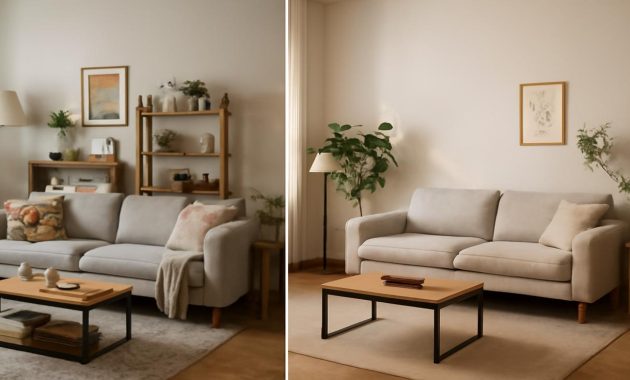
The first thing you notice is the hum. Not the refrigerator or the traffic outside, but the low, steady static in your own head. You walk into your living room and everything is… fine. The couch cushions are fluffed. The coffee table is mostly clear. There’s no avalanche of mail spilling off the counter. And yet, somehow, your whole body tightens, as if you’ve just stepped into a room crammed with stuff. Your eyes keep moving, scanning, restless. Something in the space feels noisy, even though nothing is actually wrong.
You light a candle, you open a window, you straighten a stack of books that doesn’t really need straightening. Still that feeling: crowded, unsettled, like your brain can’t find a place to sit down. If your house feels cluttered even when it isn’t, you’re not imagining it. Your eyes are picking up on a kind of visual static that your mind interprets as “too much,” and once you see it, you can’t unsee it.
The Invisible Mess You Can’t Put in a Donation Box
The truth is, clutter isn’t only about how much stuff you own. It’s also about how much your eyes have to work just to be in a room. Think about walking into a small cabin in the woods: the wooden walls, a worn rug, a few objects on a shelf. Even if that space holds everything the owner needs, it often feels soothing. Your eyes can take in the room in a few slow, easy sweeps.
Now imagine a glossy, modern apartment where the owner keeps everything “minimal.” Counters technically clear, floors open. But the eye bumps into ten different colors of packaging on the open pantry shelf. The bookcase is a rainbow of spines. The fridge door is a collage of magnets, invitations, kids’ art. None of it is actually messy. Still, your brain registers a crowded, jangly feeling. That’s visual clutter.
What your brain craves more than empty space is restful space. Places where it doesn’t need to decode and categorize every square inch. It’s the difference between standing in a forest and standing in a supermarket aisle. Both are full, but one feels like breathing and the other like homework. When your home feels cluttered despite your best organizing efforts, it’s often this mismatch: your rational brain says, “Everything’s put away,” while your senses whisper, “There’s nowhere for me to rest.”
Here’s where a surprisingly simple visual trick can do more for your peace of mind than another round of decluttering: reduce the number of “different” things your eyes have to process, without actually getting rid of anything. In other words, you change what your brain sees, even if the inventory of your home stays almost the same.
The Trick: Make Your Space Speak in Fewer “Languages”
Imagine you’re at a party where every single guest is talking in a different language at the same time. Everyone might be kind, friendly, and well-intentioned, but your nervous system would be overwhelmed. That’s what most rooms quietly do to us: every label, color, shape, and pattern is a mini-language your brain has to translate.
The visual trick is simple: you teach the room to speak in fewer, calmer languages. You don’t make it silent; you make it harmonious. You do this by intentionally repeating a few colors, containers, and shapes, so your eye recognizes patterns and stops working so hard.
Here’s the most accessible place to start: containers and surfaces. Instead of a dozen kinds of baskets, bins, trays, jars, and boxes, aim to repeat just one or two types in each area. That’s it. You’re not necessarily owning less; you’re making it look like less by reducing visual variety.
It’s stunning how much this changes the feeling of a room. You can have three times as many blankets, puzzles, pantry staples, or dog toys as your minimalist friend, and your space can still feel quieter, simply because your things belong to a clear visual family instead of throwing a party of competing shapes and colors.
Where to Start: One Shelf, One Surface, One Calm Breath
It can feel big and abstract to think about “reducing visual noise” across the whole house, so shrink the challenge down. Start with one small zone where your eyes always land: a coffee table, a nightstand, the entryway console, a kitchen counter, or a single bookshelf. That will be your experiment field.
Stand in the doorway and look at that one area. Don’t tidy yet. Just notice. Where does your gaze get snagged? A neon product label? A tangle of cords? Five different textures of baskets? A stack of mail with every envelope shouting in its own font?
Then slowly clear everything off. Set it all on the floor or a nearby surface. Feel the nakedness of that empty spot. It might feel sterile, or weirdly vulnerable. That’s good; you’re resetting your baseline. Now, choose what comes back based on this question: how can I make this area speak in as few visual “languages” as possible while still being useful and alive?
Maybe it looks like this:
- Only one kind of basket on the shelf, repeated three times.
- A tray on the coffee table that corrals the same two or three objects: a candle, a small plant, a book.
- A closed box for remotes and chargers instead of a loose pile.
- One photo frame style repeated, instead of a gallery of mismatched frames.
Often, the magic happens not just from what you remove, but from what you hide. The unsightly but necessary things—chargers, tissues, medications, remotes—can disappear into something neutral that blends with your space. When your eye meets a row of identical baskets, it interprets “one thing, repeated,” even if each basket is full of chaotic, real life.
The Secret Power of Color and Shape Repetition
Our brains are wired to love patterns. Repetition whispers, “You’ve seen this before; you know what to expect.” That sense of predictability feels peaceful. Visual clutter is what happens when the brain keeps stumbling into surprises. Different fonts, labels, shapes, and colors all demand micro-attention. You can’t feel fully relaxed if your gaze is doing tiny sprints every time you walk through a room.
One of the easiest ways to calm that sprint is to repeat the same color and shape for storage and support items. You don’t need designer bins or expensive organizers; you just need consistency.
Imagine a pantry: fifteen different cereal boxes, eight brands of pasta, a riot of packaging colors. Technically organized, emotionally exhausting. Now picture the same pantry with most items decanted into clear or white containers, or tucked into identical bins. You still own the same food. But suddenly, your pantry looks like a deep breath.
Or picture your bathroom: toothpastes, lotions, razors, hair ties in mismatched baskets and bags. Replace them with two or three containers in the same material—maybe all white, all woven, or all glass. The room shifts. It feels like someone turned down the volume. Your morning gets smoother not because there’s less in the room, but because there’s less to visually decode.
To make this practical, you can think in terms of simple, repeatable building blocks. The following table offers small, visual decisions that quietly change the mood of a room without demanding a massive makeover:
| Area | Visual Problem | Simple Visual Trick |
|---|---|---|
| Entryway | Scattered keys, mail, sunglasses, random objects | Use one tray and one lidded box in the same color; everything lives inside those two pieces. |
| Living room | Different baskets, toys and remotes everywhere | Choose one basket style and repeat it; add a single box or drawer for remotes. |
| Kitchen counter | Spices, oils, utensils scattered | Corral items on one board or tray; use matching jars or containers where possible. |
| Bathroom | Bright packaging and products on every surface | Hide products in two or three matching bins; keep only daily-use items visible. |
| Bedroom | Nightstand crowded with books, cups, chargers | Use one small tray plus a drawer organizer; limit the surface to 3–4 repeating objects. |
None of these solutions require you to become someone else—the minimalist who owns three shirts and no sentimentality. They just reduce the visual vocabulary of your home so it stops shouting and starts murmuring.
Let Your Eyes Rest: Editing What Stays in Sight
Here’s another way to think about it: not everything you own has to be part of the daily performance. Some things can live quietly offstage, behind doors and inside drawers, emerging only when needed. The visual trick is to be choosy about what earns the right to be seen all the time.
Walk through your home and ask, “If my eyes were a guest here, where would they sit down?” Right now, they might be perching nervously on stacks of books, bouncing off color explosions on the fridge, tripping over piles of shoes. You can change that by creating intentional “calm fields” in each room—areas of relative emptiness where your gaze can soften.
A calm field might be:
- A bare stretch of wall, with just one piece of art you truly love.
- A dresser top with a single plant and a bowl for jewelry, nothing more.
- Half of your kitchen counter left free, so your eye can travel without interruption.
- A sofa with only two or three pillows in similar tones, instead of a pile of patterns.
This doesn’t mean erasing your personality. It means letting the things that matter most stand out by giving them breathing room. That photo from your favorite hike glows more when it’s not battling eight other frames and a cluster of scented candles.
Editing what stays in sight is also about honesty. Do you actually use the objects that live on your surfaces, or are they there because you didn’t know where else to put them? The visual trick works best when the things you see most often are either truly useful or genuinely loved—and preferably both.
Texture, Light, and the Quiet Drama of Less
Once you’ve simplified containers and edited what’s out in the open, you can fine-tune another layer of visual calm: texture and light. This is the quiet drama that makes a room feel intentional rather than bare.
Texture is what keeps a simple space from feeling sterile. A woven basket, a linen pillow, a ceramic mug, a wooden bowl—these elements give your eyes something to enjoy without the chaos of clashing colors or busy patterns. When you repeat a few natural textures, your home starts to feel like a landscape rather than a storage unit.
Light does something similar. A single harsh overhead bulb makes every object shout. Softer, layered lighting—lamps, string lights, candles—can fade the visual noise and highlight only what matters. When the room is lit from a few directions at once, with warmer tones, the edges blur just enough to feel cozy instead of cluttered.
To play with this, you might:
- Replace one bright white bulb with a warmer, softer one in a lamp you use at night.
- Group a candle, a plant, and a small textured object (like a stone or a woven coaster) on a tray to create a small, calming focal point.
- Choose textiles in a narrow color palette—perhaps all shades of cream and sand, or blues and grays—so the variety comes from touch, not color chaos.
In this calmer context, your belongings stop feeling like a pile of obligations and start to feel like a part of your own small ecosystem. The house becomes less about “controlling stuff” and more about shaping the sensory story you move through every day.
FAQ
Why does my house feel cluttered even when it’s clean?
Because your brain responds not only to quantity, but to variety and visibility. When many different colors, shapes, labels, and objects are in view at once, your eyes have to work hard to process them, which feels like clutter even if everything is technically put away.
Do I have to get rid of a lot of things for this visual trick to work?
No. The trick focuses on changing what your eyes see, not dramatically reducing what you own. Matching containers, repeating colors and shapes, and hiding necessary but unattractive items can make a big difference without a massive declutter.
Where’s the best place to start if I feel overwhelmed?
Begin with one small, frequently used surface—a nightstand, coffee table, or entryway table. Clear it, then put back only a few items in a deliberate, visually consistent way. Once you experience the difference in that tiny area, it’s easier to continue elsewhere.
What if I love color and don’t want an all-neutral home?
You don’t need to give up color. Choose a limited palette and repeat it throughout the room. Let color show up in art, textiles, or a few favorite objects, while keeping storage and background elements more neutral or consistent.
How do I keep visual clutter from creeping back?
Create simple “homes” for categories of items—a tray for keys, a box for remotes, a basket for mail—and commit to returning things there daily. Because these homes are visually consistent and easy to reach, it becomes almost effortless to maintain the calmer look and feel over time.