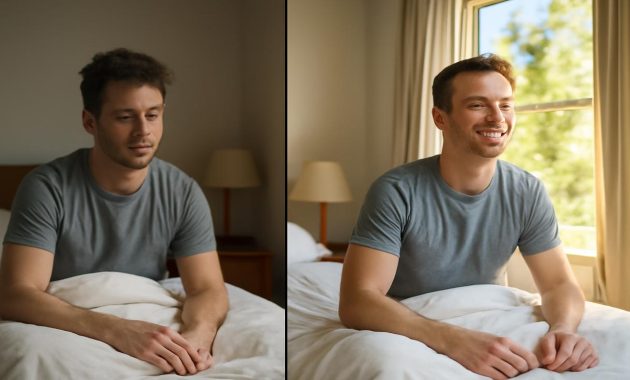
On certain weeknights in late summer, when the heat finally slips off the city like a tired coat, millions of Australians make the same small decision: they slide a window open before bed. It’s an unremarkable gesture, almost automatic—a creak of the frame, a rush of cooler night air over bare arms, the hum of distant traffic or the slow, oceanic roar of cicadas. Yet those who sleep with the window open often find something changes over time, something subtle but insistent, like a whisper at the edge of hearing. They begin to feel better. Calmer. More rested. A little more themselves.
The Night Air Nobody Owns
Ask someone why they crack the window, and you’ll hear the usual suspects: “It’s just too hot,” or “I like the breeze,” or the very Australian, “The air-con feels wrong at night.” What most people don’t say—but many slowly discover—is that this simple habit starts to work on you in ways that have little to do with temperature.
When you lie in bed with an open window in Australia, you’re not just letting in air. You’re inviting the outside world to wander quietly through your sleep. The scent of wet asphalt after a coastal storm in Cairns. The faint, dusty tang of eucalyptus on a dry Melbourne night. A shy drift of salt from the Pacific sneaking through a Sydney apartment two kilometres from the beach. If you pay attention, you begin to notice your nights are no longer an airtight box; they become a gentle, porous space where your body and the world converse.
For many people, the most unexpected benefit of this habit isn’t cooler skin or a few saved dollars on electricity. It’s a quiet, cumulative sense of reconnection—with the land, the weather, and even with your own internal rhythms. The open window loosens the lid on modern life, that pressurised cylinder of sealed rooms and artificial light. Slowly, night after night, a kind of recalibration begins.
A Different Kind of Alarm Clock
There’s a particular sound that belongs to Australian mornings with the window open. It’s not the shrill insistence of a phone. It’s the layered, slow-building choir of birds—no bird app, no mindfulness coach can replicate it. The first calls are solitary: a magpie’s liquid warble from the power line, a single kookaburra laughing at the idea of sunrise in the half-dark. Then more voices join in. Miner birds bickering over territory. Lorikeets fizzing past in streaks of green and orange, their chatter sharp and electric in the cool air.
If your bedroom window is cracked to the world, you wake up inside this soundscape, not apart from it. It’s not always gentle—some mornings, the cockatoos screech like badly tuned alarms—but it is undeniably alive. Over time, many Australians who sleep with their windows open notice they wake more gradually, almost rhythmically. The light shifts, the birds warm up, a car door slams somewhere on the street, a neighbour coughs, and you drift from dreams to consciousness through these cues, instead of having your sleep torn in half by a digital beep.
Plenty of people describe that shift in blunt, practical terms: “I just don’t feel as smashed in the morning,” or “I’m waking up before my alarm without feeling panicked.” It’s as if the body, allowed to listen again to the world’s slow, reliable signals—light, sound, temperature—starts to trust them. You’re no longer waking in a vacuum, in an airless room where time seems to arrive from nowhere. You’re waking into a dawn that has been gently assembling itself outside your window for hours.
When the Sky Becomes Part of the Room
One of the most overlooked details of sleeping with the window open is visual, not just sensory. On cloudless nights in the country, the sky over Australia can look almost outrageously crowded—stars packed together, the Milky Way a pale smear of ancient light. Even in suburbs and small towns, a wedge of night sky framed by a bedroom window can become a quiet, nightly presence.
With the glass open, that sky feels less like a painting and more like a hallway leading somewhere. The cool air and faint scents make it real, spatial, alive. You fall asleep seeing not just your ceiling, but that darker, deeper ceiling beyond it. Many people, without using the language of science or wellness, simply say they feel “less boxed in.” The difference is hard to quantify but easy to feel: your world doesn’t end at the plaster wall; it continues into a sky where clouds crawl and stars spin, even as you dream.
The Slow Medicine of Fresh Air
Modern houses and apartments, especially in dense Australian cities, are astonishingly good at one thing: keeping the outside out. Double glazing, powerful air-conditioning, sealed frames—these all make life comfortable, quieter, and safer from harsh heat or icy winter winds. But they also do something subtler: they turn our living spaces into little atmospheric islands, where the same air is inhaled and exhaled, reheated and recirculated in a weightless loop.
Open a bedroom window at night and you break that loop. Cooler outdoor air slips in; warmer, stale air sighs its way out. Dust and indoor pollutants don’t vanish, but they stop building up in quite the same way. People often describe the difference in simple, bodily language: “My chest feels lighter,” “I don’t wake up stuffy,” or “It doesn’t smell like ‘bedroom’ when I walk in at night.” They may not know terms like air exchange rates or volatile organic compounds, but their lungs and noses notice what’s happening.
There’s also the matter of temperature. In much of Australia, nights cool just enough for an open window to act like a natural regulator. Even a faint breeze can shave a few degrees off a bedroom that’s been collecting heat all day, especially in brick houses or east-facing apartments. Instead of relying entirely on air-conditioning—which dries the air and hums over your sleep—you let the night take back some of the day’s heat, slowly, naturally, with the quiet rustle of leaves for a soundtrack.
The Numbers Behind the Breeze
Australians who consistently sleep with their windows open often notice concrete, practical changes. It’s not just about “feeling good”—over the course of weeks or months, small benefits stack up.
| Observed Change | How Australians Describe It | Likely Reason |
|---|---|---|
| Waking up less groggy | “I’m not dragging myself out of bed.” | More gradual wake-up from light, sounds, and cooler air. |
| Fewer stuffy-nose mornings | “I don’t wake up blocked anymore.” | Better air circulation, lower indoor pollutant build-up. |
| Falling asleep faster | “I’m out within minutes.” | Natural cooling supports the body’s sleep onset process. |
| Lower night-time anxiety | “I don’t spiral as much in bed.” | Soothing natural sounds and connection to outside world. |
| Less reliance on air-con | “The power bill’s not as scary.” | Night cooling reduces need for mechanical cooling. |
These aren’t miracle cures or overnight transformations. They’re the kind of subtle shifts that only become obvious when you stop and think back: When did mornings stop feeling like a small emergency? When did the air in my bedroom start smelling like outside instead of “inside”?
The Emotional Weather of an Open Window
There’s another benefit Australians often discover when they sleep with the window open, and it’s harder to pin down than temperature or fresh air. It lives somewhere in the overlap between comfort and vulnerability, between safety and surrender.
Inside a fully sealed, climate-controlled room, you’re in complete command of your environment. It’s bright when you want it bright, silent when you want it silent, cool or warm at the push of a button. The world outside could be on fire or flooded; inside is always the same. That control can feel reassuring—but also strangely isolating.
Crack the window and you relinquish a little of that control. You’ll hear the late train rumbling over the river bridge, the neighbour’s back gate clicking shut, a dog barking at something unseen. The wind might pick up and rattle the blind, or a distant siren may wail through the humid dark. Yet this minor unpredictability seems to do something quietly generous to the nervous system.
Instead of being alone with your thoughts in a sealed capsule, you’re reminded—sound by sound, breeze by breeze—that a larger world is still turning. Storms roll through and pass. Frogs croak near dams on the town’s edge. The wind changes and brings with it cooler air from the sea. You’re a sleeper in the middle of all this motion, not apart from it. Many people report feeling “less trapped in my head,” as if their anxieties bleed a little into the wider landscape and soften there.
The Night Teaches You the Season
Australians who fall asleep with the window open often become, without trying, students of the seasons. Not the official ones marked on calendars—summer, autumn, winter, spring—but more local, more intimate cycles.
You notice when the night air shifts from the dry, oven-like heat of late January to the cooler, slightly moister feel of March. You can smell when rain is coming before it hits—an almost metallic scent carried on the breeze. Magpies sing different songs in August than in December. Fruit bats may pass noisily overhead in summer, following invisible river paths of blossom and fruit, then disappear into quieter routes when the trees change.
In the city, these details might come in fragments—the smell of jasmine from a neighbour’s fence in September, traffic noises softening in holiday weeks, the odd, hollow quiet of a storm-blackout night. With an open window, every season has its own signature soundtrack and bouquet, and slowly, you start to map your year by them. It’s a way of being in Australia that involves no grand hikes, no camping trips, no epic drives—just the decision to let the ongoing story of your local environment whisper through a sash of open air.
The Practicalities, the Pests, and the “What Ifs”
Of course, this isn’t a dreamy postcard. Sleeping with the window open in Australia can mean mozzies, street noise, and the occasional gecko clicking in the dark. There are safety questions for ground-floor windows, concerns about bushfire smoke in certain seasons, or heavy traffic pollution in tightly packed inner suburbs.
People who make the open-window habit work tend to weave it carefully around these realities, rather than ignoring them. Fly screens become non-negotiable. In some houses, it’s a case of cracking the top of a double-hung window rather than swinging the bottom wide open. In apartments close to busy roads, the window might only be open late at night, after traffic thins and the cooler air helps push any lingering fumes away faster.
Some compromise, opening the window fully on mild, still nights and closing it when high winds slam through, when smoke haze drifts over from a distant burn-off, or when the neighbour’s party shows no sign of stopping at midnight. Others open a hallway window instead of the bedroom one, letting air move indirectly. What matters isn’t following a strict rule but honouring the underlying instinct: to let the night in, at least some of the time, to make your sleeping place a little less sealed and solitary.
And in many parts of Australia, that instinct isn’t new. It echoes earlier generations who slept on verandas through steamy Queensland summers, or under mosquito nets in Darwin before air-conditioning was standard. It’s related, too, to the age-old practice of making camp where the breeze is best, of reading the landscape for where night air will settle cool and soft instead of pooling hot and still.
The Quiet Rebellion Against the Box
In a country where most people now live in cities and suburbs, sleeping with the window open can feel like a small act of resistance—not dramatic, but quietly subversive. It resists the idea that comfort must always be controlled, that we belong in sealed, humming cubes where climate and sound are ironed flat for convenience.
Instead, it suggests another kind of comfort: the comfort of being in conversation with the place you live. Letting your skin feel the changes in temperature. Letting your lungs share the air with the trees outside. Letting your dreams be threaded, however lightly, with crickets, wind, distant surf, or the whoosh of a late-night bus.
The unexpected benefit that Australians often discover is not simply “better sleep” in the clinical sense, though that can happen too. It’s a broader, more human kind of wellbeing—one that comes from dissolving, just a little, the hard boundary between inside and outside, between your private life and the larger living world that holds it.
Finding Your Own Version of Open
Not everyone can or should fling their windows wide every night of the year. Allergies, security, neighbourhood noise, extreme heat or cold—these are real constraints. Yet there is usually some way to loosen the seal a fraction.
- Cracking the window in the hours before you fall asleep, then closing it if noise ramps up.
- Opening windows on the side of the house that faces a quieter street, courtyard, or garden.
- Pairing fly screens with light curtains so you can let air in without feeling overexposed.
- Choosing cooler nights at the change of season to experiment with outdoor air in the bedroom.
What matters is the experiment itself: noticing what shifts when you trade a sealed, fully controlled sleeping box for something a little more permeable. Do you wake differently? Do your dreams feel different, your anxiety a shade lighter, your mornings less abrupt? Over time, you may discover the same thing many Australians do—that somewhere in the night air, in the calls of the birds and the smell of the gum trees and the rise and fall of the breeze, there is a kind of quiet medicine waiting at the edge of your window frame.
And all you have to do to receive it is this: listen, slide the glass back, and let the night wander in.
Frequently Asked Questions
Is it safe to sleep with the window open in Australia?
It depends on where you live and what floor you’re on. Many Australians safely sleep with upstairs or secure windows open, especially with locks or limiters that stop them opening too wide. Ground-floor windows may need extra care—some people only open them partially, use security screens, or choose windows that are less accessible from the street.
What about mosquitoes and insects?
Fly screens are essential in much of Australia. A well-fitted screen lets you enjoy the breeze while keeping mozzies, moths, and other insects outside. In high-mosquito areas, some people also use fans or light repellents as an extra barrier.
Won’t traffic or city noise keep me awake?
In busy areas, it can at first. Some people adapt over a week or two and find the sounds eventually fade into the background. Others choose partial solutions: opening the window later at night when traffic drops, or opening windows that face quieter courtyards or side streets instead of main roads.
Is sleeping with the window open good in winter?
In cooler regions, it may be too cold to leave a window wide open all night in winter. However, even a small gap can freshen the air, especially if you have good bedding. Many Australians experiment with a narrow opening or only opening the window for part of the night or early morning.
Can this really improve sleep quality?
Many people report falling asleep faster and waking less groggy when they have fresh, cooler air in the bedroom. The combination of natural cooling, outdoor sounds, and better air circulation often contributes to a more restful night, even if the effect is subtle at first.
What if I have allergies or asthma?
Allergies and asthma can complicate things. During high-pollen seasons or dust events, it may be better to limit outdoor air at night. Some people find a balance by opening the window on low-pollen nights, keeping surfaces dusted regularly, and paying attention to how their body responds.
Do I need to open the window every night to notice benefits?
No. Even a few nights a week can make a difference. The key is to notice how your body and mind respond over time. Many Australians find a pattern that suits the seasons and their local environment rather than committing to an all-or-nothing approach.