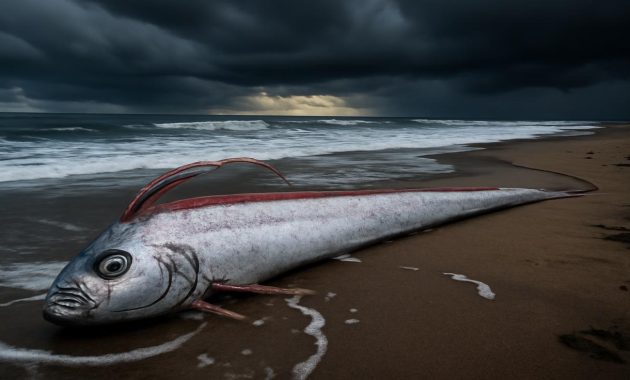
The first time I saw a picture of it, I thought it was a myth—some glitch between a sea serpent and a silver ribbon. Long and shimmering, with a face that seemed both startled and ancient, this fish didn’t look like anything that should exist in modern oceans. It looked like a rumor. Yet along the coasts that frame the United States, this very real creature occasionally washes ashore, and when it does, people whisper the same uneasy phrase: “Something bad is coming.”
The “Sea Serpent” That Isn’t a Legend
On a fog-soft morning off Southern California, the ocean is as flat as brushed metal. Pelicans cruise low, skimming the water’s skin. A pair of kayakers drift, paddles resting across their laps, when one of them sees it—at first just a flash of impossible silver beneath the surface.
They drift closer. The shape resolves into a long, ribbon-like body, banded with faint patterns, tipping and rolling with the swell. It’s dead, floating belly-up in the swell, its great, staring eye clouded like old glass. They don’t know it yet, but they’re looking at one of the strangest fish that has ever lived: the oarfish.
In coastal communities from California to the Gulf of Mexico, the appearance of an oarfish has become a kind of modern omen. Photos explode across social media. Local news crews rush to the beach. Speculation ignites: Is this a sign? Is the ocean trying to tell us something?
For centuries, stories of long, silver “sea serpents” have followed storms, earthquakes, and tsunamis. Sailors, lacking better explanations, called them monsters. Today, we have a name and a Latin classification—Regalecus glesne, the giant oarfish, sometimes called the “king of herrings.” But knowing its name hasn’t made it less eerie, or shaken the superstition that when this fish rises to the surface, disaster might not be far behind.
The Deep-Sea Drifter
To understand why the oarfish feels so otherworldly, you have to follow it downward, miles beneath the sunlit skin of the sea.
Most of its life is spent in the twilight and midnight zones of the ocean—depths where human light barely reaches and pressure would crush our bones. Down there, the water feels ancient and slow. Sound travels differently. Time feels less like a line and more like a slow, circling current.
The oarfish is built for this dim kingdom. It can grow more than 25 feet long—some reports claim even longer—making it the longest bony fish in the world. Yet it’s not the hulking giant you might picture. Its body is thin and flat, like a strand of hammered tin. Its back glows with metallic silver, sometimes streaked with iridescent blue or blackish markings, while a comb-like scarlet fin runs the length of its spine like a banner in the gloom.
Instead of swimming in the muscular, side-to-side way we know from most fish, the oarfish moves with a strange, hypnotic elegance. It often orients itself vertically, head up, tail down, and ripples that long dorsal fin in tiny undulations, drifting like a feathered spear through the water column. That odd, upright posture—if ever seen from a boat or from above—would look exactly like some fantastical creature rising from the depths.
But humans almost never see them alive. We know this fish mostly through its deaths—when the deep sends one of its own up, damaged or dying, and the shallows briefly hold a body that doesn’t seem to belong in our world at all.
Where in the U.S. Are Oarfish Found?
Though they are distributed widely across the globe in temperate and tropical oceans, oarfish are rarely spotted and even more rarely washed ashore. In the United States, they’ve turned up along several coastlines, but always as special, startling events.
| U.S. Region | Typical Type of Sighting | Notable Details |
|---|---|---|
| Southern & Central California Coast | Beached carcasses, nearshore floating individuals | Some of the most publicized U.S. discoveries; often shared widely in news and social media. |
| Northern California & Pacific Northwest | Occasional strandings and offshore encounters | Colder waters; sightings considered particularly rare. |
| Gulf of Mexico | Deep-water trawl bycatch, sporadic strandings | Largely noticed by researchers, fishers, and offshore crews. |
| Offshore Atlantic (Southeast U.S.) | Rare open-ocean sightings | Documented but far less common than Pacific encounters. |
These appearances are scattered, like driftwood on a wide shore. Each time one surfaces in U.S. waters, researchers rush to record its measurements and condition, because every specimen is a precious window into a life lived mostly beyond our reach.
The Omen of Earthquakes and the Weight of Folklore
On a small beach in California, kids squeal and crowd closer, cell phones lifted like tiny periscopes. A volunteer from a local marine lab stands near the long, limp body of an oarfish stretched across the wet sand, answering the questions that roll in waves.
“Is it poisonous?” No.
“Did it eat people?” Definitely not.
“Does it mean there’s going to be an earthquake?” The volunteer pauses. This is the tricky one.
The belief that oarfish presage earthquakes and tsunamis comes most famously from Japanese folklore. In those stories, the fish were seen as messengers of the dragon god of the sea, appearing before underwater quakes and giant waves. A long, silvery body washing ashore wasn’t just a biological event; it was a warning written in scales.
In the age of social media, that folklore has leapt oceans. Any time an oarfish turns up along U.S. shores, the comments sections fill with nervous notes: “Get ready, a big one is coming,” or “I saw a video about this—they show up before disasters.” People assemble lists of oarfish sightings that seemed to precede earthquakes or tsunamis, weaving coincidence into narrative like string into a net.
The story has power because it answers a deep, ancient fear: the fear of sudden change from a world we cannot control. Earthquakes and tsunamis arrive with little warning. Our instruments—the seismometers and tide gauges—are modern, but they don’t erase the human longing for signs we can see with our own eyes. A strange fish on a familiar beach is something we can point to, photograph, share, mythologize.
But does the ocean really send us this silver messenger before it moves its bones?
Can a Fish Predict a Disaster?
Scientifically, the story is far less dramatic than the legend. When researchers look for patterns—actual data connecting oarfish strandings to earthquakes—the trail blurs and breaks. The sightings are too rare, too scattered, and often too far from epicenters in space and time to make a robust case.
It’s true that many deep-sea creatures can respond to changes in their environment that we might barely notice: shifts in currents, pressure waves, or chemical changes in the water. Some scientists have speculated that seismic tremors could disorient or injure animals living in deep waters, driving them upwards into realms where they are poorly equipped to survive.
Yet, when oarfish appear near U.S. shores, there are usually more mundane explanations. They may be sick, wounded, or old. Storms can upset layers in the water column, dragging deep dwellers closer to the surface. Strong currents can sweep a weakened fish out of its usual range and into coastal shallows. By the time we see them, they’re often already dying, their bodies no longer suited to the light and turbulence of nearshore waters.
In other words: an oarfish on the beach is almost always a symptom of something happening in the life of that fish—or in its immediate patch of ocean—not a coded message about some far-off tectonic event.
Still, the myth persists, and not just because it’s dramatic. It persists because it’s one of the few stories that tries to knit us, however clumsily, into a conversation with the planet. It asks us to imagine that the living world might be trying to tell us something—and that we might, if we pay attention, learn to listen.
Reading the Ocean’s Subtler Warnings
If the oarfish is not actually a reliable herald of earthquakes, is it telling us anything at all? Maybe not in the precise, supernatural way folklore suggests. But each encounter with this deep-sea wanderer still feels like a whisper from a part of the planet we barely know.
Standing above an oarfish stretched out on the sand, people often fall silent for a moment. It’s hard to stay casual in the presence of a body that long and that strange. You can see the delicate fin rays that ripple like feathers along its back, the translucent skin around the eye, the way its mouth seems both frail and uncanny. This is an animal that has gone about its business for millions of years in the dark below us, uninterested in our ships and our screens, until something drove it up into our world.
The real “disaster” the oarfish hints at isn’t a single earthquake; it’s our chronic ignorance of deep-ocean life. We know the surface of Mars in finer detail than the landscapes at the depths where this fish lives. We are rewriting the chemistry and temperature of the oceans through climate change, yet we don’t fully grasp how those shifts ripple down through the food webs into the twilight zones and beyond.
When rare deep-sea animals like oarfish appear, scientists race to study them—taking tissue samples, examining stomach contents, scanning their bodies for parasites or damage. Each stranded fish becomes both a casualty and a data point, adding to the faint, still-incomplete map of how life is arranged in the darkness under our feet.
Seen in that light, the old story about oarfish and natural disasters isn’t entirely wrong. It’s just not specific enough. Disasters are not only cataclysmic events like earthquakes and tsunamis; they’re also slow-burning ones: warming seas, acidifying waters, overfishing, plastic pollution, dead zones spreading like bruises along coasts.
When any rare ocean animal washes ashore in greater numbers—or in new places—that can be a real signal that something in the environment is shifting. The oarfish becomes part of a bigger, quieter alarm system: strandings of whales and dolphins, bleaching corals, sudden die-offs of seabirds, jellyfish swarms where none swam before. No single event tells the whole story, but together they sketch a picture.
A Messenger of Wonder More Than Doom
Perhaps the most valuable thing the oarfish brings us isn’t prophecy—it’s perspective.
Imagine the journey of a single individual, somewhere in the Pacific off the U.S. West Coast. It drifts in the blue-black, its long body rippling vertically, feeding on tiny crustaceans and small fish. The sun is a vague brightness far above, never fully seen. Its world is sound and faint flashes of bioluminescence, slow upwellings of nutrient-rich water, the distant rumble of storms transmitted through deep currents.
It lives for years, possibly decades, passing unnoticed beneath cargo ships and fishing fleets. It experiences hurricanes as gentle pressure changes and waves of turbulence far overhead. It is a witness to a version of Earth that few of us will ever directly see: colder, darker, but no less alive.
Then something happens—a disease, a wound, a powerful storm, maybe a human-made disturbance we don’t yet understand—and it rises. The water brightens from charcoal to steel, then from steel to a pale, painful blue. The pressure eases, perhaps too quickly. Its body, tuned for the deep, begins to fail in the thin, sunlit water.
By the time it reaches the surface, it’s already dying. Waves push it toward land, where the sand grips its body and people cluster around, awestruck. In the flash of cameras and the murmur of voices, its long, obscure life is suddenly documented, shared, debated, mythologized.
For a brief moment, the deep ocean steps into our bustling, terrestrial lives through this one silver threshold—this fish that looks like a rumor but is, stubbornly, fact. And if all we take from that moment is fear of an earthquake, we’re missing the richer message: that our planet is larger, stranger, and more delicately balanced than our daily routines make it seem.
Living with Mystery in an Age of Measurement
We live in a time that prizes prediction. We forecast storms days in advance. We track hurricanes from space. We map fault lines and model possible tsunamis. We want to know what’s coming, to defend ourselves against surprise.
Folklore about animals and omens can feel, at first, like an outdated relic. A fish predicting a disaster? That’s not how science works. Yet, there is a sliver of shared ground between myth and measurement: both are, at their core, attempts to pay attention to the world and to find patterns in it.
The danger lies not in telling stories about oarfish, but in mistaking those stories for data. If we cling only to the drama—that this rare fish found in the United States is said to herald major natural disasters—we might miss the subtler truths that are actually within our reach.
Here’s what we can say with confidence:
- Oarfish are deep-sea dwellers that rarely appear at the surface.
- Their strandings are unusual and worth studying, but not proven predictors of earthquakes or tsunamis.
- Their presence in shallow waters often signals stress or injury—conditions that can sometimes be connected to environmental disturbances.
- Each sighting is a rare chance to learn about a poorly understood layer of our planet.
In that sense, the oarfish is indeed a messenger—not of specific catastrophes, but of how much we still don’t know, and how entangled our fate is with parts of the Earth that we rarely see.
Standing on the shore, watching a long silver body wash in and out with the swell, you might feel a flicker of unease that has nothing to do with folklore. It’s the realization that we are small creatures on a restless planet whose deeper workings are still partly hidden from us. The ground can move. The sea can rise. Strange fish can appear out of nowhere, and we don’t yet fully understand why.
Instead of demanding from the oarfish a clear prediction, maybe the wiser response is humility—a willingness to admit that there are still wild gaps in our understanding. The fish becomes a question mark drawn in water and light, inviting us to keep asking, keep studying, keep listening.
FAQs About Oarfish and Natural Disasters
Do oarfish really predict earthquakes or tsunamis?
No reliable scientific evidence shows that oarfish can predict earthquakes or tsunamis. While folklore links their appearance to major quakes, actual data do not support a consistent, causal connection. Most scientists view strandings as signs of stress or illness in the individual fish, not as prophetic warnings.
Why are oarfish sometimes found on U.S. beaches?
Oarfish that wash ashore in the United States are usually injured, sick, or disoriented. Storms, changes in currents, disease, or physical trauma can push these deep-sea fish toward the surface and into shallow coastal waters, where they cannot survive for long.
Are oarfish dangerous to humans?
No. Oarfish are not known to be dangerous to humans. They have relatively small mouths for their size and feed mainly on small fish, crustaceans, and plankton. Most encounters with humans involve dead or dying individuals that have washed ashore.
How big can an oarfish get?
Oarfish are the longest known bony fish in the world. Verified specimens have reached over 25 feet in length, and unconfirmed reports suggest they may grow even longer. Despite their length, they are slender and ribbon-like, not bulky.
Are oarfish rare?
They are rarely seen, but that doesn’t necessarily mean they are extremely rare in the ocean. Because they live in deep, open waters and seldom approach the surface, humans encounter them infrequently. Most of what we know about them comes from stranded or accidentally caught individuals.
What should you do if you find an oarfish on the beach?
If you encounter an oarfish on a U.S. beach, keep a respectful distance and avoid touching it. Take photos for documentation, then contact local marine authorities, a nearby aquarium, or a marine research institution. Scientists may be very interested in collecting data or samples from the specimen.
What can oarfish teach us about the ocean?
Oarfish provide rare insights into life in the deep, midwater regions of the ocean. Studying them helps scientists understand deep-sea ecosystems, including food webs, migration patterns, and how climate and human activity may be affecting even the darkest, most remote parts of the sea.