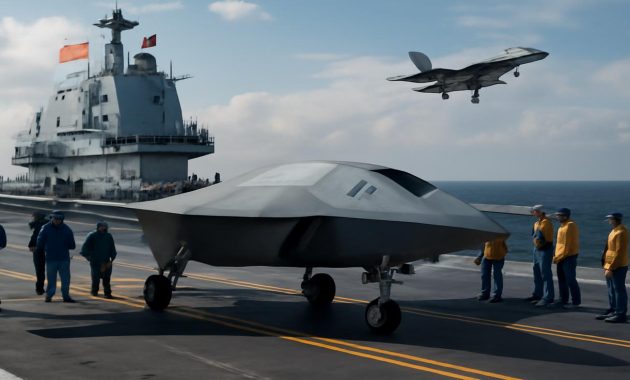
The sea was glassy that morning, a wide sheet of pewter under a hazy sky, when the dark shape rolled out from the hangar bay. It didn’t move like a traditional aircraft. No cockpit bubble, no windows, no ladder leaning against its flank. Just a sloping, angular fuselage, a pair of tucked wings, and the subdued gleam of composite skin catching the first light on a carrier deck. For a moment, the sailors around it paused, as if recognizing that this wasn’t just another machine. This was something quieter, stranger—an unmanned companion taking its place among human pilots, a “loyal wingman” on the cusp of joining life at sea.
Steel, Salt, and Silence on the Flight Deck
Close your eyes and you can almost hear it: the thrum of generators, the slap of waves against the hull, the constant hydraulic sighs of a floating airfield somewhere in blue water. For decades, the aircraft carrier has been ruled by noise—afterburners, catapults, shouting deck crews. Now, onto this stage steps a different kind of actor: a Chinese loyal wingman drone, its design lines already familiar to those who have tracked its appearances at air shows and in carefully curated state media clips.
This aircraft, believed to be a carrier-capable evolution of China’s loyal wingman concepts, looks like it was sculpted from shadow. Its nose is smooth and unbroken, the place where a pilot’s canopy would once have glittered now sealed under layers of composite and internal electronics. The wings taper with a stealthy sweep, and every edge seems calculated to deflect radar waves and attention alike.
What makes this moment feel so pivotal isn’t only the technology itself, but the setting. To operate from land is one thing; to operate from the crowded, unforgiving deck of a carrier is another. Here, there is almost no room for error. As crews maneuver the drone around parked fighters and refueling hoses, it has to behave like a well-trained partner—predictable, resilient, and ready to be hurled into the air by machinery that has always assumed a human would be riding along.
Somewhere below deck, in an operations center humming with screens and subdued voices, operators watch through data feeds and telemetry instead of canopies and windscreens. Above them, dawn light moves slowly across the drone’s skin, and the scent of salt spray mixes with jet fuel and machine oil. This is where the future of naval aviation begins to feel tangible, almost close enough to touch.
The Idea Behind a “Loyal Wingman”
At its heart, the loyal wingman concept is simple: give manned combat aircraft an unmanned partner that can fly alongside them—sometimes ahead of them—taking on the risky tasks, multiplying their reach, and expanding their eyes and ears. But in the quiet corridors of design bureaus, that simple idea evolves into something more complex and unsettling.
China’s push into loyal wingman drones mirrors similar efforts in the United States, Australia, and Europe. The core question is no longer whether drones should support fighters, but how deeply they should be woven into the fabric of air combat. Are they just expendable scouts, thrown forward like high-tech flares? Or are they trusted teammates, their algorithms learning how their human leaders think and respond?
When you imagine these drones pacing alongside a carrier-based fighter jet, the relationship becomes almost intimate. The human pilot in the manned aircraft might never see the drone directly—just a symbol on a helmet-mounted display, a stream of data on a tactical screen. Yet the drone is there, absorbing radar emissions, sniffing for signals, mapping threats, and maybe, in some future scenario, carrying weapons of its own. It feels less like a tool and more like a ghostly wingman, always close, yet never seen through a canopy.
In China’s case, the loyal wingman design that now appears poised for deck trials suggests careful attention to survivability. The lines hint at reduced radar cross-section; the intakes seem buried and shielded; the tail arrangements are minimal or blended. Every curve whispers the same message: I will be hard to see, hard to track, hard to kill.
From Runway to Rolling Deck
Making such an aircraft carrier-capable is like teaching a land predator to live at sea. It requires new instincts: stronger landing gear to absorb the brutal slam of arrested landings, folding wings to tuck neatly into the cramped spaces of a hangar deck, reinforced structures to handle the catapult’s violent pull. Designers must think about salt corrosion and wind-blown spray, about the way decks pitch and roll under the drone’s tires as if the world itself were breathing.
Chinese engineers appear to have been quietly reshaping their loyal wingman architecture for this challenge. Subtle changes—firmed-up undercarriage, arrestor hook mounts, wing configurations optimized for low-speed carrier approaches—suggest a patient progression from concept to prototype to something that can face the sea. There’s an almost evolutionary elegance to it, as if the drone were adapting to a new habitat one structural mutation at a time.
Inside the Machine: Sensors, Code, and Quiet Decisions
Walk around a modern unmanned aircraft and it quickly becomes obvious: the soul of the machine isn’t in the wings or the engine. It’s in the invisible highways of code that run from sensor to processor to actuator. The Chinese loyal wingman’s skin likely conceals less cockpit space and more electronics bays—stacked sensor packages, data links, artificial intelligence processors tasked with turning inputs into fast, high-stakes decisions.
When this drone banks over the ocean, it won’t be a human hand moving the control stick. Instead, algorithms crunch through airflow data, engine performance, deck motion, and mission parameters in milliseconds. For deck trials, that means something quietly extraordinary: the drone must learn to trust the carrier, and the carrier must learn to trust the drone.
On approach to the ship, its camera eyes and radar altimeters sense the deck’s position. Navigation systems refine its glide path. Data links hum back and forth between ship and drone, a digital conversation about crosswinds, speed, and hook position. Somewhere in that noise, a set of carefully tested routines makes the call: flare now, throttle here, brace for the jolt of steel cable.
It is a controlled fall into chaos, guided not by human instinct but by mathematics and simulation. If the drone’s first deck trials in Chinese waters proceed as analysts expect, every landing will add another layer of data, another notch of confidence, another small step in teaching a machine to dance with the sea.
Human Eyes on a Nonhuman Teammate
Yet for all the autonomy designed into these systems, human judgment still frames every move. Operators and engineers will watch each rollout and recovery with a mix of professional detachment and almost parental concern. On screens in shipboard control rooms, the unmanned aircraft will appear as a glowing icon surrounded by parameters: fuel remaining, link quality, structural load. If anything falters, fingers hover over abort commands and emergency procedures.
There is also the quiet psychological shift among carrier crews. For sailors used to seeing pilots climb down from cockpits—faces flushed, flight suits streaked with sweat and hydraulic fluid—there will be a moment of dissonance when the new drone returns. No one climbs out. No one removes a helmet. The machine simply rolls to a stop, silent, waiting for the next command. Life on deck has always been intimate with danger, with the vulnerability of human flesh near roaring turbines. Now, some of that risk transfers into composite shells and encrypted links.
Why the Sea Matters: Strategy on a Moving Map
Carriers are not just big ships; they are floating diplomatic statements. When a carrier moves, maps change meaning. Sea lanes feel narrower, disputed zones feel more tense. For China, fielding a carrier-capable loyal wingman drone adds a new layer to this maritime calculus, especially in contested waters and far from home shores.
The addition of such drones could transform each carrier into something more like a hive—a center from which not just manned fighters but swarms of semi-autonomous aircraft can radiate. A loyal wingman flying ahead of a strike group might probe enemy radar coverage, test responses, and map blind spots without imperiling a human pilot. Others could orbit as high-altitude sentries, knitting together a wider picture of the air and sea beyond the horizon.
Inside strategic command centers, staff officers will stare at these maps with a different kind of attention. Where one manned fighter once meant a single set of eyes and weapons, a carrier air wing augmented by loyal wingmen becomes an expanding halo of presence. Decision-makers will have to ask new questions: How do you interpret a sky where some aircraft think for themselves within rules, and others are flown stick-and-throttle by human hands? What does deterrence look like when unmanned silhouettes can take the brunt of the first exchange?
A Quick Look at Key Capabilities
While official details remain limited and often couched in careful language, analysts can sketch a rough picture of what this emerging Chinese loyal wingman drone might offer once it fully joins carrier operations.
| Feature | Likely Characteristics |
|---|---|
| Role | Escort, reconnaissance, electronic support, potential strike |
| Launch & Recovery | Catapult-assisted launch, arrested landing on carrier deck |
| Design Focus | Low observability, deck handling robustness, modular payloads |
| Control | Mixed remote operation and onboard autonomous functions |
| Primary Partner | Carrier-based fighters and early warning aircraft |
Even this broad outline suggests how deeply such a drone could reshape carrier operations. Instead of sending a single jet into a complex airspace, commanders could dispatch a small constellation of manned and unmanned aircraft, each tuned to a specific piece of the mission. The carrier becomes less a launch pad for individual sorties and more a conductor’s podium for an aerial orchestra.
Trial by Wind and Water
Before any of that becomes routine, though, there is the messy, unglamorous work of trials. Deck trials are a kind of crucible, burning away assumptions and exposing weaknesses. They involve everything from low-speed taxi tests across the pitching deck to full-power catapult launches, arrested landings in varying sea states, and night operations under red-lit decks and star-scattered skies.
Imagine standing on the island of the carrier as the first unmanned takeoff trial begins. The drone sits at the catapult shuttle, wings spread, its dark surface beaded with sea mist. Crew members in colored jerseys busy themselves around it—a choreography of last checks. Sensors are armed, data channels opened, high-speed cameras primed to capture every twitch of the airframe. From somewhere on the ship, a calm voice calls out the sequence, a blend of naval routine and cutting-edge experiment.
The moment the catapult fires, the deck shudders. The drone lunges forward, nose lifting as it races toward the edge of the world. For an instant it hangs between flight and failure, then the wings bite into the air. The machine climbs, and on monitors below deck, all eyes track a flood of numbers: airspeed, angle-of-attack, link stability. Silence breaks only when the data confirms what everyone hoped—the launch was clean.
Landings, of course, are harder. No aircraft is more honest than in the final seconds before touchdown, and the sea is a merciless examiner. Each pass teaches the algorithms how the carrier moves, how gusts dance between island superstructure and deck, how a slightly late flare can mean a harsh slam that reverberates through landing gear and fuselage.
In these trials, the drone is less a finished weapon than a student, its lessons encoded not in memory but in software updates and revised procedures. As the test program expands—different weights, different payloads, different weather conditions—the loyal wingman slowly earns its place among the carrier’s regular denizens.
Life After Trials: A New Normal
Assuming the deck trials succeed, there will come a quieter phase, almost more telling than the dramatic firsts. The drone will start appearing in routine flight schedules, slotted between training missions and patrol sorties. Deck crews will learn its quirks—how it turns, how its wheels smoke on hot days, which panels need extra care after salt-laden storms.
On the bridge and in the combat information center, officers will become accustomed to factoring the drone into tactical conversations. “Send the loyal wingman ahead.” “Put one on station at higher altitude.” The language will shift from “if” to “when,” from curiosity to expectation. In that subtle change of grammar lies the real revolution.
Moral Crosswinds and the Quiet Weight of Choice
Every new technology carries ethical weather with it, and these drones are no exception. The idea of a loyal wingman, so friendly in phrasing, brushes up against deeper questions: How much autonomy should such systems hold in combat? Who bears responsibility when an unmanned aircraft misidentifies a target or behaves unpredictably in a crowded airspace?
On a philosophical level, there is also something poignant about replacing a human presence in the riskiest parts of a mission. For generations, stories of naval aviation have centered around the courage and vulnerability of pilots—faces lit by instrument panels, hands sweating in gloves, the weight of life-or-death choices made in seconds. The loyal wingman’s promise is to spare some of those lives. Its shadow side is the possibility of making it easier, psychologically, to send machines into danger again and again, perhaps numbing the human sense of cost.
Chinese strategists, like their counterparts elsewhere, must navigate those crosswinds. How they code decision-making into these drones, what rules of engagement they embed, how strongly they tether machines to human oversight—these choices will ripple outward, shaping not only future conflicts but the stories we tell about them.
Somewhere down the line, a young sailor might stand leaning over the rail of a carrier at dusk, watching a loyal wingman drone return, its lights winking against the darkening sky. They might feel a twinge of admiration, even affection, for the machine that does what humans once did at far greater personal risk. Or they might feel a thin unease, wondering what it means to wage deterrence and, if necessary, war with partners that never tire, never flinch, and never truly understand why they fly.
A Sky That Feels Different
As the Chinese loyal wingman drone edges into deck trials, the broader sky over the world’s oceans subtly shifts character. It becomes a place where the boundary between manned and unmanned presence blurs, a layered airspace of metal, code, and intention. Radar operators peering at their screens may not always know which blip holds a pilot and which does not. But they will know that the patterns are becoming more intricate, more crowded with possibilities.
For now, the story is just beginning. Engineers continue to revise designs, software teams refine autonomy, naval planners script new tactics, and test crews stand ready for early-morning launches and late-night recoveries. Out on the open sea, on that narrow strip of steel where air and water meet, the loyal wingman waits for its cue.
When it finally rolls to the catapult for its first full operational launch—not just a test, but a mission—it will embody years of quiet effort and heated debate, of bold ambition and careful caution. The deck crew will signal, the machinery will roar, and the drone will leap into the thin, salt-laden air, carrying with it not only sensors and fuel but a small piece of the future of naval aviation.
FAQ
What is a “loyal wingman” drone?
A loyal wingman drone is an unmanned aircraft designed to operate alongside manned fighters, providing support roles like reconnaissance, electronic warfare, decoy functions, or even strike capabilities, all while reducing risk to human pilots.
Why is carrier compatibility such a big step?
Carrier operations are far more demanding than land-based flying. Aircraft must withstand catapult launches, arrested landings, limited deck space, and harsh maritime conditions. Making a loyal wingman drone carrier-capable means it can join naval air wings on distant deployments, greatly extending their reach.
How autonomous are these drones likely to be?
They typically combine remote human control with onboard autonomy. Humans set missions and rules, while the drone can handle tasks like navigation, basic formation flying, and some real-time decisions within defined parameters, especially during complex operations like takeoffs and landings.
What roles could a Chinese carrier-based loyal wingman perform?
Potential roles include scouting ahead of manned fighters, gathering intelligence, jamming enemy radar, acting as a decoy, extending sensor coverage for the carrier group, and possibly carrying weapons in high-risk environments.
Does this development change the balance of power at sea?
It contributes to a gradual shift rather than an immediate overhaul. Carrier-based loyal wingmen could make Chinese carrier groups more flexible and resilient, complicating the calculations of other navies and reinforcing a broader global trend toward mixed manned–unmanned air wings at sea.