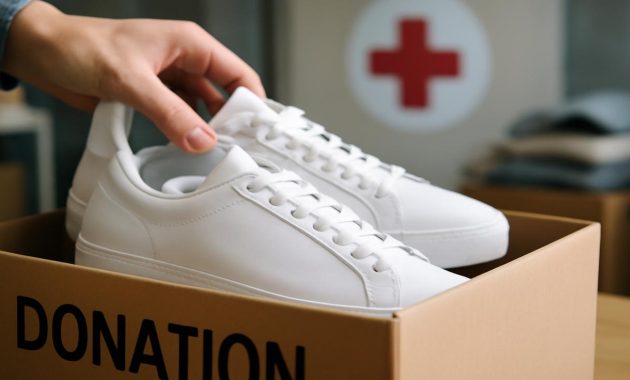
The box looked ordinary enough—just a pair of gently worn sneakers in a plastic bag, nestled between a sweater and a folded note. Yet when Daniel closed the cardboard flaps and carried the donation to the collection bin, he knew this box held a secret. Inside the sole of one shoe, tucked so deep it was almost invisible, was an Apple AirTag. A tiny white circle. A quiet question. A test.
The Sneakers That Wouldn’t Sit Still
It started, as these things often do, with a nagging doubt. Daniel had spent the winter watching news reports of overflowing donation centers and hearing stories from neighbors about how they “weren’t sure” where their donated clothes actually ended up. Some swore their jackets were shipped overseas; others insisted they were resold in discount stores. A few, more cynical, claimed nonprofits pitched the worst of it straight into landfills and quietly wrote it off as “unusable.”
One cold Saturday morning, after another closet clean-out, Daniel lined his hallway with bags meant for charity. He’d always trusted that his old clothes, especially the good ones, would end up wrapped around someone who needed them more. But trust, he realized, is hard to measure. Curiosity, though—curiosity can be tracked.
On his kitchen table lay a little collection of tech gadgets. Spare cables. A couple of old earbuds. And there, like a dare, an AirTag he’d bought and never used. He picked it up, felt the cool plastic between his fingers, and glanced back at the pile of donations. The thought came faster than he could talk himself out of it.
What if I follow just one item?
The sneakers were an obvious choice. Clean, barely worn, still holding the faint memory of early morning runs. Useful enough that someone, somewhere, would want them. He slipped the AirTag beneath the insole of the right shoe, pressed it flat, and paired it with his phone. On the screen, a little dot pulsed to life. He labeled it simply: “Red Cross Shoes.” Then he sealed the box, wrote “Clothing Donation” on the side, and drove to the nearest Red Cross drop-off.
The Slow Journey of a Fast Pair of Shoes
The donation center was quiet when he arrived. A chill wind pushed leaves against the chain-link fence; somewhere inside, a forklift beeped as it backed up. He set the box beside a stack of others, nodded to the volunteer who gave him a tired, grateful smile, and walked away. But his connection to those sneakers didn’t end at the door. It was just beginning.
In the parking lot, he opened the Find My app. For a moment, nothing moved. The dot stayed stubbornly fixed at the center, like the story hadn’t yet decided what kind it wanted to be. Then, as he merged into traffic and headed home, a tiny line of text appeared: “Location updated just now.” The AirTag was alive, waiting.
For the next two days, the sneakers barely moved. The dot hugged the same corner of the map—a warehouse district he recognized from driving past but never visiting. Maybe this is it, he thought. Maybe they’ll just sit there forever until someone sorts them or throws them away. Curiosity morphed into a low buzz of anxiety.
Then, on the third day, they started to travel.
The dot shifted a few blocks, then a few miles, then suddenly jumped across town. “They’re moving,” he muttered to no one, hovering over his phone as the shoes traveled from the warehouse to another facility near the outskirts of the city. Trucks, he assumed. Pallets. Big rolling carts of clothes that once sat in closets and drawers just like his.
Two days later, the sneakers jumped again. This time, their little digital icon appeared near a commercial port. The map zoomed in to reveal long gray warehouses and rows of shipping containers. The sneakers, labeled so neatly in his app, had become cargo.
A Map Full of Questions
That night, unable to shake the feeling of being pulled along by those shoes, he fell into a rabbit hole. How do big organizations like the Red Cross actually handle clothing donations? What happens when you drop a bag in a bin and drive away, lighter, believing you’ve done something good?
He discovered something that made him pause: in many places, the Red Cross doesn’t give your donated clothes directly to people in need—at least, not always. Instead, they often sell the items to commercial buyers. Those buyers may sort and resell them in thrift shops, export them overseas, or recycle them for industrial use. The money from those sales, the Red Cross explains if you look carefully enough, goes back into their humanitarian programs: disaster relief, emergency shelters, medical services.
Intellectually, it made sense. Logistically, it even seemed efficient. But emotionally, his expectations had been different. When he imagined his sneakers’ future, he’d pictured a person stepping into them, not a port or a price per kilo.
By the end of the week, the dot had moved again—this time, across water. The location updated near a foreign city whose name he’d only seen in headlines. The shoes had left the country. They were no longer his old runners; they were a global commodity.
Following the Invisible Thread
Days turned into a peculiar ritual. Over breakfast, during lunch breaks, in line at the grocery store, he’d check on the AirTag’s signal. It hopped from one densely packed urban neighborhood to another, then to an industrial zone dotted with sorting centers and secondhand markets. The sneakers were no longer paused in a warehouse but flowing through an invisible river of discarded clothing from wealthier countries, all streaming toward new lives or slow decay.
One afternoon, the AirTag pinged from a sprawling market. Satellite images showed canopies and tarps stretched like patchwork clouds over endless rows of stalls. This, he realized, might be where his sneakers—once a personal object, then a donation, and now a tiny speck in a global trade—were being bartered, tried on, haggled over, or maybe just piled high on a plastic sheet in the sun.
He imagined someone picking them up, pressing a thumb into the cushioning, checking the laces. Perhaps comparing them to five other pairs laid out beside them. Maybe walking away. Maybe walking toward the future in them.
The shoes had gone farther than he expected. But the question that had started this journey was still stuck back at home with him: Why didn’t the Red Cross just say this more clearly?
The Email That Put It All on Record
Curiosity can quickly turn into a kind of responsibility once you know too much. The more places the AirTag popped up, the more Daniel felt he owed someone an explanation—or maybe he wanted one himself. So he decided to write to the organization whose donation bin had kicked everything off.
His message was calm, almost apologetic in its opening.
He explained: He had anonymously donated a pair of sneakers to the Red Cross, with a tracking device inside, to better understand what happens to clothing donations. He detailed what he’d seen: the local warehouse, the port, the foreign city, the market. And then he wrote the heart of it: “I didn’t realize that donated clothes might be exported and sold through third parties. Can you tell me if this is standard practice, and how this supports your mission?”
He pressed send and felt the faint shame of someone who has peeked behind a curtain and now must confess to the stage manager.
For a few days, there was silence. The sneakers kept moving, but his inbox did not. Then, early one morning, he woke to a reply with the Red Cross logo in the header and the polite formality of institutional language.
When the Red Cross Had to Explain
Their answer was, in many ways, entirely reasonable.
Yes, they confirmed, some donated clothing and shoes are sold to textile recyclers and commercial partners instead of being given directly to individuals. This allows the organization to maximize the value of donations while avoiding the logistical nightmare of sorting, cleaning, and distributing every item on its own. The funds raised are then channeled into their core humanitarian activities. In some cases, they added, clothing may still be distributed after disasters or emergencies, but it is not the primary use of every donated garment.
Then came a paragraph that read almost like a confession, or at least an acknowledgment:
They admitted that the public often assumes clothing donations will go directly to people in need, and that this assumption doesn’t always match reality. They were “working on improving communication” about their textile partnerships and donation flows, they said, to prevent misunderstanding. Their message hinted at a tension between what is logistically effective and what feels emotionally honest.
As for the AirTag itself, the organization expressed mild concern. Tracking items through international supply chains, they said, could raise privacy issues—for drivers, sorters, and intermediaries who might not realize their cargo included a device broadcasting its location. They asked, gently but firmly, that he refrain from placing trackers in future donations.
Daniel read the email twice. The story, he realized, wasn’t one of malicious intent. It was a story of gaps: between what donors imagine and what organizations actually do, between a sneaker’s sentimental value and its economic value, between the straightforward narrative of “you give, they receive” and the actual, messy complexity of global textile flows.
What the Journey Revealed About Our Stuff
In the weeks that followed, he kept opening the app, even as the AirTag’s battery slowly drained. Sometimes the sneakers appeared on the map, sometimes they vanished for days. Perhaps the shoes had been sold. Perhaps they’d been tossed aside. The AirTag might now be lying in a drawer or tumbling around a stall on a dusty street.
But the experiment had already done its work. The little white disc had quietly traced not just a route, but a pattern—one that countless shirts, coats, pants, and shoes follow every year after they leave our hands.
What startled him most wasn’t that the Red Cross sold the shoes. It was how easily he’d assumed a different story, one with kinder, simpler edges. Standing at the donation bin, he had pictured a direct line of kindness. Instead, he’d found a long curve of commerce and logistics, where goodwill was converted into currency before becoming relief supplies, medical tents, or hot meals thousands of miles away.
And he wasn’t alone in this confusion. Many donors imagine their old jackets hugging new shoulders in the same city. They imagine a straight path: from their hallway to a shelter doorway. In reality, the path looks more like what his app had shown him: zigzags and stopovers, ships and sorting centers, warehouses and markets.
| Stage | What Donors Often Imagine | What Often Actually Happens |
|---|---|---|
| 1. Donation Drop-Off | Item goes “into the hands” of the charity. | Item enters a bulk collection and sorting system. |
| 2. Local Sorting | Staff set it aside for direct giving to people in need. | Items are graded for resale, recycling, or disposal. |
| 3. Distribution | Clothing is handed out locally, item by item. | Large batches are sold to partners or thrift networks. |
| 4. Final Use | Your item is worn by “someone in need” nearby. | Items may end up in foreign markets, shops, or recycling mills. |
A Quiet Reckoning in the Hallway Closet
Months later, standing once again in front of his closet, Daniel found himself touching fabrics differently. A winter coat he barely wore. A stack of T-shirts from long-forgotten events. Sneakers whose soles molded themselves to the floor rather than his feet.
He still believed in giving. The Red Cross email, with its careful wording and institutional tone, had not convinced him to stop donating, but to donate more thoughtfully. Maybe not every shirt needed to be boxed up. Maybe some could be offered directly to local shelters, mutual aid groups, or clothing swaps. Maybe it was worth asking charities how they handled textiles before assuming a particular story about where his generosity would land.
He bagged up a smaller pile this time. Chosen items, not just convenient discards. As he tied the plastic handles together, he turned his phone over in his hand, feeling the absence of that familiar little white tracker. He could drop an AirTag in again—repeat the experiment—join the growing movement of people testing the paths of their cast-offs. But now he knew enough to recognize that the point wasn’t the technology; it was the conversation it had forced.
Because somewhere out there, a pair of sneakers he once owned had walked him straight into a deeper question: When we let go of our things, what do we really think we’re giving—and to whom?
What the Red Cross Story Says About Us
If you zoom out from one person, one pair of sneakers, one AirTag, a larger picture emerges. The Red Cross is hardly alone. Many big charities rely on selling or wholesaling donated goods as a key revenue stream. They are tasked with turning unpredictable piles of our old belongings into predictable funding for emergencies. To do that, they plug themselves into global systems of shipping, resale, and recycling that few of us ever see.
AirTags and other tiny trackers have simply made it harder for those systems to stay invisible.
Some people feel betrayed when they discover their donated coat didn’t go directly to a specific person in crisis. Others see the logic: money from that coat, sold in bulk, might fund blankets, clean water, or medical kits that save more lives than the coat itself ever could. The tension lives in the space between impact we can measure with receipts and impact we can picture in our minds.
Organizations like the Red Cross are now being pushed to explain themselves more clearly. Not because they’ve necessarily done something wrong, but because donors like Daniel are starting to ask sharper questions. Where does my stuff go? How do you balance efficiency with transparency? When you say “your donations help people in need,” what does that really mean in the journey of a single, tangible item?
We are, in other words, waking up to the afterlife of our stuff—and realizing that the story doesn’t end at the donation bin. It bends through ports and markets and warehouses. It bends through spreadsheets and contracts and environmental costs. And somewhere along that long curve, it bends back toward us, asking us to pay attention.
FAQs
Do large charities like the Red Cross really sell donated clothes?
Yes. Many major charities sell part or all of their clothing donations to commercial textile recyclers, thrift networks, or export partners. The revenue from these sales is used to fund their core humanitarian programs rather than run stand-alone clothing distribution operations.
Is it dishonest for organizations not to give donated items directly to people in need?
Not necessarily, but it can feel misleading if donors are left with a different impression. The issue is usually less about wrongdoing and more about unclear communication. Clearer explanations about how donations are monetized and used can help align expectations with reality.
Are exported secondhand clothes bad for other countries?
The impact is complex. In some places, imported secondhand clothes provide affordable options and jobs in local markets. In others, they may undercut local textile industries or contribute to waste problems when low-quality items end up in landfills. The effect varies by region, policy, and the quality of what’s sent.
Is it ethical to put an AirTag or tracker in a donation?
It’s legal in many places to track your own property, but once you donate an item, it’s no longer yours. Trackers can raise privacy concerns for workers, transporters, and buyers who don’t know they’re being tracked. Ethically, many organizations see it as intrusive, even if the donor’s intention is curiosity or accountability.
What’s the best way to donate clothes responsibly?
Start by reducing how much you buy and keeping clothes in use longer. When donating, ask organizations how they handle textiles—do they distribute locally, sell, or recycle? Consider direct giving to shelters, community groups, or clothing swaps for items in excellent condition, and use recycling programs for worn-out textiles.