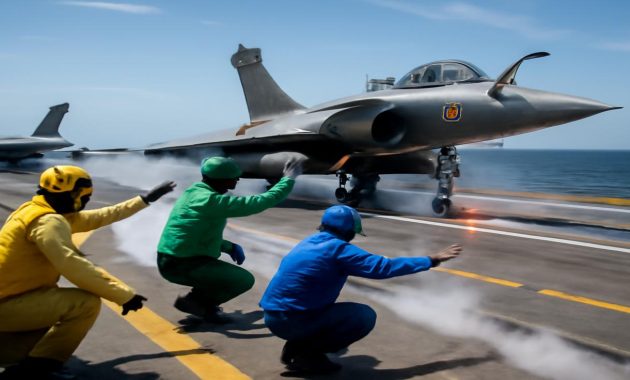
On a hazy monsoon morning off India’s western coast, the sea wears a muted steel-blue shimmer, the kind that blurs the line between water and sky. A warm, salty wind presses against the flight deck of an aircraft carrier as crew members move like choreographed shadows in yellow and green vests. Somewhere beneath that restless horizon, the future of India’s naval aviation is quietly shifting. The Indian Navy, after years of trials, debates, and patient waiting, wants to bring in 31 additional Rafale M carrier-based fighters. It’s a decision that might sound like a simple acquisition on paper. But out here, where waves climb and fall like the chests of sleeping giants, it feels like the next chapter in a story that has been unfolding for decades.
The Sea, the Sky, and a New Bird
If you sit on the edge of an Indian pier long enough, watching the ships move as tiny silhouettes toward the horizon, you begin to understand why navies dream in aircraft. The ocean is a vast, unpredictable battlefield. Ships need eyes and claws that reach far beyond their own decks—aircraft that can launch, strike, defend, and return, even when the nearest coastline is just a memory. For the Indian Navy, this dream has always been painted in shades of blue-gray metal and roaring turbines.
The Rafale M—the “M” standing for “Marine”—is a creature born precisely for this environment. It smells of aviation fuel and oil; its wings fold like a seabird perching on a crowded rock. When it idles on a carrier deck, the heat from its engines shimmers the air, turning metal into mirage. And yet under all that theater lies something quieter: a deliberate plan by the Indian Navy to reimagine what its floating airfields can do.
For years, India’s aircraft carriers have operated primarily with MiG-29K fighters—a rugged, capable machine but one that carries the weight of maintenance challenges and future uncertainties. The Navy’s move toward 31 additional Rafale M fighters is more than a move away from an older platform. It’s a shift toward an ecosystem where air, sea, and strategy feel tightly, almost elegantly, interwoven.
Why 31 Rafale M Fighters Matter at Sea
Picture an aircraft carrier not just as a ship, but as a living, breathing island. On its upper surface: jets, helicopters, cables, and catwalks; below deck: fuel lines, workshops, humming power systems, flight planning rooms. Over this floating island, the Rafale M is expected to be a kind of guardian spirit—scouting far ahead, scanning the sky, the sea surface, and even deep beyond visible horizons using electronic eyes and ears.
The decision to pursue 31 more of these jets doesn’t emerge from a vacuum. India’s maritime neighborhood is crowded and tense. From chokepoints like the Strait of Hormuz to the narrow passageways of the Malacca Strait, trade, energy, and security weave a dense web of interests. Over the past decade, other navies have been quietly but steadily expanding their reach with more ships, more aircraft, more submarines. A carrier’s fighters are the outer circle of its defense, the first impression it makes and, if necessary, its sharpest response.
The Rafale M brings with it multi-role flexibility—air defense, anti-ship missions, ground strikes, reconnaissance—folded into a single airframe. In a world where naval planners must account for fast-changing scenarios, from piracy to high-end conflict, that kind of versatility is its own form of deterrence. Every time one of these jets punches through the humid coastal air, it carries not just ordnance, but a message: India intends to see, to respond, and, if pushed, to dominate in its surrounding seas.
| Aspect | MiG-29K (Current) | Rafale M (Planned) |
|---|---|---|
| Primary Role | Carrier-based fighter, air defense | Multi-role: air, sea, land missions |
| Operational Range | Lower, more tanker-dependent | Extended reach with more endurance |
| Avionics & Sensors | Earlier-generation systems | Advanced radar, electronic warfare suite |
| Weapons Integration | Limited modern missile integration | Compatibility with a wide array of smart munitions |
| Maintenance & Reliability | Reported challenges and downtime | Designed for intensive carrier operations |
On the surface, that table may look like a simple comparison. But beneath each row lies the real story: fewer compromises. Fewer “either this or that” decisions in the operations room. More confidence that when the sea turns rough and the situation ambiguous, the fighter strapped to the deck elevator is not going to be the limiting factor.
The Quiet Drama of Carrier Deck Life
Before a Rafale M ever roars off the end of a carrier ski-jump, there is a choreography that unfolds in near-silence compared to the aircraft’s eventual thunder. A pilot walks slowly around the jet, gloved fingers tracing access panels, eyes skimming over folded wings, landing gear, intake lips. Tech crews run final checks. A deck officer watches flags, lights, hand signals, reading the wind as if it were a second language.
Introducing a new aircraft into this carefully calibrated environment isn’t just a logistics update, it’s a cultural shift. Deck crews will learn new rhythms: different fueling procedures, new checklists, new emergency drills. The sound of the auxiliary power unit, the way the jet responds to throttle inputs during deck maneuvers, how it behaves in crosswinds during launch—all of this becomes part of the living memory of the crew.
The Indian Navy has already had a flavor of Rafale operations through the Air Force’s land-based Rafale fleet. That experience is invaluable—commonality of training pipelines, overlapping maintenance philosophies, similar cockpit environments. But the sea is another teacher entirely. Salt, spray, deck pitching with waves, and cramped hangars add layers of complexity. To place 31 Rafale M fighters into that environment is to signal a long-term commitment: to train, to adapt, to master.
From Trial Flights to Long-Term Vision
Before the decision leaned firmly toward Rafale M, the Navy tested contenders on shore-based facilities designed to mimic carrier conditions—ski-jumps replicating the bow of Indian carriers, arrestor wires simulating deck landings, all watched under an unforgiving coastal sun. Engineers and pilots logged impressions in the subtle language of professionals: “handling qualities,” “payload flexibility,” “turnaround time,” “sortie generation rate.”
These carefully measured phrases mask the visceral reality. A “handling quality” during a landing approach can mean the difference between a smooth trap and a smoking cable, between a confident pilot and one who steps out of the cockpit with shoulders a little more tense each time. When a jet impresses in these trials, it doesn’t just win points; it earns trust.
The Rafale M’s performance in these evaluations—its ability to handle short takeoff but arrested recovery (STOBAR) operations from Indian-style carriers—has been one of the quiet undercurrents behind the Navy’s pursuit of these additional aircraft. The choice tells its own story: this is not about a single procurement cycle; it’s a stepping stone toward a naval air arm that feels more cohesive, more future-ready, less hostage to legacy compromises.
Strategic Ripples Across the Indian Ocean
Step back now from the deafening decks and think in satellite views. Below you unfurls the Indian Ocean, dappled by trade lanes and invisible lines of undersea cables. On maps, it’s a calm blue canvas. In reality, it’s thick with shipping traffic, energy routes, patrol tracks, and the quiet arcs of submarines no one publicly acknowledges.
Into this space, a carrier battle group is not just a cluster of steel and engines. It is a moving signal of intent. And at the heart of that signal sit the jets on its deck. When those jets evolve—from an older generation platform to a modern, flexible one like the Rafale M—the entire message changes. It tells allies that India is serious about sharing the burden of regional security; it reminds rivals that any attempt to probe or test India’s defenses will be met from above as well as from the waves.
For coastal communities along India’s shoreline, the implications are subtler but no less real. Fishermen may look up at contrails slicing the sky and not know the model of the aircraft, but they inhabit a coastline where events far offshore can ripple back as fuel prices, fishing rights, or even temporary exclusion zones. A better-equipped Navy is, in a way, a quiet promise—that the lifelines feeding ports, markets, and homes won’t be easily disrupted.
Deterrence You Can Hear and Feel
When a carrier group moves, it doesn’t announce itself in headlines. You notice it in port scuttlebutt, in distant low rumbles over the sea at odd hours. There’s a psychological weight to knowing that somewhere beyond the horizon, armed jets can be airborne within minutes. Deterrence is as much in the mind as in the missile bay.
Rafale M fighters, bristling with advanced sensors and modern weapons, amplify that psychological presence. Their radar can paint a far larger portion of the sky. Their electronic warfare suites can listen, deceive, and defend in ways older systems struggle to match. Combined with airborne early warning aircraft and ship-based sensors, they contribute to a thickening web of situational awareness—an invisible dome of vigilance hanging over key stretches of sea.
In an era where conflicts can pivot rapidly from cyber intrusions to physical skirmishes, such awareness is almost a kind of peacekeeping. It makes surprises harder, miscalculations more obvious, and reckless gambits less tempting. The decision to bring in 31 more Rafale M fighters is, beneath its hardware specifics, a decision to invest in this watchfulness.
Technology, Training, and the Human Element
To talk about new fighters and forget the humans who will fly and maintain them is to miss half the narrative. A Rafale M may be an advanced machine, but once the canopy closes, once the carrier is a shrinking rectangle below, it becomes a partnership between pilot and jet.
Indian naval aviators already carry a unique form of courage. Landing on a moving deck at night—no horizon, just blackness and a bobbing strip of light—demands an almost monastic focus. Transitioning to a new aircraft deepens the challenge. New cockpit symbology, different angles of attack, varied approach speeds. Even the way the jet “talks” through feedback in the controls and how it reacts to turbulent air—everything must be relearned, re-internalized.
Similarly, maintenance crews will enter a new ecosystem of digital diagnostics, modular components, and more integrated avionics. For many of them, this shift will mean upskilling, cross-training, and a closer interface with software as much as with spanners and hydraulic carts. The Rafale M is not just a vehicle; it’s a node in a network, exchanging data with other jets, ships, and command centers.
The Long Path to Indigenous Confidence
There’s another layer to this decision that doesn’t always make it into procurement summaries: timing. India is nurturing its own deck-based fighter programs for the future, but such indigenous projects take time—time measured in prototypes, wind-tunnel tests, and test flights that must inch carefully from taxi trials to supersonic dives. They cannot be rushed without risking lives and reliability.
The 31 additional Rafale M fighters are a bridge across this gap. They ensure that, while Indian designers and engineers slowly shape the country’s own carrier-capable aircraft, the Navy does not find itself with wings clipped by an aging or underperforming current fleet. The carriers that are already commissioned—and those on the drawing board—need air wings that are combat-credible now, not in an idealized future.
In a way, the Rafale M purchase can be seen as both an admission and a commitment: an admission that homegrown solutions aren’t fully ready yet, and a commitment that when they are, they’ll plug into a Navy that has remained sharp, practiced, and technologically literate in the interim.
Listening to the Waves of the Future
Stand again on that hypothetical pier at dusk. The horizon is a line of molten orange; distant aircraft leave thin scars of white that slowly blur into the darkening sky. Inland, cities hum, roads pulse with traffic, people sit at dining tables, watch screens, live lives seemingly detached from all of this maritime choreography.
Yet, in subtle ways, decisions like the Indian Navy’s desire to acquire 31 more Rafale M fighters touch those everyday lives. They show up in the reliability of imports, in the stability of fuel supplies, in the quiet knowledge that shipping lanes are watched, guarded, escorted when needed. They appear as one line item in a national budget, debated and argued over, weighed against schools and hospitals, roads and digital infrastructure.
Is such spending justified? That’s the undercurrent question whenever a new fighter deal glints in the public eye. One way to answer is to listen not to the numbers alone, but to the geography. India is cradled by the sea on three sides and tethered to the wider world by ocean routes. Its story cannot be separated from saltwater, from tides, from distant ports it will never own but must constantly interact with. In that context, investing in a robust, modern carrier-based air wing becomes less about prestige and more about prudence.
The Rafale M, sleek and metallic, may seem a far cry from the organic, breathing world that nature magazines often celebrate—forests, rivers, wetlands. But it, too, is an actor on a vast natural stage: the oceans that regulate climate, cradle storms, and carry our trade. The Indian Navy’s move toward acquiring these fighters is one more way humanity is negotiating its relationship with that wild, shifting blue expanse—seeking not to tame it, but to live with its uncertainties armed with a bit more foresight, a bit more reach, and a bit more resilience.
Frequently Asked Questions
Why does the Indian Navy want 31 additional Rafale M fighters?
The Navy aims to strengthen its carrier-based air power with a modern, multi-role fighter that can handle air defense, strike missions, and maritime operations. The 31 Rafale M jets will enhance the capability and longevity of India’s carrier air wings, complementing or gradually replacing older aircraft.
How are Rafale M fighters different from the Indian Air Force’s Rafales?
Both share core avionics and weapons, but the Rafale M is adapted for carrier operations. It features reinforced landing gear, a tail hook for arrested landings, and structural modifications to handle the stress of short takeoffs and deck recoveries at sea.
Will these fighters operate from all Indian aircraft carriers?
They are intended to operate from India’s STOBAR-type carriers, such as INS Vikrant, and potentially from future carriers designed with compatible takeoff and landing systems. Integration and deck trials will determine the exact operational combinations.
What happens to the existing MiG-29K fleet?
The MiG-29Ks are expected to continue operating in parallel for some time. Over the years, as maintenance and performance realities evolve and new aircraft are inducted, the Navy may gradually rebalance its fleet toward newer platforms like the Rafale M and, eventually, indigenous carrier-based fighters.
Is this move connected to indigenous fighter development?
Yes. The Rafale M helps cover the near- to mid-term operational needs while India develops its own deck-based fighters. It ensures that carrier capability remains strong and credible so that indigenous programs can mature at a safe, technically sound pace rather than being rushed by urgent operational gaps.